Sushi Robot
ProductOverview
A sushi robot is an automated machine that forms and portions sushi (Japanese vinegared rice cakes) into nigiri (hand-formed oval mounds) or barrel rolls (nori-wrapped cylinders). Commercial sushi robots are used in high-volume sushi restaurants and conveyor-belt sushi bars where consistent, rapid production is critical. The machine combines a warm rice hopper (50–60°C), an automated mixer-fluffer for seasoning conditioning, a servo-controlled scoop for fixed portions, a pneumatic forming head, a seaweed (nori) feeder, and a collection tray.
A typical sushi robot produces 250–400 pieces per hour, with cycle times of 0.5–5 seconds per piece depending on forming complexity and portion size. The operator loads a pre-prepared rice batch into the hopper, selects a forming mode (nigiri oval, barrel roll, or custom profile) on the control panel, loads nori sheets into the magazine, and presses START. The machine cycles continuously, dispensing a measured portion of rice, forming it into the selected shape with optional nori wrapping, and transferring finished sushi to a collection tray or outfeed conveyor.
How it works
Raw cooked sushi rice (usually prepared off-machine) is loaded into the Warm Rice Hopper, which maintains temperature at 50–60°C via the Thermal Jacket. A Heater Element (2 kW) circulates warm water around the hopper jacket, monitored by the Temperature Sensor (PT100 RTD). The Hopper Stirrer (5–10 RPM paddle) gently mixes rice, preventing settling and lumping.
Before forming, the Rice Mixer and Fluffer conditions the rice with seasoning. Rice is scooped into the Mixing Bowl, where Mixer Paddles (counter-rotating at 30–60 RPM) gently tumble it while the Seasoning Injector sprays vinegar and salt mist. After 30–60 seconds, the mixed rice is returned to the hopper.
When the operator presses START, the Main Motor (1 hp) initiates a forming cycle coordinated by the Programmable Controller. The Volumetric Portioning Scoop (servo-driven) lowers into the hopper, fills with a pre-programmed volume (30–50 ml = 30–50 g rice), and raises. The Proximity Sensors detect the scoop's fill position via inductive sensing.
The filled scoop deposits rice into the Sushi Forming Head. The Forming Die (2 × 1 inch oval or 1.5 inch rod) shapes the rice. A Forming Jaw, powered by a Solenoid Valve (5/2 proportional valve) at 3–6 bar air pressure, compresses the rice, packing it firmly into the forming shape. The Pneumatic Regulator controls jaw force, preventing over-compression which would crush the rice granules.
Optionally, the Seaweed Sheet Feeder can wrap the formed sushi. The Nori Magazine (spring-loaded stack) feeds nori sheets one at a time via Sheet Separator (air jet or mechanical picker). The Nori Positioner aligns the nori, and it wraps around the formed rice. Alternatively, Topping Placement Arm (servo-driven arm with vacuum gripper) can place seafood (shrimp, roe) or vegetable toppings onto the rice before or after forming.
The finished sushi is transferred to the Collection Tray by the Push Arm (servo-driven ejector). An optional Outfeed Conveyor (2–5 feet/min) can distribute sushi along a cooling or display line.
The control system consists of the Programmable Controller (PLC with 24 VDC logic), the Touch Screen Display (7 inch optional color display for recipe management), and the Mode Selector (OFF/AUTO/MANUAL). An Emergency Stop (40 mm red mushroom) halts all motion in case of jam or safety concern.
Forming profiles and modes
Different forming profiles can be achieved by swapping Forming Dies and adjusting pneumatic pressure:
- Nigiri oval: 2 × 1 inch ellipsoid, traditional sushi mound shape, 8–10 minute hand-forming pressure.
- Barrel roll: 1.5 inch diameter cylinder, nori-wrapped on outer surface, compact presentation.
- Thin rod: 1 inch diameter, for eel sushi (unagi) or specialized rolls.
Custom die profiles (tapered cone, hexagon) can be manufactured to support unique restaurant presentations. Cycle time per piece varies: nigiri typically 1–2 seconds (jaw compression + ejection), while nori-wrapped rolls add 2–3 seconds for sheet positioning and wrapping.
Hygiene and cleaning
The Hopper Tank, Mixing Bowl, Scoop Cup, and Forming Die come into direct contact with rice and must be cleaned daily to prevent bacterial growth and rice residue hardening. The rice path fully disassembles in <10 minutes using hand tools (no special fixtures required). All stainless contact parts can be washed by hand or in a commercial dishwasher at 65°C. The Forming Jaw should be wiped down after each use and lubricated with food-grade oil monthly to prevent pneumatic seal degradation.
Rice starch and water can harden on forming surfaces; soaking the disassembled parts in hot water (60–80°C) for 15–20 minutes softens hardened residue for easy removal. The Mixer Paddles can accumulate rice film; brushing with a soft-bristled brush during washing restores non-stick surface properties.
Maintenance
The Servo Motor (portioning scoop) and Main Motor (forming cycle drive) require minimal maintenance but should be visually inspected weekly for corrosion or mechanical damage. The Solenoid Valve (pneumatic jaw control) should be functionally tested weekly; a valve that fails to release the jaw fully indicates internal silt or seal damage requiring servicing or replacement.
The Proximity Sensors are self-cleaning (no moving parts) but can be blocked by rice dust; periodic compressed-air blowing clears debris. If a sensor fails to detect position, electrical continuity and voltage supply should be verified at the Programmable Controller I/O module.
The Thermal Jacket circulation pump (within the hopper thermal system) should be inspected quarterly for flow; a weaker flow indicates pump wear or coolant line clogging. Stale coolant (>2 years old) should be replaced with fresh glycol-water mix to prevent corrosion of internal aluminum hopper fins.
Sushi Robot parts and their functions
8 top-level parts · 32 parts in total · full bill of materials below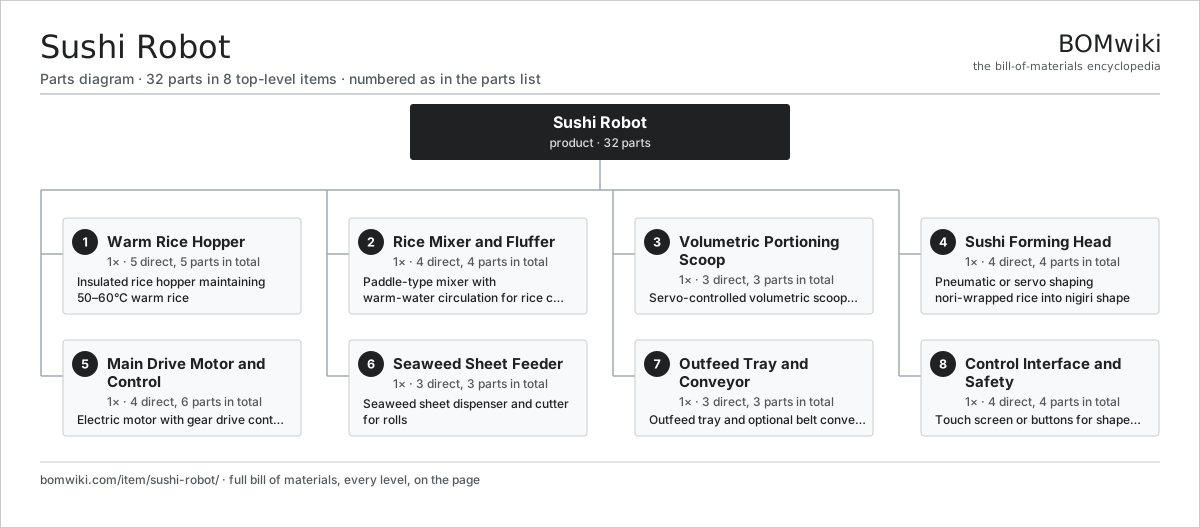
| # | Part | Qty | What it does |
|---|---|---|---|
| 1 | Warm Rice Hopper 5 parts | 1× | Insulated rice hopper maintaining 50–60°C warm rice |
| 2 | Rice Mixer and Fluffer 4 parts | 1× | Paddle-type mixer with warm-water circulation for rice conditioning |
| 3 | Volumetric Portioning Scoop 3 parts | 1× | Servo-controlled volumetric scoop for fixed rice portions |
| 4 | Sushi Forming Head 4 parts | 1× | Pneumatic or servo shaping nori-wrapped rice into nigiri shape |
| 5 | Main Drive Motor and Control 4 parts | 1× | Electric motor with gear drive controlling forming cycle |
| 6 | Seaweed Sheet Feeder 3 parts | 1× | Seaweed sheet dispenser and cutter for rolls |
| 7 | Outfeed Tray and Conveyor 3 parts | 1× | Outfeed tray and optional belt conveyor to collection area |
| 8 | Control Interface and Safety 4 parts | 1× | Touch screen or buttons for shape, portion, and cycle control |
3D model
No 3D model yet. Have a CAD file of this? Add a 3D model. STL renders right on this page; STEP, FreeCAD, and OpenSCAD sources are welcome too (openly licensed, like all 3D models on BOMwiki).
Build & assembly graph
expand / collapse · shared sub-assemblies converge · links to related products · est. labourTap an assembly to expand/collapse · tap a part to open it · use “Open page” for any node · drag to pan, scroll to zoom.
Bill of materials for Sushi Robot
8 top-level lines · 38 rows shown · 32 parts total · indented to 3 levels| # | Item / sub-assembly | Part no. | Qty/assy | Ext. qty | Parts | Type |
|---|---|---|---|---|---|---|
| 1 | Warm Rice Hopper 5 parts | sushi-robot-rice-hopper | 1× | 1 | 5 | assembly |
| 1.1 | Hopper Tank | sushi-robot-hopper-tank | 1× | 1 | · | part |
| 1.2 | Thermal Jacket | sushi-robot-rice-thermal-jacket | 1× | 1 | · | part |
| 1.3 | Temperature Sensor | sushi-robot-rice-temperature-sensor | 1× | 1 | · | part |
| 1.4 | Heater Element | sushi-robot-thermostat-heater | 1× | 1 | · | part |
| 1.5 | Hopper Stirrer | sushi-robot-hopper-stirrer | 1× | 1 | · | part |
| 2 | Rice Mixer and Fluffer 4 parts | sushi-robot-rice-mixer-fluffer | 1× | 1 | 4 | assembly |
| 2.1 | Mixing Bowl | sushi-robot-mixer-chamber | 1× | 1 | · | part |
| 2.2 | Mixer Paddles | sushi-robot-mixer-paddles | 1× | 1 | · | part |
| 2.3 | Seasoning Injector | sushi-robot-seasoning-injector | 1× | 1 | · | part |
| 2.4 | Mixer Motor | sushi-robot-mixer-motor | 1× | 1 | · | part |
| 3 | Volumetric Portioning Scoop 3 parts | sushi-robot-portioning-scoop | 1× | 1 | 3 | assembly |
| 3.1 | Scoop Cup | sushi-robot-scoop-cup | 1× | 1 | · | part |
| 3.2 | Servo Motor | sushi-robot-servo-motor | 1× | 1 | · | part |
| 3.3 | Scoop Drive Belt | sushi-robot-scoop-timing-belt | 1× | 1 | · | part |
| 4 | Sushi Forming Head 4 parts | sushi-robot-forming-mechanism | 1× | 1 | 4 | assembly |
| 4.1 | Forming Die | sushi-robot-forming-die | 1× | 1 | · | part |
| 4.2 | Forming Jaw | sushi-robot-forming-jaw | 1× | 1 | · | part |
| 4.3 | Pneumatic Regulator | sushi-robot-air-regulator | 1× | 1 | · | part |
| 4.4 | Topping Placement Arm | sushi-robot-topping-placer | 1× | 1 | · | part |
| 5 | Main Drive Motor and Control 4 parts | sushi-robot-motor-drive | 1× | 1 | 6 | assembly |
| 5.1 | Main Motor | sushi-robot-main-ac-motor | 1× | 1 | · | part |
| 5.2 | Programmable Controller | sushi-robot-plc-controller | 1× | 1 | · | part |
| 5.3 | Proximity Sensors | sushi-robot-proximity-sensors | 3× | 3 | · | part |
| 5.4 | Solenoid Valve | sushi-robot-solenoid-valve | 1× | 1 | · | part |
| 6 | Seaweed Sheet Feeder 3 parts | sushi-robot-nori-feed-system | 1× | 1 | 3 | assembly |
| 6.1 | Nori Magazine | sushi-robot-nori-magazine | 1× | 1 | · | part |
| 6.2 | Sheet Separator | sushi-robot-sheet-separator | 1× | 1 | · | part |
| 6.3 | Nori Positioner | sushi-robot-sheet-positioner | 1× | 1 | · | part |
| 7 | Outfeed Tray and Conveyor 3 parts | sushi-robot-tray-and-conveyor | 1× | 1 | 3 | assembly |
| 7.1 | Collection Tray | sushi-robot-collection-tray | 1× | 1 | · | part |
| 7.2 | Push Arm | sushi-robot-push-arm | 1× | 1 | · | part |
| 7.3 | Outfeed Conveyor | sushi-robot-conveyor-belt | 1× | 1 | · | part |
| 8 | Control Interface and Safety 4 parts | sushi-robot-control-interface | 1× | 1 | 4 | assembly |
| 8.1 | Control Enclosure | sushi-robot-control-panel | 1× | 1 | · | part |
| 8.2 | Touch Screen Display | sushi-robot-hmi-touch-screen | 1× | 1 | · | part |
| 8.3 | Emergency Stop | sushi-robot-emergency-stop-button | 1× | 1 | · | part |
| 8.4 | Mode Selector | sushi-robot-mode-selector-switch | 1× | 1 | · | part |
Something wrong in this list? Report a problem with this BOM.
Sourcing: possible vendors
Browse the supplier directory → Prices, MOQ, and lead times are algorithmic estimates, not quotes, and not claims about these companies. Company mappings are curated by keyword; est. price band $1k–$500k. How estimates work| Vendor | HQ | Specialty | MOQ | Lead time |
|---|---|---|---|---|
| gea.com ↗ | Düsseldorf, DE | Process technology | 20 units | 12–20 wks |
| buhlergroup.com ↗ | Uzwil, CH | Food & materials processing | 20 units | 12–20 wks |
| tetrapak.com ↗ | Pully, CH | Food packaging & processing | 20 units | 12–20 wks |
| jbtc.com ↗ | Chicago, US | Food processing equipment | 20 units | 12–20 wks |
| alfalaval.com ↗ | Lund, SE | Heat transfer & separation | 20 units | 12–20 wks |
1,039-word article