Suspended Scaffold (Swing Stage)
ProductOverview
A suspended scaffold (also called a swing stage, suspended platform, or cradle) is a temporary elevated work platform suspended from a building rooftop via multiple independent wire ropes and powered hoists. It allows workers to access and work on building facades for maintenance, cleaning, repairs, painting, or construction. The platform is typically 3–6 m long and 1–1.5 m wide, suspended by 4 main ropes plus 2 independent safety backup cables, providing multiple redundancy. A typical platform can support 4–6 workers plus tools, totaling 2000–4000 kg.
Suspended scaffolds are governed by strict safety regulations (OSHA in the US, EN standards in Europe) due to the high-risk nature of facade work. Every worker must be protected by a personal fall arrest harness and shock-absorbing lanyard anchored to a platform lifeline. The platform itself incorporates dual electric hoists with mechanical brakes, synchronized to prevent tilting, and multiple limit stops to prevent uncontrolled descent.
Suspended scaffolds are ubiquitous in urban environments: skyscraper window cleaning, facade restoration, cladding installation, and facade repairs all rely on suspended platforms. Unlike permanent building-mounted platforms, suspended scaffolds are erected and dismantled for each project, making them flexible and cost-effective for temporary work campaigns.
How it Works
Before deployment, the roof rigging is installed: a heavy-duty support beam is positioned across the building edge, anchored to the roof structure via multiple tie-down cables that distribute suspension load and resist wind overturning moment. The beam is aligned perfectly level using surveying instruments.
The suspension ropes (typically four, 16–20 mm diameter) are attached to anchor plates bolted to the roof beam. Each rope is individually rated for the full platform load; if any single rope fails, the remaining three ropes can safely support the entire platform and all occupants. The ropes pass over pulley guards on the roof edge, protecting them from abrasion.
At the platform end, the four ropes are attached to the dual hoists via anchor shackles. The two hoists are electrically or mechanically synchronized so that they raise and lower at exactly the same rate, keeping the platform level. A fifth and sixth rope (the backup safety cables) are attached to independent roof anchors and the platform frame, providing a completely separate suspension system. If all four main suspension ropes fail simultaneously (an extremely unlikely event), the backup cables will catch and suspend the platform, allowing safe emergency descent.
Workers arrive at the cage (an enclosed safety basket preventing tools from falling on pedestrians below) and secure themselves with full-body safety harnesses clipped to the horizontal lifeline cable running the full length of the platform. The cage door is secured, and the operator (typically located at the roof) activates the hoist controls via a wireless pendant or hardwired control.
The electric hoists energize in unison, their motors driving spooled drums that pull the suspension ropes. Sensors or mechanical synchronization ensure that both hoists extend rope at the same rate; if one hoist begins to lag (due to friction or a load imbalance), the electrical interlock throttles the faster hoist, bringing both back into sync within seconds. The platform rises smoothly at a preset speed, typically 0.5–1.0 m/s.
As the platform ascends, outrigger arms with wheeled facade guide wheels contact the building facade and slide upward. These wheels keep the platform pressed against the facade, preventing swinging and protecting the building from impacts. Elastomer bumpers on the outriggers absorb contact forces, minimizing facade damage.
When the platform reaches the desired working height (or a roof-mounted limit switch senses maximum height), the operator releases the control buttons. The load-holding spring-applied brakes on both hoists immediately engage, suspending the platform indefinitely. The platform is now stable and ready for work.
Workers perform facade work (cleaning, repairs, painting) while tethered to the platform lifeline via their lanyards. The shock-absorbing lanyard means that if a worker falls away from the platform, the lanyard gradually decelerates them, limiting peak deceleration to safe levels (typically 2–4 g, well below injury threshold). The platform railings and toe board prevent tools and materials from rolling off accidentally.
Once work is complete, the operator initiates descent. The hoists re-engage in unison, lowering the platform at a controlled rate. The proportional hoist controller allows smooth speed control; the operator can adjust descent rate from full speed down to a crawl. A large red emergency stop button on the pendant immediately halts descent if any anomaly is detected.
When the platform reaches the lower terminus (detected by mechanical limit switches), descent stops automatically. The hoists are secured, and workers exit the cage. The platform can be raised again for the next shift or dismantled if the project is complete.
Dual Hoist Synchronization
The critical engineering challenge in swing stages is keeping the two hoists synchronized. If one hoist is faster than the other, the platform tilts, risking worker safety and platform damage. There are three common synchronization methods:
Mechanical Linkage: A steel cable or rigid rod physically links the two hoist drums. If one drum accelerates, the linkage transmits force to slow it. This is simple but inflexible; adjustment requires mechanical modification.
Electrical Interlock: Load sensors on each hoist detect if one is moving faster than the other. Electronic logic modulates proportional valve openings (in hydraulic hoists) or soft-starter output (in electric hoists) to equalize speed. This is the modern standard, allowing remote speed adjustment and better precision.
Load-Sensing Hydraulics: If the hoists are hydraulically powered, a common load-sensing manifold equalizes pilot pressure to both hoist motors, maintaining identical flow regardless of load variation on each side.
Most modern suspended scaffolds use electrical interlock with position feedback: each hoist has a rotary encoder or inductive sensor monitoring rope payout. If one encoder lags, the controller throttles the other hoist proportionally, bringing them back into sync within 1–2 seconds. Synchronization tolerance is typically ±50 mm (less than 1 degree of tilt).
Safety Systems and Redundancy
Suspended scaffolds incorporate multiple independent safety layers:
Dual Main Suspension Ropes: Four ropes support the platform, each rated for 100% of the maximum load. Any single rope failure does not compromise safety; the remaining three ropes carry the full load.
Independent Backup Safety Cables: Two completely separate backup suspension cables provide a secondary suspension system anchored to independent roof points. If all four main ropes fail simultaneously (an extraordinarily unlikely event), the backup cables catch and hold the platform.
Personal Fall Protection: Each worker is secured by a full-body harness and shock-absorbing lanyard to a horizontal lifeline running the platform length. If a worker loses balance and falls away from the platform, the lanyard deploys, absorbing the fall energy and bringing them to a stop within 1–2 meters.
Load-Holding Brakes: Both hoist brakes are spring-applied, meaning they engage (apply braking force) by default and must be actively pressurized to release. If hoist power is lost, the brakes immediately engage, holding the platform indefinitely.
Mechanical Limit Stops: Mechanical limit switches at the upper and lower travel limits stop the hoists and prevent over-travel damage.
Emergency Stop Button: A large red mushroom-button emergency stop on the pendant cuts all hoist power and applies the brakes immediately.
Facade Stability: Outrigger arms and facade guide wheels prevent the platform from swinging during wind gusts or worker movement. The platform remains pressed against the facade, making it stable and safe even in high winds (20+ knot gusts).
Inspection and Maintenance
Suspended scaffolds require rigorous inspection before each use:
- Pre-deployment: All ropes are inspected for corrosion, kinks, and visible wear. Hoists are functionally tested under load (raising and lowering an empty platform). Synchronization is verified (both hoists must raise and lower at identical rates within ±50 mm).
- Weekly: Ropes are re-inspected, hoist brakes are tested for holding power, synchronization is re-checked, and all fasteners are torque-verified.
- Monthly: Hoists are serviced; rope terminations and eye-splices are re-torqued; anchor bolts on the roof beam are verified.
- Quarterly: Ropes may be rotated or replaced if wear patterns are detected; hoist motors are inspected for overheating; shock absorbers in lanyards are replaced after any deployment (even if not activated).
Rope replacement is typically required every 3–5 years depending on usage and environment. Hoists, if well-maintained, can operate for 10+ years. A typical 50-meter swing stage deployment costs 5,000–15,000 USD and requires 2–3 days of crew time to erect, operate, and dismantle.
Comparison with Alternative Access Systems
For sustained long-term facade work (months to years), permanent building-mounted facade access platforms may be cost-effective alternatives. For single-point rescue or inspection, rope-access systems (climbing techniques) are lighter and cheaper but require highly trained technicians. For interior work, traditional scaffolding or boom lifts are safer and more efficient.
Suspended Scaffold (Swing Stage) parts and their functions
8 top-level parts · 335 parts in total · full bill of materials below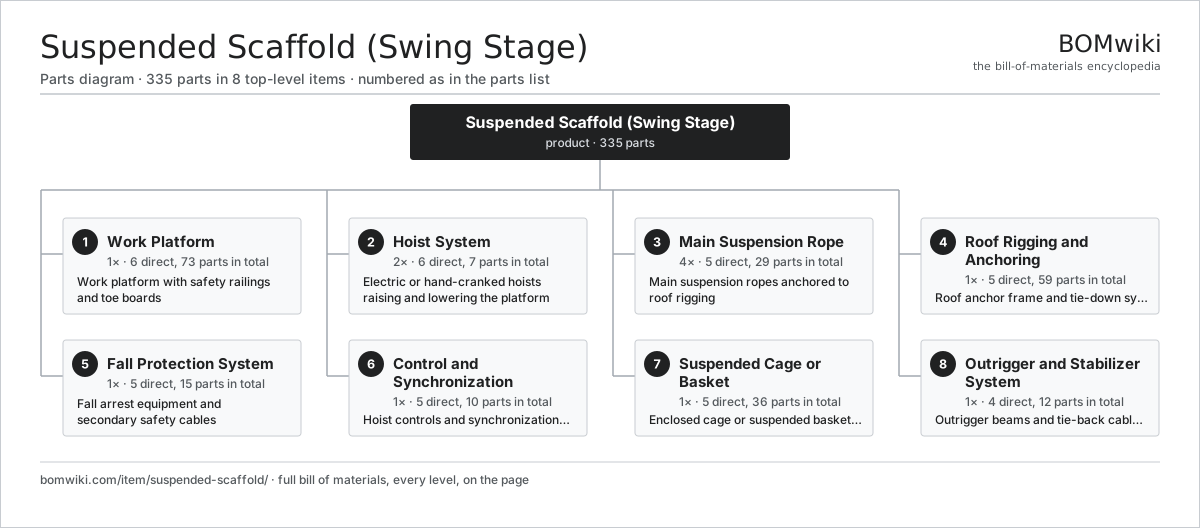
| # | Part | Qty | What it does |
|---|---|---|---|
| 1 | Work Platform 6 parts | 1× | Work platform with safety railings and toe boards |
| 2 | Hoist System 6 parts | 2× | Electric or hand-cranked hoists raising and lowering the platform |
| 3 | Main Suspension Rope 5 parts | 4× | Main suspension ropes anchored to roof rigging |
| 4 | Roof Rigging and Anchoring 5 parts | 1× | Roof anchor frame and tie-down system |
| 5 | Fall Protection System 5 parts | 1× | Fall arrest equipment and secondary safety cables |
| 6 | Control and Synchronization 5 parts | 1× | Hoist controls and synchronization interlock |
| 7 | Suspended Cage or Basket 5 parts | 1× | Enclosed cage or suspended basket assembly |
| 8 | Outrigger and Stabilizer System 4 parts | 1× | Outrigger beams and tie-back cables for stability |
3D model
No 3D model yet. Have a CAD file of this? Add a 3D model. STL renders right on this page; STEP, FreeCAD, and OpenSCAD sources are welcome too (openly licensed, like all 3D models on BOMwiki).
Build & assembly graph
expand / collapse · shared sub-assemblies converge · links to related products · est. labourTap an assembly to expand/collapse · tap a part to open it · use “Open page” for any node · drag to pan, scroll to zoom.
Bill of materials for Suspended Scaffold (Swing Stage)
8 top-level lines · 49 rows shown · 335 parts total · indented to 3 levels| # | Item / sub-assembly | Part no. | Qty/assy | Ext. qty | Parts | Type |
|---|---|---|---|---|---|---|
| 1 | Work Platform 6 parts | suspended-scaffold-platform | 1× | 1 | 73 | assembly |
| 1.1 | Platform Frame | suspended-scaffold-platform-frame | 1× | 1 | · | part |
| 1.2 | Platform Deck | suspended-scaffold-platform-deck | 1× | 1 | · | part |
| 1.3 | Safety Rail | suspended-scaffold-safety-railing | 2× | 2 | · | part |
| 1.4 | Toe Board | suspended-scaffold-toe-board | 1× | 1 | · | part |
| 1.5 | Hoist Attachment Eye | suspended-scaffold-hoist-attachment | 4× | 4 | · | part |
| 1.6 | Fastener Set | fastener-set | 64× | 64 | · | part |
| 2 | Hoist System 6 parts | suspended-scaffold-hoist-system | 2× | 2 | 7 | assembly |
| 2.1 | Electric Hoist | suspended-scaffold-electric-hoist | 1× | 2 | · | part |
| 2.2 | Hand-Crank Hoist | suspended-scaffold-hand-crank-hoist | 1× | 2 | · | part |
| 2.3 | Hoist Motor | suspended-scaffold-hoist-motor | 1× | 2 | · | part |
| 2.4 | Hoist Brake | suspended-scaffold-brake-unit | 2× | 4 | · | part |
| 2.5 | Cable Drum | suspended-scaffold-cable-drum | 1× | 2 | · | part |
| 2.6 | Hoist Control Pendant | suspended-scaffold-hoist-controller | 1× | 2 | · | part |
| 3 | Main Suspension Rope 5 parts | suspended-scaffold-wire-rope | 4× | 4 | 29 | assembly |
| 3.1 | Suspension Rope | suspended-scaffold-primary-rope | 4× | 16 | · | part |
| 3.2 | Rope Terminator | suspended-scaffold-rope-terminator | 8× | 32 | · | part |
| 3.3 | Cable Clamp | suspended-scaffold-rope-clamp | 12× | 48 | · | part |
| 3.4 | Anchor Shackle | suspended-scaffold-shackle | 4× | 16 | · | part |
| 3.5 | Wire Bundle | wire-bundle | 1× | 4 | · | part |
| 4 | Roof Rigging and Anchoring 5 parts | suspended-scaffold-roof-rigging | 1× | 1 | 59 | assembly |
| 4.1 | Roof Support Beam | suspended-scaffold-roof-beam | 2× | 2 | · | part |
| 4.2 | Anchor Plate | suspended-scaffold-anchor-plate | 4× | 4 | · | part |
| 4.3 | Edge Pulley Guard | suspended-scaffold-roof-edge-protection | 1× | 1 | · | part |
| 4.4 | Tie-Down Cable | suspended-scaffold-tie-down-cable | 4× | 4 | · | part |
| 4.5 | Fastener Set | fastener-set | 48× | 48 | · | part |
| 5 | Fall Protection System 5 parts | suspended-scaffold-safety-system | 1× | 1 | 15 | assembly |
| 5.1 | Safety Cable | suspended-scaffold-safety-cable | 2× | 2 | · | part |
| 5.2 | Safety Harness | suspended-scaffold-safety-harness | 4× | 4 | · | part |
| 5.3 | Shock-Absorbing Lanyard | suspended-scaffold-lanyard | 4× | 4 | · | part |
| 5.4 | Horizontal Lifeline | suspended-scaffold-lifeline-cable | 1× | 1 | · | part |
| 5.5 | Shock Absorber | suspended-scaffold-shock-absorber | 4× | 4 | · | part |
| 6 | Control and Synchronization 5 parts | suspended-scaffold-control-system | 1× | 1 | 10 | assembly |
| 6.1 | Limit Switch | suspended-scaffold-limit-switch | 2× | 2 | · | part |
| 6.2 | Synchronization Cable | suspended-scaffold-sync-cable | 1× | 1 | · | part |
| 6.3 | Emergency Stop Button | suspended-scaffold-emergency-stop | 1× | 1 | · | part |
| 6.4 | Hoist Control Pendant | suspended-scaffold-hoist-controller | 2× | 2 | · | part |
| 6.5 | Relay | relay | 4× | 4 | · | part |
| 7 | Suspended Cage or Basket 5 parts | suspended-scaffold-working-cage | 1× | 1 | 36 | assembly |
| 7.1 | Cage Frame | suspended-scaffold-cage-frame | 1× | 1 | · | part |
| 7.2 | Cage Mesh | suspended-scaffold-cage-mesh | 1× | 1 | · | part |
| 7.3 | Cage Door | suspended-scaffold-cage-door | 1× | 1 | · | part |
| 7.4 | Cage Floor | suspended-scaffold-cage-floor | 1× | 1 | · | part |
| 7.5 | Fastener Set | fastener-set | 32× | 32 | · | part |
| 8 | Outrigger and Stabilizer System 4 parts | suspended-scaffold-stabilizer-bars | 1× | 1 | 12 | assembly |
| 8.1 | Outrigger Arm | suspended-scaffold-outrigger-arm | 2× | 2 | · | part |
| 8.2 | Facade Guide Wheel | suspended-scaffold-guide-wheel | 2× | 2 | · | part |
| 8.3 | Tie-Back Rope | suspended-scaffold-tie-back-rope | 4× | 4 | · | part |
| 8.4 | Facade Bumper | suspended-scaffold-bumper-pad | 4× | 4 | · | part |
Something wrong in this list? Report a problem with this BOM.
Related products
same domain, ranked by shared parts All-Terrain Mobile Crane
594 parts · shares 2 with this page
All-Terrain Mobile Crane
594 parts · shares 2 with this page
 Articulating Boom Lift
120 parts · shares 2 with this page
Articulating Boom Lift
120 parts · shares 2 with this page
 Asphalt Milling Machine
1,134 parts · shares 2 with this page
Asphalt Milling Machine
1,134 parts · shares 2 with this page
 Asphalt Paver
402 parts · shares 2 with this page
Asphalt Paver
402 parts · shares 2 with this page
 Asphalt Recycler
226 parts · shares 2 with this page
Asphalt Recycler
226 parts · shares 2 with this page
 Backhoe Loader
278 parts · shares 2 with this page
Backhoe Loader
278 parts · shares 2 with this page
Sourcing: possible vendors
Browse the supplier directory → Prices, MOQ, and lead times are algorithmic estimates, not quotes, and not claims about these companies. Company mappings are curated by keyword; est. price band $15k–$2M. How estimates work| Vendor | HQ | Specialty | MOQ | Lead time |
|---|---|---|---|---|
| caterpillar.com ↗ | Irving, US | Construction & mining equipment | made to order | 16–28 wks |
|
🇯🇵Komatsu
komatsu.com ↗
|
Tokyo, JP | Construction & mining equipment | made to order | 16–28 wks |
|
🇸🇪Volvo CE
volvoce.com ↗
|
Gothenburg, SE | Construction equipment | made to order | 16–28 wks |
|
🇨🇭Liebherr
liebherr.com ↗
|
Bulle, CH | Cranes & heavy equipment | made to order | 16–28 wks |
|
🇨🇳XCMG
xcmg.com ↗
|
Xuzhou, CN | Construction machinery | made to order | 16–28 wks |
1,660-word article