Switch Point Heater
ProductOverview
A switch-point heater is a stationary installation at a railway turnout (switch) that prevents snow, ice, and frost from binding the switch points (the movable rail blades) to the fixed guard rail, which would cause the switch to jam and obstruct traffic. In winter, accumulation even a few millimeters thick can prevent full engagement, leading to slow orders, missed switches, or derailments. The heater system melts this ice continuously, maintaining the switch in a clean, free-moving state. Modern systems use either electric heating (cartridge resistors) fed from a lineside substation, or autonomous gas burners (propane) for remote locations without nearby power.
The Heating Element Unit is physically mounted directly under or alongside the switch points on a Rail-Mount Bracket Assembly of stainless steel, resisting corrosion from track salt. The Electric Heating Cartridge elements (electric systems) or Gas Burner (Optional) are modulated by a Thermostat Controller in the Control and Distribution Cabinet, which monitors ambient and rail temperature via Temperature and Load Sensors. When air temperature approaches freezing and ice is detected (either by Snow-Load Sensor pressure or rail temperature drop), the controller energizes the heater to maintain the rail above ice-formation threshold. The Melted Water Drainage System system carries meltwater away from the switch mechanism and bearings.
Electric systems are simplest and cleanest, requiring only a 230 V three-phase feeder and a disconnect. Gas systems offer higher power density and operate without electrical supply, critical in remote yards. Both use similar logic and safety features: temperature sensors, over-temperature cutouts, and status indicator lights on the Status Indicator Lights.
How it works
During normal operation in mild or warm weather, the heater is idle. As evening temperature drops toward freezing, the Ambient Temperature Sensor reports cooling to the Thermostat Controller. When the ambient temperature crosses below 2–4 °C (typically user-set), the thermostat energizes a Contactor Relay, which completes the circuit to the Electric Heating Cartridge heating elements (electric) or ignition of the Gas Burner (Optional) (gas).
Heat flows from the element into the Thermal Spreader Plate, a thermally conductive aluminum or steel spreader that conducts warmth into the rail metal itself. The Rail Temperature Sensor mounted on the visible rail surface reads back 5–15 °C above ambient; once this setpoint is achieved, the controller reduces heating (via contactor cycle or burner modulation) to maintain temperature with minimal fuel/power consumption. If accumulating snow loads trigger the Snow-Load Sensor pressure threshold, the controller boosts heating automatically to accelerate melting.
As rain or meltwater touches the hot rail surface, it immediately evaporates, preventing the meltwater from re-freezing at night. Gravity and the slight slope of the Drain Gutter channel any residual meltwater down the Drain Tube to ground, away from switch bearings. The heating cycle runs through the night and may last 8–12 hours depending on ambient severity; dawn and daytime sunshine provide additional warming, reducing evening-to-evening heating demand.
By morning, the switch points are ice-free and fully lubricated (maintenance personnel grease switches regularly). Train crews operate the switch normally, and thermal switch machines actuate without jamming. No manual de-icing is required.
Design considerations
Electric heating is chosen for yards near substations because utility power is cost-effective if already available; a 20 kW load is modest by railway standard. Gas heating dominates remote mountain passes and sidings far from electrical supply; propane burners deliver 50–100 kW with only a tank and supply line, much higher power density than electric cartridges. The Thermostat Controller uses hysteresis (e.g., energize at 1 °C, de-energize at 8 °C) to prevent chatter and extend element life; cycling every 30 seconds would cause thermal fatigue.
The Rail-Mount Bracket Assembly is mechanically isolated from the switch mechanism itself, heating is radiant, not conductive through the bearing studs, so vibration from train passage does not shake the heater assembly or loosen fasteners. Stainless steel is mandatory because track salt and cinder ballast create a corrosive environment; mild steel would rust through in 3–5 years.
The Control and Distribution Cabinet is mounted on a lineside pole or switch stand, with the Main Power Supply and Protection breaker sized to permit unattended continuous operation (a heated switch running 12 hours/day in winter = 240 kWh/month per switch). The Status Indicator Lights are visible from a distance so maintenance patrols can confirm a heater is operating without stopping to check; a dark light may indicate a blown fuse or element failure, requiring immediate attention.
Remote monitoring of the Thermostat Controller via hardwired phone line or wireless telemetry is standard for main lines; a heater failure may be detected and repaired before a switch jam causes operational disruption.
Switch Point Heater parts and their functions
7 top-level parts · 53 parts in total · full bill of materials below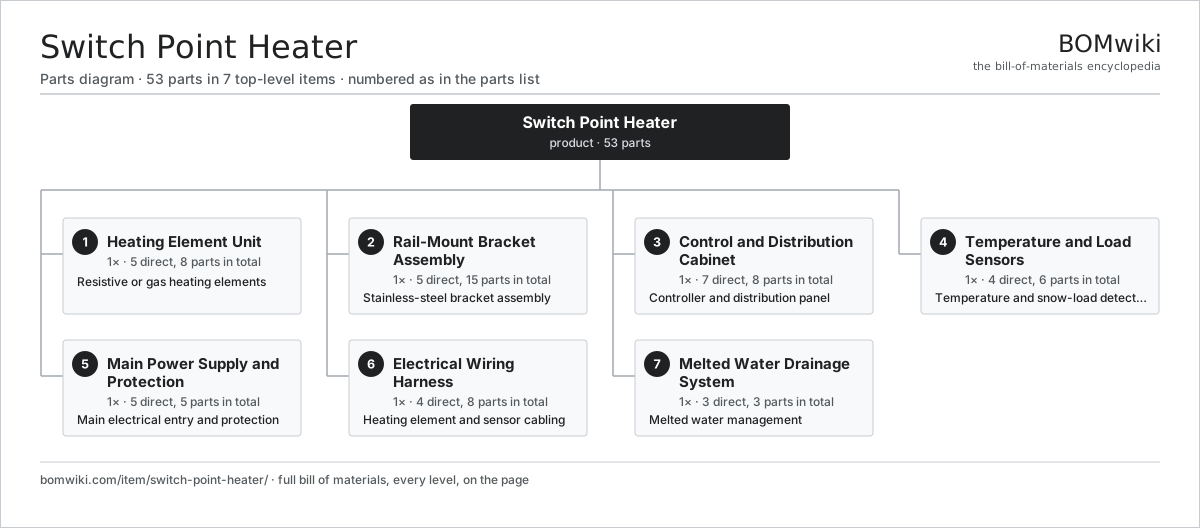
| # | Part | Qty | What it does |
|---|---|---|---|
| 1 | Heating Element Unit 5 parts | 1× | Resistive or gas heating elements |
| 2 | Rail-Mount Bracket Assembly 5 parts | 1× | Stainless-steel bracket assembly |
| 3 | Control and Distribution Cabinet 7 parts | 1× | Controller and distribution panel |
| 4 | Temperature and Load Sensors 4 parts | 1× | Temperature and snow-load detection |
| 5 | Main Power Supply and Protection 5 parts | 1× | Main electrical entry and protection |
| 6 | Electrical Wiring Harness 4 parts | 1× | Heating element and sensor cabling |
| 7 | Melted Water Drainage System 3 parts | 1× | Melted water management |
3D model
No 3D model yet. Have a CAD file of this? Add a 3D model. STL renders right on this page; STEP, FreeCAD, and OpenSCAD sources are welcome too (openly licensed, like all 3D models on BOMwiki).
Build & assembly graph
expand / collapse · shared sub-assemblies converge · links to related products · est. labourTap an assembly to expand/collapse · tap a part to open it · use “Open page” for any node · drag to pan, scroll to zoom.
Bill of materials for Switch Point Heater
7 top-level lines · 40 rows shown · 53 parts total · indented to 3 levels| # | Item / sub-assembly | Part no. | Qty/assy | Ext. qty | Parts | Type |
|---|---|---|---|---|---|---|
| 1 | Heating Element Unit 5 parts | switch-point-heater-heating-unit | 1× | 1 | 8 | assembly |
| 1.1 | Electric Heating Cartridge | switch-point-heater-resistor-cartridge | 4× | 4 | · | part |
| 1.2 | Gas Burner (Optional) | switch-point-heater-or-gas-burner | 1× | 1 | · | part |
| 1.3 | Thermal Spreader Plate | switch-point-heater-heating-plate | 1× | 1 | · | part |
| 1.4 | Thermal Feedback Sensor | switch-point-heater-thermal-sensor | 1× | 1 | · | part |
| 1.5 | Element Housing | switch-point-heater-element-housing | 1× | 1 | · | part |
| 2 | Rail-Mount Bracket Assembly 5 parts | switch-point-heater-mounting-frame | 1× | 1 | 15 | assembly |
| 2.1 | Mounting Rail | switch-point-heater-mounting-rail | 2× | 2 | · | part |
| 2.2 | Corner Bracket | switch-point-heater-mounting-bracket | 4× | 4 | · | part |
| 2.3 | Rail Clamp Collar | switch-point-heater-clamp-collar | 4× | 4 | · | part |
| 2.4 | Electrical Isolation Pad | switch-point-heater-insulation-pad | 4× | 4 | · | part |
| 2.5 | Fastener Set | fastener-set | 1× | 1 | · | part |
| 3 | Control and Distribution Cabinet 7 parts | switch-point-heater-control-cabinet | 1× | 1 | 8 | assembly |
| 3.1 | Cabinet Enclosure | switch-point-heater-cabinet-box | 1× | 1 | · | part |
| 3.2 | Thermostat Controller | switch-point-heater-thermostat-controller | 1× | 1 | · | part |
| 3.3 | Contactor Relay | switch-point-heater-contactor-relay | 2× | 2 | · | part |
| 3.4 | Over-Temperature Cutout | switch-point-heater-overtemp-cutout | 1× | 1 | · | part |
| 3.5 | Status Indicator Lights | switch-point-heater-status-lights | 1× | 1 | · | part |
| 3.6 | Cabinet Vent Filter | switch-point-heater-cabinet-ventilation | 1× | 1 | · | part |
| 3.7 | Cabinet Drain Plug | switch-point-heater-drain-plug | 1× | 1 | · | part |
| 4 | Temperature and Load Sensors 4 parts | switch-point-heater-sensors | 1× | 1 | 6 | assembly |
| 4.1 | Ambient Temperature Sensor | switch-point-heater-air-temp-sensor | 1× | 1 | · | part |
| 4.2 | Rail Temperature Sensor | switch-point-heater-rail-temp-sensor | 1× | 1 | · | part |
| 4.3 | Snow-Load Sensor | switch-point-heater-snow-load-sensor | 1× | 1 | · | part |
| 4.4 | Sensor Cable | switch-point-heater-sensor-cable | 3× | 3 | · | part |
| 5 | Main Power Supply and Protection 5 parts | switch-point-heater-power-supply | 1× | 1 | 5 | assembly |
| 5.1 | Main Disconnect Switch | switch-point-heater-disconnect-switch | 1× | 1 | · | part |
| 5.2 | Circuit Breaker | switch-point-heater-circuit-breaker | 1× | 1 | · | part |
| 5.3 | Ground Distribution Bus | switch-point-heater-ground-bus | 1× | 1 | · | part |
| 5.4 | Surge Suppressor | switch-point-heater-surge-protector | 1× | 1 | · | part |
| 5.5 | Connector | connector | 1× | 1 | · | part |
| 6 | Electrical Wiring Harness 4 parts | switch-point-heater-wiring-harness | 1× | 1 | 8 | assembly |
| 6.1 | High-Temperature Heating Cable | switch-point-heater-heating-cable | 1× | 1 | · | part |
| 6.2 | Multi-Pin Connector | switch-point-heater-connector-plug | 2× | 2 | · | part |
| 6.3 | Cable Gland | switch-point-heater-cable-gland | 4× | 4 | · | part |
| 6.4 | Control Wire | switch-point-heater-thermostat-wire | 1× | 1 | · | part |
| 7 | Melted Water Drainage System 3 parts | switch-point-heater-drainage | 1× | 1 | 3 | assembly |
| 7.1 | Drain Gutter | switch-point-heater-drain-gutter | 1× | 1 | · | part |
| 7.2 | Drain Tube | switch-point-heater-drain-tube | 1× | 1 | · | part |
| 7.3 | Drain Screen | switch-point-heater-drain-screen | 1× | 1 | · | part |
Something wrong in this list? Report a problem with this BOM.
Sourcing: possible vendors
Browse the supplier directory → Prices, MOQ, and lead times are algorithmic estimates, not quotes, and not claims about these companies. Company mappings are curated by keyword; est. price band $500k–$60M. How estimates work| Vendor | HQ | Specialty | MOQ | Lead time |
|---|---|---|---|---|
|
🇨🇳CRRC
crrcgc.cc ↗
|
Beijing, CN | Rolling stock & rail systems | made to order | 40–72 wks |
|
🇫🇷Alstom
alstom.com ↗
|
Saint-Ouen, FR | Rail rolling stock | made to order | 40–72 wks |
| mobility.siemens.com ↗ | Munich, DE | Rail systems | made to order | 40–72 wks |
| stadlerrail.com ↗ | Bussnang, CH | Rail rolling stock | made to order | 40–72 wks |
|
🇺🇸Wabtec
wabteccorp.com ↗
|
Pittsburgh, US | Rail equipment | made to order | 40–72 wks |
843-word article