System Scaffolding
ProductOverview
System scaffolding (or modular tube scaffolding) is a load-bearing temporary structure built from standardized steel tubes and castings, connected via rosette nodes at fixed angular intervals. This approach, pioneered in Europe and standardized across DIN and EN regulations, has become the dominant method for facade work, interior refurbishment, and any multi-story construction requiring frequent reconfigurations. Unlike traditional putlog or ledger scaffolding, system scaffolds offer superior geometric flexibility, faster assembly, and predictable safety margins through their pin-jointed connections.
The scaffold consists of four main subsystems: a frame of vertical uprights and horizontal ledgers, a rosette-based connector assembly enabling multi-directional bracing, removable decking platforms, and a base-and-leveling system that adapts to irregular ground. This modular stack allows workers to build outward, upward, and inward from a fixed grid without cutting, bending, or improvising members.
Frame Structure & Loading
The core frame is built from square or circular steel tubes, typically 48 mm or 60 mm diameter with 3–4 mm wall thickness. Uprights run vertically, usually 2.0 m tall (though 1.5 m and 3.0 m sections exist), and are spaced 1.3–2.0 m apart along the building facade. Ledger beams run perpendicular to the uprights, typically at 1.3–2.0 m spacing, supporting the decking platforms. Each intersecting node features a Rosette Castings casting, a spherical or cubical forging with radially drilled holes at fixed 45° angles, allowing bolted attachment of bracing members without field drilling or welding.
The working load per platform is typically 2–4 kN/m² distributed load, with concentrated point loads up to 3 kN at node locations (enough for two workers plus materials, tools, and a small pump). Load is transmitted vertically down the uprights to the Base Plates, then to the ground. Horizontal wind or impact loads flow through Diagonal Braces and Knee Braces in tension and compression.
Connectors & Modularity
The Rosette Connector System subsystem, particularly the rosette node, is the enabling innovation. Instead of welding, clamping, or bolting onto tube flanges, ledgers and braces are simply slotted into radial holes and secured with through-bolts and split pins. This achieves several advantages:
- Rapid assembly: Two workers can erect 20–30 m² per day without special tools or trades.
- Repeatability: Identical connection angles across every bay, reducing errors and inspection time.
- Flexibility: Members can be added or removed in any combination, horizontal, angled at 45°, 60°, or 90°, without modification.
- Standardized bolts: M12 or M16 grade-8 bolts with mechanical or wedge locking, reusable indefinitely.
The rosette itself is cast from ductile iron (EN-GJS-400-15) or forged steel, weighing 1–2 kg per node, and is designed to be welded or bolted to the vertical upright. Modern systems slot the rosette onto a special tube fitting that accepts bolts radially, avoiding field welding entirely.
Decking & Platforms
Platforms span between ledger beams and are removable, allowing scaffolding to remain in place while work cycles progress independently. Traditional platforms are laminated timber boards (softwood, typically pine or spruce) 225 mm wide and 30–38 mm thick, with edges strengthened by steel angles. Higher-wear environments use metal expanded-metal or bar-grating decks (aluminum or galvanized steel). All boards are held in place by Deck Securing Clamps, spring-loaded or friction grips that prevent drift under foot traffic or wind without requiring tools. Load ratings for new timber planks are typically 1.5–2.0 kN/m²; boards must be inspected for defects (cracks, rot, splitting) every 6–12 months and replaced if found.
Bracing & Lateral Stiffness
Unbraced scaffolding is unstable. Diagonal Braces in 30–40 mm tube form X- or K-patterns across bays, reducing lateral sway (first natural frequency increases from ~0.3 Hz to ~1.0 Hz with proper bracing). Diagonals are typically placed on alternate bays to reduce cost while maintaining adequate stiffness. At frame corners and at the building interface, Knee Braces, short, rigid members, provide torsional restraint and moment resistance, especially critical at platform edges and where eccentric loads are applied.
Bracing design follows Eurocode 9 or DIN 4687; the engineer calculates deflection limits (typically L/250 where L is the unsupported height) and wind pressure resistance. Higher buildings or exposed coastal sites require denser bracing, sometimes doubling the volume of diagonal members.
Base System & Ground Preparation
The Base and Leveling System subsystem anchors the scaffold and adapts to uneven terrain. Base plates (typically 250×250 mm or 400×400 mm steel) distribute the upright load over a large footprint, reducing bearing pressure to acceptable levels (500–1000 kPa on firm soil). For sloped ground, Adjustable Jacks, threaded screw assemblies, provide 0–300 mm vertical adjustment, allowing fine leveling without shims. Each upright corner must be individually leveled to a tolerance of ±10 mm over the full height, checked with a transit or laser level at erection and weekly thereafter.
Ground preparation is critical: the base area must be clear of soft spots, voids, or frost-heave zones. In wet climates, base plates are sometimes placed on timbers, concrete pads, or adjustable jack bases to elevate the scaffold above puddles and prevent corrosion.
Assembly & Erection
A typical system scaffold is erected in layers, bottom to top:
- Base plates and adjustable jacks are positioned and leveled.
- First pair of uprights is lowered into place and leveled (one worker per corner, using plumb bob or laser).
- Ledger beams are bolted at the rosette nodes using Fastener Set (M12 grade-8 bolts, mechanical lock washers, and split pins).
- Transversal beams are added to maintain lateral spacing.
- Diagonal bracing is attached.
- Decking is laid and secured with Deck Securing Clamps.
- Guardrails and toe boards are installed.
This sequence repeats every 2 m of height. Two skilled workers can erect 20–30 m² of new platform area per day; teardown is roughly half the time because disassembly order is flexible (no sequencing constraints like welding).
Safety & Standards
Guardrails (Guardrails) are mandatory on all working platforms, typically 1000–1200 mm high and rated to resist 1.1 kN horizontal push (a falling worker's impact energy). Toe boards (Toe Boards) prevent tools from rolling off. Access between levels is via Access Stairs, welded frames with slip-resistant treads, typically 1.0–1.2 m wide.
Inspection is frequent: daily visual (no visible bends, cracks, or rust perforation), weekly full walkover (tightness of all bolts, board condition, bracing alignment), and annual non-destructive testing (for long-term rentals). In high-wind zones or after notable wind events, full re-inspection is mandatory.
Common Configurations & Variants
- Single-width: 0.7–1.0 m platform width, typical for facade work.
- Double-width: 1.2–1.5 m, used for interior refurbishment or heavy material storage.
- Multi-story: Stacked facades from ground to roof, with intermediate loading floors.
- Cantilever sections: Platforms projecting beyond building footprint for facade cleaning or repair.
- Shoring: Horizontal bracing supporting slab formwork from below (using props and base plates).
The same tubes, rosettes, and bolts are recombined into each configuration, and the kit typically costs USD 15–25 per m² of platform area to rent annually, or USD 50–100 per m² for purchase. A typical 10-story facade project might require 500–1000 m² of platform area and 10–20 tonnes of steel tubes and castings.
System Scaffolding parts and their functions
7 top-level parts · 22 parts in total · full bill of materials below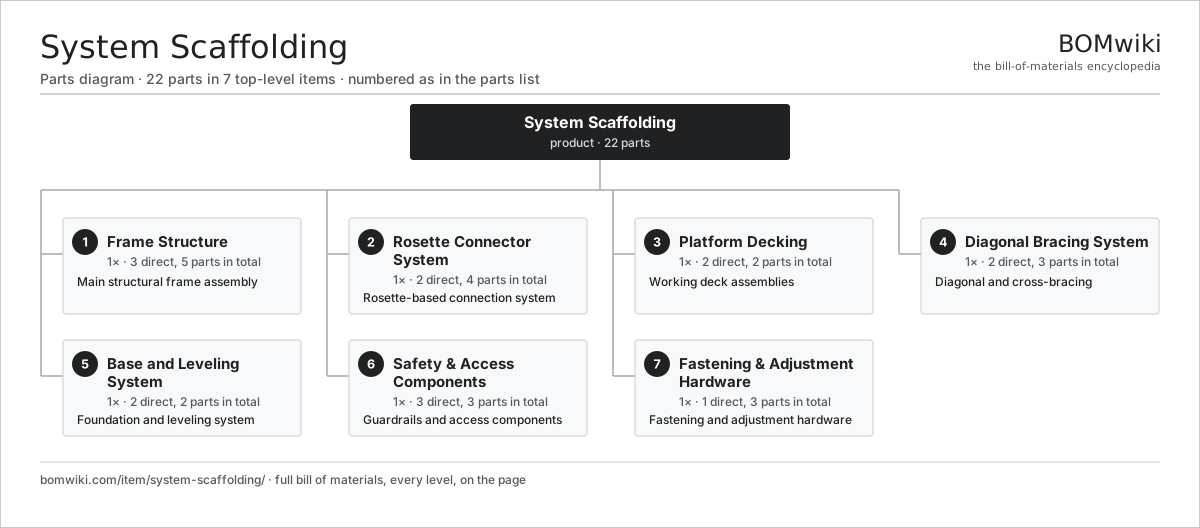
| # | Part | Qty | What it does |
|---|---|---|---|
| 1 | Frame Structure 3 parts | 1× | Main structural frame assembly |
| 2 | Rosette Connector System 2 parts | 1× | Rosette-based connection system |
| 3 | Platform Decking 2 parts | 1× | Working deck assemblies |
| 4 | Diagonal Bracing System 2 parts | 1× | Diagonal and cross-bracing |
| 5 | Base and Leveling System 2 parts | 1× | Foundation and leveling system |
| 6 | Safety & Access Components 3 parts | 1× | Guardrails and access components |
| 7 | Fastening & Adjustment Hardware 1 parts | 1× | Fastening and adjustment hardware |
3D model
No 3D model yet. Have a CAD file of this? Add a 3D model. STL renders right on this page; STEP, FreeCAD, and OpenSCAD sources are welcome too (openly licensed, like all 3D models on BOMwiki).
Build & assembly graph
expand / collapse · shared sub-assemblies converge · links to related products · est. labourTap an assembly to expand/collapse · tap a part to open it · use “Open page” for any node · drag to pan, scroll to zoom.
Bill of materials for System Scaffolding
7 top-level lines · 22 rows shown · 22 parts total · indented to 3 levels| # | Item / sub-assembly | Part no. | Qty/assy | Ext. qty | Parts | Type |
|---|---|---|---|---|---|---|
| 1 | Frame Structure 3 parts | system-scaffolding-frame | 1× | 1 | 5 | assembly |
| 1.1 | Uprights | system-scaffolding-uprights | 2× | 2 | · | part |
| 1.2 | Ledger Beams | system-scaffolding-ledgers | 2× | 2 | · | part |
| 1.3 | Transversal Beams | system-scaffolding-transversals | 1× | 1 | · | part |
| 2 | Rosette Connector System 2 parts | system-scaffolding-connectors | 1× | 1 | 4 | assembly |
| 2.1 | Rosette Castings | system-scaffolding-rosettes | 2× | 2 | · | part |
| 2.2 | Fastener Set | fastener-set | 2× | 2 | · | part |
| 3 | Platform Decking 2 parts | system-scaffolding-platforms | 1× | 1 | 2 | assembly |
| 3.1 | Deck Boards | system-scaffolding-deck-boards | 1× | 1 | · | part |
| 3.2 | Deck Securing Clamps | system-scaffolding-deck-clamps | 1× | 1 | · | part |
| 4 | Diagonal Bracing System 2 parts | system-scaffolding-bracing | 1× | 1 | 3 | assembly |
| 4.1 | Diagonal Braces | system-scaffolding-diagonals | 2× | 2 | · | part |
| 4.2 | Knee Braces | system-scaffolding-knee-braces | 1× | 1 | · | part |
| 5 | Base and Leveling System 2 parts | system-scaffolding-base | 1× | 1 | 2 | assembly |
| 5.1 | Base Plates | system-scaffolding-base-plates | 1× | 1 | · | part |
| 5.2 | Adjustable Jacks | system-scaffolding-adjustable-jacks | 1× | 1 | · | part |
| 6 | Safety & Access Components 3 parts | system-scaffolding-safety | 1× | 1 | 3 | assembly |
| 6.1 | Guardrails | system-scaffolding-guardrails | 1× | 1 | · | part |
| 6.2 | Toe Boards | system-scaffolding-toe-boards | 1× | 1 | · | part |
| 6.3 | Access Stairs | system-scaffolding-access-stairs | 1× | 1 | · | part |
| 7 | Fastening & Adjustment Hardware 1 parts | system-scaffolding-hardware | 1× | 1 | 3 | assembly |
| 7.1 | Fastener Set | fastener-set | 3× | 3 | · | part |
Something wrong in this list? Report a problem with this BOM.
Sourcing: possible vendors
Browse the supplier directory → Prices, MOQ, and lead times are algorithmic estimates, not quotes, and not claims about these companies. Company mappings are curated by keyword; est. price band $15k–$2M. How estimates work| Vendor | HQ | Specialty | MOQ | Lead time |
|---|---|---|---|---|
| caterpillar.com ↗ | Irving, US | Construction & mining equipment | made to order | 16–28 wks |
|
🇯🇵Komatsu
komatsu.com ↗
|
Tokyo, JP | Construction & mining equipment | made to order | 16–28 wks |
|
🇸🇪Volvo CE
volvoce.com ↗
|
Gothenburg, SE | Construction equipment | made to order | 16–28 wks |
|
🇨🇭Liebherr
liebherr.com ↗
|
Bulle, CH | Cranes & heavy equipment | made to order | 16–28 wks |
|
🇨🇳XCMG
xcmg.com ↗
|
Xuzhou, CN | Construction machinery | made to order | 16–28 wks |
1,239-word article