Tabletop Electron Microscope
ProductOverview
A tabletop electron microscope is a laboratory-scale scanning electron microscope engineered for compact benchtop installation without requiring dedicated laboratory infrastructure (dedicated vacuum lines, cryogenic supplies, or special power conditioning). With spatial resolution of 10–50 nm and field of view from 100 μm to 1 mm, it bridges the gap between optical microscopy and research-grade SEMs. Tabletop models are widely used in quality control, failure analysis, and educational settings where footprint and ease of operation outweigh the need for ultra-high resolution.
The design philosophy emphasizes simplicity: the entire optical path, vacuum system, and electronics are integrated into a self-contained cabinet. The Electron Column generates and focuses the beam, the Vacuum Pump Unit unit is bolted directly to the column, and the Control Electronics Box contains all scanning and power electronics. Operators move specimens using a Motorized Stage, image using a BSE Scintillator detector, and capture or record data via USB or Ethernet.
How it works
The Electron Gun thermionic cathode emits electrons when heated to 2600 K by a molybdenum filament wire. The Accelerating Anode applies 5–30 kV between cathode and anode, accelerating emitted electrons into a narrow beam. The Condenser Coil focuses this beam from a few micrometers to sub-micron diameter. The Objective Lens fine-tunes focus onto the specimen.
The Scan Generator generates sawtooth waveforms that drive electromagnetic deflection coils in the objective lens. These coils scan the focused beam across the specimen surface in a precise rectangular raster pattern, typically at 50–100 Hz frame rate.
When the beam strikes the sample, electrons scatter. BSE Scintillator backscattered electrons (elastically scattered, high-energy) are collected by a plastic scintillator, which converts electron energy to visible photons. A photomultiplier tube amplifies the faint photon signal, and the Detector Amp converts the output to standard video levels (0–5 V). As the raster scans, pixel brightness is indexed by beam position, building a complete topographic image.
The Vacuum Pump Unit unit combines a Turbomolecular Rotor (60k rpm magnetically levitated impeller) and a Roughing Pump (oil-sealed rotary vane). The rotary pump first reduces chamber pressure from atmospheric (~760 Torr) to ~1 Torr over 5 minutes, then the turbo takes over, reaching <1×10⁻⁵ Torr in another 10 minutes. The Isolation Valve seals the turbo during rough pump operation to prevent contamination.
All high-voltage and scanning circuitry resides in the Control Electronics Box. The HV Supply generates adjustable 0–30 kV with <0.1% ripple. The Interface Board over USB accepts magnification, spot size, and brightness commands from host software or onboard Display Module buttons. The Cooling Unit circulates water or glycol coolant through the high-voltage supply and lens coils, dissipating ~500–1000 W of heat.
Engineering trade-offs
Tabletop designs sacrifice ultimate resolution for accessibility. Traditional research SEMs achieve 1–3 nm by using more complex lens designs, stricter vacuum (10⁻⁷ Torr), and auxiliary pumping stages. Tabletop models reach 10–50 nm because of simpler single-stage objective lenses and slightly higher residual vacuum (1×10⁻⁵ Torr), which introduces more chromatic aberration. The benefit: no external vacuum pumps, no liquid-nitrogen cryogenic systems, no monthly maintenance on diffusion pumps. Setup is: plug power, flip pump switch, wait 15 minutes for vacuum.
Applications
Tabletop SEMs excel in failure analysis of solder joints, IC package inspection, microelectronics QA, and materials surface morphology. In academia, they are standard for teaching electron microscopy without the complexity of research instruments. Their portability and low footprint make them attractive for on-site inspection (factory floors, service centers) where moving samples is preferable to moving equipment.
Tabletop Electron Microscope parts and their functions
5 top-level parts · 23 parts in total · full bill of materials below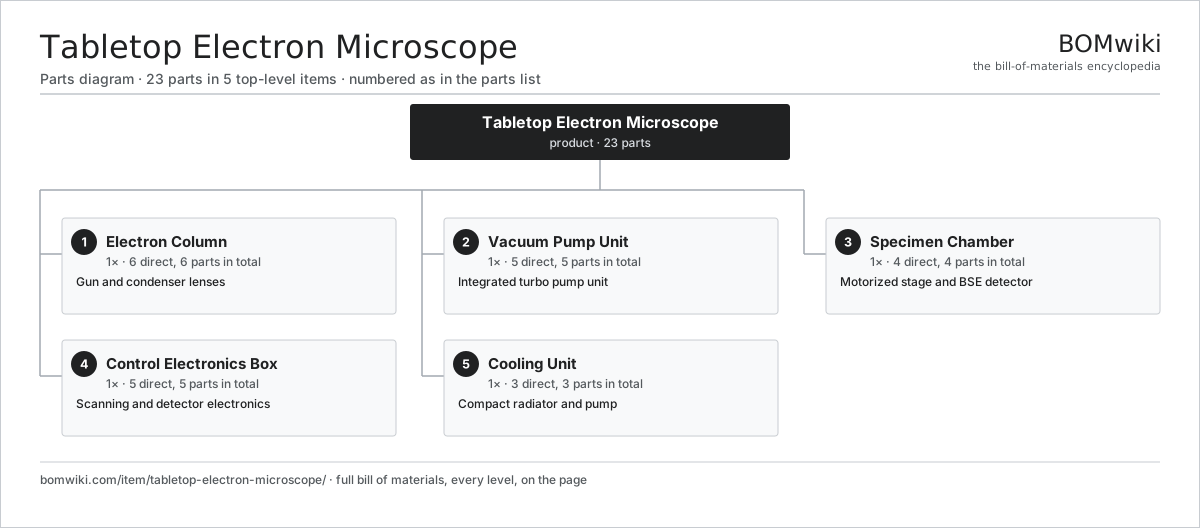
| # | Part | Qty | What it does |
|---|---|---|---|
| 1 | Electron Column 6 parts | 1× | Gun and condenser lenses |
| 2 | Vacuum Pump Unit 5 parts | 1× | Integrated turbo pump unit |
| 3 | Specimen Chamber 4 parts | 1× | Motorized stage and BSE detector |
| 4 | Control Electronics Box 5 parts | 1× | Scanning and detector electronics |
| 5 | Cooling Unit 3 parts | 1× | Compact radiator and pump |
3D model
No 3D model yet. Have a CAD file of this? Add a 3D model. STL renders right on this page; STEP, FreeCAD, and OpenSCAD sources are welcome too (openly licensed, like all 3D models on BOMwiki).
Build & assembly graph
expand / collapse · shared sub-assemblies converge · links to related products · est. labourTap an assembly to expand/collapse · tap a part to open it · use “Open page” for any node · drag to pan, scroll to zoom.
Bill of materials for Tabletop Electron Microscope
5 top-level lines · 28 rows shown · 23 parts total · indented to 3 levels| # | Item / sub-assembly | Part no. | Qty/assy | Ext. qty | Parts | Type |
|---|---|---|---|---|---|---|
| 1 | Electron Column 6 parts | tabletop-electron-microscope-electron-column | 1× | 1 | 6 | assembly |
| 1.1 | Electron Gun | tabletop-electron-microscope-gun-assembly | 1× | 1 | · | part |
| 1.2 | Accelerating Anode | tabletop-electron-microscope-accelerating-anode | 1× | 1 | · | part |
| 1.3 | Condenser Coil | tabletop-electron-microscope-condenser-coil | 1× | 1 | · | part |
| 1.4 | Objective Lens | tabletop-electron-microscope-objective-coil | 1× | 1 | · | part |
| 1.5 | Column Tube | tabletop-electron-microscope-column-tube | 1× | 1 | · | part |
| 1.6 | HV Cable | tabletop-electron-microscope-high-voltage-cable | 1× | 1 | · | part |
| 2 | Vacuum Pump Unit 5 parts | tabletop-electron-microscope-vacuum-pump | 1× | 1 | 5 | assembly |
| 2.1 | Turbomolecular Rotor | tabletop-electron-microscope-turbo-rotor | 1× | 1 | · | part |
| 2.2 | Roughing Pump | tabletop-electron-microscope-roughing-pump | 1× | 1 | · | part |
| 2.3 | Pump Controller | tabletop-electron-microscope-pump-controller | 1× | 1 | · | part |
| 2.4 | Vacuum Gauge | tabletop-electron-microscope-vacuum-gauge | 1× | 1 | · | part |
| 2.5 | Isolation Valve | tabletop-electron-microscope-isolation-valve | 1× | 1 | · | part |
| 3 | Specimen Chamber 4 parts | tabletop-electron-microscope-specimen-chamber | 1× | 1 | 4 | assembly |
| 3.1 | Motorized Stage | tabletop-electron-microscope-motorized-stage | 1× | 1 | · | part |
| 3.2 | Specimen Clip | tabletop-electron-microscope-specimen-clip | 1× | 1 | · | part |
| 3.3 | BSE Scintillator | tabletop-electron-microscope-bse-scintillator | 1× | 1 | · | part |
| 3.4 | Chamber Housing | tabletop-electron-microscope-chamber-housing | 1× | 1 | · | part |
| 4 | Control Electronics Box 5 parts | tabletop-electron-microscope-control-box | 1× | 1 | 5 | assembly |
| 4.1 | Scan Generator | tabletop-electron-microscope-scan-circuit | 1× | 1 | · | part |
| 4.2 | Detector Amp | tabletop-electron-microscope-detector-amp | 1× | 1 | · | part |
| 4.3 | HV Supply | tabletop-electron-microscope-high-voltage-supply | 1× | 1 | · | part |
| 4.4 | Interface Board | tabletop-electron-microscope-interface-board | 1× | 1 | · | part |
| 4.5 | Display Module | tabletop-electron-microscope-display-module | 1× | 1 | · | part |
| 5 | Cooling Unit 3 parts | tabletop-electron-microscope-cooling-unit | 1× | 1 | 3 | assembly |
| 5.1 | Mini Pump | tabletop-electron-microscope-mini-pump | 1× | 1 | · | part |
| 5.2 | Mini Radiator | tabletop-electron-microscope-mini-radiator | 1× | 1 | · | part |
| 5.3 | Coolant Loop | tabletop-electron-microscope-coolant-loop | 1× | 1 | · | part |
Something wrong in this list? Report a problem with this BOM.
Used in 1 assembly
Sourcing: possible vendors
Browse the supplier directory → Prices, MOQ, and lead times are algorithmic estimates, not quotes, and not claims about these companies. Company mappings are curated by keyword; est. price band $1k–$500k. How estimates work| Vendor | HQ | Specialty | MOQ | Lead time |
|---|---|---|---|---|
| thermofisher.com ↗ | Waltham, US | Lab instruments | 100 units | 10–18 wks |
|
🇺🇸Agilent
agilent.com ↗
|
Santa Clara, US | Analytical instruments | 100 units | 10–18 wks |
|
🇺🇸Bruker
bruker.com ↗
|
Billerica, US | Scientific instruments | 100 units | 10–18 wks |
|
🇯🇵Shimadzu
shimadzu.com ↗
|
Kyoto, JP | Analytical instruments | 100 units | 10–18 wks |
|
🇺🇸Waters
waters.com ↗
|
Milford, US | Chromatography & MS | 100 units | 10–18 wks |
658-word article