Tackle Box
ProductOverview
A tackle box is a specialized fishing storage container holding hooks, lures, weights, sinkers, and other small bait and tackle items. Unlike generic storage boxes, tackle boxes feature numerous small compartments (15–50) designed for specific tackle types, and many include a dedicated worm-storage compartment with aeration to keep live bait alive during transport and storage.
Tackle boxes range from small personal models (1–2 liters, ~$20) to professional tournament cases (5+ liters, $50–150). The basic design remains consistent: hinged clamshell enclosure with compartmented trays, spring-loaded latches, and a top carrying handle.
Shell Construction
The Box Enclosure consists of:
- Base Pan: Molded polypropylene (most common, lightweight, rust-proof) or stamped steel (durable but corrodes).
- Lid Panel: Hinged top with a catch area for the latch mechanism.
- Side walls and end panels: Molded as a single unit or separately assembled.
- Hinge: Typically two butt hinges allowing the lid to open 120–180°.
Material selection:
- Polypropylene: Lightweight (0.9 g/cm³), UV-resistant but becomes brittle in extreme cold, non-corrosive.
- Steel: Heavier but stronger; requires paint or powder coat for corrosion resistance; develops rust if storage involves moisture.
Wall thickness: Typically 2–3 mm; thicker plastic is more durable but increases weight.
Compartment System
The Compartmented Tray System comprises removable or fixed trays with compartment bins sized for different tackle types:
Typical compartment sizes:
- Small bins (1×1 inch): Hooks, small sinkers.
- Medium bins (2×2 inch): Spinners, small lures.
- Large bins (3×3 inch): Crankbaits, large lures.
- Bulk storage: Open areas for spools of line, bobbers.
Bin design:
- Transparent or translucent plastic: Allows identification without opening the bin.
- Snap-on lids: Individual bins have separate lids, reducing spill risk if one is knocked over.
- Tiered arrangement: Smaller bins near the top (frequent access), larger bins deeper.
Compartment separation via dividers: Plastic walls prevent tackle from mixing between compartments; dividers are removable on some models, allowing customization.
Organization strategy:
- Lure type: One section for crankbaits, another for soft plastics.
- Hook size: Segregated by gauge and type (circle, treble, single).
- Weight: Sinkers, split shot, and weights in dedicated compartments.
- Maintenance: Hooks are sharp; compartmentalization prevents accidental cuts when reaching for lures.
Worm Storage Compartment
The Worm Storage Compartment is a specialized section for live bait (earthworms, minnows):
- Worm Storage Bin: An airtight compartment separate from the main tackle area.
- Ventilation Slat: Narrow slats (0.25–0.5 inch gaps) allowing air circulation without allowing worms to escape.
- Moss Pad: Damp sphagnum moss (or newspaper) maintaining humidity; worms need 90%+ relative humidity to survive.
Worm viability:
- Duration: Properly stored worms remain viable for 2–4 weeks.
- Temperature: Ideal ~50–60°F (10–15°C); direct sunlight or heat kills worms within hours.
- Moisture: Excessively dry conditions (humidity <70%) dehydrate worms; too wet causes root rot of moss and anaerobic conditions killing worms.
Aerating slat design:
- Width: 0.25–0.375 inch gaps allow air exchange but prevent worms from crawling through.
- Pattern: Typically 6–12 slats spanning the length of the compartment, creating uniform air flow.
- Seal: The main tackle-box lid seals this compartment when closed, preventing worms from escaping.
Care protocol:
- Change moss weekly: Old moss becomes anaerobic (no dissolved oxygen), killing worms.
- Maintain temperature: Store the tackle box in a cool location (basement, garage); never in a hot car.
- Ventilate: Open the worm compartment daily if the tackle box is closed for >8 hours, allowing fresh air exchange.
Tray System
Many tackle boxes use two-tier or single-tier trays:
Single-tier design:
- One Top Tray spanning the entire interior; contains the bulk of compartments.
- Bottom of the box: Open area for bulk items (line spools, bobbers, net, pliers).
Two-tier design (optional Secondary Tray):
- Top Top Tray: Shallow compartments for hooks, small lures.
- Secondary Tray: Deeper compartments underneath for larger lures and tackle.
- Storage increase: Allows ~50% more capacity than single-tier without increasing overall box size.
Removable vs. fixed:
- Removable trays: Easier to reach deep tackle; can be removed for transport or cleaning.
- Fixed trays: More stable, less rattling during transport; slightly less accessible.
Latch and Lock System
The Latch and Lock Assembly consist of two spring-loaded latches:
Latch designs:
- Toggle latch: Flipped up to unlock, pushed down to lock (fast operation).
- Twist latch: Rotated 90° to lock (slower but more secure).
- Cam latch: Rotating cam mechanism; less common but very secure.
Mechanism:
- Latch lever pressed/flipped into the locked position.
- Latch Spring provides spring-loaded tension, keeping the latch engaged.
- Latch Catch: Strike plate on the base shell receives the latch.
Security level: Basic latches prevent accidental opening during transport; they are not theft-proof. Fishermen on boats or at crowded fishing spots may add a small padlock for additional security.
Failure modes:
- Spring fatigue: After 500+ open/close cycles, the spring weakens; latch becomes loose.
- Latch wear: Plastic latch surfaces wear smooth, reducing friction; latch slips when not fully engaged.
- Catch plate cracking: Brittle plastic can crack if the tackle box is dropped on the latch side.
Handle and Portability
The Top Carry Handle is typically a single arched handle molded from plastic or injection-molded ABS:
- Design: Comfortable grip (~1.5 inch diameter), 10–14 inches long.
- Material: Plastic (lightweight, easier to grip in wet hands) or metal (durable but conducts cold).
- Mounting: Riveted or bolted to both sides of the box, distributing load evenly.
Load capacity: A typical tackle box weighs 1–3 kg empty; fully loaded with tackle, ~5–8 kg total. A quality handle supports this load without cracking or deforming.
Failure mode: Stress cracks typically initiate at the bracket attachment points, where the concentrated load creates high stress.
Durability & Maintenance
Tackle boxes typically last 5–12 years with proper care:
| Component | Lifespan | Failure Mode |
|---|---|---|
| Polypropylene shell | 8–12 years | Brittleness (UV exposure), cracking |
| Steel shell | 6–10 years | Rust (if paint chipped or neglected) |
| Latches | 5–8 years | Spring fatigue, wear |
| Hinges | 6–10 years | Corrosion, loosening |
| Compartment dividers | 5–10 years | Warping, discoloration |
| Handle | 6–10 years | Stress cracks at brackets |
Maintenance:
- Rinse with fresh water after saltwater use (fishing in ocean or brackish water causes corrosion).
- Dry thoroughly before storing (trapped moisture promotes mold and corrosion).
- Avoid prolonged sun exposure (UV degrades plastic; warms contents, killing worms).
- Store in cool, dry location (basement, garage; not in hot attic).
- Replace worm moss weekly (prevents anaerobic decay).
- Check latches seasonally (replace if springs lose tension).
Storage practices:
- Leave latches open if storing for >1 month (reduces latching fatigue; prevents warping).
- Store worm compartment empty (old moss and decaying organic matter cause odor).
- Organize tackle before storage (prevents tangling and makes next trip easier).
Comparison: Tackle Box Styles
| Type | Capacity | Organization | Portability | Cost | Durability |
|---|---|---|---|---|---|
| Standard compartmented | Small (2–3 L) | Excellent | Easy | $30–80 | 5–10 years |
| Soft tackle bag | Medium (5–8 L) | Fair | Very easy | $40–100 | 3–7 years |
| Rolling tackle station | Large (10+ L) | Excellent | Difficult (wheels) | $100–300 | 5–10 years |
| Backpack tackle | Medium (3–5 L) | Good | Very easy | $50–150 | 4–8 years |
The traditional hard-shell tackle box remains popular for its durability, organization, and cost-effectiveness; newer soft and rolling alternatives appeal to anglers prioritizing portability and capacity.
Specialized Applications
Saltwater tackle boxes: Stainless steel or marine-grade polypropylene, anodized hardware (resists saltwater corrosion).
Tournament tackle boxes: Multiple tiers (4–6 levels), waterproof compartments, and premium latches; cost $100–300+ but designed for professional fishing.
Minimalist tackle kits: Smaller boxes (8×6×4 inches) for backpackers and fly fishers, ~$15–40.
These variations address specific fishing environments and anglers' needs while maintaining the core compartmented storage design.
Tackle Box parts and their functions
6 top-level parts · 64 parts in total · full bill of materials below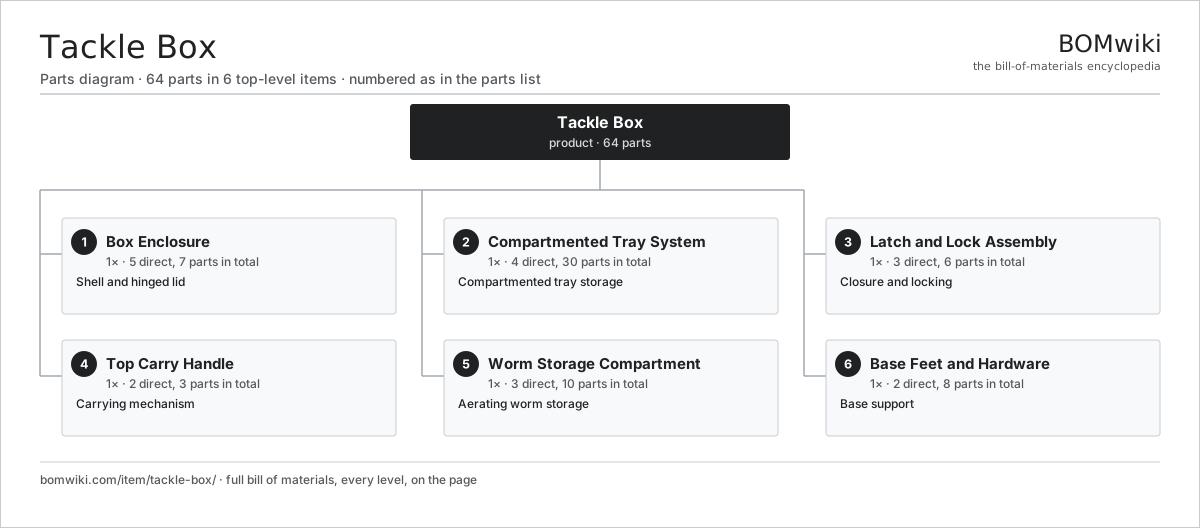
| # | Part | Qty | What it does |
|---|---|---|---|
| 1 | Box Enclosure 5 parts | 1× | Shell and hinged lid |
| 2 | Compartmented Tray System 4 parts | 1× | Compartmented tray storage |
| 3 | Latch and Lock Assembly 3 parts | 1× | Closure and locking |
| 4 | Top Carry Handle 2 parts | 1× | Carrying mechanism |
| 5 | Worm Storage Compartment 3 parts | 1× | Aerating worm storage |
| 6 | Base Feet and Hardware 2 parts | 1× | Base support |
3D model
No 3D model yet. Have a CAD file of this? Add a 3D model. STL renders right on this page; STEP, FreeCAD, and OpenSCAD sources are welcome too (openly licensed, like all 3D models on BOMwiki).
Build & assembly graph
expand / collapse · shared sub-assemblies converge · links to related products · est. labourTap an assembly to expand/collapse · tap a part to open it · use “Open page” for any node · drag to pan, scroll to zoom.
Bill of materials for Tackle Box
6 top-level lines · 25 rows shown · 64 parts total · indented to 3 levels| # | Item / sub-assembly | Part no. | Qty/assy | Ext. qty | Parts | Type |
|---|---|---|---|---|---|---|
| 1 | Box Enclosure 5 parts | tackle-box-enclosure | 1× | 1 | 7 | assembly |
| 1.1 | Base Pan | tackle-box-base-pan | 1× | 1 | · | part |
| 1.2 | Lid Panel | tackle-box-lid-panel | 1× | 1 | · | part |
| 1.3 | Side Wall | tackle-box-side-walls | 2× | 2 | · | part |
| 1.4 | End Panel | tackle-box-end-panels | 2× | 2 | · | part |
| 1.5 | Hinge | tackle-box-hinge-assembly | 1× | 1 | · | part |
| 2 | Compartmented Tray System 4 parts | tackle-box-tray-system | 1× | 1 | 30 | assembly |
| 2.1 | Top Tray | tackle-box-tray-1 | 1× | 1 | · | part |
| 2.2 | Secondary Tray | tackle-box-tray-2 | 1× | 1 | · | part |
| 2.3 | Compartment Bin | tackle-box-tray-compartment | 20× | 20 | · | part |
| 2.4 | Tray Divider | tackle-box-divider | 8× | 8 | · | part |
| 3 | Latch and Lock Assembly 3 parts | tackle-box-latches | 1× | 1 | 6 | assembly |
| 3.1 | Latch Lever | tackle-box-latch-lever | 2× | 2 | · | part |
| 3.2 | Latch Spring | tackle-box-latch-spring | 2× | 2 | · | part |
| 3.3 | Latch Catch | tackle-box-latch-catch | 2× | 2 | · | part |
| 4 | Top Carry Handle 2 parts | tackle-box-handle | 1× | 1 | 3 | assembly |
| 4.1 | Handle Bar | tackle-box-handle-bar | 1× | 1 | · | part |
| 4.2 | Handle Bracket | tackle-box-handle-bracket | 2× | 2 | · | part |
| 5 | Worm Storage Compartment 3 parts | tackle-box-worm-compartment | 1× | 1 | 10 | assembly |
| 5.1 | Worm Storage Bin | tackle-box-worm-bin | 1× | 1 | · | part |
| 5.2 | Ventilation Slat | tackle-box-worm-lid-slats | 8× | 8 | · | part |
| 5.3 | Moss Pad | tackle-box-worm-moss-pad | 1× | 1 | · | part |
| 6 | Base Feet and Hardware 2 parts | tackle-box-feet-hardware | 1× | 1 | 8 | assembly |
| 6.1 | Rubber Foot | tackle-box-rubber-foot | 4× | 4 | · | part |
| 6.2 | Foot Bracket | tackle-box-foot-bracket | 4× | 4 | · | part |
Something wrong in this list? Report a problem with this BOM.
Sourcing: possible vendors
Browse the supplier directory → Prices, MOQ, and lead times are algorithmic estimates, not quotes, and not claims about these companies. Company mappings are curated by keyword; est. price band $20–$2k. How estimates work| Vendor | HQ | Specialty | MOQ | Lead time |
|---|---|---|---|---|
|
🇺🇸Coleman
coleman.com ↗
|
Chicago, US | Camping gear | 1,000 units | 6–10 wks |
| thenorthface.com ↗ | Denver, US | Outdoor apparel & gear | 1,000 units | 6–10 wks |
|
🇺🇸YETI
yeti.com ↗
|
Austin, US | Coolers & drinkware | 1,000 units | 6–10 wks |
| decathlon.com ↗ | Villeneuve-d'Ascq, FR | Sporting goods | 1,000 units | 6–10 wks |
|
🇺🇸Garmin
garmin.com ↗
|
Olathe, US | GPS & wearables | 1,000 units | 6–10 wks |
1,320-word article