Tactical Antenna Mast
ProductOverview
The Tactical Antenna Mast is a lightweight, rapidly-deployable system for raising radio antennas, satellite terminals, or surveillance sensors to optimal operating height in forward command posts, fire support bases, and temporary encampments. The mast consists of nested aluminum tubes that telescope from a compact 8-foot stowed length to 40–50 feet extended height within 2–3 minutes, using a simple manual crank or optional pneumatic drive.
The nested tube design is inherently stable: each section (3.0", 2.75", 2.5", and 2.25" outside diameter) slides smoothly inside the larger section above it, reducing packing volume without requiring external joints or clips. Bronze guide bushings at each interface provide low-friction sliding and load distribution. Detent pins at fixed intervals (every 4 feet of extension) allow the operator to lock intermediate positions if partial height is adequate for a specific mission.
The mast is stabilized by a four-point Guy Cable System anchoring system: steel wire-rope cables run from a guard ring at 80% of mast height to four ground anchors positioned symmetrically around the base, at distances of 100–150 feet. This geometry ensures the mast remains vertical (< 0.5 degree deflection) in 20-knot wind, and can withstand transient gusts up to 30 knots without collapse.
The Base Plate Assembly is bolted to the ground (or to a vehicle trailer for mobile operations) and includes a slewing ring that allows 360-degree mast rotation without removing guy cables. This enables rapid antenna orientation to track satellites or point directional antennas toward distant radio stations.
A Wind Sensor anemometer mounted on the mast provides real-time wind speed feedback, displayed at the operator station via simple digital readout. Safe operating procedures call for retracting the mast if sustained wind speeds exceed 25 knots, preventing structural overload or antenna damage.
How it works
Deployment begins with site selection and ground preparation. A level, well-drained area is chosen, and the four ground anchors are positioned in a square pattern approximately 150 feet from the intended mast base (the exact distance depends on the guy cable length available). Each anchor is either a deadman (a wooden or steel plate buried 3 feet deep) or a screw-in helical anchor twisted into the ground until it is set firmly.
The Base Plate Assembly is positioned at the center of the anchor square and bolted to the ground or to trailer tie-down points. Leveling feet on the base plate are adjusted until a spirit level indicates < 0.5 degree tilt. The base plate must be level to ensure the mast extends vertically and avoids binding.
The four Guy Cable cables are pulled from the equipment bundle and connected to the guard ring at 80% of the expected extended height. Each cable is initially slack to allow mast extension without resistance. The cables are then routed to their respective ground anchors and attached using U-bolt clamps, with initial tension set by hand (a light pull with one hand is sufficient).
The operator begins extending the mast using the Crank Handle two-speed crank. At 1:4 reduction (low speed), the crank handles 40 feet of mast extension; at 1:1 (high speed), less force is required but more turns are needed. The operator cranks smoothly, feeling for resistance; the Drive Screw acme thread converts rotary motion to linear extension of the innermost tube, which lifts the upper sections with it.
As the mast extends, the operator monitors extension stops marked on the exterior tubes. At each extension point (every 4 feet), a detent pin clicks into place, locking that stage and allowing the operator to pause or stop at any intermediate height. For maximum height, the operator continues extending until all four sections are fully deployed.
Once fully extended, the operator manually tightens the four guy cable tensioners (turnbuckles or ratchet devices) in sequence, applying equal tension to each cable (typically 500–1,000 lbs per cable, determined by a tension gauge or by observing cable deflection under a known downward force). Equal tension ensures the mast remains vertical; if one cable is slack, the mast tilts toward the others.
The Antenna Interface mounting plate at the mast top is now accessible. The antenna or satellite terminal is mechanically bolted to the plate using the three provided bolt holes. The antenna's coaxial feed cable (RF signal) is threaded through the Coax Feed-Through sealed connector, and the connector is hand-tightened to achieve a weatherproof seal. Low-voltage power leads (if the antenna requires power) are routed through the cable tray alongside the mast.
The Wind Sensor anemometer (if equipped) displays wind speed on a local readout. Operations personnel note this reading; if sustained wind exceeds 25 knots, the antenna is covered with a protective cap (to reduce wind loading) or the mast is partially lowered to reduce height and wind moment.
Radio operators then use the Rotation Ring slewing ring to orient the antenna toward the desired direction (toward a distant relay station, or for dish antennas, toward a specific satellite). The ring rotates freely via hand-crank gearbox, allowing 360-degree coverage.
At the end of the mission or when the site is abandoned, the process reverses: the antenna is unbolted and lowered, cables are unhooked and coiled, and the mast is retracted using the crank in reverse. As each stage retracts, the detent pin is manually disengaged, allowing the next stage to collapse. Full retraction takes 3–4 minutes. The mast is lowered to the ground, bundled with cables and guy anchors, and loaded on the truck for relocation.
Design rationale
The nested tube design (rather than a tripod or lattice tower) was selected because it minimizes footprint and weight. A 40-foot lattice tower weighs 500+ lbs and requires 50 feet of truck bed length; the telescoping mast weighs 150 lbs stowed and occupies 4 feet × 4 feet × 8 feet. This compactness allows rapid deployment from a single personnel carrier.
Aluminum (rather than steel) was chosen for the tubes because it provides adequate strength at minimal weight and does not corrode in salt-spray environments (coastal bases). Aluminum's modulus is lower than steel, making it slightly more flexible, but the guy-cable system provides lateral bracing that compensates, keeping deflection below 0.5 degree.
The four-point guy-cable system is critical to stability. A mast without guys would sway violently in wind, and antennas with narrow beam patterns would lose lock on satellites. The guy cables act as lateral springs, distributing bending moments to the ground anchors rather than concentrating stress in the mast base. The 80% height attachment point (guard ring) places the cable attachment above the center of gravity of the antenna and coax, providing maximum restoring moment against wind force.
The manual crank drive was selected because it operates without external power and provides tactile feedback to the operator: if the mast binds (a section is not aligned properly), the increased resistance is immediately felt. A pneumatic drive system (optional) is faster for frequent deployments but requires compressor support and adds complexity. Most tactical units use the manual crank for its reliability and simplicity.
The Mechanical Brake holding the mast position is essential: if the operator releases the crank, the brake engages and prevents the mast from collapsing under its own weight or wind moment. The brake is friction-based (not a ratchet) to allow smooth manual extension without jumping or hesitation.
The Rotation Ring slewing bearing allows antenna reorientation without disconnecting guy cables. If the mast could not rotate, the cables would wrap around it and jam. The ring is typically a marine-grade slewing bearing with ball elements rated for 1 million cycles; it allows smooth 360-degree freedom with minimal play.
The anemometer system provides operators with real-time decision support: weather can change rapidly in mountainous or coastal areas, and the sensor alerts personnel to wind hazards that might not be obvious from ground level. At 40 feet height, wind speeds are 15–20% higher than at ground level due to reduced surface friction, so a 20-knot ground wind corresponds to 25+ knots at mast height.
Operational constraints
The Guy Cable system requires clear ground space for anchors. In dense forest or urban environments, finding four anchor points 150 feet apart may be impossible. Shorter masts (20–30 feet) with closer anchor points (50–75 feet) are used in constrained areas, but this reduces antenna gain and requires more frequent site relocations to maintain line-of-sight paths.
Wind speed is the primary operational limit. Maximum safe operating wind is 25 knots with antennas deployed. Above this speed, the mast can oscillate and resonant modes can build up, risking structural failure of the aluminum tubes (fatigue crack initiation). If sustained wind exceeds limits, the antenna is furled (covered with a protective cap), reducing wind loading, or the mast is partially lowered.
Temperature extremes affect mast behavior slightly. Aluminum expands approximately 0.0000127 inches per inch per degree Celsius; a 40-foot mast that is 480 inches experiences expansion of 6.1 inches for a 100°C temperature rise. In practice, this is negligible for antenna alignment, but it should be considered when setting guy cable tension in hot climates: cables should be set with slightly less tension in hot conditions to avoid over-tensioning as the mast contracts in cool nights.
Sand and salt-spray environments accelerate corrosion of steel components (guy cables, anchor bolts, fasteners). In coastal areas, stainless steel hardware is substituted, and cables are treated with a corrosion-inhibiting oil. Aluminum is naturally corrosion-resistant via its oxide layer, but the layer can be damaged by abrasion; any scratches are touched up with clear epoxy paint to prevent pit corrosion.
Maintenance and field repair
Monthly inspections check guy cables for fraying, rust, or corrosion. Any visible corrosion is brushed clean and treated with light machine oil. Frayed wires at cable terminations are a sign of impact damage; the cable is replaced.
The Rotation Ring slewing bearing is lubricated quarterly using a marine-grade grease applied via grease fittings. Over-greasing can cause the bearing to seize; only a small amount (5–10 ml per grease fitting) is applied.
The Guide Bushing bronze sleeves are inspected annually. If the mast feels rough when extending (stiction or grinding sensation), the bushings are likely worn and should be replaced by removing the inner tube and sliding out the worn bushing. Replacement takes 30 minutes and restores smooth extension.
The Detent Pin spring-loaded pins are checked to ensure they click firmly into place at each extension point. If pins fail to engage, the spring is replaced; without detents, the mast cannot be safely held at intermediate heights.
The Base Plate and Rotation Ring are protected from corrosion by a coat of mil-spec paint or clear epoxy. Damage to the paint (caused by impact or sand scour) is touched up immediately to prevent rust formation in the steel base.
The anemometer cup rotor is inspected quarterly to ensure it rotates freely and is not cracked. A damaged rotor provides false wind speed readings; it is replaced as a complete assembly (cup and stem) rather than attempting to glue or repair cracks, as structural integrity must be guaranteed.
Guy cables are visually inspected for broken strands before each deployment. If more than three broken wires are visible in a short span (6 inches), the cable is replaced. Steel wire rope weakens rapidly once fractures begin propagating.
The Coax Feed-Through connector is cleaned annually using isopropyl alcohol on a lint-free cloth. Salt deposits or oxidation on the gold-plated contacts reduces RF signal quality; cleaning restores performance. The connector is then spray-treated with a clear acrylic protective coating to prevent future contamination.
Tactical Antenna Mast parts and their functions
7 top-level parts · 169 parts in total · full bill of materials below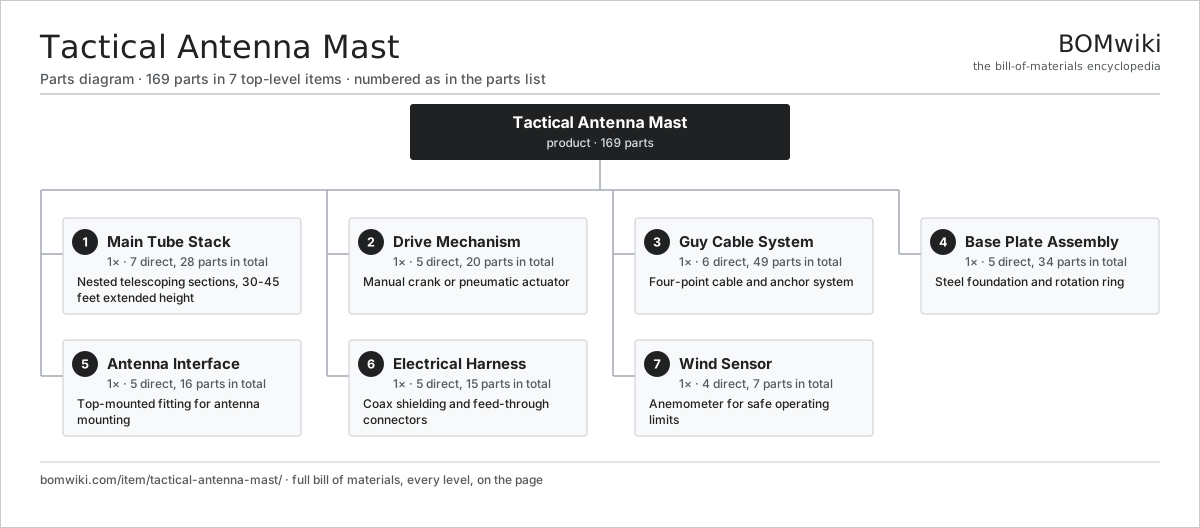
| # | Part | Qty | What it does |
|---|---|---|---|
| 1 | Main Tube Stack 7 parts | 1× | Nested telescoping sections, 30-45 feet extended height |
| 2 | Drive Mechanism 5 parts | 1× | Manual crank or pneumatic actuator |
| 3 | Guy Cable System 6 parts | 1× | Four-point cable and anchor system |
| 4 | Base Plate Assembly 5 parts | 1× | Steel foundation and rotation ring |
| 5 | Antenna Interface 5 parts | 1× | Top-mounted fitting for antenna mounting |
| 6 | Electrical Harness 5 parts | 1× | Coax shielding and feed-through connectors |
| 7 | Wind Sensor 4 parts | 1× | Anemometer for safe operating limits |
3D model
No 3D model yet. Have a CAD file of this? Add a 3D model. STL renders right on this page; STEP, FreeCAD, and OpenSCAD sources are welcome too (openly licensed, like all 3D models on BOMwiki).
Build & assembly graph
expand / collapse · shared sub-assemblies converge · links to related products · est. labourTap an assembly to expand/collapse · tap a part to open it · use “Open page” for any node · drag to pan, scroll to zoom.
Bill of materials for Tactical Antenna Mast
7 top-level lines · 44 rows shown · 169 parts total · indented to 3 levels| # | Item / sub-assembly | Part no. | Qty/assy | Ext. qty | Parts | Type |
|---|---|---|---|---|---|---|
| 1 | Main Tube Stack 7 parts | tactical-antenna-mast-main-tube-stack | 1× | 1 | 28 | assembly |
| 1.1 | Tube Section 1 (Base) | tactical-antenna-mast-tube-section-1 | 1× | 1 | · | part |
| 1.2 | Tube Section 2 | tactical-antenna-mast-tube-section-2 | 1× | 1 | · | part |
| 1.3 | Tube Section 3 | tactical-antenna-mast-tube-section-3 | 1× | 1 | · | part |
| 1.4 | Tube Section 4 (Top) | tactical-antenna-mast-tube-section-4 | 1× | 1 | · | part |
| 1.5 | Guide Bushing | tactical-antenna-mast-guide-bushing | 4× | 4 | · | part |
| 1.6 | Detent Pin | tactical-antenna-mast-detent-pin | 8× | 8 | · | part |
| 1.7 | Fastener Set | fastener-set | 12× | 12 | · | part |
| 2 | Drive Mechanism 5 parts | tactical-antenna-mast-drive-mechanism | 1× | 1 | 20 | assembly |
| 2.1 | Drive Screw | tactical-antenna-mast-drive-screw | 1× | 1 | · | part |
| 2.2 | Crank Handle | tactical-antenna-mast-crank-handle | 1× | 1 | · | part |
| 2.3 | Pneumatic Cylinder | tactical-antenna-mast-pneumatic-cylinder | 1× | 1 | · | part |
| 2.4 | Mechanical Brake | tactical-antenna-mast-mechanical-brake | 1× | 1 | · | part |
| 2.5 | Fastener Set | fastener-set | 16× | 16 | · | part |
| 3 | Guy Cable System 6 parts | tactical-antenna-mast-guy-cable-system | 1× | 1 | 49 | assembly |
| 3.1 | Guy Cable | tactical-antenna-mast-guy-cable | 4× | 4 | · | part |
| 3.2 | Cable Clamp | tactical-antenna-mast-cable-clamp | 16× | 16 | · | part |
| 3.3 | Ground Anchor | tactical-antenna-mast-ground-anchor | 4× | 4 | · | part |
| 3.4 | Cable Tensioner | tactical-antenna-mast-cable-tensioner | 4× | 4 | · | part |
| 3.5 | Cable Guard Ring | tactical-antenna-mast-cable-guard-ring | 1× | 1 | · | part |
| 3.6 | Fastener Set | fastener-set | 20× | 20 | · | part |
| 4 | Base Plate Assembly 5 parts | tactical-antenna-mast-base-plate-assembly | 1× | 1 | 34 | assembly |
| 4.1 | Base Plate | tactical-antenna-mast-base-plate | 1× | 1 | · | part |
| 4.2 | Rotation Ring | tactical-antenna-mast-rotation-ring | 1× | 1 | · | part |
| 4.3 | Leveling Foot | tactical-antenna-mast-leveling-foot | 4× | 4 | · | part |
| 4.4 | Foundation Bolt | tactical-antenna-mast-foundation-bolt | 16× | 16 | · | part |
| 4.5 | Fastener Set | fastener-set | 12× | 12 | · | part |
| 5 | Antenna Interface 5 parts | tactical-antenna-mast-antenna-interface | 1× | 1 | 16 | assembly |
| 5.1 | Mounting Plate | tactical-antenna-mast-mounting-plate | 1× | 1 | · | part |
| 5.2 | Coax Feed-Through | tactical-antenna-mast-coax-feed-through | 1× | 1 | · | part |
| 5.3 | Grounding Strap | tactical-antenna-mast-grounding-strap | 1× | 1 | · | part |
| 5.4 | Cable Tray | tactical-antenna-mast-cable-tray | 1× | 1 | · | part |
| 5.5 | Fastener Set | fastener-set | 12× | 12 | · | part |
| 6 | Electrical Harness 5 parts | tactical-antenna-mast-electrical-harness | 1× | 1 | 15 | assembly |
| 6.1 | Coax Cable | tactical-antenna-mast-coax-cable | 1× | 1 | · | part |
| 6.2 | Control Cable | tactical-antenna-mast-control-cable | 1× | 1 | · | part |
| 6.3 | Cable Spiral Wrap | tactical-antenna-mast-cable-spiral-wrap | 1× | 1 | · | part |
| 6.4 | Connector Set | tactical-antenna-mast-connector-set | 4× | 4 | · | part |
| 6.5 | Fastener Set | fastener-set | 8× | 8 | · | part |
| 7 | Wind Sensor 4 parts | tactical-antenna-mast-wind-sensor | 1× | 1 | 7 | assembly |
| 7.1 | Anemometer Cup | tactical-antenna-mast-anemometer-cup | 1× | 1 | · | part |
| 7.2 | Sensor Electronics | tactical-antenna-mast-sensor-electronics | 1× | 1 | · | part |
| 7.3 | Sensor Cable | tactical-antenna-mast-sensor-cable | 1× | 1 | · | part |
| 7.4 | Fastener Set | fastener-set | 4× | 4 | · | part |
Something wrong in this list? Report a problem with this BOM.
Sourcing: possible vendors
Browse the supplier directory → Prices, MOQ, and lead times are algorithmic estimates, not quotes, and not claims about these companies. Company mappings are curated by keyword; est. price band $200–$100M. How estimates work| Vendor | HQ | Specialty | MOQ | Lead time |
|---|---|---|---|---|
| smithsdetection.com ↗ | London, GB | Security screening | made to order | 24–52 wks |
|
🇺🇸Leidos
leidos.com ↗
|
Reston, US | Security & screening | made to order | 24–52 wks |
|
🇺🇸Rapiscan
rapiscansystems.com ↗
|
Torrance, US | X-ray screening | made to order | 24–52 wks |
|
🇫🇷Thales
thalesgroup.com ↗
|
Paris, FR | Defense electronics | made to order | 24–52 wks |
| baesystems.com ↗ | London, GB | Defense | made to order | 24–52 wks |
2,031-word article