Tandem Parachute Rig
ProductOverview
A tandem skydiving system enables a passenger with no prior training to experience freefall and parachute descent under the control of a certified tandem instructor. The instructor wears a specially designed harness that physically attaches the passenger via carabiners, forming a single two-person unit for the entire jump, from airplane exit through freefall, deployment, and landing.
The system relies on two parachutes (main and reserve), automated safety devices (AAD, automatic activation device), and careful redundancy: if the main parachute fails to open, the AAD fires the reserve at a critical altitude; if both fail, a ballistic parachute mounted on the aircraft allows the instructor to evacuate with the passenger via a deployed chute and controlled descent.
Harness and attachment
The tandem rig begins with a Harness and Container Assembly, a specially designed Instructor Harness worn by the instructor. This is not a solo skydiving harness, it's over-built, with thick padding and reinforced connection points because it must support not only the instructor (170+ lbs) but also the passenger (often 240+ lbs), for a total ~400–500 lbs under opening shock.
The Leg Straps lower-body restraints are thicker than solo gear, and the harness includes four large Connector Carabiner steel locking carabiners positioned at the shoulders and hips. The passenger wears a lighter Passenger Harness Attachment attachment harness with its own leg loops and shoulder straps, then clips directly to the instructor using the carabiners.
In freefall, the instructor and passenger are now a single rigid object: the instructor controls the exit attitude, rate of descent, and orientation; the passenger simply experiences the freefall sensation without needing to do anything. At deployment altitude (typically 4000–5000 ft AGL), the instructor reaches for the bright orange Ripcord Handle on the chest and pulls.
Deployment and canopy
The Ripcord and Deployment Handle works like a solo rig: pulling the handle actuates a Pin Cutter that shears the three Closing Pin holding the main container closed. The Deployment Bridle connected to a small Drogue Chute pilot chute pulls the Main Container pack open.
The Main Canopy unfolds: a large rectangular ram-air parachute (~230 sq ft, 21 m²), significantly larger than solo gear. The Suspension Lines (grouped A, B, C, D) and Line Connector D-rings transmit load through four Suspension Lines risers to the harness. Opening shock is noticeable (roughly 2 G) but not violent because the large canopy decelerates the pair gradually over a few seconds.
Once under canopy, the instructor steers using toggle lines (not shown in the BOM, but attached to the main canopy rear), and both occupants ride facing forward, the passenger seated in front of the instructor. Descent rate is ~16 ft/s (4.9 m/s) in calm air, about 1 minute to descend from 4000 ft.
Emergency systems
The Reserve Canopy is an identical parachute packed in a separate Reserve Container also built into the harness. If the main fails (torn panel, off-heading opening, malfunction), the instructor can perform a cutaway: pulling a tandem-parachute-rig-reserve-ripcord-system handle that pops the main container open, allowing the main canopy to fall away. Then the instructor deploys the reserve manually via a separate Passenger Reserve Ripcord ripcord handle.
But more importantly, the Automatic Activation Device (AAD) (automatic activation device) is a micro-computer monitoring freefall altitude and descent rate. The AAD Altimeter barometric sensor continuously measures altitude. If at any point the aircraft descends below a critical altitude (typically 500 ft AGL) without an open parachute, the AAD Processor logic fires the AAD Initiator, a small explosive charge that cuts the reserve pins, automatically deploying the reserve parachute.
This AAD is a life-saver if the instructor becomes incapacitated (medical emergency, loss of consciousness) and fails to deploy any parachute: the AAD ensures a canopy opens automatically with enough altitude for a safe descent.
Instrumentation
The Backup Altimeter system includes both mechanical and electronic backup: a Mechanical Altimeter wrist-mounted needle gauge (no batteries, always works) and an Electronic Altimeter digital display (often with audible altitude alarms at pre-set points like 5000 ft and deployment altitude). The instructor checks both continuously during freefall, using visual altitude to determine when to deploy.
Operation
Typical tandem jump:
- Passenger and instructor exit the aircraft at altitude (~4500 ft).
- Freefall for ~60 seconds while falling through 3000+ ft of altitude.
- At deployment altitude (~4000 ft AGL), instructor pulls the Ripcord Handle.
- Main parachute opens (opening shock ~2 G).
- Instructor steers the pair toward the landing zone, spiraling down if needed.
- At ~500 ft, instructor flares the parachute (pulls toggles fully) to slow descent.
- Both land on their feet or buttocks at ~10–15 mph.
If anything goes wrong, main canopy torn, off-heading opening, tangled lines, the instructor performs the cutaway and deploys the reserve. The passenger remains physically attached throughout, experiencing the malfunction and recovery as a single unit. Deployment of both main and reserve on a tandem rig is rare but trained and practiced.
Certification and inspection
Tandem parachutes are certified under TSO (technical standard order) and packed by certified riggers every 90 days or ~25 jumps, whichever is sooner. The entire system undergoes annual inspection for line wear, fabric wear, and component corrosion. Modern tandem rigs are highly reliable, complete double-malfunction (both main and reserve failing to open) is statistically rarer than a car crash.
Tandem Parachute Rig parts and their functions
8 top-level parts · 64 parts in total · full bill of materials below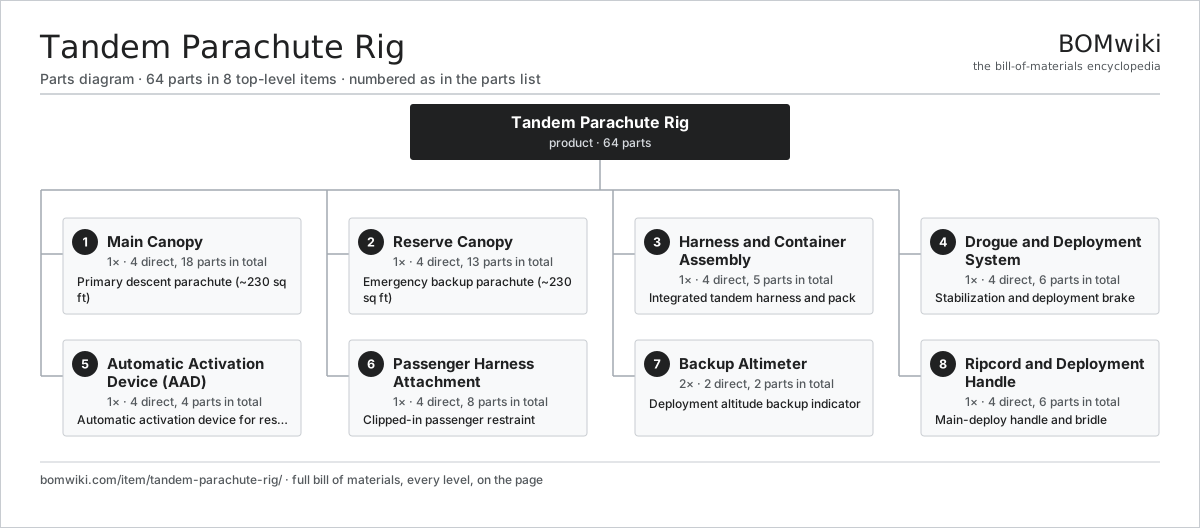
| # | Part | Qty | What it does |
|---|---|---|---|
| 1 | Main Canopy 4 parts | 1× | Primary descent parachute (~230 sq ft) |
| 2 | Reserve Canopy 4 parts | 1× | Emergency backup parachute (~230 sq ft) |
| 3 | Harness and Container Assembly 4 parts | 1× | Integrated tandem harness and pack |
| 4 | Drogue and Deployment System 4 parts | 1× | Stabilization and deployment brake |
| 5 | Automatic Activation Device (AAD) 4 parts | 1× | Automatic activation device for reserve |
| 6 | Passenger Harness Attachment 4 parts | 1× | Clipped-in passenger restraint |
| 7 | Backup Altimeter 2 parts | 2× | Deployment altitude backup indicator |
| 8 | Ripcord and Deployment Handle 4 parts | 1× | Main-deploy handle and bridle |
3D model
No 3D model yet. Have a CAD file of this? Add a 3D model. STL renders right on this page; STEP, FreeCAD, and OpenSCAD sources are welcome too (openly licensed, like all 3D models on BOMwiki).
Build & assembly graph
expand / collapse · shared sub-assemblies converge · links to related products · est. labourTap an assembly to expand/collapse · tap a part to open it · use “Open page” for any node · drag to pan, scroll to zoom.
Bill of materials for Tandem Parachute Rig
8 top-level lines · 38 rows shown · 64 parts total · indented to 3 levels| # | Item / sub-assembly | Part no. | Qty/assy | Ext. qty | Parts | Type |
|---|---|---|---|---|---|---|
| 1 | Main Canopy 4 parts | tandem-parachute-rig-main-canopy | 1× | 1 | 18 | assembly |
| 1.1 | Canopy Fabric | tandem-parachute-rig-canopy-fabric | 1× | 1 | · | part |
| 1.2 | Suspension Lines | tandem-parachute-rig-suspension-lines | 8× | 8 | · | part |
| 1.3 | Line Connector | tandem-parachute-rig-line-connector | 8× | 8 | · | part |
| 1.4 | Vent Holes | tandem-parachute-rig-vent-holes | 1× | 1 | · | part |
| 2 | Reserve Canopy 4 parts | tandem-parachute-rig-reserve-canopy | 1× | 1 | 13 | assembly |
| 2.1 | Reserve Fabric | tandem-parachute-rig-reserve-fabric | 1× | 1 | · | part |
| 2.2 | Reserve Lines | tandem-parachute-rig-reserve-lines | 8× | 8 | · | part |
| 2.3 | Reserve Risers | tandem-parachute-rig-reserve-risers | 2× | 2 | · | part |
| 2.4 | Reserve Pack Pin | tandem-parachute-rig-reserve-pack-pins | 2× | 2 | · | part |
| 3 | Harness and Container Assembly 4 parts | tandem-parachute-rig-harness-container | 1× | 1 | 5 | assembly |
| 3.1 | Instructor Harness | tandem-parachute-rig-instructor-harness | 1× | 1 | · | part |
| 3.2 | Leg Straps | tandem-parachute-rig-leg-straps | 2× | 2 | · | part |
| 3.3 | Main Container | tandem-parachute-rig-main-container | 1× | 1 | · | part |
| 3.4 | Reserve Container | tandem-parachute-rig-reserve-container | 1× | 1 | · | part |
| 4 | Drogue and Deployment System 4 parts | tandem-parachute-rig-drogue-system | 1× | 1 | 6 | assembly |
| 4.1 | Drogue Chute | tandem-parachute-rig-drogue-chute | 1× | 1 | · | part |
| 4.2 | Deployment Bridle | tandem-parachute-rig-deployment-bridle | 1× | 1 | · | part |
| 4.3 | Bridle Attachment | tandem-parachute-rig-bridle-attachment | 1× | 1 | · | part |
| 4.4 | Closing Pin | tandem-parachute-rig-closing-pins | 3× | 3 | · | part |
| 5 | Automatic Activation Device (AAD) 4 parts | tandem-parachute-rig-aad | 1× | 1 | 4 | assembly |
| 5.1 | AAD Altimeter | tandem-parachute-rig-aad-altimeter | 1× | 1 | · | part |
| 5.2 | AAD Processor | tandem-parachute-rig-aad-processor | 1× | 1 | · | part |
| 5.3 | AAD Initiator | tandem-parachute-rig-aad-initiator | 1× | 1 | · | part |
| 5.4 | AAD Housing | tandem-parachute-rig-aad-housing | 1× | 1 | · | part |
| 6 | Passenger Harness Attachment 4 parts | tandem-parachute-rig-passenger-harness | 1× | 1 | 8 | assembly |
| 6.1 | Passenger Shoulder Harness | tandem-parachute-rig-passenger-shoulder-harness | 1× | 1 | · | part |
| 6.2 | Passenger Leg Strap | tandem-parachute-rig-passenger-leg-strap | 2× | 2 | · | part |
| 6.3 | Connector Carabiner | tandem-parachute-rig-connector-carabiner | 4× | 4 | · | part |
| 6.4 | Passenger Reserve Ripcord | tandem-parachute-rig-passenger-reserve-ripcord | 1× | 1 | · | part |
| 7 | Backup Altimeter 2 parts | tandem-parachute-rig-altimeter | 2× | 2 | 2 | assembly |
| 7.1 | Mechanical Altimeter | tandem-parachute-rig-mechanical-altimeter | 1× | 2 | · | part |
| 7.2 | Electronic Altimeter | tandem-parachute-rig-electronic-altimeter | 1× | 2 | · | part |
| 8 | Ripcord and Deployment Handle 4 parts | tandem-parachute-rig-ripcord-system | 1× | 1 | 6 | assembly |
| 8.1 | Ripcord Handle | tandem-parachute-rig-ripcord-handle | 1× | 1 | · | part |
| 8.2 | Ripcord Cable | tandem-parachute-rig-ripcord-cable | 1× | 1 | · | part |
| 8.3 | Pin Cutter | tandem-parachute-rig-pin-cutter | 3× | 3 | · | part |
| 8.4 | Ripcord Pocket | tandem-parachute-rig-ripcord-pocket | 1× | 1 | · | part |
Something wrong in this list? Report a problem with this BOM.
Sourcing: possible vendors
Browse the supplier directory → Prices, MOQ, and lead times are algorithmic estimates, not quotes, and not claims about these companies. Company mappings are curated by keyword; est. price band $50k–$300M. How estimates work| Vendor | HQ | Specialty | MOQ | Lead time |
|---|---|---|---|---|
|
🇺🇸Boeing
boeing.com ↗
|
Arlington, US | Aerospace OEM | made to order | 40–80 wks |
|
🇫🇷Airbus
airbus.com ↗
|
Toulouse, FR | Aerospace OEM | made to order | 40–80 wks |
| lockheedmartin.com ↗ | Bethesda, US | Aerospace & defense | made to order | 40–80 wks |
|
🇧🇷Embraer
embraer.com ↗
|
São José dos Campos, BR | Aircraft OEM | made to order | 40–80 wks |
| txtav.com ↗ | Wichita, US | Aircraft OEM | made to order | 40–80 wks |
975-word article