Mattress Tape Edge Machine
ProductOverview
The mattress tape edge machine is a specialized piece of upholstery equipment that applies decorative fabric binding tape to the perimeter edges of mattresses using a chainstitch sewing head. This finishing operation not only provides aesthetic appeal but also reinforces the mattress edge against wear and compression. The machine accommodates a wide range of mattress sizes (typically twin through queen) and integrates a rotating turntable, articulating sewing arm, tape feeding system, and sophisticated PLC control to track edge contours and maintain consistent stitch quality.
The tape edge finish is particularly important in premium mattress construction. The chainstitch (also called coverstitch) allows individual stitches to be unraveled from one end if needed, and creates a flexible seam suitable for upholstered goods. The stitch interlocks the tape with the mattress cover, securing it firmly while maintaining the fabric's natural drape.
How it works
The mattress is placed on the rotating turntable and secured using pneumatic edge-grip arms. The height actuator raises or lowers the turntable to position the mattress edge at the precise height where the sewing needle will engage, accounting for mattress thickness variation (typically ±20 mm).
The articulating arm is positioned relative to the mattress perimeter using a servo stepper motor that controls a proportional directional solenoid valve. This allows the arm to swing in an arc around the turntable center and to slide in and out radially, maintaining a constant standoff distance from the mattress edge. Position feedback from an arm position encoder is continuously monitored by the PLC, correcting for turntable runout and mattress geometry irregularities.
The decorative tape (typically 15–50 mm width, polyester or cotton) unwinds from a large supply roll, maintaining constant tension via a magnetic particle brake. The tape advances toward the sewing needle frame along a precision guide plate that aligns the tape edge with the needle entry point.
The chainstitch head consists of a reciprocating upper needle bar (oscillating 30–80 cycles per minute) and a rotating looper hook driven by a crank linkage from a 1–2 hp motor. On each needle cycle:
- The needle descends through the tape and mattress cover fabric.
- The rotating looper hook catches the thread loop and passes it around the thread supply from the lower bobbin case.
- The needle rises, pulling tight and forming the chainstitch interlock.
- The upper and lower thread tensioners (100–500 g adjustable) maintain even tension, preventing loops or puckers.
The stitch length (typically 4 mm for mattress work) is set via a barrel cam that controls needle throw. This bite distance is critical: too long and the stitch weakens; too short and the seam becomes stiff.
As the needle frame advances along the mattress edge, the turntable rotates at 10–30 rpm, continuously presenting fresh edge perimeter to the needle. The PLC coordinates turntable rotation speed, sewing head cycle rate, and tape advance (via an advance sensor) to maintain synchronization. If the turntable runout is detected (measured by the arm position feedback), the PLC automatically corrects arm swing angle to compensate.
The edge clamping arms hold the mattress edge rigid throughout the sewing pass. A pressure relief valve (adjustable 0.5–1 MPa) prevents over-compression, which would crush the foam and create visible indentations.
Operational sequence
- Operator loads mattress onto turntable, positions edge-clamp arms, and raises height actuator to needle contact.
- PLC receives mattress dimensions (length, width) and displays expected cycle time and tape consumption.
- Operator selects tape type (color, width) and threads the needle using the optional motorized threader.
- Start button initiates turntable rotation and sewing head motor; the proportional arm positioning valve moves the arm into sewing position via PLC command.
- Needle begins cycling; tape advances at the rate synchronized to turntable rotation, creating a continuous seam.
- PLC monitors arm position encoder and adjusts proportional valve output to correct for any drift; if edge position drifts >5 mm, PLC triggers an alarm.
- As turntable completes rotation, the clamping arms release and turntable stops.
- Operator unloads mattress; residual tape tail is trimmed by hand or (on advanced models) by an automatic tape cutter.
Thread path and maintenance
The thread path runs from the spool through multiple ceramic guide eyelets (reducing friction and heat) into the upper tension discs, then down through a needle clamp. The lower thread path routes from a rotating bobbin case through a slot guide and back toward the looper. Regular thread path cleaning (removing lint and fuzz every 8–16 hours of operation) maintains smooth tension and extends needle life.
Needle changes occur when the needle develops a burr or hook (typically after 8–16 hours of continuous sewing, or 1000–2000 mattresses). A dull needle creates snags in delicate fabrics and causes skipped stitches.
Quality parameters
Consistent stitch quality requires careful control of:
- Thread tension: upper and lower must match (100–200 g range typical); unequal tension creates loops or puckers.
- Needle penetration: adjusted by sewing head motor speed and turntable rotation speed ratio; if mattress cover is too thin or thick, needle may skip fabric.
- Arm tracking accuracy: drift >5 mm from target edge is visible and weakens the seam; encoder feedback calibration is essential.
- Tape tension: loose tape creates wrinkles; over-tension can cause puckering or shredding during sewing.
Modern machines log all parameters (head speed, turntable speed, arm position, thread tension) to memory, enabling root-cause analysis when defects occur.
Mattress Tape Edge Machine parts and their functions
8 top-level parts · 39 parts in total · full bill of materials below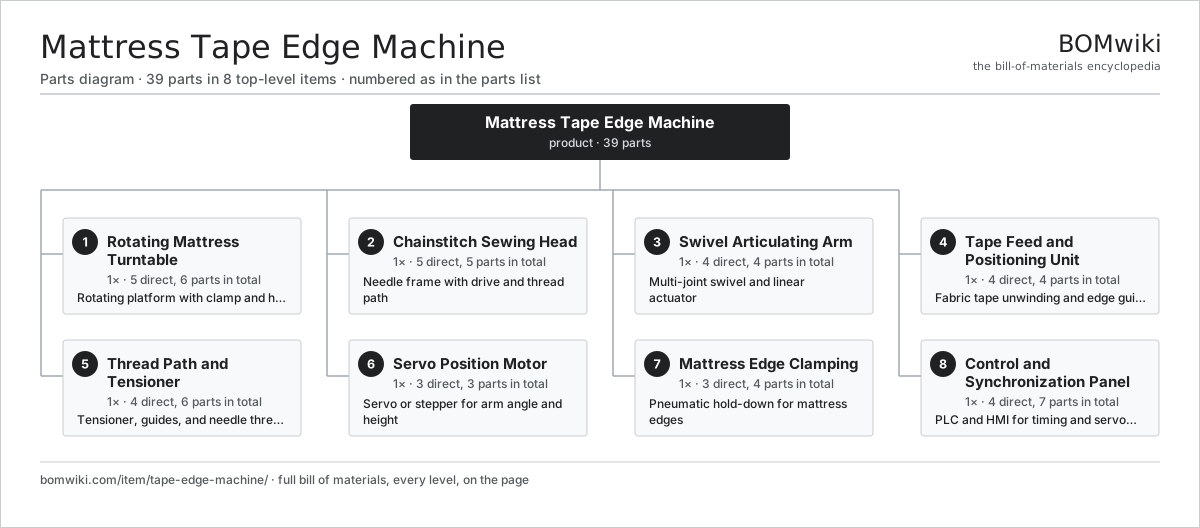
| # | Part | Qty | What it does |
|---|---|---|---|
| 1 | Rotating Mattress Turntable 5 parts | 1× | Rotating platform with clamp and height adjust |
| 2 | Chainstitch Sewing Head 5 parts | 1× | Needle frame with drive and thread path |
| 3 | Swivel Articulating Arm 4 parts | 1× | Multi-joint swivel and linear actuator |
| 4 | Tape Feed and Positioning Unit 4 parts | 1× | Fabric tape unwinding and edge guide |
| 5 | Thread Path and Tensioner 4 parts | 1× | Tensioner, guides, and needle threader |
| 6 | Servo Position Motor 3 parts | 1× | Servo or stepper for arm angle and height |
| 7 | Mattress Edge Clamping 3 parts | 1× | Pneumatic hold-down for mattress edges |
| 8 | Control and Synchronization Panel 4 parts | 1× | PLC and HMI for timing and servo coordination |
3D model
No 3D model yet. Have a CAD file of this? Add a 3D model. STL renders right on this page; STEP, FreeCAD, and OpenSCAD sources are welcome too (openly licensed, like all 3D models on BOMwiki).
Build & assembly graph
expand / collapse · shared sub-assemblies converge · links to related products · est. labourTap an assembly to expand/collapse · tap a part to open it · use “Open page” for any node · drag to pan, scroll to zoom.
Bill of materials for Mattress Tape Edge Machine
8 top-level lines · 40 rows shown · 39 parts total · indented to 3 levels| # | Item / sub-assembly | Part no. | Qty/assy | Ext. qty | Parts | Type |
|---|---|---|---|---|---|---|
| 1 | Rotating Mattress Turntable 5 parts | tape-edge-machine-turntable | 1× | 1 | 6 | assembly |
| 1.1 | Large Slewing Ring Bearing | tape-edge-machine-turntable-bearing | 1× | 1 | · | part |
| 1.2 | Low-Speed Turntable Drive Motor | tape-edge-machine-turntable-motor | 1× | 1 | · | part |
| 1.3 | Cast Iron Turntable Platform | tape-edge-machine-turntable-platform | 1× | 1 | · | part |
| 1.4 | Pneumatic Edge Clamp Cylinder | tape-edge-machine-clamp-air-cylinder | 2× | 2 | · | part |
| 1.5 | Electric Height Adjustment Screw | tape-edge-machine-height-actuator | 1× | 1 | · | part |
| 2 | Chainstitch Sewing Head 5 parts | tape-edge-machine-chainstitch-head | 1× | 1 | 5 | assembly |
| 2.1 | Oscillating Needle Bar | tape-edge-machine-needle-bar | 1× | 1 | · | part |
| 2.2 | Needle Bar Set Screw | tape-edge-machine-needle-clamp | 1× | 1 | · | part |
| 2.3 | Rotating Looper Hook | tape-edge-machine-looper-hook | 1× | 1 | · | part |
| 2.4 | Sewing Head Drive Motor | tape-edge-machine-head-motor | 1× | 1 | · | part |
| 2.5 | Stitch Length Adjustment Cam | tape-edge-machine-stitch-length-cam | 1× | 1 | · | part |
| 3 | Swivel Articulating Arm 4 parts | tape-edge-machine-articulating-arm | 1× | 1 | 4 | assembly |
| 3.1 | Vertical Arm Spindle Bearing | tape-edge-machine-arm-base-bearing | 1× | 1 | · | part |
| 3.2 | Pneumatic Arm Swing Cylinder | tape-edge-machine-arm-rotate-cylinder | 1× | 1 | · | part |
| 3.3 | Linear Slide Actuator | tape-edge-machine-arm-slide-actuator | 1× | 1 | · | part |
| 3.4 | Aluminum Arm Mounting Bracket | tape-edge-machine-arm-bracket | 1× | 1 | · | part |
| 4 | Tape Feed and Positioning Unit 4 parts | tape-edge-machine-tape-feeder | 1× | 1 | 4 | assembly |
| 4.1 | Tape Roll Quick-Change Spindle | tape-edge-machine-tape-spool-holder | 1× | 1 | · | part |
| 4.2 | Tape Tension Magnetic Particle Brake | tape-edge-machine-tape-tension-brake | 1× | 1 | · | part |
| 4.3 | Tape Edge Guide Plate | tape-edge-machine-guide-plate | 1× | 1 | · | part |
| 4.4 | Encoder | encoder | 1× | 1 | · | part |
| 5 | Thread Path and Tensioner 4 parts | tape-edge-machine-thread-system | 1× | 1 | 6 | assembly |
| 5.1 | Dual-Disc Thread Tension Brake | tape-edge-machine-thread-tensioner | 1× | 1 | · | part |
| 5.2 | Ceramic Thread Guide Eyelet | tape-edge-machine-guide-eye | 3× | 3 | · | part |
| 5.3 | Motorized Needle Threader | tape-edge-machine-needle-threader | 1× | 1 | · | part |
| 5.4 | Rotating Bobbin Case | tape-edge-machine-bobbin-case | 1× | 1 | · | part |
| 6 | Servo Position Motor 3 parts | tape-edge-machine-positioning-motor | 1× | 1 | 3 | assembly |
| 6.1 | NEMA 34 Stepper Motor | tape-edge-machine-servo-motor | 1× | 1 | · | part |
| 6.2 | Proportional 4/3 Directional Solenoid Valve | tape-edge-machine-proportional-valve | 1× | 1 | · | part |
| 6.3 | Arm Position Feedback Encoder | tape-edge-machine-position-feedback | 1× | 1 | · | part |
| 7 | Mattress Edge Clamping 3 parts | tape-edge-machine-clamp-system | 1× | 1 | 4 | assembly |
| 7.1 | Parallel Slide Gripper Pads | tape-edge-machine-clamp-gripper | 2× | 2 | · | part |
| 7.2 | Clamp Solenoid Directional Valve | tape-edge-machine-clamp-control-valve | 1× | 1 | · | part |
| 7.3 | Pressure Relief Valve | tape-edge-machine-pressure-limiter | 1× | 1 | · | part |
| 8 | Control and Synchronization Panel 4 parts | tape-edge-machine-control-panel | 1× | 1 | 7 | assembly |
| 8.1 | Microcontroller | mcu | 1× | 1 | · | part |
| 8.2 | LCD Panel | lcd-panel | 1× | 1 | · | part |
| 8.3 | Relay | relay | 4× | 4 | · | part |
| 8.4 | Power Supply | power-supply | 1× | 1 | · | part |
Something wrong in this list? Report a problem with this BOM.
Sourcing: possible vendors
Browse the supplier directory → Prices, MOQ, and lead times are algorithmic estimates, not quotes, and not claims about these companies. Company mappings are curated by keyword; est. price band $10k–$1M. How estimates work| Vendor | HQ | Specialty | MOQ | Lead time |
|---|---|---|---|---|
|
🇨🇭Rieter
rieter.com ↗
|
Winterthur, CH | Spinning machinery | 10 units | 14–24 wks |
| truetzschler.com ↗ | Mönchengladbach, DE | Textile machinery | 10 units | 14–24 wks |
|
🇧🇪Picanol
picanol.be ↗
|
Ypres, BE | Weaving machines | 10 units | 14–24 wks |
| karlmayer.com ↗ | Obertshausen, DE | Warp knitting machines | 10 units | 14–24 wks |
|
🇨🇭Saurer
saurer.com ↗
|
Arbon, CH | Spinning & embroidery | 10 units | 14–24 wks |
1,081-word article