Telecom Equipment Shelter
ProductOverview
A telecom equipment shelter is the backbone of a cell site, housing the Shelter Body and all the electronics that process voice and data traffic. The shelter protects sensitive equipment from rain, snow, extreme temperatures, and dust while maintaining optimal operating conditions. A typical shelter contains baseband processors, power supplies, RF transceiver modules, and backhaul equipment, all requiring protection from weather and heat.
Most shelters are either 20 ft ISO shipping containers with foam insulation added, or custom-built steel or aluminum enclosures. The container approach is cost-effective and modular: standard containers can be shipped on trucks and installed quickly. A full-size 20 ft container (8×8.5×8.5 feet) houses two or three 42U equipment racks, an air conditioning unit, battery backup, and a distribution panel.
The HVAC System maintains interior temperature at 65–75°F and humidity at 30–45%, critical for equipment reliability. Electronics generate heat (30–50 kW in a busy site), and without cooling, the interior temperature would exceed 130°F, causing equipment to fail. The air conditioning unit is sized based on equipment power dissipation and exterior climate (hotter locations require larger AC units).
The Power Distribution system receives utility AC power (typically 208V three-phase or 480V), distributes it via breakers to a main Power Distribution Unit, and powers both AC equipment (HVAC) and DC supplies (baseband, power amplifiers). A UPS Battery Shelf system provides backup power, allowing continued operation during brief outages and enabling orderly shutdown if an outage is prolonged.
The Equipment Racks are 19 inch standard frames bolted to the floor, holding baseband processors, power supplies, optical transceivers, and RF equipment. All cables are organized via Cable Management systems, color-coded and labeled, to simplify troubleshooting and maintenance.
Security is enforced via Security & Access: a keyed or electronic lock on the access door, visitor logging, and security cameras. Theft and unauthorized access are ongoing concerns on cell sites, especially in urban areas.
Finally, Monitoring System sensors log temperature, power draw, and system health, automatically alerting the network operations center (NOC) if conditions drift outside safe ranges (e.g., temperature >85°F, power >100 kW).
How It Works
Utility power enters the shelter at a Main Breaker, is metered, and is distributed via a Distribution Panel to a Power Distribution Unit. The PDU has 24–48 outlets, each with a breaker, supplying individual equipment racks.
The HVAC System system runs continuously during peak traffic hours (when equipment generates the most heat), and cycles on/off based on interior temperature measured by the Temperature Sensor. A Thermostat with a 2°C deadband prevents rapid on/off cycling. The AC unit draws 5–20 kW during operation, making it a major consumer of shelter power.
The baseband processor (running Layer 1/2 modem functions) and RF equipment (TX/RX chains) are mounted in the racks. RF feeders and power cables are routed through the Cable Management system. A Patch Panel provides cross-connect points for fiber (CPRI or backhaul links) and copper (power and control lines).
The UPS Battery Shelf is sized to support critical loads (baseband and alarms) for 10 minutes to several hours, allowing graceful shutdown or handoff to backup generators if a utility outage is extended. In remote sites with frequent outages, large battery banks (100+ kWh) may be deployed.
The Monitoring System continuously samples:
- Interior temperature: alarm if >85°F (equipment may be thermally throttling or failing)
- Exterior temperature: for predictive HVAC load modeling
- Power consumption: to detect equipment failures (a failed PA draws less current)
- System alarms: doors, battery status, AC unit operation
These metrics are reported to the NOC via SNMP or syslog, allowing remote operators to diagnose issues and dispatch field technicians if needed.
Maintenance and Environmental Impact
Shelter maintenance includes:
- Monthly HVAC filter replacement (or cleaning if reusable)
- Quarterly cleaning of AC condenser coils (accumulated dust reduces cooling efficiency)
- Annual inspection of foam insulation for moisture or thermal damage
- Monitoring of battery SoC (state of charge) and voltage for degradation
Thermal stress is the leading cause of premature equipment failure. Overheating by just 10°C can halve component lifespan. Operators monitor temperature trends and add supplemental cooling (e.g., larger AC unit or portable cooling cart) if average temperature creeps up over months.
Environmental impact is notable: large AC units consume 5–20 kW continuously, equivalent to 10–50 homes. Operators in temperate climates aim for 70–72°F setpoints to balance equipment reliability with energy cost. In hot climates, night setbacks (raising temperature during low-traffic hours) are common.
Noise from the AC unit (75–80 dB(A)) can be a concern in residential areas. Manufacturers offer sound-attenuated shelters with thicker foam and baffled ductwork, adding cost but improving community relations.
The shelter itself presents a fire risk if not properly maintained: equipment failures, battery venting, and fuel-powered generators can cause fires. Most shelters have fire suppression systems (FM-200 or foam), and many operators require quarterly fire drills and equipment inspections.
Telecom Equipment Shelter parts and their functions
7 top-level parts · 30 parts in total · full bill of materials below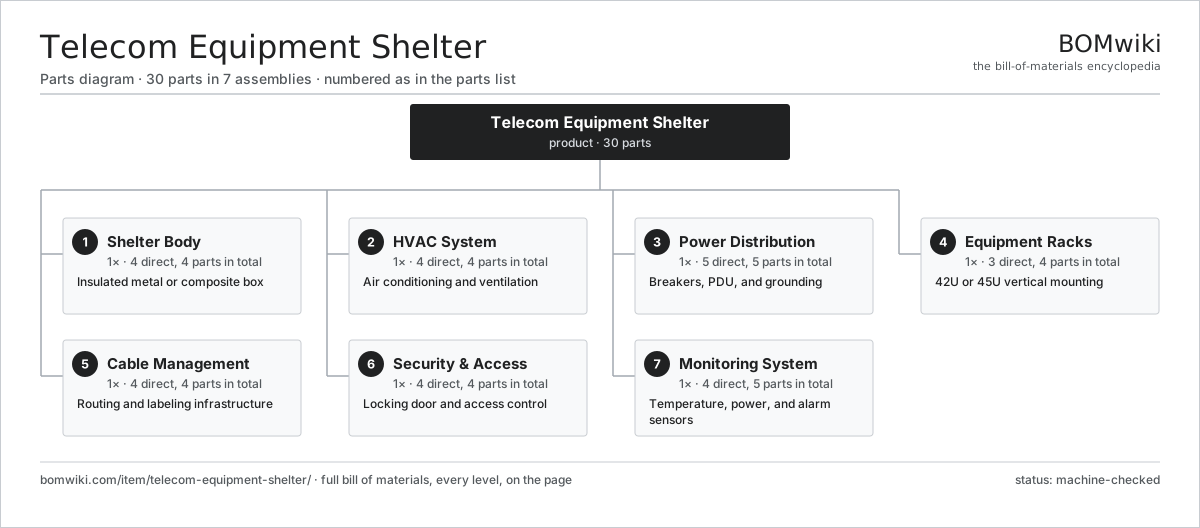
| # | Part | Qty | What it does |
|---|---|---|---|
| 1 | Shelter Body 4 parts | 1× | Insulated metal or composite box |
| 2 | HVAC System 4 parts | 1× | Air conditioning and ventilation |
| 3 | Power Distribution 5 parts | 1× | Breakers, PDU, and grounding |
| 4 | Equipment Racks 3 parts | 1× | 42U or 45U vertical mounting |
| 5 | Cable Management 4 parts | 1× | Routing and labeling infrastructure |
| 6 | Security & Access 4 parts | 1× | Locking door and access control |
| 7 | Monitoring System 4 parts | 1× | Temperature, power, and alarm sensors |
3D model
No 3D model yet. Have a CAD file of this? Add a 3D model — STL renders right on this page; STEP, FreeCAD, and OpenSCAD sources are welcome too (openly licensed, like all 3D models on BOMwiki).
Build & assembly graph
expand / collapse · shared sub-assemblies converge · links to related products · est. labourTap an assembly to expand/collapse · tap a part to open it · use “Open page” for any node · drag to pan, scroll to zoom.
Bill of materials for Telecom Equipment Shelter
7 top-level lines · 35 rows shown · 30 parts total · indented to 3 levels| # | Item / sub-assembly | Part no. | Qty/assy | Ext. qty | Parts | Type |
|---|---|---|---|---|---|---|
| 1 | Shelter Body 4 parts | telecom-equipment-shelter-body | 1× | 1 | 4 | assembly |
| 1.1 | Container Shell | telecom-equipment-shelter-container-shell | 1× | 1 | · | part |
| 1.2 | Insulation | telecom-equipment-shelter-insulation-layer | 1× | 1 | · | part |
| 1.3 | Floor Deck | telecom-equipment-shelter-floor-structure | 1× | 1 | · | part |
| 1.4 | Roof Vent | telecom-equipment-shelter-roof-vent | 1× | 1 | · | part |
| 2 | HVAC System 4 parts | telecom-equipment-shelter-hvac | 1× | 1 | 4 | assembly |
| 2.1 | AC Unit | telecom-equipment-shelter-ac-unit | 1× | 1 | · | part |
| 2.2 | Ductwork | telecom-equipment-shelter-ductwork | 1× | 1 | · | part |
| 2.3 | Thermostat | telecom-equipment-shelter-thermostat | 1× | 1 | · | part |
| 2.4 | Condensate Drain | telecom-equipment-shelter-condensate-drain | 1× | 1 | · | part |
| 3 | Power Distribution 5 parts | telecom-equipment-shelter-power-distribution | 1× | 1 | 5 | assembly |
| 3.1 | Main Breaker | telecom-equipment-shelter-main-breaker | 1× | 1 | · | part |
| 3.2 | Distribution Panel | telecom-equipment-shelter-distribution-panel | 1× | 1 | · | part |
| 3.3 | Power Distribution Unit | telecom-equipment-shelter-pdu | 1× | 1 | · | part |
| 3.4 | Grounding System | telecom-equipment-shelter-grounding-system | 1× | 1 | · | part |
| 3.5 | UPS Battery Shelf | telecom-equipment-shelter-usp-battery | 1× | 1 | · | part |
| 4 | Equipment Racks 3 parts | telecom-equipment-shelter-equipment-racks | 1× | 1 | 4 | assembly |
| 4.1 | Rack Frame | telecom-equipment-shelter-rack-frame | 2× | 2 | · | part |
| 4.2 | Mounting Brackets | telecom-equipment-shelter-mounting-brackets | 1× | 1 | · | part |
| 4.3 | Cable Tray | telecom-equipment-shelter-cable-tray | 1× | 1 | · | part |
| 5 | Cable Management 4 parts | telecom-equipment-shelter-cable-management | 1× | 1 | 4 | assembly |
| 5.1 | Cable Entry Panel | telecom-equipment-shelter-cable-entry-panel | 1× | 1 | · | part |
| 5.2 | Patch Panel | telecom-equipment-shelter-patch-panel | 1× | 1 | · | part |
| 5.3 | Label System | telecom-equipment-shelter-label-system | 1× | 1 | · | part |
| 5.4 | Cable Clamps | telecom-equipment-shelter-cable-clamps | 1× | 1 | · | part |
| 6 | Security & Access 4 parts | telecom-equipment-shelter-security-access | 1× | 1 | 4 | assembly |
| 6.1 | Access Door | telecom-equipment-shelter-access-door | 1× | 1 | · | part |
| 6.2 | Access Control | telecom-equipment-shelter-access-control | 1× | 1 | · | part |
| 6.3 | Security Camera | telecom-equipment-shelter-security-camera | 1× | 1 | · | part |
| 6.4 | Visitor Log | telecom-equipment-shelter-visitor-log | 1× | 1 | · | part |
| 7 | Monitoring System 4 parts | telecom-equipment-shelter-monitoring-system | 1× | 1 | 5 | assembly |
| 7.1 | Temperature Sensor | telecom-equipment-shelter-temp-sensor | 2× | 2 | · | part |
| 7.2 | Power Meter | telecom-equipment-shelter-power-meter | 1× | 1 | · | part |
| 7.3 | Alarm Relay | telecom-equipment-shelter-alarm-relay | 1× | 1 | · | part |
| 7.4 | Remote Monitoring | telecom-equipment-shelter-remote-monitoring | 1× | 1 | · | part |
Sourcing: possible vendors
Prices, MOQ, and lead times are algorithmic estimates, not quotes, and not claims about these companies. Company mappings are curated by keyword; est. price band $30–$50k. How estimates work| Vendor | HQ | Specialty | MOQ | Lead time |
|---|---|---|---|---|
|
🇺🇸Cisco
cisco.com ↗
|
San Jose, US | Networking | 500 units | 8–14 wks |
|
🇺🇸Juniper
juniper.net ↗
|
Sunnyvale, US | Networking | 500 units | 8–14 wks |
| arista.com ↗ | Santa Clara, US | Networking | 500 units | 8–14 wks |
|
🇫🇮Nokia
nokia.com ↗
|
Espoo, FI | Telecom equipment | 500 units | 8–14 wks |
|
🇨🇳Huawei
huawei.com ↗
|
Shenzhen, CN | Networking & telecom | 500 units | 8–14 wks |
882-word article