Observatory Dome
ProductOverview
An astronomical dome (or observatory dome) is a rotating shelter enclosing a telescope, protecting optics and instruments from wind, rain, and thermal gradients while allowing unobstructed access to the sky. The dome rotates in azimuth to follow the telescope's pointing direction, and a motorized shutter door opens to expose the telescope aperture.
A typical research dome is 8–15 m in diameter, housing optical telescopes (0.5–4 m aperture) and their supporting instruments. The Observatory Dome integrates structural engineering (wind resistance, thermal stability), precision mechanics (low-friction rotation), and control automation (synchronizing dome azimuth with telescope hour angle) to achieve seeing-limited observations.
How it works
Dome Structure
The Dome Structure is a hemispherical or cylindrical shell, historically wooden (now aluminum alloy or fiberglass composite for corrosion resistance). The Shell Panels are assembled in segments and supported by an internal Framework truss. Modern domes are lightweight: 50–200 tonnes depending on diameter and construction.
The interior Interior Lining minimizes dust and thermal turbulence. Polished surfaces reduce thermal radiation divergence; some observatories install air vents allowing slow nighttime cooling to equilibrate dome and external ambient temperatures (critical for seeing quality).
Rotation Mechanism
The Base Ring is a fixed azimuth track at the dome base, typically a welded steel rail or precast concrete ring. The dome sits on roller bogies (3–4 independently sprung wheels per side) that distribute the 50–200 tonne load and guide smooth rotation with minimal friction.
A three-phase AC motor (10–50 kW) drives the dome via belt or gear coupling at 0.5–2 rpm. Modern domes use variable-frequency drives (VFDs) to enable smooth acceleration/deceleration and programmable ramp profiles. An integrated Motor Encoder reports azimuth position to the control computer at 0.1° resolution.
Shutter Door
The Shutter Assembly is a motorized door (often two leaves for large domes) opening the dome slit to expose the telescope primary mirror. The Shutter Panel is a lightweight aluminum or composite structure; a Counterweight reduces motor load. The Shutter Motor operates at 5–15 cm/sec, opening fully in 30–60 seconds.
A Shutter Guide rail or track keeps the door parallel and binding-free. Limit switches prevent over-travel; a manual crank allows manual opening if power fails.
Fixed Pier
The Mounting Pier is the critical structural element. It sits on bedrock or a deep concrete foundation, intentionally decoupled from the rotating dome structure via isolation pads. This prevents dome rotation vibrations from coupling into the telescope mount and distorting observations.
The Mounting Plate atop the pier provides a precision-drilled interface for the equatorial or altitude-azimuth telescope mount.
Automated Dome Tracking
The Control System automatically rotates the dome to keep the shutter aligned with the telescope pointing direction. The control PC receives telescope coordinates (right ascension, declination) from the main telescope controller via ethernet or serial link. It computes the required dome azimuth (direction the telescope is pointing) and commands the motor controller to position the dome accordingly.
A feedback loop compares the measured azimuth (from the encoder) to the setpoint, adjusting motor speed to maintain ±0.5° alignment. If the telescope slews faster than the dome can rotate (rare, but possible for rapid repointing), the control software warns the observer.
Thermal Environment
Daytime heating of the dome can establish steep internal temperature gradients that cause air convection ("dome seeing"), degrading image quality. Modern observatories:
- Operate with the shutter closed during the day.
- Install ventilation louvers allowing nighttime cooling.
- Paint domes white to minimize solar absorption.
- Use forced-air circulation to equilibrate interior and exterior temperatures 1–2 hours before observing.
A well-designed dome maintains thermal uniformity within ±2°C, critical for telescopes with large focal-plane instruments where thermal focusing errors exceed optical aberrations.
Wind Load and Structural Design
The dome must survive >100 mph wind gusts without deformation or rocking. Wind loads increase with aperture height and dome diameter. Critical design considerations:
- Anchorages: heavy bolts or cable guy-lines anchoring dome base to foundation.
- Frequency response: dome natural frequency (typically 1–5 Hz) must avoid resonance with local wind frequencies.
- Damping: elastomeric isolation pads or friction dampers at bogie supports dissipate wind-gust energy.
Access and Maintenance
The Ladder and Walkway provides safe access for maintenance. A Landing Platform at mid-dome allows work on the primary mirror and instruments. Perimeter railings comply with occupational safety standards. Anti-slip coating on walkways prevents falls in wet conditions.
Modern Trends
Contemporary observatories increasingly feature:
- Robotic domes: fully autonomous operation without on-site staff.
- Distributed controls: SCADA (supervisory control and data acquisition) networks linking multiple domes.
- Integrated systems: dome position fed directly into telescope mount feedback loops, eliminating manual guidance.
- Lightweight materials: carbon-fiber or advanced composite domes reducing wind-load stresses.
Large new facilities (e.g., Las Cumbres Observatory network) standardize dome designs for 1–2 m telescopes, enabling rapid deployment and low operational cost.
Observatory Dome parts and their functions
8 top-level parts · 37 parts in total · full bill of materials below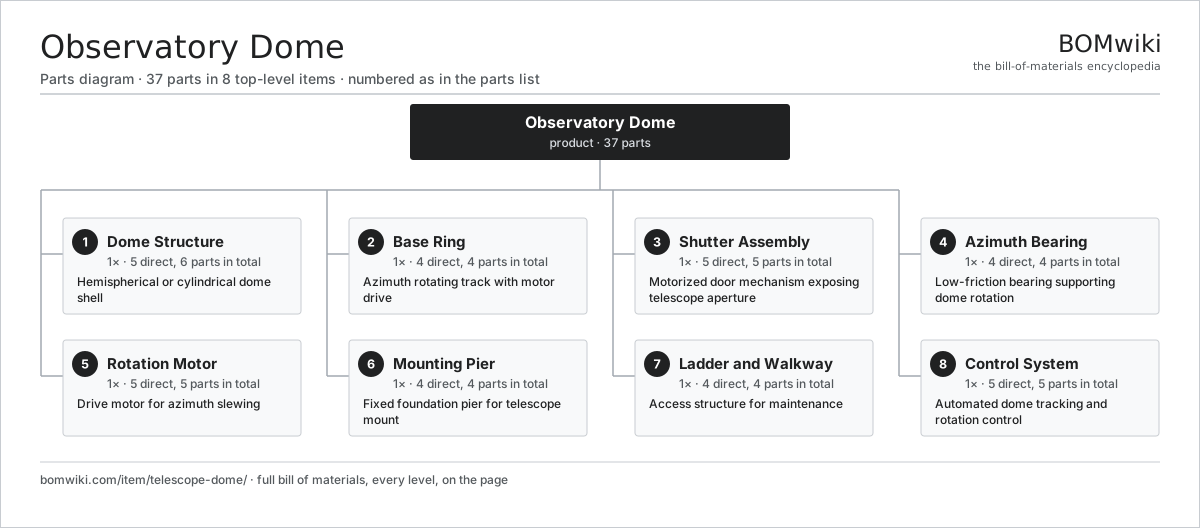
| # | Part | Qty | What it does |
|---|---|---|---|
| 1 | Dome Structure 5 parts | 1× | Hemispherical or cylindrical dome shell |
| 2 | Base Ring 4 parts | 1× | Azimuth rotating track with motor drive |
| 3 | Shutter Assembly 5 parts | 1× | Motorized door mechanism exposing telescope aperture |
| 4 | Azimuth Bearing 4 parts | 1× | Low-friction bearing supporting dome rotation |
| 5 | Rotation Motor 5 parts | 1× | Drive motor for azimuth slewing |
| 6 | Mounting Pier 4 parts | 1× | Fixed foundation pier for telescope mount |
| 7 | Ladder and Walkway 4 parts | 1× | Access structure for maintenance |
| 8 | Control System 5 parts | 1× | Automated dome tracking and rotation control |
3D model
No 3D model yet. Have a CAD file of this? Add a 3D model. STL renders right on this page; STEP, FreeCAD, and OpenSCAD sources are welcome too (openly licensed, like all 3D models on BOMwiki).
Build & assembly graph
expand / collapse · shared sub-assemblies converge · links to related products · est. labourTap an assembly to expand/collapse · tap a part to open it · use “Open page” for any node · drag to pan, scroll to zoom.
Bill of materials for Observatory Dome
8 top-level lines · 44 rows shown · 37 parts total · indented to 3 levels| # | Item / sub-assembly | Part no. | Qty/assy | Ext. qty | Parts | Type |
|---|---|---|---|---|---|---|
| 1 | Dome Structure 5 parts | telescope-dome-structure | 1× | 1 | 6 | assembly |
| 1.1 | Shell Panels | telescope-dome-shell-panels | 1× | 1 | · | part |
| 1.2 | Framework | telescope-dome-framework | 1× | 1 | · | part |
| 1.3 | Weatherproofing | telescope-dome-weatherproofing | 1× | 1 | · | part |
| 1.4 | Interior Lining | telescope-dome-interior-lining | 1× | 1 | · | part |
| 1.5 | Fastener Set | fastener-set | 2× | 2 | · | part |
| 2 | Base Ring 4 parts | telescope-dome-base-ring | 1× | 1 | 4 | assembly |
| 2.1 | Track Ring | telescope-dome-track-ring | 1× | 1 | · | part |
| 2.2 | Bogie Wheels | telescope-dome-bogie-wheels | 1× | 1 | · | part |
| 2.3 | Drive Coupling | telescope-dome-drive-coupling | 1× | 1 | · | part |
| 2.4 | Fastener Set | fastener-set | 1× | 1 | · | part |
| 3 | Shutter Assembly 5 parts | telescope-dome-shutter-assembly | 1× | 1 | 5 | assembly |
| 3.1 | Shutter Panel | telescope-dome-shutter-panel | 1× | 1 | · | part |
| 3.2 | Counterweight | telescope-dome-shutter-counterweight | 1× | 1 | · | part |
| 3.3 | Shutter Motor | telescope-dome-shutter-motor | 1× | 1 | · | part |
| 3.4 | Shutter Guide | telescope-dome-shutter-guide | 1× | 1 | · | part |
| 3.5 | Safety Limit | telescope-dome-shutter-safety-limit | 1× | 1 | · | part |
| 4 | Azimuth Bearing 4 parts | telescope-dome-azimuth-bearing | 1× | 1 | 4 | assembly |
| 4.1 | Slewing Bearing | telescope-dome-slewing-bearing | 1× | 1 | · | part |
| 4.2 | Bearing Lubrication | telescope-dome-bearing-lubrication | 1× | 1 | · | part |
| 4.3 | Bearing Seals | telescope-dome-bearing-seals | 1× | 1 | · | part |
| 4.4 | Fastener Set | fastener-set | 1× | 1 | · | part |
| 5 | Rotation Motor 5 parts | telescope-dome-rotation-motor | 1× | 1 | 5 | assembly |
| 5.1 | Primary Motor | telescope-dome-motor-primary | 1× | 1 | · | part |
| 5.2 | Gearbox | telescope-dome-gearbox | 1× | 1 | · | part |
| 5.3 | Frequency Drive | telescope-dome-frequency-drive | 1× | 1 | · | part |
| 5.4 | Motor Encoder | telescope-dome-motor-encoder | 1× | 1 | · | part |
| 5.5 | Power Supply | power-supply | 1× | 1 | · | part |
| 6 | Mounting Pier 4 parts | telescope-dome-mounting-pier | 1× | 1 | 4 | assembly |
| 6.1 | Pier Foundation | telescope-dome-pier-foundation | 1× | 1 | · | part |
| 6.2 | Vibration Damper | telescope-dome-pier-vibration-damper | 1× | 1 | · | part |
| 6.3 | Mounting Plate | telescope-dome-pier-mounting-plate | 1× | 1 | · | part |
| 6.4 | Fastener Set | fastener-set | 1× | 1 | · | part |
| 7 | Ladder and Walkway 4 parts | telescope-dome-ladder-walkway | 1× | 1 | 4 | assembly |
| 7.1 | Ladder Steps | telescope-dome-ladder-steps | 1× | 1 | · | part |
| 7.2 | Landing Platform | telescope-dome-landing-platform | 1× | 1 | · | part |
| 7.3 | Safety Rails | telescope-dome-safety-rails | 1× | 1 | · | part |
| 7.4 | Anti-Slip Surface | telescope-dome-anti-slip-surface | 1× | 1 | · | part |
| 8 | Control System 5 parts | telescope-dome-control-system | 1× | 1 | 5 | assembly |
| 8.1 | Control PC | telescope-dome-control-pc | 1× | 1 | · | part |
| 8.2 | Motor Controller | telescope-dome-motor-controller | 1× | 1 | · | part |
| 8.3 | Position Sensor | telescope-dome-position-sensor | 1× | 1 | · | part |
| 8.4 | Network Interface | telescope-dome-network-interface | 1× | 1 | · | part |
| 8.5 | Power Supply | power-supply | 1× | 1 | · | part |
Something wrong in this list? Report a problem with this BOM.
Related products
same domain, ranked by shared parts Adaptive Optics System
35 parts · shares 1 with this page
Adaptive Optics System
35 parts · shares 1 with this page
 Camera Motion Control Rig
210 parts · shares 1 with this page
Camera Motion Control Rig
210 parts · shares 1 with this page
 Digital Cinema Camera
305 parts · shares 1 with this page
Digital Cinema Camera
305 parts · shares 1 with this page
 Document Camera
247 parts · shares 1 with this page
Document Camera
247 parts · shares 1 with this page
 High-Speed Camera
183 parts · shares 1 with this page
High-Speed Camera
183 parts · shares 1 with this page
 Industrial 3D Scanner
149 parts · shares 1 with this page
Industrial 3D Scanner
149 parts · shares 1 with this page
Sourcing: possible vendors
Browse the supplier directory → Prices, MOQ, and lead times are algorithmic estimates, not quotes, and not claims about these companies. Company mappings are curated by keyword; est. price band $100–$8k. How estimates work| Vendor | HQ | Specialty | MOQ | Lead time |
|---|---|---|---|---|
|
🇯🇵Canon
canon.com ↗
|
Tokyo, JP | Imaging & optics | 500 units | 10–16 wks |
|
🇯🇵Nikon
nikon.com ↗
|
Tokyo, JP | Imaging & optics | 500 units | 10–16 wks |
|
🇩🇪ZEISS
zeiss.com ↗
|
Oberkochen, DE | Optics & optoelectronics | 500 units | 10–16 wks |
| leica-camera.com ↗ | Wetzlar, DE | Cameras & optics | 500 units | 10–16 wks |
| flir.com ↗ | Wilsonville, US | Thermal imaging | 500 units | 10–16 wks |
893-word article