Terminal Tractor
ProductOverview
The terminal tractor is a heavy-duty yard locomotive designed to move and position containers, trailers, and specialized loads throughout port and inland container terminals. Unlike reach stackers or straddle carriers that lift loads vertically, terminal tractors focus on horizontal movement: they couple to trailers via a fifth wheel, push or pull using articulated drawbar systems, and operate powered lift decks for staging and transfer operations.
Terminal tractors are typically deployed in dense container yards where tractor-trailer combinations move boxes between vessel, stack, and road transportation areas. The offset forward cab (mounted ahead of the front axle) provides exceptional visibility over the fifth wheel and surrounding cargo, critical for safe operation in congested terminals where pedestrian and vehicle traffic interweave.
How It Works
The terminal tractor begins a shift with the diesel engine idling, the deck in the lowered position, and the fifth wheel ready for trailer coupling. The operator steers the tractor (manually or power-assisted) toward a trailer or container load using the Steering System. The forward-positioned cab provides excellent sightlines to the fifth wheel and trailing load.
When coupling a trailer, the operator backs the tractor slowly under the trailer kingpin, aligning the ball coupling on the Fifth Wheel with the kingpin. A low-speed bump engages the kingpin into the fifth wheel saddle. The operator then engages the Locking Mechanism, securing the trailer to the tractor. The Kingpin Slide allows fine longitudinal adjustment to balance load distribution between front and rear axles.
For deck operations (moving a single container or load stage), the operator engages the hydraulic pump, which drives the Hydraulic System. The Deck Control Valve directs flow to the Lift Cylinders, raising the Deck Platform to approximately 0.5–1.5 meters. The container or load is positioned on the deck, and the four Lock Keepers are engaged to secure it. The deck is lowered again for transport.
The Diesel Engine idles at a light throttle while stationary; the operator applies throttle progressively, and the Transmission (8–16 speed manual or automated) upshifts as road speed increases. The Brake System is air-actuated: the operator applies brake force via a foot valve or hand lever, which pressurizes the Air Compressor output through the Brake Control Valve to the Brake Cylinders on all four axles. The ABS Module prevents wheel lockup if braking force exceeds tire grip. The Exhaust Brake Valve provides engine braking on long downgrades.
At destination, the operator reverses or maneuvers into position, uncouples the trailer (releasing the Locking Mechanism), or lowers the deck and positions the next load. The cycle repeats.
Subsystems
Chassis and Frame
The Chassis is a heavy-gauge steel structure supporting the engine, transmission, axles, and fifth wheel. The Frame Rails (two main beams) run longitudinally from the front axle to the rear axle group. The Cross Members provide lateral bracing and mounting points for the engine, transmission, brake tanks, and lift deck. The Front Axle is a single heavy-duty axle with kingpin and steering geometry. The Rear Axles are typically dual-axle (tandem) or triple-axle (tridem) configurations, with each axle carrying integral differential and drive flanges. The Suspension Assembly (leaf springs or air suspension) isolates the frame from road shock and provides load leveling when weights change.
Engine and Fuel System
The Diesel Engine is a turbocharged 6-cylinder or 8-cylinder producing 300–450 kW for full-load starts and sustained operation. The Engine Block integrates the cylinder block, head, and cam drive. The Fuel System includes a large tank (500–700 liters) for extended operation without refueling, a fuel pump, filters, and high-pressure injectors. The Cooling System and Air Intake System with Blower Motor turbocharger maintain efficiency and power output across operating conditions. The Radiator dissipates heat to ambient air via a large core and electric fan.
Transmission and Drivetrain
Power flows from the engine through the Transmission, which selects among 8–16 forward gears and reverse. Modern tractors use automated manual transmissions that shift without interrupting torque flow. The Clutch Unit is a single or dual-plate dry clutch, engaged and disengaged for neutral position and engine startup. The Exhaust Brake Valve valve restricts exhaust gas flow, providing engine braking and reducing reliance on wheel brakes on long downhill sections. Torque flows from the transmission output to the Rear Axles via a driveshaft, where the differential splits power between the two (or three) rear wheels.
Fifth Wheel Coupling
The Fifth Wheel is mounted on the chassis frame aft of the cab, over the drive axle. The Fifth Wheel Plate is a steel plate bolted to the frame; the Ball Coupling (typically 50–70mm hemispherical ball) protrudes upward to engage the trailer kingpin. The Locking Mechanism is a lever-operated or hydraulic latch that secures the kingpin in the fifth wheel saddle and prevents separation. The Kingpin Slide allows longitudinal adjustment of the fifth wheel position to balance the load: moving the fifth wheel rearward increases weight on the front axle and front tires, while moving it forward transfers load to the rear axles.
Lift Deck
The Lift Deck Assembly is an integral or bolt-on cargo platform mounted on the chassis or on a separate cart frame. The Deck Platform is typically 2.5m x 2.5m (or custom sized) with Lock Keepers at each corner engaging standard ISO container corner fittings. Dual Lift Cylinders (12–15cm bore, double-acting) are actuated by the Deck Control Valve to raise and lower the deck. The Deck Position Stops are mechanical or hydraulic limit stops preventing over-extension and ensuring safe positions. A Pressure Sensor feeds load weight feedback to the operator display.
Steering System
The Steering System is hydraulic power-assisted. The operator rotates the Steering Wheel, which actuates a spool inside the Power Steering Pump (or separate control valve), directing low-pressure steering fluid to one side or the other. The Steering Gear (worm-and-sector or rack-and-pinion) converts rotational input to linear motion. The Drag Link and Tie Rods mechanically couple the steering gear to the front axle kingpin, articulating the wheels. Turning radius is tight, typically 6–8 meters outside edge, enabling the tractor to maneuver in confined yard spaces.
Operator Cab
The Operator Cab is mounted forward of the front axle, providing 360-degree visibility and an elevated vantage point. The Cab Shell is welded steel with reinforced structure. The Windshield is large, laminated safety glass. The Door Assembly (dual doors) includes integral side mirrors. The Seat Assembly is an air-suspended operator seat with manual or proportional controls for deck lift, hydraulic functions, and transmission selection. The Dashboard displays engine speed, fuel level, coolant temperature, air tank pressure, and deck position. The Lighting System system includes headlights, taillights, brake lights, turn signals, work lights for yard operations, and backup alarm.
Brake System
The Brake System is entirely air-actuated (pneumatic). The Air Compressor is belt-driven by the engine and produces 8–10 bar compressed air. The Brake Air Tanks store compressed air with integral moisture removal (dryer cartridge). The Brake Control Valve are multi-section spool valves that distribute brake pressure to the service brake circuit (foot pedal), parking brake circuit (spring-applied), and trailer brake circuit (proportional control). The Brake Cylinders on each axle are spring-return actuators: when pressurized, they release the brakes; when depressurized, internal springs apply the brakes. The ABS Module is an electronic control unit that modulates brake pressure during hard braking to prevent wheel lockup.
Hydraulic System
The Hydraulic System is a low-pressure auxiliary circuit for deck lift only. The Hydraulic Pump is an engine-driven gear pump generating 150–200 bar. The Deck Control Valve modulates flow to the lift cylinders; the operator engages it via a cabin lever. The Hydraulic Reservoir holds 200–400 liters with integral return filtration. The Relief Valve opens at 200 bar to protect against overpressure. The Hydraulic Hoses are SAE-rated and routed from the tank through the pump, control valve, and lift cylinders via quick-disconnect couplers for serviceability.
Performance and Operational Characteristics
Terminal tractors operate under demanding conditions: frequent start-stop duty, heavy loading, rough yard surfaces, and continuous exposure to dust and corrosive salt spray. Maintenance is rigorous: oil changes every 300–500 hours, filter replacements, brake inspections, and seal checks. Air brake service includes dryer cartridge replacement and moisture draining from tanks.
Fuel consumption averages 30–50 liters per hour depending on load and duty cycle. Modern tractors integrate telematics modules tracking fuel use, idle time, braking patterns, and route optimization. Electronic load-management systems measure deck weight and advise safe limits.
Safety features include rollover protection structures (ROPS) on the cab, lighting that exceeds port regulations, and parking brake systems that hold the vehicle on grades up to 15 degrees. Driver training is mandatory: fifth wheel coupling, load balancing, awareness of low-clearance zones, and pedestrian safety in yards with mixed foot and vehicle traffic.
Terminal Tractor parts and their functions
9 top-level parts · 72 parts in total · full bill of materials below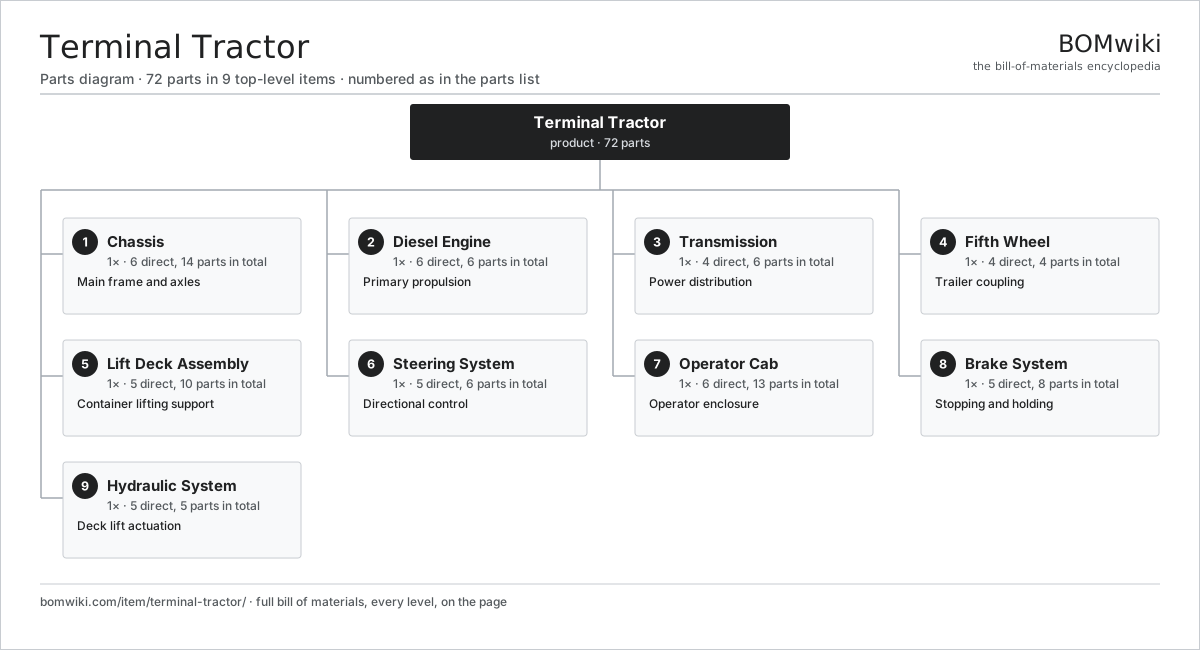
| # | Part | Qty | What it does |
|---|---|---|---|
| 1 | Chassis 6 parts | 1× | Main frame and axles |
| 2 | Diesel Engine 6 parts | 1× | Primary propulsion |
| 3 | Transmission 4 parts | 1× | Power distribution |
| 4 | Fifth Wheel 4 parts | 1× | Trailer coupling |
| 5 | Lift Deck Assembly 5 parts | 1× | Container lifting support |
| 6 | Steering System 5 parts | 1× | Directional control |
| 7 | Operator Cab 6 parts | 1× | Operator enclosure |
| 8 | Brake System 5 parts | 1× | Stopping and holding |
| 9 | Hydraulic System 5 parts | 1× | Deck lift actuation |
3D model
No 3D model yet. Have a CAD file of this? Add a 3D model. STL renders right on this page; STEP, FreeCAD, and OpenSCAD sources are welcome too (openly licensed, like all 3D models on BOMwiki).
Build & assembly graph
expand / collapse · shared sub-assemblies converge · links to related products · est. labourTap an assembly to expand/collapse · tap a part to open it · use “Open page” for any node · drag to pan, scroll to zoom.
Bill of materials for Terminal Tractor
9 top-level lines · 60 rows shown · 72 parts total · indented to 3 levels| # | Item / sub-assembly | Part no. | Qty/assy | Ext. qty | Parts | Type |
|---|---|---|---|---|---|---|
| 1 | Chassis 6 parts | terminal-tractor-chassis | 1× | 1 | 14 | assembly |
| 1.1 | Frame Rails | terminal-tractor-frame-rails | 2× | 2 | · | part |
| 1.2 | Cross Members | terminal-tractor-crossmembers | 3× | 3 | · | part |
| 1.3 | Front Axle | terminal-tractor-front-axle | 1× | 1 | · | part |
| 1.4 | Rear Axles | terminal-tractor-rear-axles | 2× | 2 | · | part |
| 1.5 | Suspension Assembly | terminal-tractor-suspension | 2× | 2 | · | part |
| 1.6 | Fastener Set | fastener-set | 4× | 4 | · | part |
| 2 | Diesel Engine 6 parts | terminal-tractor-diesel-engine | 1× | 1 | 6 | assembly |
| 2.1 | Engine Block | terminal-tractor-engine-block | 1× | 1 | · | part |
| 2.2 | Fuel System | terminal-tractor-fuel-system | 1× | 1 | · | part |
| 2.3 | Cooling System | terminal-tractor-cooling-system | 1× | 1 | · | part |
| 2.4 | Air Intake System | terminal-tractor-air-system | 1× | 1 | · | part |
| 2.5 | Radiator | radiator | 1× | 1 | · | part |
| 2.6 | Blower Motor | blower-motor | 1× | 1 | · | part |
| 3 | Transmission 4 parts | terminal-tractor-transmission | 1× | 1 | 6 | assembly |
| 3.1 | Transmission Box | terminal-tractor-transmission-box | 1× | 1 | · | part |
| 3.2 | Clutch Unit | terminal-tractor-clutch-unit | 1× | 1 | · | part |
| 3.3 | Exhaust Brake Valve | terminal-tractor-exhaust-brake | 1× | 1 | · | part |
| 3.4 | Helical Gear Pair | gear-pair | 3× | 3 | · | part |
| 4 | Fifth Wheel 4 parts | terminal-tractor-fifth-wheel | 1× | 1 | 4 | assembly |
| 4.1 | Fifth Wheel Plate | terminal-tractor-fifth-wheel-plate | 1× | 1 | · | part |
| 4.2 | Ball Coupling | terminal-tractor-ball-coupling | 1× | 1 | · | part |
| 4.3 | Locking Mechanism | terminal-tractor-locking-mechanism | 1× | 1 | · | part |
| 4.4 | Kingpin Slide | terminal-tractor-kingpin-slide | 1× | 1 | · | part |
| 5 | Lift Deck Assembly 5 parts | terminal-tractor-lift-deck | 1× | 1 | 10 | assembly |
| 5.1 | Deck Platform | terminal-tractor-deck-platform | 1× | 1 | · | part |
| 5.2 | Lift Cylinders | terminal-tractor-lift-cylinders | 2× | 2 | · | part |
| 5.3 | Deck Position Stops | terminal-tractor-deck-stops | 2× | 2 | · | part |
| 5.4 | Lock Keepers | terminal-tractor-lock-keepers | 4× | 4 | · | part |
| 5.5 | Pressure Sensor | pressure-sensor | 1× | 1 | · | part |
| 6 | Steering System 5 parts | terminal-tractor-steering-system | 1× | 1 | 6 | assembly |
| 6.1 | Steering Wheel | terminal-tractor-steering-wheel | 1× | 1 | · | part |
| 6.2 | Power Steering Pump | terminal-tractor-power-steering-pump | 1× | 1 | · | part |
| 6.3 | Steering Gear | terminal-tractor-steering-gear | 1× | 1 | · | part |
| 6.4 | Drag Link | terminal-tractor-drag-link | 1× | 1 | · | part |
| 6.5 | Tie Rods | terminal-tractor-tie-rods | 2× | 2 | · | part |
| 7 | Operator Cab 6 parts | terminal-tractor-cab | 1× | 1 | 13 | assembly |
| 7.1 | Cab Shell | terminal-tractor-cab-shell | 1× | 1 | · | part |
| 7.2 | Windshield | terminal-tractor-windshield | 1× | 1 | · | part |
| 7.3 | Door Assembly | terminal-tractor-door-assembly | 2× | 2 | · | part |
| 7.4 | Seat Assembly 5 parts | seat-assembly | 1× | 1 | 7 | assembly |
| 7.4.1 | Seat Frame | seat-frame | 1× | 1 | · | part |
| 7.4.2 | Seat Foam | seat-foam | 2× | 2 | · | part |
| 7.4.3 | Seat Cover | seat-cover | 1× | 1 | · | part |
| 7.4.4 | Seat Motor | seat-motor | 2× | 2 | · | part |
| 7.4.5 | Seat Heater Mat | seat-heater | 1× | 1 | · | part |
| 7.5 | Dashboard | terminal-tractor-dashboard | 1× | 1 | · | part |
| 7.6 | Lighting System | terminal-tractor-lights | 1× | 1 | · | part |
| 8 | Brake System 5 parts | terminal-tractor-brake-system | 1× | 1 | 8 | assembly |
| 8.1 | Air Compressor | terminal-tractor-air-compressor | 1× | 1 | · | part |
| 8.2 | Brake Air Tanks | terminal-tractor-brake-tanks | 1× | 1 | · | part |
| 8.3 | Brake Control Valve | terminal-tractor-brake-valves | 1× | 1 | · | part |
| 8.4 | Brake Cylinders | terminal-tractor-brake-cylinders | 4× | 4 | · | part |
| 8.5 | ABS Module | terminal-tractor-abs-module | 1× | 1 | · | part |
| 9 | Hydraulic System 5 parts | terminal-tractor-hydraulic-system | 1× | 1 | 5 | assembly |
| 9.1 | Hydraulic Pump | terminal-tractor-pump | 1× | 1 | · | part |
| 9.2 | Deck Control Valve | terminal-tractor-deck-control-valve | 1× | 1 | · | part |
| 9.3 | Hydraulic Reservoir | terminal-tractor-hydraulic-tank | 1× | 1 | · | part |
| 9.4 | Relief Valve | terminal-tractor-relief-valve | 1× | 1 | · | part |
| 9.5 | Hydraulic Hoses | terminal-tractor-hoses | 1× | 1 | · | part |
Something wrong in this list? Report a problem with this BOM.
Related products
same domain, ranked by shared parts Reach Stacker
71 parts · shares 9 with this page
Reach Stacker
71 parts · shares 9 with this page
 Straddle Carrier
122 parts · shares 9 with this page
Straddle Carrier
122 parts · shares 9 with this page
 Telehandler
349 parts · shares 7 with this page
Telehandler
349 parts · shares 7 with this page
 Forklift
4,153 parts · shares 7 with this page
Forklift
4,153 parts · shares 7 with this page
 Articulated Forklift
2,417 parts · shares 1 with this page
Articulated Forklift
2,417 parts · shares 1 with this page
 Bag Dump Station
134 parts · shares 1 with this page
Bag Dump Station
134 parts · shares 1 with this page
Sourcing: possible vendors
Browse the supplier directory → Prices, MOQ, and lead times are algorithmic estimates, not quotes, and not claims about these companies. Company mappings are curated by keyword; est. price band $2k–$300k. How estimates work| Vendor | HQ | Specialty | MOQ | Lead time |
|---|---|---|---|---|
| toyota-industries.com ↗ | Kariya, JP | Forklifts & logistics | 20 units | 10–16 wks |
| kiongroup.com ↗ | Frankfurt, DE | Forklifts (Linde, STILL) | 20 units | 10–16 wks |
| jungheinrich.com ↗ | Hamburg, DE | Warehouse trucks | 20 units | 10–16 wks |
| crown.com ↗ | New Bremen, US | Forklifts | 20 units | 10–16 wks |
|
🇨🇳Hangcha
hcforklift.com ↗
|
Hangzhou, CN | Forklifts & material handling | 20 units | 10–16 wks |
1,615-word article