Textile Laminating Machine
ProductOverview
A textile laminating machine bonds two or more fabric layers together using adhesive and pressure, creating composite structures with enhanced properties. Laminated textiles are used in automotive seat covers, apparel insulation, waterproof membranes, footwear, and industrial fabrics. The machine unwinds multiple fabric rolls, applies adhesive to one surface, passes the assembly through heated nip rollers, cools the bond, and rewinds the finished laminate.
Modern machines handle continuous roll-to-roll processing at speeds up to 60 m/minute for thin flexible laminates, though thicker composites run slower. The key challenge is uniform adhesive distribution and controlled bonding pressure while maintaining dimensional stability and preventing fiber distortion.
How It Works
The process begins with 2–3 input rolls mounted on separate shafts. Fabric unwinds at constant tension maintained by friction brakes. The first fabric passes under an adhesive applicator, which dispenses a thin, even adhesive film onto its surface.
The second (or third) fabric is positioned on top of the wet adhesive layer. The bonded assembly then passes between heated nip rollers, which apply pressure (typically 100–300 kN) and heat (100–180°C depending on adhesive type). Pressure forces adhesive into fabric interstices, and heat activates polymerization or coalescence of adhesive particles.
After nip bonding, the laminate enters a cooling zone where controlled air or water cooling sets the adhesive structure. Finally, the laminated fabric is rewound onto a take-up roll at the same speed as input to maintain zero slack and prevent wrinkles.
Adhesive Application Systems
The choice of adhesive application method affects cost and product quality:
Roller applicator (most common): An applicator roller rotating in an adhesive pan picks up adhesive and spreads it onto fabric as it rotates. Thickness is controlled by metering valve restricting pan depth.
Knife coating: A stationary blade scrapes excess adhesive from a saturated fabric, leaving a uniform film.
Slot-die: A precision nozzle extrudes adhesive directly onto fabric in a controlled width.
All methods feed from an adhesive reservoir containing 20–100 liters of adhesive, maintained at constant temperature (typically 20–40°C depending on viscosity requirements) using a filtration system removes contaminants, preventing clogging.
Nip Bonding
The nip roller assembly is the machine's core. The top roller is heated to process setpoint (80–180°C depending on adhesive), while the bottom roller may also be heated or cooled for specific processes. Both rollers are precision-ground steel with embedded heater cartridges or water jacket cooling.
A hydraulic or pneumatic actuator applies nip force, typically 100–300 kN (25–75 kN/m of width), creating a narrow pressure zone 2–5 mm long. Fabric speed, nip temperature, nip pressure, and dwell time must balance to ensure complete adhesive activation without degrading substrates.
Temperature sensors embedded in each nip roller provide feedback to a PID controller, which adjusts heater power to maintain ±1°C setpoint despite continuous material flow.
Temperature Management
Different adhesive systems require different activation temperatures:
- PU (polyurethane): Often moisture-curing; nip temperature 60–100°C.
- Acrylic: Heat-activated; nip temperature 100–140°C.
- Polyester: Melting-point adhesives; nip temperature 140–180°C.
Too low temperature results in incomplete cure and weak bonds; too high temperature risks fabric degradation (melting, scorching) or adhesive reticulation. The cooling section must dissipate heat rapidly to stabilize bond structure and prevent adhesive diffusion during winding.
Fabric Compatibility
Laminating machines handle natural fibers (cotton, wool, linen), synthetics (polyester, nylon, acrylic), and foam (polyurethane, polyethylene). Thicker substrates require higher nip pressure. Some foam laminates need careful speed control to prevent compression and subsequent expansion. Delicate fabrics require lower temperature and shorter dwell time.
Typical laminate constructions:
- Fabric-to-foam: 200 g/m² polyester with 10 mm PU foam backing (automotive seats).
- Fabric-to-fabric: 150 g/m² outer with 50 g/m² reinforcement liner (waterproof membranes).
- Multi-layer: Three fabrics bonded (reinforced composites).
Production Control
The main motor (5.5–15 kW) drives all rollers at synchronized speeds via belt transmission. A variable frequency drive allows speed adjustment from 10–60 m/minute depending on adhesive cure time and fabric stiffness. Operator controls:
- Speed (m/minute)
- Nip temperature (°C)
- Nip pressure (kN)
- Adhesive flow rate (ml/minute)
- Cooling fan or water circulation speed
Unwind tension brakes maintain constant input fabric tension. Floating dancer arms sense tension changes and adjust brake force automatically, compensating for diameter reduction as rolls deplete.
Quality Factors
Bond strength depends on adhesive coverage, nip pressure, temperature, and dwell time. Incomplete coverage creates weak spots; excessive adhesive increases cost and may transfer to the fabric surface (stickiness). Nip pressure must be uniform across the width; uneven pressure causes wavy edges or center buckle.
Fabric distortion is common if unwind tension is too low (fabric creases) or rewind speed varies (wrinkles). Proper tension control on all rollers is critical for dimensional stability.
Post-laminate cooling prevents adhesive migration into upper layers during winding. If the laminate is wound while hot, adhesive can diffuse and tacky layers may stick together during storage, requiring separation before use (undesirable in most applications).
Variants
- Hot-air laminating: Adhesive-coated fabric is pressed through heated air chamber instead of nip rollers; used for light weight, breathable laminates.
- Water-based adhesive machines: Require longer cooling zones for moisture evaporation.
- Foam laminating: Specialized machines with larger nip areas and lower pressures to prevent foam crushing.
Textile Laminating Machine parts and their functions
8 top-level parts · 69 parts in total · full bill of materials below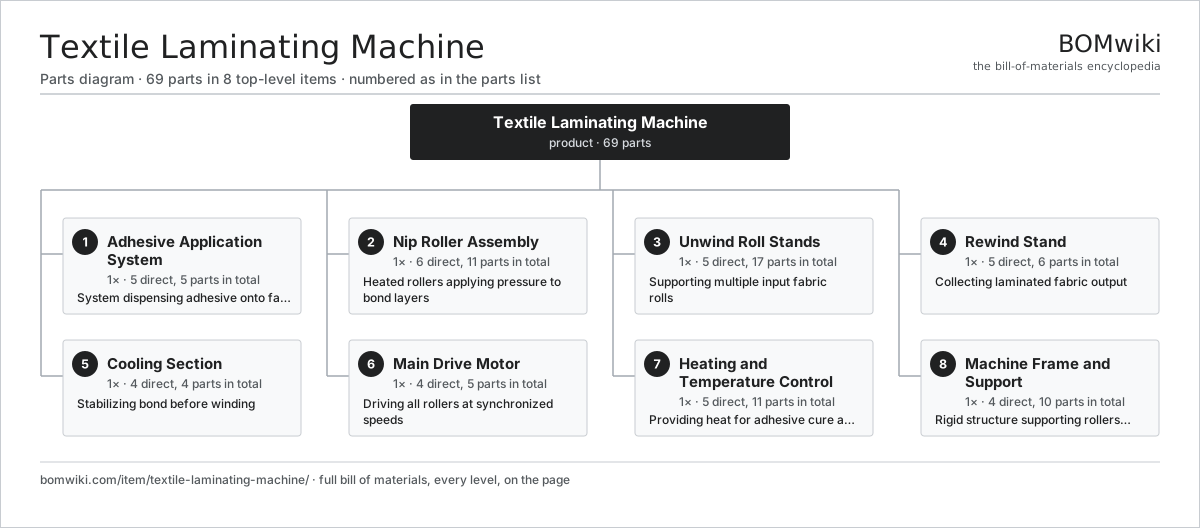
| # | Part | Qty | What it does |
|---|---|---|---|
| 1 | Adhesive Application System 5 parts | 1× | System dispensing adhesive onto fabric surfaces |
| 2 | Nip Roller Assembly 6 parts | 1× | Heated rollers applying pressure to bond layers |
| 3 | Unwind Roll Stands 5 parts | 1× | Supporting multiple input fabric rolls |
| 4 | Rewind Stand 5 parts | 1× | Collecting laminated fabric output |
| 5 | Cooling Section 4 parts | 1× | Stabilizing bond before winding |
| 6 | Main Drive Motor 4 parts | 1× | Driving all rollers at synchronized speeds |
| 7 | Heating and Temperature Control 5 parts | 1× | Providing heat for adhesive cure and nip pressure |
| 8 | Machine Frame and Support 4 parts | 1× | Rigid structure supporting rollers and heating elements |
3D model
No 3D model yet. Have a CAD file of this? Add a 3D model. STL renders right on this page; STEP, FreeCAD, and OpenSCAD sources are welcome too (openly licensed, like all 3D models on BOMwiki).
Build & assembly graph
expand / collapse · shared sub-assemblies converge · links to related products · est. labourTap an assembly to expand/collapse · tap a part to open it · use “Open page” for any node · drag to pan, scroll to zoom.
Bill of materials for Textile Laminating Machine
8 top-level lines · 46 rows shown · 69 parts total · indented to 3 levels| # | Item / sub-assembly | Part no. | Qty/assy | Ext. qty | Parts | Type |
|---|---|---|---|---|---|---|
| 1 | Adhesive Application System 5 parts | textile-laminating-machine-adhesive-application | 1× | 1 | 5 | assembly |
| 1.1 | Adhesive Pump | textile-laminating-machine-adhesive-pump | 1× | 1 | · | part |
| 1.2 | Adhesive Metering Head | textile-laminating-machine-adhesive-metering-head | 1× | 1 | · | part |
| 1.3 | Applicator Roller | textile-laminating-machine-roller-applicator | 1× | 1 | · | part |
| 1.4 | Adhesive Reservoir | textile-laminating-machine-adhesive-reservoir | 1× | 1 | · | part |
| 1.5 | Adhesive Filter | textile-laminating-machine-adhesive-filter | 1× | 1 | · | part |
| 2 | Nip Roller Assembly 6 parts | textile-laminating-machine-nip-roller-system | 1× | 1 | 11 | assembly |
| 2.1 | Top Nip Roller | textile-laminating-machine-nip-roller-top | 1× | 1 | · | part |
| 2.2 | Bottom Nip Roller | textile-laminating-machine-nip-roller-bottom | 1× | 1 | · | part |
| 2.3 | Nip Roller Shaft | textile-laminating-machine-roller-shaft | 2× | 2 | · | part |
| 2.4 | Pressure Control Cylinder | textile-laminating-machine-pressure-control-cylinder | 1× | 1 | · | part |
| 2.5 | Roller Thermocouple | textile-laminating-machine-roller-thermocouples | 2× | 2 | · | part |
| 2.6 | Ball Bearing | ball-bearing | 4× | 4 | · | part |
| 3 | Unwind Roll Stands 5 parts | textile-laminating-machine-unwind-stands | 1× | 1 | 17 | assembly |
| 3.1 | Unwind Roll Shaft | textile-laminating-machine-roll-shaft | 3× | 3 | · | part |
| 3.2 | Roll Holder Block | textile-laminating-machine-roll-holder-block | 3× | 3 | · | part |
| 3.3 | Unwind Tension Brake | textile-laminating-machine-tension-brake | 3× | 3 | · | part |
| 3.4 | Dancer Tension Arm | textile-laminating-machine-dancer-arm | 2× | 2 | · | part |
| 3.5 | Ball Bearing | ball-bearing | 6× | 6 | · | part |
| 4 | Rewind Stand 5 parts | textile-laminating-machine-rewind-stand | 1× | 1 | 6 | assembly |
| 4.1 | Rewind Drive Motor | textile-laminating-machine-rewind-motor | 1× | 1 | · | part |
| 4.2 | Rewind Output Shaft | textile-laminating-machine-rewind-shaft | 1× | 1 | · | part |
| 4.3 | Rewind Press Roller | textile-laminating-machine-rewind-nip-roller | 1× | 1 | · | part |
| 4.4 | Output Tension Arm | textile-laminating-machine-output-tension-control | 1× | 1 | · | part |
| 4.5 | Ball Bearing | ball-bearing | 2× | 2 | · | part |
| 5 | Cooling Section 4 parts | textile-laminating-machine-cooling-zone | 1× | 1 | 4 | assembly |
| 5.1 | Cooling Roller | textile-laminating-machine-cool-roller | 1× | 1 | · | part |
| 5.2 | Cooling Fan | textile-laminating-machine-cooling-fan | 1× | 1 | · | part |
| 5.3 | Water Circulation Pump | textile-laminating-machine-water-circulation-pump | 1× | 1 | · | part |
| 5.4 | Cooling Temperature Sensor | textile-laminating-machine-cool-temperature-sensor | 1× | 1 | · | part |
| 6 | Main Drive Motor 4 parts | textile-laminating-machine-drive-motor | 1× | 1 | 5 | assembly |
| 6.1 | Main Drive Motor | textile-laminating-machine-main-motor | 1× | 1 | · | part |
| 6.2 | Variable Frequency Drive | textile-laminating-machine-speed-control-vfd | 1× | 1 | · | part |
| 6.3 | Power Transmission | textile-laminating-machine-transmission-system | 1× | 1 | · | part |
| 6.4 | Relay | relay | 2× | 2 | · | part |
| 7 | Heating and Temperature Control 5 parts | textile-laminating-machine-heating-system | 1× | 1 | 11 | assembly |
| 7.1 | Heating Element | heating-element | 4× | 4 | · | part |
| 7.2 | PID Temperature Controller | textile-laminating-machine-pid-controller | 1× | 1 | · | part |
| 7.3 | Solid State Relay | textile-laminating-machine-solid-state-relay | 2× | 2 | · | part |
| 7.4 | Temperature Sensor | textile-laminating-machine-temperature-sensor | 3× | 3 | · | part |
| 7.5 | Microcontroller | mcu | 1× | 1 | · | part |
| 8 | Machine Frame and Support 4 parts | textile-laminating-machine-frame | 1× | 1 | 10 | assembly |
| 8.1 | Main Frame | textile-laminating-machine-main-frame | 1× | 1 | · | part |
| 8.2 | Sheet Metal Panel | sheet-panel | 4× | 4 | · | part |
| 8.3 | Vibration Isolator Foot | textile-laminating-machine-vibration-isolators | 4× | 4 | · | part |
| 8.4 | Fastener Set | fastener-set | 1× | 1 | · | part |
Something wrong in this list? Report a problem with this BOM.
Related products
same domain, ranked by shared parts Automatic Fabric Cutting Machine
1,695 parts · shares 2 with this page
Automatic Fabric Cutting Machine
1,695 parts · shares 2 with this page
 Digital Textile Printer
1,093 parts · shares 2 with this page
Fabric Coating Machine
316 parts · shares 2 with this page
FDY Filament Spinning Line
679 parts · shares 2 with this page
Digital Textile Printer
1,093 parts · shares 2 with this page
Fabric Coating Machine
316 parts · shares 2 with this page
FDY Filament Spinning Line
679 parts · shares 2 with this page
 Meltblown Nonwoven Line
933 parts · shares 2 with this page
Mercerizing Range
585 parts · shares 2 with this page
Meltblown Nonwoven Line
933 parts · shares 2 with this page
Mercerizing Range
585 parts · shares 2 with this page
Sourcing: possible vendors
Browse the supplier directory → Prices, MOQ, and lead times are algorithmic estimates, not quotes, and not claims about these companies. Company mappings are curated by keyword; est. price band $10k–$1M. How estimates work| Vendor | HQ | Specialty | MOQ | Lead time |
|---|---|---|---|---|
|
🇨🇭Rieter
rieter.com ↗
|
Winterthur, CH | Spinning machinery | 10 units | 14–24 wks |
| truetzschler.com ↗ | Mönchengladbach, DE | Textile machinery | 10 units | 14–24 wks |
|
🇧🇪Picanol
picanol.be ↗
|
Ypres, BE | Weaving machines | 10 units | 14–24 wks |
| karlmayer.com ↗ | Obertshausen, DE | Warp knitting machines | 10 units | 14–24 wks |
|
🇨🇭Saurer
saurer.com ↗
|
Arbon, CH | Spinning & embroidery | 10 units | 14–24 wks |
991-word article