Theater Fly System
ProductOverview
A theater fly system is a counterweight-assisted rope-and-pulley mechanism suspending theatrical scenery, lighting rigs, and special effects above a stage. By balancing the weight of scenery with metal counterweight blocks in a traveling Counterweight Arbor carriage, the system allows stagehands to raise and lower heavy sets with minimal hand-pull force, sometimes as little as 5–15 kg of operator effort for a 500+ kg scenic load.
The core principle is mechanical advantage through balance: Support Ropes suspend both the scenic Stage Battens above and the Counterweight Arbor counterweight assembly side-by-side, passing over a series of Pulley Blocks (pulleys) mounted to the overhead Overhead Grid. When configured for hand pull, a Manual or Motor Control rope tail extends down to stage level where crew members haul, raising the batten.
Overhead structure and grid
The Overhead Grid is a steel structural framework spanning the theater above the stage fly loft. Large Grid Beam (structural I-beams or trusses) provide the primary support; secondary Grid Frame welding and bracing hold the Loft Block pulley mounting points.
Typical theater grid heights are 10–25 m above the stage floor, allowing battens to be flown in and out of sight (above the "fly gallery" or top of the proscenium arch, typically 5–7 m above the stage). This overhead height provides both the mechanical reach for scenic effects and safety clearance from personnel below.
Counterweight arbors and guide system
Each fly line has a paired Counterweight Arbor carriage hanging in a vertical Guide Rail (C-channel, 150–200 mm profile). The arbor is a welded-steel cage holding stacked Weight Bar iron bars (standard 10 kg units, stackable). The arbor travels up and down via Arbor Roller wheels rolling inside the guide rails.
To balance a 500 kg scenic load, the operator loads 50 × 10 kg bars into the arbor (~500 kg total). The load on both the Stage Battens (above) and Counterweight Arbor (below) is now equal, creating a system in equilibrium: minimal hand effort raises either one, and gravity gently lowers either one.
Rope routing and pulley system
Steel Steel Wire Rope (6–10 mm diameter, 6×19 or 8×19S wire rope) connects the batten to the arbor through a series of fixed and moveable Pulley Blocks:
- Loft blocks: Fixed pulleys mounted to the Overhead Grid above the stage, routing rope from batten downward toward arbor.
- Head block: A large pulley at the downstage edge of the grid, redirecting rope horizontally toward the lock rail.
- Snatch blocks: Moveable pulleys on the scenic batten side, providing mechanical advantage (2:1 or greater if configured for multiple-part ropeway).
Each block contains Block Bearing (ball or roller bearing) allowing smooth rope travel, and is secured with Block Shackle stainless shackles or clevis pins to the grid framing.
Battens and rigging attachment
The Stage Battens are horizontal steel pipes (1.5–3" diameter Schedule 40, 3–15 m long) spanning the stage width. Lighting instruments, scenery, and special effects are secured to battens via theatrical rigging hardware: shackles, eye bolts, and Scenic Rigging rope-grab devices.
Lighting Rig modern theaters also rig aluminum truss and intelligent lighting fixtures to battens, allowing complex light shows suspended above audience view.
Rope Attachment secure the Steel Wire Rope to battens via wire clamps or eye bolts, with Rope Termination spliced or swaged rope ends rated for 100% of rope breaking strength.
Manual hand-pull operation
In traditional Manual or Motor Control hand-pull systems, the main rope passes up through the grid, over the head block, and extends downstage as a Hand Haul Rope rope tail (typically 25–32 mm diameter synthetic rope, 8–10 m long) guided by Rope Guide pulleys to convenient operator height on stage.
Stagehands grasp the hand-haul rope and pull downward; the rope moves through the block system, lowering the batten and simultaneously raising the arbor (or vice versa for raise). Because the batten and arbor are balanced, the pull force is modest, often just 10–20 kg for a 500+ kg batten.
Once positioned, the rope is secured at the Lock Rail System lock rail via Lock Mechanism friction locks or Cleat theatrical cleats, holding the batten steady for the duration of the scene.
Motorized operation
Modern theaters often install an optional Motor Hoist electric chain hoist (500 kg–2 tonne capacity) or wire-rope winch, controlled by a pendant switch and raising/lowering battens at 0.3–1.0 m/s. This increases crew efficiency and allows faster scene changes in fast-paced productions.
Safety and load monitoring
The Safety and Inspection Systems includes:
- Load pins: Load Pin load cell pins on batten rope terminations preventing overload operation.
- Rope guards: Rope Guard protective guards preventing contact with moving rope near loft blocks.
- Annual inspection: Inspection Schedule professional rigging inspector certifies all ropes, blocks, and arbors per ANSI E1.6 and local building codes.
- Operator training: Safety Manual comprehensive safety manual and crew training ensure safe handling.
Rope lifespan in theatrical service is typically 8–15 years, depending on use frequency and load cycling. Annual non-destructive inspection (visual and sometimes ultrasonic) detects wire breakage or hidden degradation.
Operational context
Theater fly systems are essential for:
- Scene automation: Raising/lowering full stage sets between acts.
- Special effects: Flying performers, lighting effects, suspended props.
- Lighting rigging: Supporting heavy lighting trusses and intelligent fixtures.
- Crew safety: Allowing ground-level scene changes without high-work platforms or cranes.
A typical stage may have 8–20 fly lines, each independently operated and balanced. During a complex production, cues are carefully marked and timed, with stagehands raising and lowering battens in precise sequence to match scene choreography. The simplicity and reliability of counterweight balance make it the standard for theatrical operations worldwide.
Theater Fly System parts and their functions
8 top-level parts · 1,454 parts in total · full bill of materials below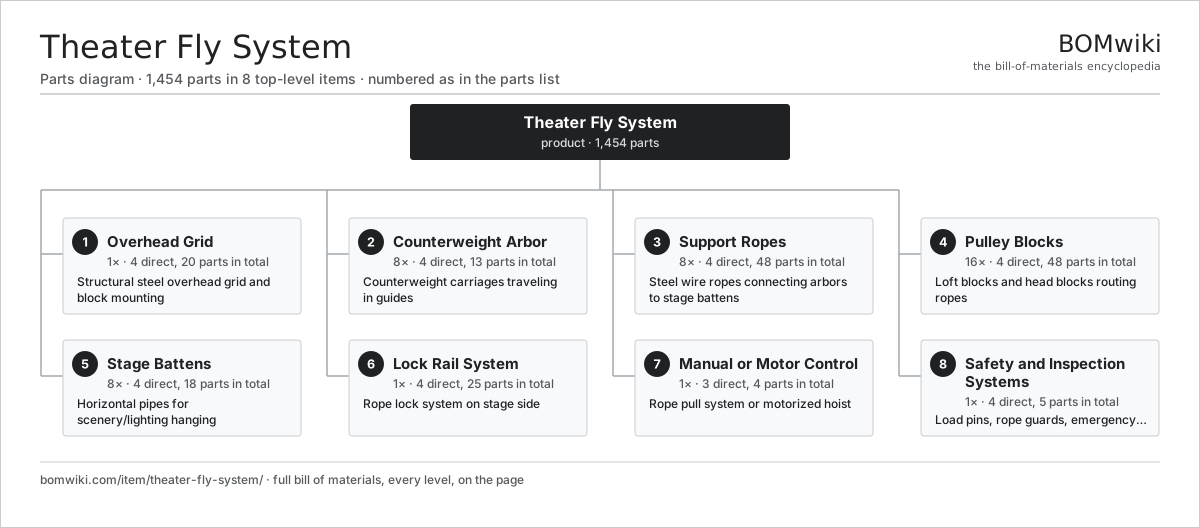
| # | Part | Qty | What it does |
|---|---|---|---|
| 1 | Overhead Grid 4 parts | 1× | Structural steel overhead grid and block mounting |
| 2 | Counterweight Arbor 4 parts | 8× | Counterweight carriages traveling in guides |
| 3 | Support Ropes 4 parts | 8× | Steel wire ropes connecting arbors to stage battens |
| 4 | Pulley Blocks 4 parts | 16× | Loft blocks and head blocks routing ropes |
| 5 | Stage Battens 4 parts | 8× | Horizontal pipes for scenery/lighting hanging |
| 6 | Lock Rail System 4 parts | 1× | Rope lock system on stage side |
| 7 | Manual or Motor Control 3 parts | 1× | Rope pull system or motorized hoist |
| 8 | Safety and Inspection Systems 4 parts | 1× | Load pins, rope guards, emergency stops |
Diagrams & photos


3D model
No 3D model yet. Have a CAD file of this? Add a 3D model. STL renders right on this page; STEP, FreeCAD, and OpenSCAD sources are welcome too (openly licensed, like all 3D models on BOMwiki).
Build & assembly graph
expand / collapse · shared sub-assemblies converge · links to related products · est. labourTap an assembly to expand/collapse · tap a part to open it · use “Open page” for any node · drag to pan, scroll to zoom.
Bill of materials for Theater Fly System
8 top-level lines · 39 rows shown · 1,454 parts total · indented to 3 levels| # | Item / sub-assembly | Part no. | Qty/assy | Ext. qty | Parts | Type |
|---|---|---|---|---|---|---|
| 1 | Overhead Grid 4 parts | theater-fly-system-grid | 1× | 1 | 20 | assembly |
| 1.1 | Grid Beam | theater-fly-system-grid-beams | 2× | 2 | · | part |
| 1.2 | Grid Frame | theater-fly-system-grid-frame | 1× | 1 | · | part |
| 1.3 | Loft Block | theater-fly-system-loft-blocks | 16× | 16 | · | part |
| 1.4 | Head Block | theater-fly-system-head-block | 1× | 1 | · | part |
| 2 | Counterweight Arbor 4 parts | theater-fly-system-arbor | 8× | 8 | 13 | assembly |
| 2.1 | Arbor Frame | theater-fly-system-arbor-frame | 1× | 8 | · | part |
| 2.2 | Weight Bar | theater-fly-system-weight-bar | 6× | 48 | · | part |
| 2.3 | Guide Rail | theater-fly-system-guide-rail | 2× | 16 | · | part |
| 2.4 | Arbor Roller | theater-fly-system-arbor-roller | 4× | 32 | · | part |
| 3 | Support Ropes 4 parts | theater-fly-system-ropes | 8× | 8 | 48 | assembly |
| 3.1 | Steel Wire Rope | theater-fly-system-steel-rope | 8× | 64 | · | part |
| 3.2 | Synthetic Rope | theater-fly-system-synthetic-rope | 8× | 64 | · | part |
| 3.3 | Rope Attachment | theater-fly-system-rope-attachment | 16× | 128 | · | part |
| 3.4 | Rope Termination | theater-fly-system-rope-termination | 16× | 128 | · | part |
| 4 | Pulley Blocks 4 parts | theater-fly-system-blocks | 16× | 16 | 48 | assembly |
| 4.1 | Snatch Block | theater-fly-system-snatch-block | 4× | 64 | · | part |
| 4.2 | Fixed Block | theater-fly-system-fixed-block | 12× | 192 | · | part |
| 4.3 | Block Bearing | theater-fly-system-block-bearing | 16× | 256 | · | part |
| 4.4 | Block Shackle | theater-fly-system-block-shackle | 16× | 256 | · | part |
| 5 | Stage Battens 4 parts | theater-fly-system-battens | 8× | 8 | 18 | assembly |
| 5.1 | Batten Pipe | theater-fly-system-batten-pipe | 8× | 64 | · | part |
| 5.2 | Batten Hanger | theater-fly-system-batten-hanger | 8× | 64 | · | part |
| 5.3 | Scenic Rigging | theater-fly-system-scenic-rigging | 1× | 8 | · | part |
| 5.4 | Lighting Rig | theater-fly-system-lighting-rig | 1× | 8 | · | part |
| 6 | Lock Rail System 4 parts | theater-fly-system-lock-rail | 1× | 1 | 25 | assembly |
| 6.1 | Lock Rail | theater-fly-system-lock-rail-rail | 1× | 1 | · | part |
| 6.2 | Lock Mechanism | theater-fly-system-lock-mechanism | 8× | 8 | · | part |
| 6.3 | Rope Tie-Off | theater-fly-system-rope-tie-off | 8× | 8 | · | part |
| 6.4 | Cleat | theater-fly-system-cleat | 8× | 8 | · | part |
| 7 | Manual or Motor Control 3 parts | theater-fly-system-manual-control | 1× | 1 | 4 | assembly |
| 7.1 | Hand Haul Rope | theater-fly-system-hand-haul | 1× | 1 | · | part |
| 7.2 | Rope Guide | theater-fly-system-rope-guide | 2× | 2 | · | part |
| 7.3 | Motor Hoist | theater-fly-system-motor-hoist | 1× | 1 | · | part |
| 8 | Safety and Inspection Systems 4 parts | theater-fly-system-safety-equipment | 1× | 1 | 5 | assembly |
| 8.1 | Load Pin | theater-fly-system-load-pin | 2× | 2 | · | part |
| 8.2 | Rope Guard | theater-fly-system-rope-guard | 1× | 1 | · | part |
| 8.3 | Inspection Schedule | theater-fly-system-inspection-schedule | 1× | 1 | · | part |
| 8.4 | Safety Manual | theater-fly-system-safety-briefing | 1× | 1 | · | part |
Something wrong in this list? Report a problem with this BOM.
Sourcing: possible vendors
Browse the supplier directory → Prices, MOQ, and lead times are algorithmic estimates, not quotes, and not claims about these companies. Company mappings are curated by keyword; est. price band $10k–$200k. How estimates work| Vendor | HQ | Specialty | MOQ | Lead time |
|---|---|---|---|---|
|
🇺🇸Otis
otis.com ↗
|
Farmington, US | Elevators & escalators | 20 units | 14–24 wks |
| schindler.com ↗ | Ebikon, CH | Elevators & escalators | 20 units | 14–24 wks |
|
🇫🇮KONE
kone.com ↗
|
Espoo, FI | Elevators & escalators | 20 units | 14–24 wks |
| tkelevator.com ↗ | Düsseldorf, DE | Elevators | 20 units | 14–24 wks |
| mitsubishielectric.com ↗ | Tokyo, JP | Elevators & electronics | 20 units | 14–24 wks |
1,063-word article