Throwline Launcher
ProductOverview
A throwline launcher is a specialized pneumatic device designed to project a weighted rescue line across swift-water hazards, ravines, or to stranded victims beyond normal throwing distance. The launcher uses compressed gas (typically CO2 or air) to propel a projectile (100–300 g) carrying a rescue line at speeds of 40–80 m/s, achieving effective range of 20–60 meters depending on model and operator skill. The rescue line remains attached to the projectile via a breakaway link; once the victim grasps the line, the projectile separates and the line serves as a haul path for extrication or self-rescue.
Throwline launchers are standard equipment in swift-water rescue teams, mountain rescue operations, and situations where victims are separated from rescuers by water, terrain, or width that exceeds human throwing capability (~12 meters for an athletic person).
Design Architecture
Pressure Chamber and Barrel
The barrel chamber is a sealed pressure vessel where the propellant gas (typically CO2 at 30–70 bar) is stored and released. The barrel tube is typically steel or aluminum, 30–40 mm ID and 400–600 mm long. Internal surfaces are polished and hard-anodized to reduce friction during projectile flight and to prevent gas leakage around the projectile.
The breech block is a removable end cap that closes the barrel for projectile loading. A breach seal (high-durometer O-ring) maintains pressure integrity during firing. When the trigger is pulled, the breech block remains closed and the propellant is released, driving the projectile down the barrel and out the muzzle.
Firing Mechanism and Safety
The firing mechanism is the trigger-controlled release system. In most models, pulling the trigger opens a release solenoid or mechanical poppet valve that connects the pressurized chamber to the space behind the projectile. The rapid pressure differential accelerates the projectile toward the muzzle.
A spring return mechanism and return spring provide trigger feel and automatic reset to the safe (unpressed) position. Modern designs include electronic safeties: the launcher cannot be fired unless charged, and the trigger is mechanically blocked until a dedicated safety switch is released.
Projectile Engineering
The projectile is a crucial design element. It must be:
- Aerodynamic: A streamlined cone or bullet shape (100–300 g) minimizes drag and maintains range at distance.
- Impact-Safe: An impact absorber (foam or rubber pad) on the nose reduces the trauma of impact for a person struck in the head or torso. Modern projectiles are designed to cause minimal injury even at full range.
- Low-Profile: Small enough to fit the barrel (30–40 mm ID) but heavy enough to carry the line.
The projectile is typically composite (aramid-phenolic), aluminum, or high-density plastic. The line attachment lug is a welded or molded loop on the projectile where the rescue line is connected via carabiner or snap hook.
Line Storage and Deployment
The line canister is a woven nylon or mesh bag (2–5 liter capacity) attached to the launcher barrel. The rescue line (typically 6–8 mm polypropylene or polyester, 50–100 meters long) is loosely packed in the canister. As the projectile launches and accelerates, the line pulls smoothly from the canister, preventing tangles and allowing rapid deployment.
A spool guide (rod or plate) maintains controlled line tension during canister feed. The line guide at the canister outlet is a smooth, large-diameter ring preventing line snags. This design allows even untrained operators to launch the line without tangling, critical in emergency situations.
Propellant System
Most commercial launchers use disposable CO2 cartridges (16 g or 25 g), similar to those in paintball guns. A cartridge puncture mechanism pierces the seal on a fresh cartridge, releasing gas at full pressure (60 bar). The regulator valve reduces and stabilizes this pressure to a consistent working pressure (30–40 bar), ensuring uniform launch velocity across multiple shots from the same cartridge.
Professional or high-volume units use rechargeable air tanks (4.5 liters at 200 bar), allowing dozens of launches per fill and lower operating cost. Tank-based systems are heavier but offer superior consistency and are preferred by dedicated rescue teams.
Aiming and Sighting
The sighting system comprises front and rear sights mounted on a rail. The front sight is a simple bead (often fluorescent orange or high-visibility), and the rear sight is adjustable for windage (side drift) and elevation (range). Experienced operators can achieve ±2 m accuracy at 50 meters with proper technique.
Modern sighting rails follow mil-spec picatinny standards, allowing mounted optics (red-dot scopes, magnified sight) for improved accuracy in dim conditions or at maximum range. Some rescue teams mount laser rangefinders or illuminators for night operations.
Operating Principles and Technique
Pre-Launch Setup
- The launcher is inspected for cracks or damage.
- A fresh CO2 cartridge is installed or the air tank is checked for adequate charge.
- The rescue line is loaded in the canister and a test pull confirms smooth feeding.
- The projectile is inserted into the breech and the breech block is closed and latched.
- The launcher is sighted at the target, accounting for distance, wind, and elevation.
Launch Sequence
- The safety lever is switched to "Fire."
- The trigger is pulled steadily, avoiding jerking or anticipation.
- The launcher fires, accelerating the projectile to 40–80 m/s.
- The projectile leaves the muzzle and the rescue line trails behind from the canister.
- Flight time is typically 1–2 seconds to reach 50 meters.
Victim Contact and Recovery
- The victim catches the projectile and/or grasps the rescue line.
- A breakaway link (shear-pin or Velcro coupling) separates the projectile from the line once the victim pulls with force.
- The victim is instructed to wrap the line around a fixed object (a tree, rock outcrop) or to hold fast while rescuers establish a hauling system.
- Once secured, rescuers either pull the victim to safety or deploy a mechanical advantage pulley system to assist if the victim is injured or unconscious.
Factors Affecting Range and Accuracy
Distance Limitations
Theoretical range follows projectile physics: a 200 g projectile at 60 m/s achieves ~183 meters in vacuum. In air, drag reduces effective range to 20–60 meters depending on:
- Projectile Weight: Heavier projectiles (300 g) travel farther but are harder to catch and more dangerous.
- Launch Pressure: Higher pressure (70 bar) extends range by ~20%.
- Line Weight: Heavier rescue line (thicker) increases air resistance and reduces range by 10–20%.
- Elevation Angle: Optimal angle is typically 30–45° for maximum range; lower angles improve accuracy at close range.
Wind and Environmental Factors
A 10 m/s crosswind deflects a projectile by 1–2 meters at 50 meters range. Rescue teams train extensively on wind compensation. Some advanced launchers use laser rangefinders and wind-speed inputs to calculate firing angles automatically.
Operator Training
A skilled rescue operator can achieve ±2 meter accuracy at 50 meters. Untrained persons typically achieve ±10 meter accuracy. Training emphasizes:
- Trigger control: smooth press, avoiding jerking.
- Sight alignment: proper eye focus on the rear sight.
- Breath control: holding breath during the final trigger squeeze.
- Wind reading: observing ripples on water or tree movement.
Safety Considerations
Impact Energy and Injury Risk
A 200 g projectile at 60 m/s carries 360 joules of kinetic energy. Impact force depends on contact duration and impact surface. A projectile striking bare skin or soft tissue can cause severe bruising, lacerations, or concussion. However, the impact absorber foam/rubber pad reduces peak force by 40–60%, and training stresses aiming for the chest or abdomen (higher pain tolerance) rather than the head.
In rare cases, a victim with severe hypothermia or unconsciousness may not be able to catch the projectile safely. In such scenarios, rescuers establish a direct rope system (swimmer-deployed, or paddled rescue boat) instead.
Launcher Pressure Safety
The barrel is designed for 3–4× the operating pressure (~100–250 bar). Cartridges are engineered to fail-safe: over-pressurization results in seal rupture or relief valve pop rather than barrel rupture. Modern launchers include a release solenoid with mechanical override: the solenoid must be energized for the launcher to fire, preventing accidental discharge if the electrical system fails.
Range and Environmental Compliance
Some jurisdictions treat pneumatic line guns as "weapons" and restrict their use or licensing. Rescue teams typically obtain permits or operate under emergency operations authority. In international incidents (e.g., maritime rescue), advance clearance with coast guards is essential.
Variations and Applications
Distance-Optimized Launchers
Purpose-built units for maximum range (40–60 m) use heavier, lower-drag projectiles and higher pressures. These are typical in ocean rescue, where distances are greater.
Accuracy-Optimized Launchers
Designed for confined rivers or narrow ravines where distance is 15–30 m but accuracy is critical. Often include optical sights and heavier damping to reduce recoil vibration.
Multi-Shot Capability
Professional units allow rapid cartridge swapping (30–60 second reload) or use multi-chamber designs, enabling 3–5 shots before re-pressurizing.
Integrated Systems
Some modern rescue setups integrate the launcher with electronic distance and wind sensors, calculating firing angle automatically and displaying it via a display panel.
Throwline Launcher parts and their functions
7 top-level parts · 27 parts in total · full bill of materials below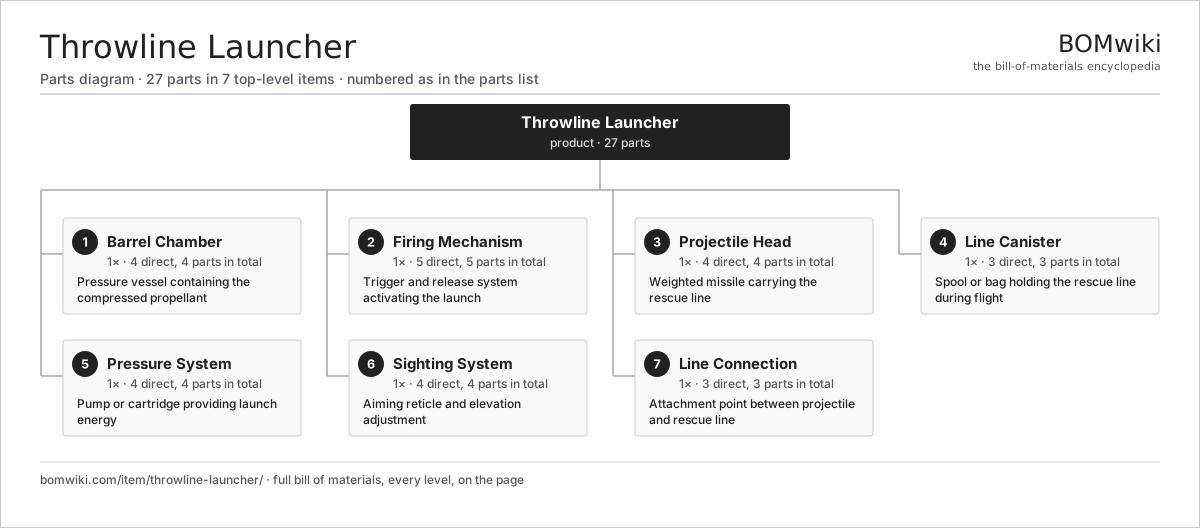
| # | Part | Qty | What it does |
|---|---|---|---|
| 1 | Barrel Chamber 4 parts | 1× | Pressure vessel containing the compressed propellant |
| 2 | Firing Mechanism 5 parts | 1× | Trigger and release system activating the launch |
| 3 | Projectile Head 4 parts | 1× | Weighted missile carrying the rescue line |
| 4 | Line Canister 3 parts | 1× | Spool or bag holding the rescue line during flight |
| 5 | Pressure System 4 parts | 1× | Pump or cartridge providing launch energy |
| 6 | Sighting System 4 parts | 1× | Aiming reticle and elevation adjustment |
| 7 | Line Connection 3 parts | 1× | Attachment point between projectile and rescue line |
3D model
No 3D model yet. Have a CAD file of this? Add a 3D model. STL renders right on this page; STEP, FreeCAD, and OpenSCAD sources are welcome too (openly licensed, like all 3D models on BOMwiki).
Build & assembly graph
expand / collapse · shared sub-assemblies converge · links to related products · est. labourTap an assembly to expand/collapse · tap a part to open it · use “Open page” for any node · drag to pan, scroll to zoom.
Bill of materials for Throwline Launcher
7 top-level lines · 34 rows shown · 27 parts total · indented to 3 levels| # | Item / sub-assembly | Part no. | Qty/assy | Ext. qty | Parts | Type |
|---|---|---|---|---|---|---|
| 1 | Barrel Chamber 4 parts | throwline-launcher-barrel-chamber | 1× | 1 | 4 | assembly |
| 1.1 | Barrel Tube | throwline-launcher-barrel-tube | 1× | 1 | · | part |
| 1.2 | Breech Block | throwline-launcher-breech-block | 1× | 1 | · | part |
| 1.3 | Breach Seal | throwline-launcher-breach-seal | 1× | 1 | · | part |
| 1.4 | Fastener Set | fastener-set | 1× | 1 | · | part |
| 2 | Firing Mechanism 5 parts | throwline-launcher-firing-mechanism | 1× | 1 | 5 | assembly |
| 2.1 | Trigger Lever | throwline-launcher-trigger-lever | 1× | 1 | · | part |
| 2.2 | Release Solenoid | throwline-launcher-release-solenoid | 1× | 1 | · | part |
| 2.3 | Spring Return | throwline-launcher-spring-return | 1× | 1 | · | part |
| 2.4 | Coil Spring | coil-spring | 1× | 1 | · | part |
| 2.5 | Fastener Set | fastener-set | 1× | 1 | · | part |
| 3 | Projectile Head 4 parts | throwline-launcher-projectile-head | 1× | 1 | 4 | assembly |
| 3.1 | Head Body | throwline-launcher-head-body | 1× | 1 | · | part |
| 3.2 | Impact Absorber | throwline-launcher-impact-absorber | 1× | 1 | · | part |
| 3.3 | Line Attachment Lug | throwline-launcher-line-attachment-lug | 1× | 1 | · | part |
| 3.4 | Fastener Set | fastener-set | 1× | 1 | · | part |
| 4 | Line Canister 3 parts | throwline-launcher-line-canister | 1× | 1 | 3 | assembly |
| 4.1 | Canister Body | throwline-launcher-canister-body | 1× | 1 | · | part |
| 4.2 | Spool Guide | throwline-launcher-spool-guide | 1× | 1 | · | part |
| 4.3 | Line Guide | throwline-launcher-line-guide | 1× | 1 | · | part |
| 5 | Pressure System 4 parts | throwline-launcher-pressure-system | 1× | 1 | 4 | assembly |
| 5.1 | Air Cartridge | throwline-launcher-air-cartridge | 1× | 1 | · | part |
| 5.2 | Cartridge Puncture | throwline-launcher-cartridge-puncture | 1× | 1 | · | part |
| 5.3 | Regulator Valve | throwline-launcher-regulator-valve | 1× | 1 | · | part |
| 5.4 | Fastener Set | fastener-set | 1× | 1 | · | part |
| 6 | Sighting System 4 parts | throwline-launcher-sighting-system | 1× | 1 | 4 | assembly |
| 6.1 | Sight Rail | throwline-launcher-sight-rail | 1× | 1 | · | part |
| 6.2 | Front Sight | throwline-launcher-front-sight | 1× | 1 | · | part |
| 6.3 | Rear Sight | throwline-launcher-rear-sight | 1× | 1 | · | part |
| 6.4 | Fastener Set | fastener-set | 1× | 1 | · | part |
| 7 | Line Connection 3 parts | throwline-launcher-line-connection | 1× | 1 | 3 | assembly |
| 7.1 | Connection Snap | throwline-launcher-connection-snap | 1× | 1 | · | part |
| 7.2 | Breakaway Link | throwline-launcher-breakaway-link | 1× | 1 | · | part |
| 7.3 | Line Guide Ring | throwline-launcher-line-guide-ring | 1× | 1 | · | part |
Something wrong in this list? Report a problem with this BOM.
Related products
same domain, ranked by shared parts Air Ambulance Helicopter
150 parts · shares 1 with this page
Air Ambulance Helicopter
150 parts · shares 1 with this page
 Emergency Escape Breathing Apparatus
23 parts · shares 1 with this page
Emergency Escape Breathing Apparatus
23 parts · shares 1 with this page
 Emergency Eyewash Station
89 parts · shares 1 with this page
Emergency Eyewash Station
89 parts · shares 1 with this page
 Evacuation Chair
87 parts · shares 1 with this page
Evacuation Chair
87 parts · shares 1 with this page
 Fire Extinguisher
26 parts · shares 1 with this page
Fire Extinguisher
26 parts · shares 1 with this page
 Fire Hydrant
42 parts · shares 1 with this page
Fire Hydrant
42 parts · shares 1 with this page
Sourcing: possible vendors
Browse the supplier directory → Prices, MOQ, and lead times are algorithmic estimates, not quotes, and not claims about these companies. Company mappings are curated by keyword; est. price band $30–$1M. How estimates work| Vendor | HQ | Specialty | MOQ | Lead time |
|---|---|---|---|---|
| rosenbauer.com ↗ | Leonding, AT | Fire apparatus | 200 units | 8–14 wks |
|
🇺🇸Oshkosh
oshkoshcorp.com ↗
|
Oshkosh, US | Specialty trucks (Pierce) | 200 units | 8–14 wks |
| msasafety.com ↗ | Cranberry Township, US | Safety equipment | 200 units | 8–14 wks |
|
🇩🇪Dräger
draeger.com ↗
|
Lübeck, DE | Safety & medical tech | 200 units | 8–14 wks |
| honeywell.com ↗ | Charlotte, US | Building & safety tech | 200 units | 8–14 wks |
1,616-word article