Torsion Testing Machine
ProductOverview
A torsion testing machine applies controlled rotational loading (twisting) to cylindrical or tubular specimens, measuring torque and angular displacement to determine torsional shear properties and generate shear stress-strain curves. The apparatus consists of a servo-controlled rotating chuck (motor-driven, 1–100 rpm) gripping one end of the specimen, a fixed tailstock chuck gripping the other end, an inline torque transducer (strain-gauge load cell, ±1% accuracy), a rotary encoder measuring twist angle (±0.1° resolution), and a real-time controller executing monotonic ramp, cyclic, or fatigue test profiles.
Torsion testing is essential for shafts, fasteners, wire products, and structural members subjected to twisting loads. The test generates the shear modulus (G), shear yield strength (τy), and ultimate shear strength (τmax), which are critical for fatigue design, thread strength verification, and material selection in rotating machinery.
How it works
The specimen (typically 3–12 mm diameter, 50–100 mm gauge length, marked with witness lines for angle measurement) is clamped in the Rotating Chuck Assembly (motor-driven collet) at one end and the Tailstock Chuck (fixed collet) at the other. The collet sets are hardened steel with <0.05 mm runout to prevent bending moments that would corrupt the pure-torsion test.
The Drive Motor (AC servo motor, 3–5 kW) and Planetary Reducer (planetary gearbox, 10:1 or 20:1) drive the rotating chuck at a programmable speed (1–100 rpm, set by the Real-Time Control Module real-time processor). As the chuck rotates, the specimen twists (shears), and stress develops in the material.
An inline Torque Measurement Cell transducer (mounted on or integrated with the rotating chuck axis) measures the applied torque with ±1% accuracy via strain-gauge bridge. A Angle Encoder Assembly (1024+ PPR rotary encoder) mounted on the chuck shaft counts pulses to measure angular displacement with ±0.1° resolution.
The Real-Time Control Module closes a feedback loop at 1 kHz, comparing commanded torque or rotation-rate to the measured values and adjusting motor speed via the Motor Controller servo drive. Test profiles include:
- Monotonic Ramp: Steady rotation at constant angular velocity (e.g., 10 rpm) until specimen failure, generating a single shear stress-strain curve.
- Cyclic/Fatigue: Sinusoidal torque oscillation (e.g., ±500 N·m at 1 Hz) for thousands of cycles to map torsional fatigue strength.
- Controlled Strain Rate: Rotation rate adjusted to maintain constant shear strain rate (e.g., 0.1 s⁻¹) despite material stiffness variation during strain hardening.
The Data Acquisition Module module logs torque and angle at ≥100 Hz to an SD card or USB storage, enabling post-test calculation of:
Shear Stress (τ) = (Torque × Radius) ÷ Polar Moment of Inertia (J) Shear Strain (γ) = (Radius × Angle in Radians) ÷ Gauge Length
These are plotted as a shear stress-strain curve, determining the linear elastic region (shear modulus G = Δτ/Δγ), yield point, and ultimate shear strength.
Failure detection is triggered when torque drops sharply (specimen separated or necked) or when angle reaches a maximum limit (to prevent uncontrolled buckling). The controller auto-saves the test data and triggers optional high-speed video or photo capture of the failure mode.
Specimen types and stress concentration
Common torsion test specimens include:
- Round Bar (ASTM E143): Solid cylinder, gauge length 50 mm, diameter 3–12 mm.
- Tubular Specimen: Hollow cylinder simulating shafts, with inner and outer diameter constraints.
- Fastener (Bolt/Screw): Full-size or reduced-shank fastener to assess thread shear strength.
- Wire: Small diameter (0.5–3 mm) twisted until fracture to determine wire toughness.
Stress concentration at the grip-specimen interface is a common source of error: if the collet grip is too shallow or off-center, a bending moment superimposes on the pure-torsion state, yielding false low results. Most standards (ASTM E143) require ≥3 specimen diameters of grip length to ensure pure torsion in the gauge section.
Shear modulus and material characterization
The linear elastic region of the torsion test yields the shear modulus (G), which is related to Young's modulus (E) and Poisson's ratio (ν) by:
G = E ÷ (2(1 + ν))
For steel, G ≈ 80 GPa; for aluminum, G ≈ 26 GPa. Deviations from expected G values can indicate material degradation, cold work, or heat-treatment issues. Quality-control labs often perform miniature torsion tests on retained samples from production batches to verify mechanical property consistency.
Cyclic torsion and fatigue
Cyclic torsion testing generates shear fatigue S-N curves, analogous to axial fatigue. Many components (shafts, fasteners) fail in combined torsion and bending under in-service loading. The machine applies sinusoidal torque oscillation (e.g., ±500 N·m at 0.5–5 Hz) for 10⁴ to 10⁷ cycles, logging peak/valley torque and cycle count. Failure is detected via sudden torque drop (crack propagation) or reaching a cycle limit (no failure, pass/no-fail criterion).
Goodman or Haigh diagrams plot mean torque versus torque amplitude to show torsional fatigue strength under different mean stress conditions. Rotating-bending fatigue (used for shafts) is complemented by torsional fatigue data to assess the combined-stress envelope for design.
Testing fasteners: thread stripping and prevailing torque
Torsion machines are used to measure bolt and screw strength per ISO 898 or ASTM F606. A fastener is twisted in the test machine until the head separates (thread stripping failure) or the fastener fractures. The maximum torque is recorded and compared to proof-load requirements (e.g., Grade 8.8 M10 bolt must sustain ≥70 N·m without permanent deformation).
Prevailing-torque tests on self-locking fasteners (nylon-insert locknuts) measure the frictional resistance to rotation, verifying that locknuts maintain their locking property after thermal cycling or salt-spray corrosion.
Elevated-temperature torsion
Optional environmental chambers (electric heater + insulated enclosure) heat the specimen and gauge section to 20–200°C, enabling temperature-dependent shear modulus and fatigue strength assessment. Temperature control ±2°C during multi-hour cyclic tests is critical to avoid scatter in fatigue life due to thermal expansion or viscous-damping effects.
Modern torsion machines integrate with LIMS for automated batch testing and design-curve generation, enabling probabilistic fatigue-life prediction (Weibull analysis) on multiple samples at each torque level.
Torsion Testing Machine parts and their functions
7 top-level parts · 22 parts in total · full bill of materials below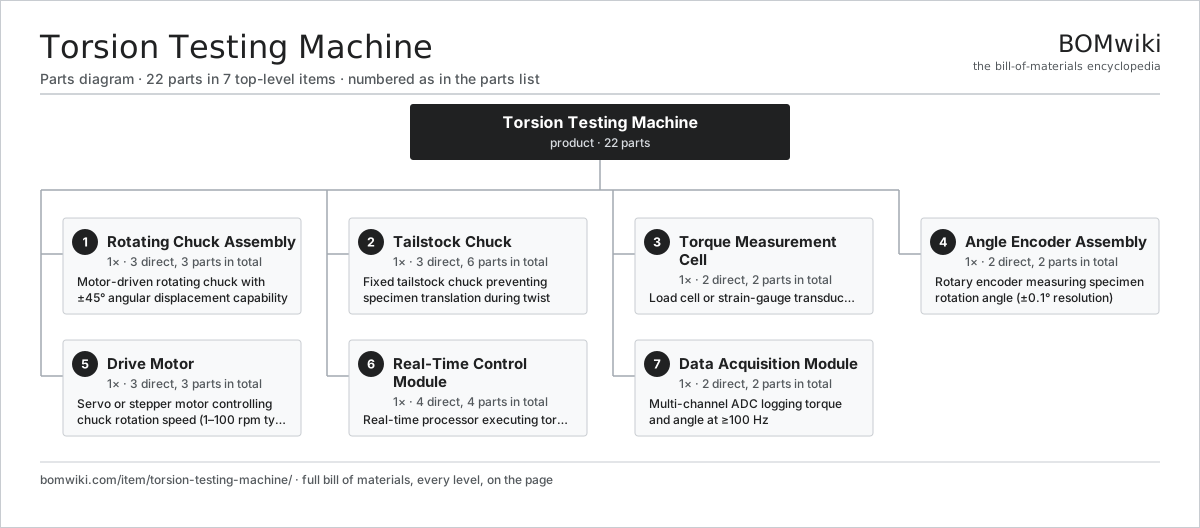
| # | Part | Qty | What it does |
|---|---|---|---|
| 1 | Rotating Chuck Assembly 3 parts | 1× | Motor-driven rotating chuck with ±45° angular displacement capability |
| 2 | Tailstock Chuck 3 parts | 1× | Fixed tailstock chuck preventing specimen translation during twist |
| 3 | Torque Measurement Cell 2 parts | 1× | Load cell or strain-gauge transducer measuring applied torque |
| 4 | Angle Encoder Assembly 2 parts | 1× | Rotary encoder measuring specimen rotation angle (±0.1° resolution) |
| 5 | Drive Motor 3 parts | 1× | Servo or stepper motor controlling chuck rotation speed (1–100 rpm typical) |
| 6 | Real-Time Control Module 4 parts | 1× | Real-time processor executing torque-ramp profiles and angle measurement |
| 7 | Data Acquisition Module 2 parts | 1× | Multi-channel ADC logging torque and angle at ≥100 Hz |
3D model
No 3D model yet. Have a CAD file of this? Add a 3D model. STL renders right on this page; STEP, FreeCAD, and OpenSCAD sources are welcome too (openly licensed, like all 3D models on BOMwiki).
Build & assembly graph
expand / collapse · shared sub-assemblies converge · links to related products · est. labourTap an assembly to expand/collapse · tap a part to open it · use “Open page” for any node · drag to pan, scroll to zoom.
Bill of materials for Torsion Testing Machine
7 top-level lines · 26 rows shown · 22 parts total · indented to 3 levels| # | Item / sub-assembly | Part no. | Qty/assy | Ext. qty | Parts | Type |
|---|---|---|---|---|---|---|
| 1 | Rotating Chuck Assembly 3 parts | torsion-testing-machine-rotating-chuck | 1× | 1 | 3 | assembly |
| 1.1 | Chuck Body | torsion-testing-machine-chuck-body | 1× | 1 | · | part |
| 1.2 | Collet Set | torsion-testing-machine-collet-set | 1× | 1 | · | part |
| 1.3 | Chuck Coupling | torsion-testing-machine-chuck-coupling | 1× | 1 | · | part |
| 2 | Tailstock Chuck 3 parts | torsion-testing-machine-tailstock-chuck | 1× | 1 | 6 | assembly |
| 2.1 | Tailstock Housing | torsion-testing-machine-tailstock-body | 1× | 1 | · | part |
| 2.2 | Tailstock Linear Rail | torsion-testing-machine-tailstock-rail | 1× | 1 | · | part |
| 2.3 | Ball Bearing | ball-bearing | 4× | 4 | · | part |
| 3 | Torque Measurement Cell 2 parts | torsion-testing-machine-torque-cell | 1× | 1 | 2 | assembly |
| 3.1 | Torque Transducer | torsion-testing-machine-torque-transducer | 1× | 1 | · | part |
| 3.2 | Torque Signal Conditioner | torsion-testing-machine-torque-signal-conditioner | 1× | 1 | · | part |
| 4 | Angle Encoder Assembly 2 parts | torsion-testing-machine-angle-encoder | 1× | 1 | 2 | assembly |
| 4.1 | Encoder | encoder | 1× | 1 | · | part |
| 4.2 | Encoder Coupling | torsion-testing-machine-encoder-coupling | 1× | 1 | · | part |
| 5 | Drive Motor 3 parts | torsion-testing-machine-drive-motor | 1× | 1 | 3 | assembly |
| 5.1 | Servo Motor | torsion-testing-machine-motor | 1× | 1 | · | part |
| 5.2 | Planetary Reducer | torsion-testing-machine-motor-reducer | 1× | 1 | · | part |
| 5.3 | Motor Controller | torsion-testing-machine-motor-controller | 1× | 1 | · | part |
| 6 | Real-Time Control Module 4 parts | torsion-testing-machine-controller | 1× | 1 | 4 | assembly |
| 6.1 | Microcontroller | mcu | 1× | 1 | · | part |
| 6.2 | ADC/DAC Module | torsion-testing-machine-adc-dac | 1× | 1 | · | part |
| 6.3 | Encoder Counter Module | torsion-testing-machine-encoder-counter | 1× | 1 | · | part |
| 6.4 | LCD Panel | lcd-panel | 1× | 1 | · | part |
| 7 | Data Acquisition Module 2 parts | torsion-testing-machine-data-acquisition | 1× | 1 | 2 | assembly |
| 7.1 | 24-Bit ADC Module | torsion-testing-machine-adc-24bit | 1× | 1 | · | part |
| 7.2 | Storage Module | torsion-testing-machine-storage-module | 1× | 1 | · | part |
Something wrong in this list? Report a problem with this BOM.
Related products
same domain, ranked by shared parts Flow Cytometer
110 parts · shares 3 with this page
Flow Cytometer
110 parts · shares 3 with this page
 Rockwell Hardness Tester
97 parts · shares 3 with this page
Rockwell Hardness Tester
97 parts · shares 3 with this page
 Rotational Viscometer
69 parts · shares 3 with this page
Rotational Viscometer
69 parts · shares 3 with this page
 Scanning Electron Microscope
1,000 parts · shares 3 with this page
Superconductor Materials Lab
1,846 parts · shares 3 with this page
Scanning Electron Microscope
1,000 parts · shares 3 with this page
Superconductor Materials Lab
1,846 parts · shares 3 with this page
Sourcing: possible vendors
Browse the supplier directory → Prices, MOQ, and lead times are algorithmic estimates, not quotes, and not claims about these companies. Company mappings are curated by keyword; est. price band $1k–$500k. How estimates work| Vendor | HQ | Specialty | MOQ | Lead time |
|---|---|---|---|---|
| thermofisher.com ↗ | Waltham, US | Lab instruments | 100 units | 10–18 wks |
|
🇺🇸Agilent
agilent.com ↗
|
Santa Clara, US | Analytical instruments | 100 units | 10–18 wks |
|
🇺🇸Bruker
bruker.com ↗
|
Billerica, US | Scientific instruments | 100 units | 10–18 wks |
|
🇯🇵Shimadzu
shimadzu.com ↗
|
Kyoto, JP | Analytical instruments | 100 units | 10–18 wks |
|
🇺🇸Waters
waters.com ↗
|
Milford, US | Chromatography & MS | 100 units | 10–18 wks |
1,034-word article