Tortilla Machine
ProductOverview
Tortilla machines are fully automated production lines that transform wheat dough into finished, stacked tortillas in a continuous process. The dough hopper maintains a heated reservoir of dough at 35–40°C. A pneumatic ball-cutter divider cuts individual portions from the dough stream, each portion sized and weighted for a specific tortilla size (typically 40–120 g). The cut dough is deposited onto a heated pneumatic press, which flattens it to 0.5–2 mm thickness in seconds. The flattened dough (now a tortilla blank) is transferred to a high-heat griddle conveyor running at 350–500°C, where the tortilla cooks in 30–90 seconds, developing characteristic blistering and light browning. After cooking, tortillas move to a cooling conveyor, where they cool to ambient temperature, and then are automatically stacked with separator sheets into packs.
Industrial tortilla production at this throughput (2000–8000 tortillas/hour) was historically labor-intensive. Modern automated lines replace manual operations and dramatically improve consistency. A single machine with one operator can produce 4000–6000 tortillas daily, equivalent to 20–30 workers doing hand-rolling and cooking. Bakeries, restaurant chains, and food manufacturers operate these machines continuously during production hours.
How It Works
The process is a synchronized sequence of operations: (1) the auger continuously feeds dough from the hopper toward the divider cutter; (2) the solenoid valve opens, allowing a pneumatic cylinder to retract the ball cutter, which cuts a dough portion from the stream and deposits it onto the press; (3) the press cylinder descends, closing the upper and lower heated platens (160–200°C) and flattening the dough in 5–10 seconds; (4) the press opens, and an automated arm or conveyor transfers the flattened dough blank onto the moving griddle conveyor; (5) as the conveyor carries the tortilla over the hot griddle (350–500°C), the dough cooks and develops characteristic bubbles and slight browning in 30–90 seconds (depending on griddle speed); (6) the cooked tortilla exits onto the cooling conveyor, where ambient air cools it; (7) a powered stacker with a separator-sheet feeder automatically stacks the tortillas into packs.
The entire cycle time is typically 2–8 seconds per tortilla, depending on settings. A well-tuned machine running continuously produces one tortilla every 0.5–1 second, translating to 3600–7200 tortillas per hour.
Design Considerations
Dough temperature is critical. Warm dough (35–40°C) flows smoothly through the auger and divider, and compresses easily under the press. Cold dough (< 25°C) becomes stiff and difficult to portion; warm dough (> 45°C) becomes too soft and sticky, adhering to rollers and jams. The heating jacket maintains constant temperature, using either hot water circulation (via steam) or electric immersion heaters.
The ball cutter is a precision component. The rotating ball has a fixed knife that cuts dough at a specific circumference. For consistent portion weight, the ball rotation speed and knife timing must be synchronized with the dough feed rate. Worn or dulled knife edges leave ragged dough surfaces, and the cut portions vary in weight. Ball cutters require sharpening or replacement every 2–4 weeks in high-volume operations.
The heated press platens must maintain uniform surface temperature. Uneven heating causes uneven dough flattening and color variations in the finished tortilla. Electric heater cartridges (typically 3 kW total) are standard; some machines use a single large cartridge, while others use multiple smaller cartridges for better heat distribution. Platen surfaces must be smooth and level; any dents or warping results in misshapen tortillas.
The griddle temperature is the dominant factor in cook quality. At 350°C, tortillas cook slowly and pale; at 500°C, they cook very quickly, darkening significantly, but risking burning. Most facilities set the griddle to 400–450°C and adjust conveyor speed (0.5–2 m/min) to achieve desired browning. Faster conveyor speed (less dwell time) produces lighter tortillas; slower speed produces darker, more cooked tortillas with more blistering.
The griddle conveyor belt operates at extreme temperature and must withstand thermal cycling. Stainless-steel mesh belts are standard, but they require frequent cleaning. Dough residue, oil, and char accumulate, reducing belt flexibility and increasing drag on the motor. Daily cleaning with a soft brush and occasional degreasing (with food-safe alkaline cleaner) maintain belt life to 1–2 years before replacement.
The adjustable platen gap must be calibrated carefully. For a given dough portion weight, the final tortilla thickness depends on platen closure distance. Incorrect gap settings produce oversized (too thin) or undersized (too thick) tortillas. Most machines allow 0.5–2 mm adjustment via a mechanical stop or screw; operators dial in the correct gap empirically by monitoring finished product thickness.
The automated stacker greatly improves throughput and reduces labor, but requires maintenance. The separator-sheet feeder must align sheets correctly; misaligned sheets jam the stacker. The pneumatic stacker arm cycles rapidly (once per tortilla); worn cylinders and solenoid valves require periodic rebuild or replacement.
Hygiene is essential. Flour dust and dough residue accumulate in all mechanical areas. Daily washdown with hot water and weekly deep cleaning (disassembly of removable parts and soak-cleaning) prevent flour spoilage and bacterial growth. All stainless-steel surfaces must be sanitized before each production run.
Troubleshooting common problems:
- Tortillas stick to press platens: Surfaces are too hot or not smooth. Clean and polish platen surfaces; check thermostat setting.
- Uneven tortilla thickness: Platen gap is misaligned or platens are not parallel. Adjust stop screw; use a feeler gauge to verify uniform gap.
- Dough portions vary in weight: Ball cutter is dull or ball rotation is out of sync with dough feed rate. Sharpen or replace cutter; verify solenoid timing.
- Tortillas burn or cook unevenly: Griddle surface is dirty or temperature is too high. Clean griddle with soft brush; reduce temperature or increase conveyor speed.
Tortilla Machine parts and their functions
7 top-level parts · 37 parts in total · full bill of materials below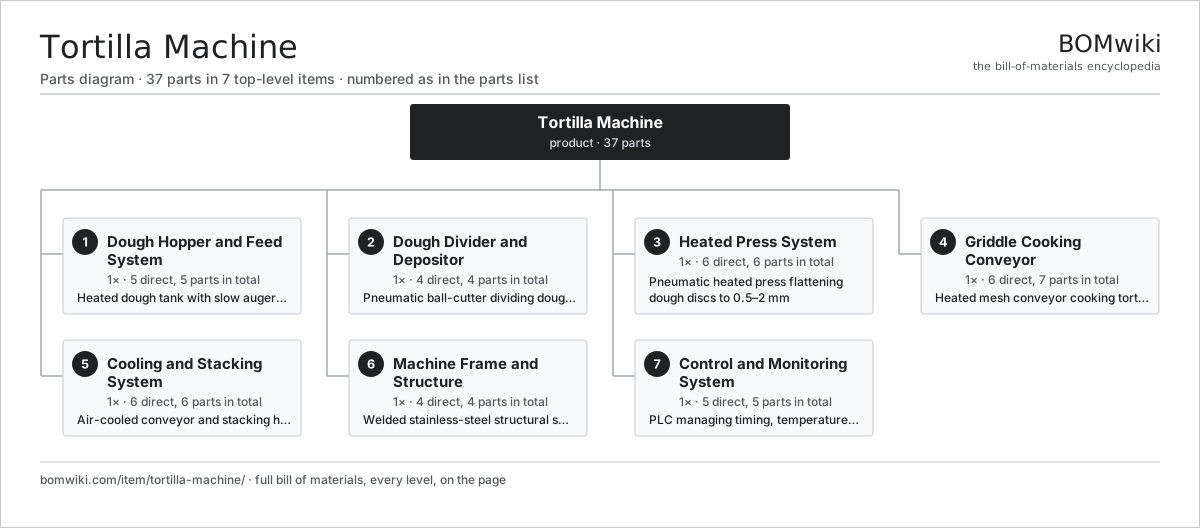
| # | Part | Qty | What it does |
|---|---|---|---|
| 1 | Dough Hopper and Feed System 5 parts | 1× | Heated dough tank with slow auger feed |
| 2 | Dough Divider and Depositor 4 parts | 1× | Pneumatic ball-cutter dividing dough into precise portions |
| 3 | Heated Press System 6 parts | 1× | Pneumatic heated press flattening dough discs to 0.5–2 mm |
| 4 | Griddle Cooking Conveyor 6 parts | 1× | Heated mesh conveyor cooking tortillas at 350–500°C |
| 5 | Cooling and Stacking System 6 parts | 1× | Air-cooled conveyor and stacking hopper |
| 6 | Machine Frame and Structure 4 parts | 1× | Welded stainless-steel structural support |
| 7 | Control and Monitoring System 5 parts | 1× | PLC managing timing, temperature, and conveyor speed |
3D model
No 3D model yet. Have a CAD file of this? Add a 3D model. STL renders right on this page; STEP, FreeCAD, and OpenSCAD sources are welcome too (openly licensed, like all 3D models on BOMwiki).
Build & assembly graph
expand / collapse · shared sub-assemblies converge · links to related products · est. labourTap an assembly to expand/collapse · tap a part to open it · use “Open page” for any node · drag to pan, scroll to zoom.
Bill of materials for Tortilla Machine
7 top-level lines · 43 rows shown · 37 parts total · indented to 3 levels| # | Item / sub-assembly | Part no. | Qty/assy | Ext. qty | Parts | Type |
|---|---|---|---|---|---|---|
| 1 | Dough Hopper and Feed System 5 parts | tortilla-machine-dough-hopper | 1× | 1 | 5 | assembly |
| 1.1 | Dough Hopper Tank | tortilla-machine-hopper-vessel | 1× | 1 | · | part |
| 1.2 | Heating Jacket | tortilla-machine-heating-jacket | 1× | 1 | · | part |
| 1.3 | Dough Auger | tortilla-machine-dough-auger | 1× | 1 | · | part |
| 1.4 | Auger Motor | tortilla-machine-auger-motor | 1× | 1 | · | part |
| 1.5 | Fastener Set | fastener-set | 1× | 1 | · | part |
| 2 | Dough Divider and Depositor 4 parts | tortilla-machine-divider-depositor | 1× | 1 | 4 | assembly |
| 2.1 | Ball Cutter | tortilla-machine-divider-ball-cutter | 1× | 1 | · | part |
| 2.2 | Divider Cylinder | tortilla-machine-divider-cylinder | 1× | 1 | · | part |
| 2.3 | Divider Solenoid | tortilla-machine-divider-solenoid | 1× | 1 | · | part |
| 2.4 | Fastener Set | fastener-set | 1× | 1 | · | part |
| 3 | Heated Press System 6 parts | tortilla-machine-press-system | 1× | 1 | 6 | assembly |
| 3.1 | Press Pneumatic Cylinder | tortilla-machine-press-cylinder | 1× | 1 | · | part |
| 3.2 | Upper Press Platen | tortilla-machine-upper-platen | 1× | 1 | · | part |
| 3.3 | Lower Press Platen | tortilla-machine-lower-platen | 1× | 1 | · | part |
| 3.4 | Platen Heater | tortilla-machine-platen-heater | 1× | 1 | · | part |
| 3.5 | Thickness Stop | tortilla-machine-thickness-stop | 1× | 1 | · | part |
| 3.6 | Fastener Set | fastener-set | 1× | 1 | · | part |
| 4 | Griddle Cooking Conveyor 6 parts | tortilla-machine-griddle-conveyor | 1× | 1 | 7 | assembly |
| 4.1 | Griddle Surface | tortilla-machine-griddle-surface | 1× | 1 | · | part |
| 4.2 | Griddle Conveyor Belt | tortilla-machine-conveyor-belt | 1× | 1 | · | part |
| 4.3 | Griddle Heater | tortilla-machine-griddle-heater | 1× | 1 | · | part |
| 4.4 | Griddle Conveyor Motor | tortilla-machine-conveyor-motor | 1× | 1 | · | part |
| 4.5 | Conveyor Roller | tortilla-machine-conveyor-rollers | 2× | 2 | · | part |
| 4.6 | Fastener Set | fastener-set | 1× | 1 | · | part |
| 5 | Cooling and Stacking System 6 parts | tortilla-machine-cooling-conveyor | 1× | 1 | 6 | assembly |
| 5.1 | Cooling Conveyor Belt | tortilla-machine-cooling-belt | 1× | 1 | · | part |
| 5.2 | Cooling Conveyor Motor | tortilla-machine-cooling-motor | 1× | 1 | · | part |
| 5.3 | Stacking Hopper | tortilla-machine-stacking-hopper | 1× | 1 | · | part |
| 5.4 | Stacker Cylinder | tortilla-machine-stacker-cylinder | 1× | 1 | · | part |
| 5.5 | Separator Sheet Feeder | tortilla-machine-separator-feeder | 1× | 1 | · | part |
| 5.6 | Fastener Set | fastener-set | 1× | 1 | · | part |
| 6 | Machine Frame and Structure 4 parts | tortilla-machine-support-frame | 1× | 1 | 4 | assembly |
| 6.1 | Main Frame | tortilla-machine-main-frame | 1× | 1 | · | part |
| 6.2 | Thermal Insulation | tortilla-machine-thermal-insulation | 1× | 1 | · | part |
| 6.3 | Sheet Metal Panel | sheet-panel | 1× | 1 | · | part |
| 6.4 | Fastener Set | fastener-set | 1× | 1 | · | part |
| 7 | Control and Monitoring System 5 parts | tortilla-machine-controls | 1× | 1 | 5 | assembly |
| 7.1 | PLC Controller | tortilla-machine-plc-module | 1× | 1 | · | part |
| 7.2 | Temperature Controller | tortilla-machine-temperature-controller | 1× | 1 | · | part |
| 7.3 | Control Panel Enclosure | tortilla-machine-control-panel | 1× | 1 | · | part |
| 7.4 | Relay | relay | 1× | 1 | · | part |
| 7.5 | Fastener Set | fastener-set | 1× | 1 | · | part |
Something wrong in this list? Report a problem with this BOM.
Related products
same domain, ranked by shared parts Bakery Deck Oven
44 parts · shares 1 with this page
Beverage Carbonator
95 parts · shares 1 with this page
Blood Coagulator/Dryer
38 parts · shares 1 with this page
Breading Machine
43 parts · shares 1 with this page
Brine Chilling System
239 parts · shares 1 with this page
Bakery Deck Oven
44 parts · shares 1 with this page
Beverage Carbonator
95 parts · shares 1 with this page
Blood Coagulator/Dryer
38 parts · shares 1 with this page
Breading Machine
43 parts · shares 1 with this page
Brine Chilling System
239 parts · shares 1 with this page
Sourcing: possible vendors
Browse the supplier directory → Prices, MOQ, and lead times are algorithmic estimates, not quotes, and not claims about these companies. Company mappings are curated by keyword; est. price band $1k–$500k. How estimates work| Vendor | HQ | Specialty | MOQ | Lead time |
|---|---|---|---|---|
| gea.com ↗ | Düsseldorf, DE | Process technology | 20 units | 12–20 wks |
| buhlergroup.com ↗ | Uzwil, CH | Food & materials processing | 20 units | 12–20 wks |
| tetrapak.com ↗ | Pully, CH | Food packaging & processing | 20 units | 12–20 wks |
| jbtc.com ↗ | Chicago, US | Food processing equipment | 20 units | 12–20 wks |
| alfalaval.com ↗ | Lund, SE | Heat transfer & separation | 20 units | 12–20 wks |
1,098-word article