Tower Clock
ProductOverview
A tower clock (turret clock) is a large public clock driven by falling weights, built to run for days between windings while showing time on dials metres across and striking the hours on a bell. Unlike a domestic clock it must hold its rate while wind, ice, and snow load its exterior hands, which is why the classic design pairs a heavy pendulum with a gravity escapement that isolates timekeeping from everything happening outside.
The movement has two independent gear trains side by side on the Movement Frame: the Going Train keeps time continuously, and the Striking Train sits locked except for a few seconds each hour. The Pendulum and Gravity Escapement regulate the first; the Motion Works carry its output to the four Dial Assembly units; and the Weight & Winding System powers both trains.
The going side
Power enters at the Great Wheel, bolted to the Winding Drum around which the going weight's rope is coiled. The Going Weight, 50 to 250 kg of cast iron, descends its shaft over the week, and its torque is geared up through the Third Wheel to the escape arbor, each stage turning faster and carrying less force than the last. The arbors run in bronze Pivot Bushings that can be re-bored and replaced as they wear over decades. Because winding removes drive torque, a Harrison Maintaining Power ratchet stores a minute or two of spring drive so the clock never stops or runs backward while the Winding Unit is in use.
Gravity escapement and pendulum
The defining component is the Gravity Escapement, usually the double three-legged gravity design Edmund Beckett (Lord Grimthorpe) introduced for the Westminster clock in 1859. The train does not push the pendulum directly. Instead it lifts each Gravity Arm through a fixed height and locks against a Locking Stone; the pendulum, passing centre, unlocks one arm, which then falls a fixed distance alongside the pendulum and hands it a push. The impulse the pendulum receives depends only on the arm's weight and drop, gravity, and not at all on how hard wind is twisting the hands two floors above. Surplus train energy at each release is burned off by the Escapement Fly.
The Pendulum is the time standard. A two-second beat needs an effective length near 4 m, so the Pendulum Rod is invar or a zinc-steel stack to cancel thermal expansion, hanging from a thin Suspension Spring rather than a pivot. The Pendulum Bob is set coarsely with the Rating Nut and trimmed in service by laying gram weights on the Regulation Tray, adding weight raises the effective centre of mass and gains a fraction of a second per day, without ever stopping the clock. Well-kept turret clocks hold a few seconds per week this way.
Striking
The Striking Train has its own Strike Great Wheel, drum, and the heavier Strike Weight, because lifting a bell hammer 156 times a day takes far more energy than timekeeping. Just before the hour, a cam on the going side raises the Lifting Lever (the "warning"), and on the hour it drops, unlocking the train. The Pin Wheel then rotates, each pin lifting the counterweighted tail of the Bell Hammer and letting it fall on the rim of the Hour Bell. The Strike Fly is an air brake that paces the blows evenly, and the Count Wheel, a plate with notches spaced 1, 2, 3 … 12, re-locks the train after the correct count.
Getting time to the dials
The movement sits in a room behind or below the dials, so a once-per-hour output is carried outward mechanically. A vertical shaft from the movement enters the Bevel Gearbox, which splits it four ways into Leading-Off Rods, one per face. At each dial a Minute Wheel Set and a 12:1 Helical Gear Pair drive the concentric Hand Arbor. The Minute Hand on a 3 m dial can be 1.5–2 m long, so both hands are hollow copper or aluminium and carry counterweights behind the arbor: the design load is wind pressure on the hand area, not the hand's own mass. The Dial Face is often a skeleton casting glazed with opal glass and lit from behind; the Dial Frame ties the whole face to the masonry.
Frame and care
Everything mounts on the Flatbed, a machined cast-iron bed carrying Frame Standard pillars for each arbor, the horizontal layout that replaced earlier birdcage frames in the 19th century because every bearing is accessible without dismantling the clock. A Setting Dial on the frame lets the keeper set the time without seeing the exterior dials. Maintenance is mostly lubrication, inspection of each Wire Rope over its full run down the weight shaft, and re-bushing worn pivots with fresh Pivot Bushings; the heavy, slow-moving works commonly stay in service for well over a century.
Tower Clock parts and their functions
8 top-level parts · 76 parts in total · full bill of materials below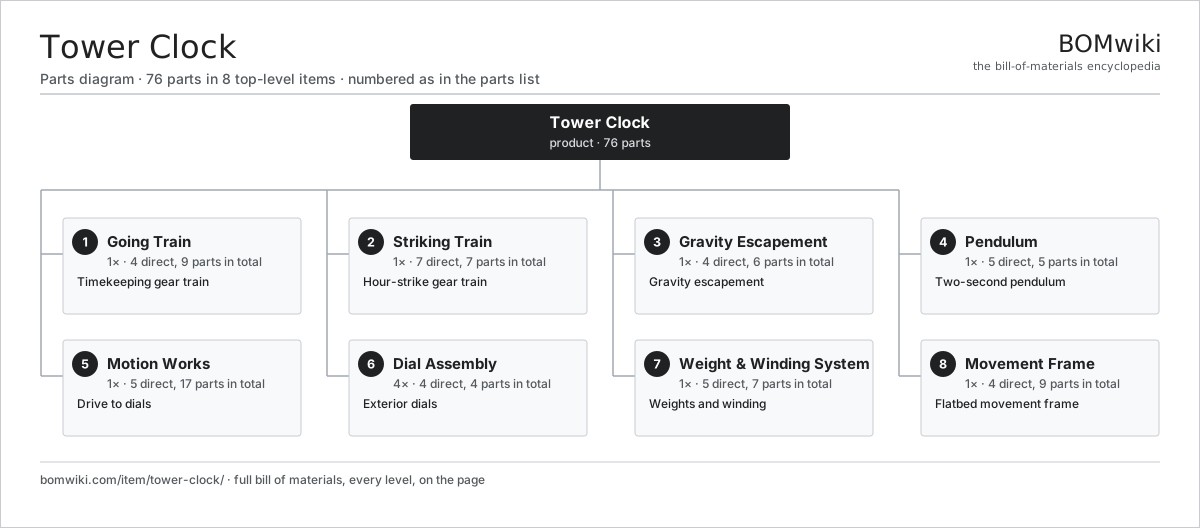
| # | Part | Qty | What it does |
|---|---|---|---|
| 1 | Going Train 4 parts | 1× | Timekeeping gear train |
| 2 | Striking Train 7 parts | 1× | Hour-strike gear train |
| 3 | Gravity Escapement 4 parts | 1× | Gravity escapement |
| 4 | Pendulum 5 parts | 1× | Two-second pendulum |
| 5 | Motion Works 5 parts | 1× | Drive to dials |
| 6 | Dial Assembly 4 parts | 4× | Exterior dials |
| 7 | Weight & Winding System 5 parts | 1× | Weights and winding |
| 8 | Movement Frame 4 parts | 1× | Flatbed movement frame |
3D model
No 3D model yet. Have a CAD file of this? Add a 3D model. STL renders right on this page; STEP, FreeCAD, and OpenSCAD sources are welcome too (openly licensed, like all 3D models on BOMwiki).
Build & assembly graph
expand / collapse · shared sub-assemblies converge · links to related products · est. labourTap an assembly to expand/collapse · tap a part to open it · use “Open page” for any node · drag to pan, scroll to zoom.
Bill of materials for Tower Clock
8 top-level lines · 46 rows shown · 76 parts total · indented to 3 levels| # | Item / sub-assembly | Part no. | Qty/assy | Ext. qty | Parts | Type |
|---|---|---|---|---|---|---|
| 1 | Going Train 4 parts | tower-clock-going-train | 1× | 1 | 9 | assembly |
| 1.1 | Great Wheel | tower-clock-great-wheel | 1× | 1 | · | part |
| 1.2 | Third Wheel | tower-clock-third-wheel | 1× | 1 | · | part |
| 1.3 | Maintaining Power | tower-clock-maintaining-power | 1× | 1 | · | part |
| 1.4 | Pivot Bushing | tower-clock-bushing | 6× | 6 | · | part |
| 2 | Striking Train 7 parts | tower-clock-striking-train | 1× | 1 | 7 | assembly |
| 2.1 | Strike Great Wheel | tower-clock-strike-great-wheel | 1× | 1 | · | part |
| 2.2 | Pin Wheel | tower-clock-pin-wheel | 1× | 1 | · | part |
| 2.3 | Count Wheel | tower-clock-count-wheel | 1× | 1 | · | part |
| 2.4 | Strike Fly | tower-clock-strike-fly | 1× | 1 | · | part |
| 2.5 | Lifting Lever | tower-clock-lifting-lever | 1× | 1 | · | part |
| 2.6 | Bell Hammer | tower-clock-hammer | 1× | 1 | · | part |
| 2.7 | Hour Bell | tower-clock-bell | 1× | 1 | · | part |
| 3 | Gravity Escapement 4 parts | tower-clock-escapement | 1× | 1 | 6 | assembly |
| 3.1 | Escape Assembly | tower-clock-escape-wheel | 1× | 1 | · | part |
| 3.2 | Gravity Arm | tower-clock-gravity-arm | 2× | 2 | · | part |
| 3.3 | Locking Stone | tower-clock-locking-stone | 2× | 2 | · | part |
| 3.4 | Escapement Fly | tower-clock-escapement-fly | 1× | 1 | · | part |
| 4 | Pendulum 5 parts | tower-clock-pendulum | 1× | 1 | 5 | assembly |
| 4.1 | Pendulum Rod | tower-clock-pendulum-rod | 1× | 1 | · | part |
| 4.2 | Pendulum Bob | tower-clock-pendulum-bob | 1× | 1 | · | part |
| 4.3 | Suspension Spring | tower-clock-suspension-spring | 1× | 1 | · | part |
| 4.4 | Rating Nut | tower-clock-rating-nut | 1× | 1 | · | part |
| 4.5 | Regulation Tray | tower-clock-regulation-tray | 1× | 1 | · | part |
| 5 | Motion Works 5 parts | tower-clock-motion-works | 1× | 1 | 17 | assembly |
| 5.1 | Leading-Off Rod | tower-clock-leading-off-rod | 4× | 4 | · | part |
| 5.2 | Bevel Gearbox | tower-clock-bevel-gearbox | 1× | 1 | · | part |
| 5.3 | Minute Wheel Set | tower-clock-minute-wheel-set | 4× | 4 | · | part |
| 5.4 | Hand Arbor | tower-clock-hand-arbor | 4× | 4 | · | part |
| 5.5 | Helical Gear Pair | gear-pair | 4× | 4 | · | part |
| 6 | Dial Assembly 4 parts | tower-clock-dial-assembly | 4× | 4 | 4 | assembly |
| 6.1 | Dial Face | tower-clock-dial-face | 1× | 4 | · | part |
| 6.2 | Minute Hand | tower-clock-minute-hand | 1× | 4 | · | part |
| 6.3 | Hour Hand | tower-clock-hour-hand | 1× | 4 | · | part |
| 6.4 | Dial Frame | tower-clock-dial-frame | 1× | 4 | · | part |
| 7 | Weight & Winding System 5 parts | tower-clock-weight-system | 1× | 1 | 7 | assembly |
| 7.1 | Going Weight | tower-clock-going-weight | 1× | 1 | · | part |
| 7.2 | Strike Weight | tower-clock-strike-weight | 1× | 1 | · | part |
| 7.3 | Wire Rope | tower-clock-wire-rope | 2× | 2 | · | part |
| 7.4 | Winding Drum | tower-clock-winding-drum | 2× | 2 | · | part |
| 7.5 | Winding Unit | tower-clock-winding-unit | 1× | 1 | · | part |
| 8 | Movement Frame 4 parts | tower-clock-frame | 1× | 1 | 9 | assembly |
| 8.1 | Flatbed | tower-clock-flatbed | 1× | 1 | · | part |
| 8.2 | Frame Standard | tower-clock-frame-standard | 6× | 6 | · | part |
| 8.3 | Setting Dial | tower-clock-setting-dial | 1× | 1 | · | part |
| 8.4 | Fastener Set | fastener-set | 1× | 1 | · | part |
Something wrong in this list? Report a problem with this BOM.
Related products
same domain, ranked by shared parts Carriage Clock
49 parts · shares 1 with this page
Carriage Clock
49 parts · shares 1 with this page
 Cuckoo Clock
79 parts · shares 1 with this page
Cuckoo Clock
79 parts · shares 1 with this page
 Flip Clock
119 parts · shares 1 with this page
Flip Clock
119 parts · shares 1 with this page
 Marine Chronometer
46 parts · shares 1 with this page
Marine Chronometer
46 parts · shares 1 with this page
 Mechanical Metronome
27 parts · shares 1 with this page
Mechanical Metronome
27 parts · shares 1 with this page
 Radio-Controlled Atomic Clock
130 parts · shares 1 with this page
Radio-Controlled Atomic Clock
130 parts · shares 1 with this page
Sourcing: possible vendors
Browse the supplier directory → Prices, MOQ, and lead times are algorithmic estimates, not quotes, and not claims about these companies. Company mappings are curated by keyword; est. price band $20–$50k. How estimates work| Vendor | HQ | Specialty | MOQ | Lead time |
|---|---|---|---|---|
|
🇯🇵Seiko
seikowatches.com ↗
|
Tokyo, JP | Watches | 500 units | 8–14 wks |
|
🇯🇵Citizen
citizenwatch-global.com ↗
|
Tokyo, JP | Watches | 500 units | 8–14 wks |
|
🇯🇵Casio
casio.com ↗
|
Tokyo, JP | Watches & electronics | 500 units | 8–14 wks |
| swatchgroup.com ↗ | Biel, CH | Watches (Omega, Tissot) | 500 units | 8–14 wks |
| titancompany.in ↗ | Bengaluru, IN | Watches & timepieces | 500 units | 8–14 wks |
904-word article