Track Bicycle
ProductOverview
A track bicycle is the most mechanically reduced racing bicycle there is: one gear, no freewheel, no brakes, no shifters, no cables. It is built for the velodrome, a banked oval of wood or concrete, typically 250 m around with banking up to about 42-45° in the turns, where every event from a 10-second flying 200 m to a 40 km points race is ridden on essentially the same machine.
The Frameset is built stiffer than any road frame because nothing on the track rewards comfort. The Track Frame uses steep 74-75° angles and a short wheelbase for immediate steering response in pack racing, and places the bottom bracket 55-65 mm higher than a road bike so the pedals, which never stop turning, clear the boards on steep banking. There are no brake mounts, no cable stops, and no bottle bosses; races are short enough that none are needed. The Aero Fork is a deep-bladed aero carbon unit with no brake hole drilled in its crown.
Why no brakes
The absence of brakes is deliberate and is a safety feature, not an omission. Track racing happens in dense packs at 50-70 km/h with riders centimetres apart on a banked surface. A rider who grabbed a brake lever in that environment would decelerate far faster than anyone behind could react, causing a pile-up; with no brakes on any bike, every rider's speed changes are gradual and predictable. Slowing happens through the fixed drivetrain instead: because the Fixed Cog is rigidly coupled to the rear wheel, applying back-pressure on the pedals brakes the bike smoothly through the chain. Velodrome rules ban brakes outright for this reason, and they also ban quick-release skewers in favour of bolted Axle Nut Pair so nothing can loosen in a crash. The banking itself helps too, riders can shed speed by riding up the track, trading kinetic energy for height.
The fixed drivetrain
The Fixed-Gear Drivetrain has no freewheel mechanism anywhere. The Fixed Cog, a hardened steel cog of 13-16 teeth, threads directly onto the rear hub of the Track Hub Set. Pedalling forward drives the wheel; the wheel, in turn, drives the pedals, so the rider's legs never coast. Back-pedalling torque acts to unscrew the cog, which is why a Lockring with a left-hand thread is tightened against it: any torque that loosens the cog tightens the lockring. This two-thread interlock is what makes pedal braking safe.
Gear selection is a workshop operation, not a handlebar one. Riders carry cogs and chainrings and swap them with the Cog & Lockring Tools, a chain whip and lockring spanner, choosing perhaps 92 gear inches for a bunch race and 106 or more for a flying 200 m. The Track Crankset runs 165 mm arms, shorter than road cranks, purely for pedal clearance on the banking, and the heavy 1/8 in Track Chain is tensioned by sliding the wheel in the rear-facing Track Ends against the Chain Tensioners. Sprint efforts put more than 2,000 W through the Bottom Bracket, and standing starts can load the chain to several times pedalling tension.
Wheels and tires
Indoor velodromes have no wind, which changes wheel design completely. The Deep-Section Wheelset runs depths that would be unrideable in a road crosswind: a Deep-Section Front Wheel of 50-90 mm or a molded 3-5 spoke wheel, and almost universally a full Rear Disc Wheel that eliminates spoke drag altogether. Tires are Tubular Tire, casings sewn shut around the tube and glued to the rim, inflated to 9-12 bar, far above road pressure, because a board track is smooth enough that high pressure simply rolls faster.
Rider interface
Because the feet are the brakes, foot retention is critical. The Track Pedals are set to maximum release tension, and sprinters add Toe Straps cinched over the shoe: a foot that pulls out during a standing start or at 65 km/h leaves the rider with no control over cranks that are still being driven by the rear wheel. The Cockpit uses a narrow 360-400 mm Track Drop Bar with a deep round bend; sprint bars are steel or heavily reinforced because the opening pull of a standing start can permanently bend an ordinary road bar. The Seating places a firm Track Saddle on an aero Aero Seatpost, set forward to match the steep seat angle.
A complete track bike weighs 6.8-8 kg, the UCI enforces a 6.8 kg minimum, and contains no component that is not strictly required to go around an oval as fast as possible.
Track Bicycle parts and their functions
7 top-level parts · 37 parts in total · full bill of materials below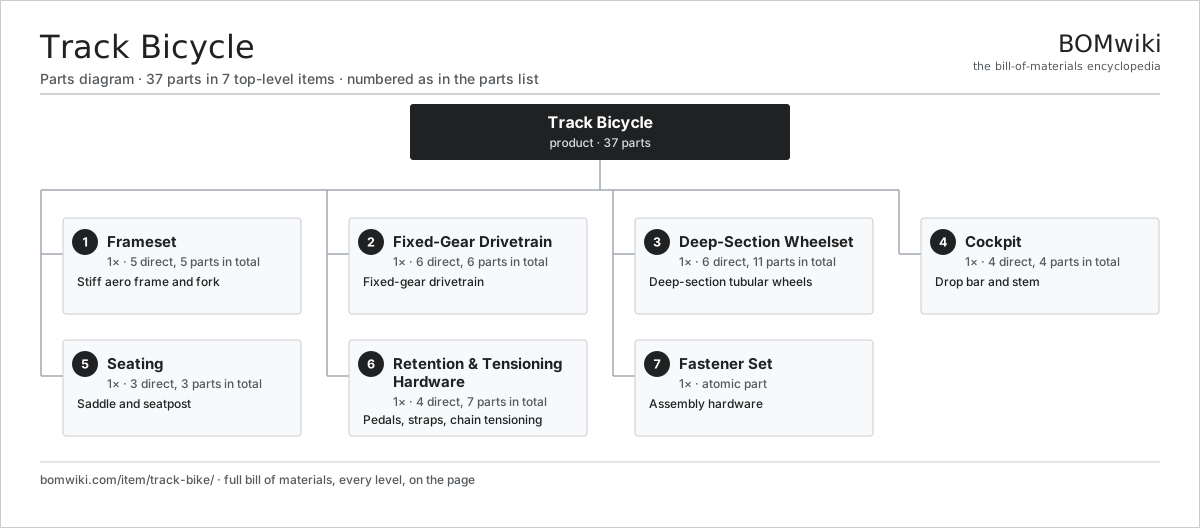
| # | Part | Qty | What it does |
|---|---|---|---|
| 1 | Frameset 5 parts | 1× | Stiff aero frame and fork |
| 2 | Fixed-Gear Drivetrain 6 parts | 1× | Fixed-gear drivetrain |
| 3 | Deep-Section Wheelset 6 parts | 1× | Deep-section tubular wheels |
| 4 | Cockpit 4 parts | 1× | Drop bar and stem |
| 5 | Seating 3 parts | 1× | Saddle and seatpost |
| 6 | Retention & Tensioning Hardware 4 parts | 1× | Pedals, straps, chain tensioning |
| 7 | Fastener Set | 1× | Assembly hardware |
3D model
No 3D model yet. Have a CAD file of this? Add a 3D model. STL renders right on this page; STEP, FreeCAD, and OpenSCAD sources are welcome too (openly licensed, like all 3D models on BOMwiki).
Build & assembly graph
expand / collapse · shared sub-assemblies converge · links to related products · est. labourTap an assembly to expand/collapse · tap a part to open it · use “Open page” for any node · drag to pan, scroll to zoom.
Bill of materials for Track Bicycle
7 top-level lines · 35 rows shown · 37 parts total · indented to 3 levels| # | Item / sub-assembly | Part no. | Qty/assy | Ext. qty | Parts | Type |
|---|---|---|---|---|---|---|
| 1 | Frameset 5 parts | track-frameset | 1× | 1 | 5 | assembly |
| 1.1 | Track Frame | track-frame | 1× | 1 | · | part |
| 1.2 | Aero Fork | track-fork | 1× | 1 | · | part |
| 1.3 | Headset | track-headset | 1× | 1 | · | part |
| 1.4 | Track Ends | track-dropouts | 1× | 1 | · | part |
| 1.5 | Seatpost Wedge Clamp | track-seatpost-wedge | 1× | 1 | · | part |
| 2 | Fixed-Gear Drivetrain 6 parts | track-drivetrain | 1× | 1 | 6 | assembly |
| 2.1 | Track Crankset | track-crankset | 1× | 1 | · | part |
| 2.2 | Bottom Bracket | track-bottom-bracket | 1× | 1 | · | part |
| 2.3 | Fixed Cog | track-fixed-cog | 1× | 1 | · | part |
| 2.4 | Lockring | track-lockring | 1× | 1 | · | part |
| 2.5 | Track Chain | track-chain | 1× | 1 | · | part |
| 2.6 | Chainring Bolt Set | track-chainring-bolts | 1× | 1 | · | part |
| 3 | Deep-Section Wheelset 6 parts | track-wheelset | 1× | 1 | 11 | assembly |
| 3.1 | Deep-Section Front Wheel | track-front-wheel-deep | 1× | 1 | · | part |
| 3.2 | Rear Disc Wheel | track-rear-disc | 1× | 1 | · | part |
| 3.3 | Track Hub Set | track-hub-set | 1× | 1 | · | part |
| 3.4 | Tubular Tire | track-tubular-tire | 2× | 2 | · | part |
| 3.5 | Axle Nut Pair | track-axle-nuts | 2× | 2 | · | part |
| 3.6 | Ball Bearing | ball-bearing | 4× | 4 | · | part |
| 4 | Cockpit 4 parts | track-cockpit | 1× | 1 | 4 | assembly |
| 4.1 | Track Drop Bar | track-drop-bar | 1× | 1 | · | part |
| 4.2 | Stem | track-stem | 1× | 1 | · | part |
| 4.3 | Bar Tape | track-bar-tape | 1× | 1 | · | part |
| 4.4 | Headset Top Cap | track-headset-cap | 1× | 1 | · | part |
| 5 | Seating 3 parts | track-seating | 1× | 1 | 3 | assembly |
| 5.1 | Track Saddle | track-saddle | 1× | 1 | · | part |
| 5.2 | Aero Seatpost | track-aero-seatpost | 1× | 1 | · | part |
| 5.3 | Saddle Rail Clamp | track-saddle-clamp | 1× | 1 | · | part |
| 6 | Retention & Tensioning Hardware 4 parts | track-contact-hardware | 1× | 1 | 7 | assembly |
| 6.1 | Track Pedals | track-pedals | 2× | 2 | · | part |
| 6.2 | Toe Straps | track-toe-straps | 2× | 2 | · | part |
| 6.3 | Chain Tensioners | track-chain-tensioners | 2× | 2 | · | part |
| 6.4 | Cog & Lockring Tools | track-tool-kit-cog | 1× | 1 | · | part |
| 7 | Fastener Set | fastener-set | 1× | 1 | · | part |
Something wrong in this list? Report a problem with this BOM.
Sourcing: possible vendors
Browse the supplier directory → Prices, MOQ, and lead times are algorithmic estimates, not quotes, and not claims about these companies. Company mappings are curated by keyword; est. price band $200–$12k. How estimates work| Vendor | HQ | Specialty | MOQ | Lead time |
|---|---|---|---|---|
|
🇹🇼Giant
giant-bicycles.com ↗
|
Taichung, TW | Bicycles | 500 units | 6–12 wks |
|
🇺🇸Trek
trekbikes.com ↗
|
Waterloo, US | Bicycles | 500 units | 6–12 wks |
| specialized.com ↗ | Morgan Hill, US | Bicycles | 500 units | 6–12 wks |
|
🇹🇼Merida
merida-bikes.com ↗
|
Yuanlin, TW | Bicycles | 500 units | 6–12 wks |
| cannondale.com ↗ | Wilton, US | Bicycles | 500 units | 6–12 wks |
789-word article