Trackless Train
ProductOverview
A trackless train is a motorized, electrically powered amusement ride that mimics a traditional railway but operates on paved ground without rails. The train consists of a powered Tractor Head (the locomotive equivalent) pulling 2–4 articulated passenger Coach Car. The tractor contains the Drive System (an electric motor and transmission), the Battery Pack, and the operator's Operator Cab. The coaches are unpowered; they simply roll on rubber tires and are pulled along by the tractor via Coupling System.
Most trackless trains follow a pre-programmed route using a Guidance Sensor that senses an embedded wire or optical line embedded in the ground or painted on the pavement. This allows the train to operate autonomously or semi-autonomously, ideal for theme parks, zoos, and tourist attractions where riders enjoy the novelty of a motorized journey without worrying about navigation.
Tractor design and propulsion
The Tractor Head is the active power unit. The Tractor Chassis is a welded steel frame housing the Electric Motor (typically 5–15 kW, running on 48–80 V DC or AC from the Battery Pack). The motor drives a Transmission, which may be a simple gear reduction or a more complex differential gearbox that distributes power to the Tire and Wheel.
The Tire and Wheel are large pneumatic tires (0.5–1.0 m diameter) mounted on sturdy axles. Rubber tires provide good traction on pavement while absorbing vibration, offering a smoother ride than metal wheels on track. The tires are rated for the combined weight of the tractor and all coaches (typically 10–20 metric tons total).
Inside the tractor is the operator's Operator Cab, a fully enclosed control station with a Steering Wheel (300–400 mm diameter), foot pedals for Pedal Assembly (accelerator and brake), and a windshield (Windshield). The cab provides protection from weather and allows the operator to see the path ahead and passenger areas.
Steering and guidance
The Steering System system is dual-function:
Manual steering for autonomous operation without path sensors: The operator uses the Steering Wheel to steer the tractor via a mechanical Linkage that adjusts the front wheel angle. The Transmission contains a differential that allows the inside and outside wheels to rotate at different speeds during a turn, preventing wheel slip.
Automatic path-following via embedded guidance: For semi-autonomous operation, a Guidance Sensor mounted under the tractor reads an embedded signal. Many modern systems use an inductive loop, a continuous wire embedded in the ground (50–100 mm deep) carrying a low-frequency AC signal (1–10 kHz). The receiver's Receiver Antenna detects the magnetic field of this loop. The Receiver Board decode the position relative to the centerline and send a correction signal to a Steering Valve, which modulates a Steering Cylinder that adjusts the front wheel steering angle automatically. This allows the tractor to "follow" the wire without operator input, maintaining the centerline within ±50 mm.
Alternative systems use optical line-following: a painted line on the pavement is sensed by a camera or array of optical sensors, and the steering is corrected based on the visual feedback.
Coaches and coupling
The Coach Car are unpowered passenger cars. Each Coach Chassis is a simple welded steel frame with no engine. It has Coach Wheel, smaller free-rolling tires (0.4–0.7 m diameter) on both front and rear axles; the weight of the coach pushes the wheels down, and the forward pull from the tractor drags the coach along. No power or braking is required.
The Coach Body is a fiberglass or painted metal shell, often designed with windows and attractive graphics. Inside, the Seating Area consists of bench seats (4–8 passengers per coach) arranged in rows, facing forward or outward for viewing. A Safety Rail runs along the sides, and lap belts or 3-point Seat Belt harnesses are provided for restraint during acceleration and braking.
Access is via fold-down Entry Steps stairs at the coach front and rear, allowing boarding during loading intervals.
Coupling between the tractor and first coach, and between successive coaches, uses articulated hinges. The Tractor Coupler (a ball hitch or yoke on the tractor's rear) mates with the Coach Coupler (a socket or yoke on the coach's front). A Hitch Pin locks the coupling. This articulation allows the train to bend when navigating curves; the coaches pivot slightly relative to the tractor and to each other, distributing the bending forces evenly and preventing capsizing on tight turns.
Power and battery
The Battery Pack is the energy source. Most modern trackless trains use 48V or 80V lithium-ion batteries (similar to industrial forklift packs) for fast charging and long cycle life. The battery pack sits low in the Tractor Chassis, keeping the center of gravity low for stability.
Charge time is typically 2–4 hours for a full recharge; run time is 8–12 hours of continuous operation depending on duty cycle (speed, terrain, acceleration profile). The Battery Management (battery management system) monitors cell voltage, temperature, and current, protecting against over-charge, over-discharge, and thermal runaway. A Charger, either mounted onboard or external, replenishes the battery overnight.
The motor power output determines acceleration and gradeability. A 10 kW motor accelerates a 15-ton loaded train at approximately 0.7 m/s² on level ground. On a 5–10 percent grade (uphill), the train slows but can still climb at 2–4 km/h. Overly steep grades or hills are avoided in route planning.
Safety and structural integrity
The Tractor Chassis and Coach Chassis are stress-tested for the combined load. Welded joints are inspected for cracks. The Coupling System system must be robust; failure of the articulated hitch could cause a coach to separate and cause injury.
The Bumpers on the tractor front and rear provide passive impact protection in case of accidental collision. LED Headlight units illuminate the path; Tail Light clusters alert pedestrians. The Speaker speaker emits chimes or bells to warn pedestrians and announce stops.
Speed governors are standard; the operator controls speed via the accelerator pedal, but the control system electronically limits top speed to 15–20 km/h to prevent derailment (tipping) on curves or emergency braking situations.
Operating environments
Trackless trains are typical attractions in theme parks, zoos, botanical gardens, shopping centers, and historic districts. Typical routes are 1–3 km in length, taking 10–20 minutes to complete at cruise speed. Loading/unloading may occur at fixed stations with designated platforms.
Outdoor operation exposes the train to weather. The Body Panels must be UV-resistant. Tires can be affected by temperature extremes (becoming hard and less grippy in cold, soft and prone to wear in heat). Rubber weathering degrades the Safety Rail and Seat Belt materials over 5–10 years; these are periodic replacement items.
Maintenance
Routine inspections include:
- Visual check of tires for cracks, bulges, or embedded objects.
- Testing brakes (manual via the operator's pedal and the Transmission's engine braking).
- Verifying the Guidance Sensor alignment (if equipped) and signal strength.
- Checking coupling security and articulation smoothness.
- Battery voltage and health checks.
Major maintenance intervals include tire rotation/replacement (every 50,000–100,000 km), Transmission fluid changes, and bearing inspection. The Electric Motor and Transmission are sealed units; they rarely require service beyond periodic oil top-ups (on older hydraulic units) or bearing lubrication on non-sealed models.
Variants
Some premium trackless trains feature premium seating, entertainment systems (screens, audio), and even small dining capabilities. Others are themed to look like vintage trains, space shuttles, or fantasy vehicles. Capacity can range from 20 to 100+ passengers across multiple cars. The longest operational systems are found in large theme parks and can operate continuously, with multiple trains on separate embedded wire circuits to maximize throughput.
Trackless Train parts and their functions
9 top-level parts · 65 parts in total · full bill of materials below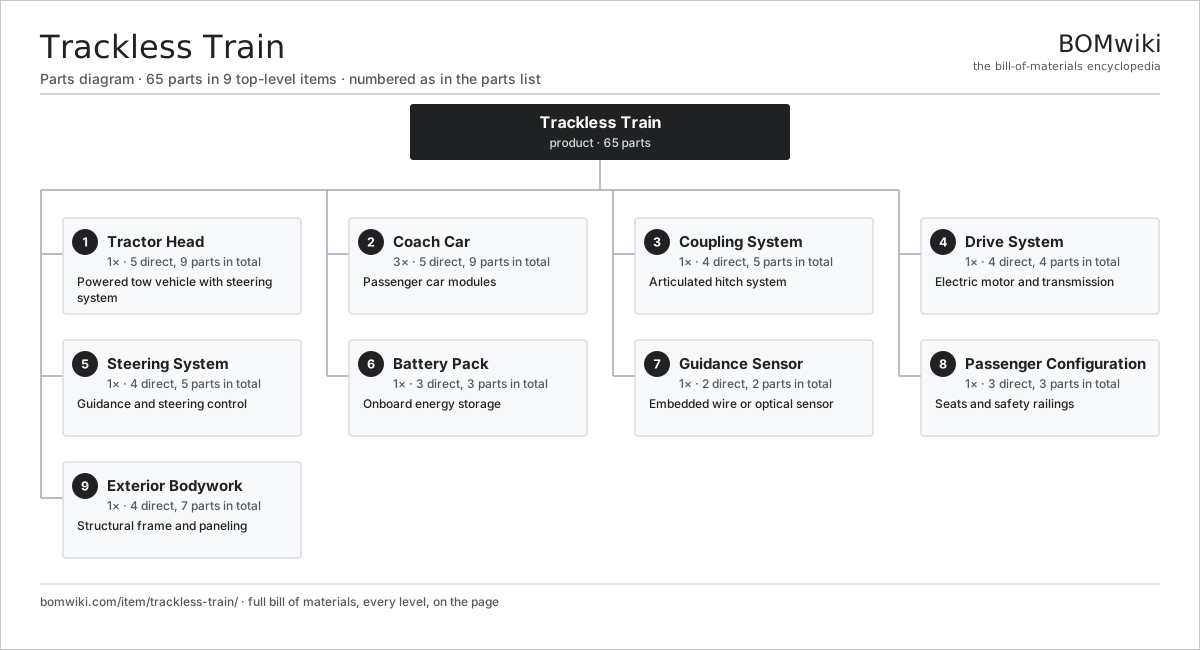
| # | Part | Qty | What it does |
|---|---|---|---|
| 1 | Tractor Head 5 parts | 1× | Powered tow vehicle with steering system |
| 2 | Coach Car 5 parts | 3× | Passenger car modules |
| 3 | Coupling System 4 parts | 1× | Articulated hitch system |
| 4 | Drive System 4 parts | 1× | Electric motor and transmission |
| 5 | Steering System 4 parts | 1× | Guidance and steering control |
| 6 | Battery Pack 3 parts | 1× | Onboard energy storage |
| 7 | Guidance Sensor 2 parts | 1× | Embedded wire or optical sensor |
| 8 | Passenger Configuration 3 parts | 1× | Seats and safety railings |
| 9 | Exterior Bodywork 4 parts | 1× | Structural frame and paneling |
3D model
No 3D model yet. Have a CAD file of this? Add a 3D model. STL renders right on this page; STEP, FreeCAD, and OpenSCAD sources are welcome too (openly licensed, like all 3D models on BOMwiki).
Build & assembly graph
expand / collapse · shared sub-assemblies converge · links to related products · est. labourTap an assembly to expand/collapse · tap a part to open it · use “Open page” for any node · drag to pan, scroll to zoom.
Bill of materials for Trackless Train
9 top-level lines · 53 rows shown · 65 parts total · indented to 3 levels| # | Item / sub-assembly | Part no. | Qty/assy | Ext. qty | Parts | Type |
|---|---|---|---|---|---|---|
| 1 | Tractor Head 5 parts | trackless-train-tractor | 1× | 1 | 9 | assembly |
| 1.1 | Tractor Chassis | trackless-train-tractor-chassis | 1× | 1 | · | part |
| 1.2 | Tire and Wheel | trackless-train-wheels | 2× | 2 | · | part |
| 1.3 | Frame Members | trackless-train-frame | 1× | 1 | · | part |
| 1.4 | Operator Cab 3 parts | trackless-train-operator-cab | 1× | 1 | 4 | assembly |
| 1.4.1 | Cab Shell | trackless-train-cab-structure | 1× | 1 | · | part |
| 1.4.2 | Windshield | trackless-train-cab-window | 1× | 1 | · | part |
| 1.4.3 | Control Panel 2 parts + deeper › | trackless-train-cab-controls | 1× | 1 | 2 | assembly |
| 1.5 | Fastener Set | fastener-set | 1× | 1 | · | part |
| 2 | Coach Car 5 parts | trackless-train-coaches | 3× | 3 | 9 | assembly |
| 2.1 | Coach Chassis | trackless-train-coach-chassis | 1× | 3 | · | part |
| 2.2 | Coach Wheel | trackless-train-coach-wheels | 2× | 6 | · | part |
| 2.3 | Coach Body | trackless-train-coach-body | 1× | 3 | · | part |
| 2.4 | Seating Area 3 parts | trackless-train-coach-seating | 1× | 3 | 4 | assembly |
| 2.4.1 | Bench Seat | trackless-train-seat-bench | 2× | 6 | · | part |
| 2.4.2 | Safety Rail | trackless-train-safety-rail | 1× | 3 | · | part |
| 2.4.3 | Seat Belt | trackless-train-seat-belt | 1× | 3 | · | part |
| 2.5 | Hitch Pin | trackless-train-coach-hitch-pin | 1× | 3 | · | part |
| 3 | Coupling System 4 parts | trackless-train-coupling | 1× | 1 | 5 | assembly |
| 3.1 | Tractor Coupler | trackless-train-coupler-tractor | 1× | 1 | · | part |
| 3.2 | Coach Coupler | trackless-train-coupler-coach | 2× | 2 | · | part |
| 3.3 | Hitch Pin | trackless-train-hitch-pin | 1× | 1 | · | part |
| 3.4 | Fastener Set | fastener-set | 1× | 1 | · | part |
| 4 | Drive System 4 parts | trackless-train-drive-system | 1× | 1 | 4 | assembly |
| 4.1 | Electric Motor | trackless-train-electric-motor | 1× | 1 | · | part |
| 4.2 | Transmission | trackless-train-transmission | 1× | 1 | · | part |
| 4.3 | Motor Mount | trackless-train-motor-mounting | 1× | 1 | · | part |
| 4.4 | Fastener Set | fastener-set | 1× | 1 | · | part |
| 5 | Steering System 4 parts | trackless-train-steering | 1× | 1 | 5 | assembly |
| 5.1 | Guidance Sensor 2 parts | trackless-train-guidance-receiver | 1× | 1 | 2 | assembly |
| 5.1.1 | Receiver Antenna | trackless-train-receiver-antenna | 1× | 1 | · | part |
| 5.1.2 | Receiver Board | trackless-train-receiver-electronics | 1× | 1 | · | part |
| 5.2 | Steering Valve | trackless-train-proportional-valve | 1× | 1 | · | part |
| 5.3 | Steering Cylinder | trackless-train-hydraulic-cylinder | 1× | 1 | · | part |
| 5.4 | Linkage | trackless-train-steering-linkage | 1× | 1 | · | part |
| 6 | Battery Pack 3 parts | trackless-train-power-battery | 1× | 1 | 3 | assembly |
| 6.1 | Battery Cells | trackless-train-battery-cells | 1× | 1 | · | part |
| 6.2 | Battery Management | trackless-train-battery-bms | 1× | 1 | · | part |
| 6.3 | Charger | trackless-train-charger | 1× | 1 | · | part |
| 7 | Guidance Sensor 2 parts | trackless-train-guidance-receiver | 1× | 1 | 2 | assembly |
| 7.1 | Receiver Antenna | trackless-train-receiver-antenna | 1× | 1 | · | part |
| 7.2 | Receiver Board | trackless-train-receiver-electronics | 1× | 1 | · | part |
| 8 | Passenger Configuration 3 parts | trackless-train-passenger-seating | 1× | 1 | 3 | assembly |
| 8.1 | Bench Seat | trackless-train-seat-bench | 1× | 1 | · | part |
| 8.2 | Safety Rail | trackless-train-safety-rail | 1× | 1 | · | part |
| 8.3 | Entry Steps | trackless-train-step-entrance | 1× | 1 | · | part |
| 9 | Exterior Bodywork 4 parts | trackless-train-bodywork | 1× | 1 | 7 | assembly |
| 9.1 | Body Panels | trackless-train-body-panels | 1× | 1 | · | part |
| 9.2 | Bumpers | trackless-train-bumpers | 1× | 1 | · | part |
| 9.3 | Lights 2 parts | trackless-train-lighting | 1× | 1 | 4 | assembly |
| 9.3.1 | Headlight | trackless-train-headlight | 2× | 2 | · | part |
| 9.3.2 | Tail Light | trackless-train-tail-light | 2× | 2 | · | part |
| 9.4 | Speaker | trackless-train-sound-system | 1× | 1 | · | part |
Something wrong in this list? Report a problem with this BOM.
Sourcing: possible vendors
Browse the supplier directory → Prices, MOQ, and lead times are algorithmic estimates, not quotes, and not claims about these companies. Company mappings are curated by keyword; est. price band $20–$3k. How estimates work| Vendor | HQ | Specialty | MOQ | Lead time |
|---|---|---|---|---|
|
🇩🇰LEGO
lego.com ↗
|
Billund, DK | Construction toys | 2,000 units | 6–10 wks |
|
🇺🇸Mattel
mattel.com ↗
|
El Segundo, US | Toys | 2,000 units | 6–10 wks |
|
🇺🇸Hasbro
hasbro.com ↗
|
Pawtucket, US | Toys & games | 2,000 units | 6–10 wks |
| bandainamco.co.jp ↗ | Tokyo, JP | Toys & amusement | 2,000 units | 6–10 wks |
| spinmaster.com ↗ | Toronto, CA | Toys | 2,000 units | 6–10 wks |
1,403-word article