Train Wash Plant
ProductOverview
A train wash plant is a stationary or semi-portable facility designed for high-throughput cleaning of locomotives and freight cars, removing accumulated grime, salt, insects, and lightweight corrosion that accumulates during rail transit. Unlike mobile or manual cleaning, a fixed wash plant optimizes water recirculation, a crucial economics driver because clean-water consumption at 100+ m³ per consist would be unsustainable without treatment and reuse. The facility is fundamentally a controlled environment over the track: a Brush Carriage Gantry supporting multiple Rotary Brush Unit Assembly that lower and traverse the length of the car consist, while Water Supply and Heating supplies heated detergent solution and a Water Treatment and Recycling treats and reuses the runoff.
The cleaning process is fully automated: a locomotive driver pulls forward into the wash bay, stops at a sensor, and presses a START button or simply waits for the plant controller to detect the train's position via induction loops in the track. The Operator Control and Automation Panel sequences the operation: brush motors energize, the Brush Carriage Gantry begins longitudinal motion at 0.5–1 m/min (roughly the speed of the water spray), and the brushes lower to contact the car sides. The Detergent Mixing and Delivery proportions chemical into the water, and Rotary Brush Unit Assembly rotate at 200–400 RPM, agitating and scrubbing the surface. As the gantry traverses the entire consist, each car's sides receive 2–3 minutes of scrubbing; roof and under-frame are tackled in a second and third pass. Total cycle time is 10–15 minutes depending on consist length.
All runoff drains into a Collection Sump, where gravity settling, oil skimming, and sand filtration remove 95% of solids and contaminants. The Water Treatment and Recycling recirculates the cleaned water back into the Water Supply and Heating supply, reducing fresh-water demand to 20–40 m³ per consist instead of 100+ m³. Savings in water cost, wastewater treatment, and chemicalusage make the plant economical for high-volume facilities washing 20–50 consists per day.
How it works
A southbound freight train pulling 110 cars approaches the wash plant and comes to a stop at the entry sensor. The locomotive operator presses the START button on the Operator Control and Automation Panel or the wash plant detects the position automatically. The PLC initializes: it energizes the Supply Pump, which draws water from the Water Treatment and Recycling reservoir and pushes it through the Water Heater at 50 m³/h. The heated water reaches 50 °C and flows into the Mixer Manifold, where the Chemical Pump injects detergent concentrate at a ratio of 1:100 (1 liter per 100 liters water).
The PLC signals the Rotary Brush Unit Assembly motor drives (via VFD) to ramp up to 250 RPM and simultaneously commands the Brush Carriage Gantry drive motor to begin forward motion at 0.8 m/min. As the gantry traverses, the Vertical Lift Actuator keeps brush units at the proper height for side contact: first pass at mid-car height (brushing the side at mid-level), second pass lowered for the lower flank and wheels, third pass elevated for roof and upper sides. Detergent solution sprays from Spray Nozzle units onto the brush-contact zone, and the rotating brush drums scrub vigorously. Dirty water cascades down the sides and collects in floor gutters.
As the gantry reaches the end of the consist (marked by induction loop sensors), the PLC reverses the direction and the Vertical Lift Actuator raises the brushes clear of the cars. A rinse-only second pass uses fresh Water Supply and Heating water (no detergent) to wash away any residual soap. Once complete, the PLC signals the locomotive operator that washing is finished (via horn tone or light), and the locomotive driver proceeds through the exit gate.
Meanwhile, the runoff water (now in the collection sump) is continuously being processed: solids settle to the bottom, an Oil Separator skims diesel fuel and oil films to a waste container, and the Sand Filter Bed removes remaining particulates. By the time the next train arrives (15 minutes later), the filtered water is recirculated back into the supply tank, ready for reuse.
Design considerations
The Brush Carriage Gantry is a slow-moving overhead conveyor; speeds are deliberately kept to 0.5–1.5 m/min to maximize brush contact time per unit length and to allow low-pressure detergent application without excessive splash loss. Higher speeds would require higher water pressure to maintain cleaning efficacy but would reduce detergent dwell time and increase overspray waste. The Rotary Brush Unit Assembly are kept soft (nylon or polypropylene bristles) to avoid damaging painted surfaces on passenger cars or freight livery; harder brushes suit graffiti or heavy corrosion but risk stripping paint.
The Water Treatment and Recycling treatment train (settling, filtration, oil separation) is sized to handle worst-case input: a dirty consist arriving after weeks of dust and grime accumulation, with possibly 30+ m³ of runoff needing processing within 12 hours. The Sand Filter Bed is typically a shallow outdoor bed or multi-stage cartridge filter requiring monthly backwash or element replacement. Oil/water separation is critical: diesel and locomotive grease would otherwise emulsify and be re-deposited on the next train, defeating the purpose of washing.
Water heating via Water Heater is a trade-off: heated water (40–60 °C) accelerates detergent action and reduces water viscosity for better penetration into crevices, but fuel cost is ~5–10 kW continuous operation. Many cold-climate facilities run heated only in winter; summer operations rely on ambient water temps (often warm enough given high flowrates and solar heating of storage tanks).
The Operator Control and Automation Panel typically implements a semi-automatic cycle: operator selects "fast wash" (7–10 min, sides and lower only) or "full detail" (15 min, all surfaces), the PLC sequences all steps, and only manual override is available for maintenance or emergency stop via Emergency Stop.
Train Wash Plant parts and their functions
8 top-level parts · 60 parts in total · full bill of materials below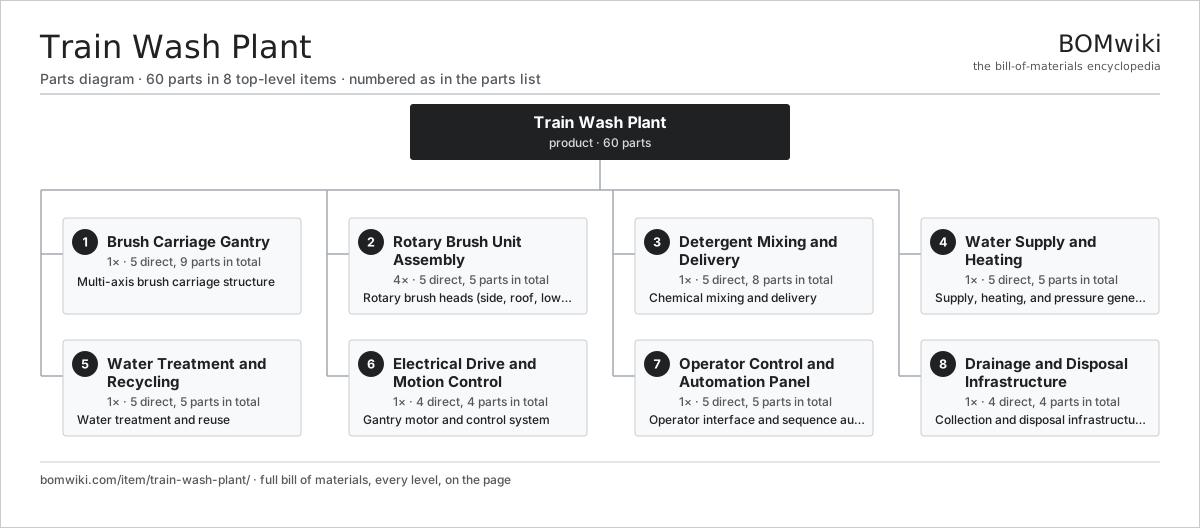
| # | Part | Qty | What it does |
|---|---|---|---|
| 1 | Brush Carriage Gantry 5 parts | 1× | Multi-axis brush carriage structure |
| 2 | Rotary Brush Unit Assembly 5 parts | 4× | Rotary brush heads (side, roof, lower) |
| 3 | Detergent Mixing and Delivery 5 parts | 1× | Chemical mixing and delivery |
| 4 | Water Supply and Heating 5 parts | 1× | Supply, heating, and pressure generation |
| 5 | Water Treatment and Recycling 5 parts | 1× | Water treatment and reuse |
| 6 | Electrical Drive and Motion Control 4 parts | 1× | Gantry motor and control system |
| 7 | Operator Control and Automation Panel 5 parts | 1× | Operator interface and sequence automation |
| 8 | Drainage and Disposal Infrastructure 4 parts | 1× | Collection and disposal infrastructure |
3D model
No 3D model yet. Have a CAD file of this? Add a 3D model. STL renders right on this page; STEP, FreeCAD, and OpenSCAD sources are welcome too (openly licensed, like all 3D models on BOMwiki).
Build & assembly graph
expand / collapse · shared sub-assemblies converge · links to related products · est. labourTap an assembly to expand/collapse · tap a part to open it · use “Open page” for any node · drag to pan, scroll to zoom.
Bill of materials for Train Wash Plant
8 top-level lines · 46 rows shown · 60 parts total · indented to 3 levels| # | Item / sub-assembly | Part no. | Qty/assy | Ext. qty | Parts | Type |
|---|---|---|---|---|---|---|
| 1 | Brush Carriage Gantry 5 parts | train-wash-plant-gantry-frame | 1× | 1 | 9 | assembly |
| 1.1 | Main Guide Rail | train-wash-plant-main-rail | 2× | 2 | · | part |
| 1.2 | Carriage Beam | train-wash-plant-carriage-beam | 1× | 1 | · | part |
| 1.3 | Gantry Drive Motor | train-wash-plant-drive-motor | 1× | 1 | · | part |
| 1.4 | Guide Roller | train-wash-plant-guide-roller | 4× | 4 | · | part |
| 1.5 | Vertical Lift Actuator | train-wash-plant-vertical-lift | 1× | 1 | · | part |
| 2 | Rotary Brush Unit Assembly 5 parts | train-wash-plant-brush-units | 4× | 4 | 5 | assembly |
| 2.1 | Brush Motor | train-wash-plant-brush-motor | 1× | 4 | · | part |
| 2.2 | Brush Drum | train-wash-plant-brush-drum | 1× | 4 | · | part |
| 2.3 | Brush Arm | train-wash-plant-brush-mount-arm | 1× | 4 | · | part |
| 2.4 | Pressure Spring | train-wash-plant-brush-pressure-spring | 1× | 4 | · | part |
| 2.5 | Brush Guard | train-wash-plant-brush-guard-shroud | 1× | 4 | · | part |
| 3 | Detergent Mixing and Delivery 5 parts | train-wash-plant-detergent-system | 1× | 1 | 8 | assembly |
| 3.1 | Detergent Tank | train-wash-plant-detergent-tank | 1× | 1 | · | part |
| 3.2 | Chemical Pump | train-wash-plant-chemical-pump | 1× | 1 | · | part |
| 3.3 | Control Solenoid | train-wash-plant-solenoid-valve | 1× | 1 | · | part |
| 3.4 | Mixer Manifold | train-wash-plant-mixer-manifold | 1× | 1 | · | part |
| 3.5 | Spray Nozzle | train-wash-plant-nozzle-sprayer | 4× | 4 | · | part |
| 4 | Water Supply and Heating 5 parts | train-wash-plant-water-system | 1× | 1 | 5 | assembly |
| 4.1 | Supply Pump | train-wash-plant-supply-pump | 1× | 1 | · | part |
| 4.2 | Water Heater | train-wash-plant-water-heater | 1× | 1 | · | part |
| 4.3 | Pressure Accumulator | train-wash-plant-pressure-accumulator | 1× | 1 | · | part |
| 4.4 | Pressure Regulator | train-wash-plant-pressure-regulator | 1× | 1 | · | part |
| 4.5 | Main Water Lines | train-wash-plant-main-distribution | 1× | 1 | · | part |
| 5 | Water Treatment and Recycling 5 parts | train-wash-plant-recycling-system | 1× | 1 | 5 | assembly |
| 5.1 | Collection Sump | train-wash-plant-sump-tank | 1× | 1 | · | part |
| 5.2 | Settling Tank | train-wash-plant-settling-tank | 1× | 1 | · | part |
| 5.3 | Sand Filter Bed | train-wash-plant-sand-filter | 1× | 1 | · | part |
| 5.4 | Recirculation Pump | train-wash-plant-recirculation-pump | 1× | 1 | · | part |
| 5.5 | Oil Separator | train-wash-plant-oil-separator | 1× | 1 | · | part |
| 6 | Electrical Drive and Motion Control 4 parts | train-wash-plant-electrical-drive | 1× | 1 | 4 | assembly |
| 6.1 | Main VFD Drive | train-wash-plant-main-vfd | 1× | 1 | · | part |
| 6.2 | Brush Motor VFD | train-wash-plant-brush-vfd | 1× | 1 | · | part |
| 6.3 | Motion Controller | train-wash-plant-servo-controller | 1× | 1 | · | part |
| 6.4 | Position Feedback | train-wash-plant-position-sensor | 1× | 1 | · | part |
| 7 | Operator Control and Automation Panel 5 parts | train-wash-plant-control-panel | 1× | 1 | 5 | assembly |
| 7.1 | PLC | train-wash-plant-plc-controller | 1× | 1 | · | part |
| 7.2 | Touchscreen HMI | train-wash-plant-touch-screen-hmi | 1× | 1 | · | part |
| 7.3 | Emergency Stop | train-wash-plant-emergency-stop | 1× | 1 | · | part |
| 7.4 | Manual Jog Controls | train-wash-plant-manual-override | 1× | 1 | · | part |
| 7.5 | Sequence Timer | train-wash-plant-cycle-timer | 1× | 1 | · | part |
| 8 | Drainage and Disposal Infrastructure 4 parts | train-wash-plant-drainage | 1× | 1 | 4 | assembly |
| 8.1 | Concrete Floor | train-wash-plant-concrete-floor | 1× | 1 | · | part |
| 8.2 | Gutter System | train-wash-plant-gutter-system | 1× | 1 | · | part |
| 8.3 | Drain Pump | train-wash-plant-drain-pump | 1× | 1 | · | part |
| 8.4 | Oil/Sediment Separator Pit | train-wash-plant-separator-pit | 1× | 1 | · | part |
Something wrong in this list? Report a problem with this BOM.
Sourcing: possible vendors
Browse the supplier directory → Prices, MOQ, and lead times are algorithmic estimates, not quotes, and not claims about these companies. Company mappings are curated by keyword; est. price band $500k–$60M. How estimates work| Vendor | HQ | Specialty | MOQ | Lead time |
|---|---|---|---|---|
|
🇨🇳CRRC
crrcgc.cc ↗
|
Beijing, CN | Rolling stock & rail systems | made to order | 40–72 wks |
|
🇫🇷Alstom
alstom.com ↗
|
Saint-Ouen, FR | Rail rolling stock | made to order | 40–72 wks |
| mobility.siemens.com ↗ | Munich, DE | Rail systems | made to order | 40–72 wks |
| stadlerrail.com ↗ | Bussnang, CH | Rail rolling stock | made to order | 40–72 wks |
|
🇺🇸Wabtec
wabteccorp.com ↗
|
Pittsburgh, US | Rail equipment | made to order | 40–72 wks |
1,051-word article