Backyard Trampoline
ProductOverview
A backyard trampoline converts a jumper's downward momentum into stored spring energy and gives most of it back. The architecture has been stable since trampolines became a mass consumer product in the 1990s: a circular Frame Ring & Legs of galvanised steel tube stands on W-shaped legs, a nearly inextensible Jumping Mat spans the ring, and 72 steel extension springs in the Spring Set bridge the gap between mat edge and frame. Around it, a Safety Enclosure net stops jumpers leaving the mat, a Padding Set covers the springs, and an Anchor Kit ties the whole assembly to the ground. A 3.66 m (12 ft) model is the common family size.
How it works
The mat itself barely stretches, that is deliberate. The Mat Cloth is woven polypropylene (the trade name Permatron is common) chosen for UV resistance and dimensional stability; if the cloth stretched, the bounce would be mushy and the cloth would fatigue. Instead, all elasticity lives in the Coil Spring ring. When the jumper lands, the mat deflects into a shallow cone and every spring around the perimeter extends; a hard landing on a 12 ft model extends each spring by several centimetres, storing on the order of 1 kJ across the set. The springs recoil, the cone flattens, and the jumper is launched. Spring count and length set the feel: more and longer springs (e.g. 96 × 215 mm on large models) give a deeper, softer bounce; short springs give a hard, fast one. Peak loads on the frame reach 5-7 times body weight, which is why the Top Rail Section tubes are 42 mm diameter with welded T-Socket joints rather than thin furniture tube.
Force transfer at the mat edge is the detail that decides product life. Each spring hooks a galvanised V-Ring sewn into the Mat Hem; the hem is folded cloth stitched with 6-10 rows of UV-resistant thread over a Webbing Strip, because a single failed V-ring overloads its neighbours and unzips the edge. At the frame end, the spring hook drops into a punched hole in the Spring Anchor Holes. Assembly tensions the system progressively, springs are fitted in opposing quarters with the Spring Pull Tool so the mat pulls up evenly.
Structure and stability
The frame ring is self-locking under load: spring tension pulls the rail sections inward against their sockets, so the ring needs only small screws from a Fastener Set to stay assembled. Each W-Leg is a bent W of tube, two Leg Upright posts and a long Leg Base Tube ground run, which triangulates the structure and spreads point loads over soft lawns. An empty trampoline, however, is a 70-90 kg sail: a 12 ft model presents several square metres of mat and net to the wind, and gusts above ~60 km/h can flip an unanchored one. The Ground Stake corkscrews and Anchor Strap ratchets exist for exactly this failure mode.
Safety systems
Injury statistics drove the modern enclosure. Most trampoline injuries historically came from falling off the mat or striking the springs and frame; the netted Safety Enclosure and the Spring Pad address both. Six padded Enclosure Pole uprights, clamped to the legs by bolted Pole Clamp pairs, carry a knotless polyethylene Enclosure Net about 180 cm above the mat, high enough that a rebounding jumper meets net, not air. The Net Entry closes with overlapping zip and buckles, and Net Tension Cord cords keep the net taut so a falling child is deflected back onto the mat rather than pocketed against a pole. The Spring Pad is a 25 mm closed-cell foam annulus in a PVC skin, lashed down with Pad Tie Cords; the Pole Foam Sleeve foam covers the remaining hard points. ASTM F381 and EN 71-14 set the test requirements, mat strength, net integrity, padding impact attenuation, and labelling (one jumper at a time, no somersaults).
Access and variants
The Access Ladder hooks over the rail with curved Ladder Hook brackets and gives two or three wide Ladder Step treads up to the 76-90 cm mat height. Beyond the round backyard model, the same parts inventory scales to rectangular competition trampolines (which bounce higher because all springs load simultaneously rather than progressively), springless designs that replace the coil springs with composite rods under the frame, and in-ground installations that delete the legs and enclosure by setting the frame ring flush with the lawn over a retaining pit.
Backyard Trampoline parts and their functions
8 top-level parts · 216 parts in total · full bill of materials below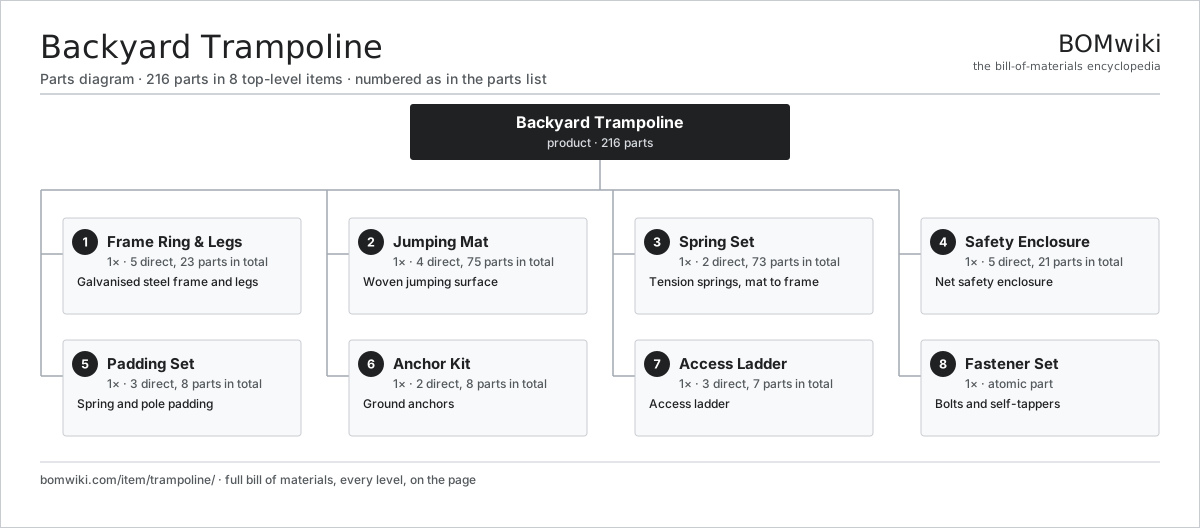
| # | Part | Qty | What it does |
|---|---|---|---|
| 1 | Frame Ring & Legs 5 parts | 1× | Galvanised steel frame and legs |
| 2 | Jumping Mat 4 parts | 1× | Woven jumping surface |
| 3 | Spring Set 2 parts | 1× | Tension springs, mat to frame |
| 4 | Safety Enclosure 5 parts | 1× | Net safety enclosure |
| 5 | Padding Set 3 parts | 1× | Spring and pole padding |
| 6 | Anchor Kit 2 parts | 1× | Ground anchors |
| 7 | Access Ladder 3 parts | 1× | Access ladder |
| 8 | Fastener Set | 1× | Bolts and self-tappers |
3D model
No 3D model yet. Have a CAD file of this? Add a 3D model. STL renders right on this page; STEP, FreeCAD, and OpenSCAD sources are welcome too (openly licensed, like all 3D models on BOMwiki).
Build & assembly graph
expand / collapse · shared sub-assemblies converge · links to related products · est. labourTap an assembly to expand/collapse · tap a part to open it · use “Open page” for any node · drag to pan, scroll to zoom.
Bill of materials for Backyard Trampoline
8 top-level lines · 34 rows shown · 216 parts total · indented to 3 levels| # | Item / sub-assembly | Part no. | Qty/assy | Ext. qty | Parts | Type |
|---|---|---|---|---|---|---|
| 1 | Frame Ring & Legs 5 parts | trampoline-frame-ring | 1× | 1 | 23 | assembly |
| 1.1 | Top Rail Section | trampoline-rail-section | 6× | 6 | · | part |
| 1.2 | T-Socket | trampoline-t-socket | 6× | 6 | · | part |
| 1.3 | W-Leg 2 parts | trampoline-leg | 3× | 3 | 3 | assembly |
| 1.3.1 | Leg Upright | trampoline-leg-upright | 2× | 6 | · | part |
| 1.3.2 | Leg Base Tube | trampoline-leg-base | 1× | 3 | · | part |
| 1.4 | Spring Anchor Holes | trampoline-spring-hole-row | 1× | 1 | · | part |
| 1.5 | Fastener Set | fastener-set | 1× | 1 | · | part |
| 2 | Jumping Mat 4 parts | trampoline-jumping-mat | 1× | 1 | 75 | assembly |
| 2.1 | Mat Cloth | trampoline-mat-cloth | 1× | 1 | · | part |
| 2.2 | Mat Hem | trampoline-mat-hem | 1× | 1 | · | part |
| 2.3 | V-Ring | trampoline-v-ring | 72× | 72 | · | part |
| 2.4 | Webbing Strip | trampoline-webbing-strip | 1× | 1 | · | part |
| 3 | Spring Set 2 parts | trampoline-spring-set | 1× | 1 | 73 | assembly |
| 3.1 | Coil Spring | coil-spring | 72× | 72 | · | part |
| 3.2 | Spring Pull Tool | trampoline-spring-tool | 1× | 1 | · | part |
| 4 | Safety Enclosure 5 parts | trampoline-enclosure | 1× | 1 | 21 | assembly |
| 4.1 | Enclosure Pole | trampoline-enclosure-pole | 6× | 6 | · | part |
| 4.2 | Pole Clamp | trampoline-pole-clamp | 12× | 12 | · | part |
| 4.3 | Enclosure Net | trampoline-net | 1× | 1 | · | part |
| 4.4 | Net Entry | trampoline-net-entry | 1× | 1 | · | part |
| 4.5 | Net Tension Cord | trampoline-net-tension-rope | 1× | 1 | · | part |
| 5 | Padding Set 3 parts | trampoline-pad-set | 1× | 1 | 8 | assembly |
| 5.1 | Spring Pad | trampoline-spring-pad | 1× | 1 | · | part |
| 5.2 | Pole Foam Sleeve | trampoline-pole-sleeve | 6× | 6 | · | part |
| 5.3 | Pad Tie Cords | trampoline-pad-ties | 1× | 1 | · | part |
| 6 | Anchor Kit 2 parts | trampoline-anchor-kit | 1× | 1 | 8 | assembly |
| 6.1 | Ground Stake | trampoline-ground-stake | 4× | 4 | · | part |
| 6.2 | Anchor Strap | trampoline-anchor-strap | 4× | 4 | · | part |
| 7 | Access Ladder 3 parts | trampoline-ladder | 1× | 1 | 7 | assembly |
| 7.1 | Ladder Rail | trampoline-ladder-rail | 2× | 2 | · | part |
| 7.2 | Ladder Step | trampoline-ladder-step | 3× | 3 | · | part |
| 7.3 | Ladder Hook | trampoline-ladder-hook | 2× | 2 | · | part |
| 8 | Fastener Set | fastener-set | 1× | 1 | · | part |
Something wrong in this list? Report a problem with this BOM.
Related products
same domain, ranked by shared parts Animatronic Toy
202 parts · shares 1 with this page
Animatronic Toy
202 parts · shares 1 with this page
 Arcade Cabinet
122 parts · shares 1 with this page
Arcade Cabinet
122 parts · shares 1 with this page
 Automatic Card Shuffler
87 parts · shares 1 with this page
Bingo Blower
158 parts · shares 1 with this page
Automatic Card Shuffler
87 parts · shares 1 with this page
Bingo Blower
158 parts · shares 1 with this page
 Bowling Pinsetter
130 parts · shares 1 with this page
Bowling Pinsetter
130 parts · shares 1 with this page
 Bumper Boats
268 parts · shares 1 with this page
Bumper Boats
268 parts · shares 1 with this page
Sourcing: possible vendors
Browse the supplier directory → Prices, MOQ, and lead times are algorithmic estimates, not quotes, and not claims about these companies. Company mappings are curated by keyword; est. price band $20–$3k. How estimates work| Vendor | HQ | Specialty | MOQ | Lead time |
|---|---|---|---|---|
|
🇩🇰LEGO
lego.com ↗
|
Billund, DK | Construction toys | 2,000 units | 6–10 wks |
|
🇺🇸Mattel
mattel.com ↗
|
El Segundo, US | Toys | 2,000 units | 6–10 wks |
|
🇺🇸Hasbro
hasbro.com ↗
|
Pawtucket, US | Toys & games | 2,000 units | 6–10 wks |
| bandainamco.co.jp ↗ | Tokyo, JP | Toys & amusement | 2,000 units | 6–10 wks |
| spinmaster.com ↗ | Toronto, CA | Toys | 2,000 units | 6–10 wks |
771-word article