Rotating Climbing Wall
ProductOverview
A Treadwall is a motorized climbing wall that moves toward and away from the climber, similar to a treadmill but for climbing. The core element is a Rotating Panel Loop, a continuous loop of climbing wall panels rotating around upper and lower pulleys. As the user climbs, the wall continuously scrolls downward, presenting new holds indefinitely. Unlike a static climbing wall where a climber reaches the top, a Treadwall enforces constant engagement: rest and the wall carries the user downward; climb and gain vertical elevation. The user can climb continuously for 5–30 minutes depending on fitness and intensity, making it a pure aerobic or anaerobic climbing training tool.
The Motor and Drive System propels the panel loop at speeds from 0.3 to 2.0 m/s (about 1–7 km/h), controlled by the user or a trainer via a Electronics and Display Module. The wall angle is adjustable from 90° (vertical) to 60° (overhanging), changing the intensity from moderate to extreme.
Panel loop and hold system
The Rotating Panel Loop is the rotating climbing surface. It is constructed of modular Panel Segment sections, typically 1.5 meters tall and 0.8–1.2 meters wide, connected by Panel Joint Hinge hinges. The panels are made of composite or plastic-faced plywood, with embedded Hold T-Nut Mount T-nuts (threaded inserts) in a grid pattern. Holds are then screwed into these inserts, allowing complete customizability of the climb difficulty and hold types.
The Jug Hold is a large, ergonomic hand hold with an opening of 75–100 mm, shaped like a coffee mug handle. Jugs are beginner-friendly, requiring minimal finger strength and engaging the full hand. The Sloper Hold is a rounded, downward-facing hold that engages the palm and distal finger pads, training open-hand climbing and finger tendon endurance. The Pocket Hold is a small cavity accepting one or two fingers, building finger strength and requiring fine motor control.
A typical Treadwall face has 70–100 holds distributed across the surface. Professional gyms often change hold configurations monthly to keep the wall "fresh" and prevent training staleness. Competition or advanced training walls use standardized hold sizes and materials (plastic or fiberglass), while recreational walls may mix in wooden holds for aesthetic variety.
The panels rotate around two Ball Bearing pulleys: the Upper Redirect Pulley at the top and the Lower Drive Pulley at the base. The upper pulley acts as a redirect, allowing the loop to change direction; the lower pulley is driven by the motor and pulls the loop downward, causing the wall surface to descend toward the user.
Motor and speed control
The AC Motor is a 1.5–3.0 kW AC motor, sized to move the wall panel mass (typically 200–400 kg) and overcome bearing friction. At maximum speed (2.0 m/s), a typical machine consumes 2–3 kW continuous.
The Variable Speed Controller is a variable-frequency drive (VFD) or PWM controller that continuously adjusts motor speed from 0–100% of full load. The user sets speed via a control knob or touchscreen on the Electronics and Display Module. A Speed Encoder on the pulley shaft feeds back the actual panel loop velocity, allowing closed-loop control.
Speed ranges from 0.3 m/s (a slow, easy climb requiring strong sustained effort) to 2.0 m/s (a moderate-pace climb requiring good power endurance, or a hard sprint for interval training). The relationship between speed and effort is not linear: climbing at 0.3 m/s against the climber's body weight is equivalent to ascending a fixed ladder at ~1 meter per 3 seconds, a very sustainable pace; at 2.0 m/s it is equivalent to sprinting up stairs, unsustainable for more than 30–60 seconds.
Angle adjustment and difficulty scaling
The Wall Angle Adjustment Mechanism mechanism tilts the entire wall. At 90° the wall is vertical; at 75° it is slightly overhanging; at 60° it is severely overhanging (45° from horizontal). The angle adjustment is either manual (a Angle Adjustment Actuator lever or pin), allowing discrete positions, or motorized (a linear actuator or servo motor), allowing smooth angle changes.
The Angle Lock Pin prevents drift once an angle is selected. Angle is displayed on a printed or digital Angle Indicator Scale mounted on the frame.
Overhanging angles dramatically increase difficulty. A vertical climb at a given speed is a certain metabolic demand; an overhanging climb at the same speed and height requires much greater grip and upper-body pulling force. Most recreational users work at 75–85° (slightly overhanging); competitive climbers or training athletes use 90° (vertical) to near-horizontal (0°, fully overhanging).
User experience and climbing metrics
A typical session might be:
- Warm-up: 5 minutes at 0.5 m/s, vertical wall, easy holds.
- Intervals: 8–10 sets of 2 minutes at 1.2 m/s, 75° angle, 90 seconds rest between sets.
- Cool-down: 5 minutes at 0.3 m/s, vertical, recovering.
The Display Panel shows time elapsed, current speed, estimated distance climbed (calculated from speed and panel loop length), and estimated calories burned (heuristic based on body weight, speed, and wall angle). Some machines include a climbing "power output" estimate in watts, though this is approximate.
The psychological appeal of a Treadwall is the endless climbing: there is no "summit" or failure point (topping out a route). A climber can always climb longer if they have energy, or drop speed if they tire. The continuous nature makes it excellent for building aerobic capacity and muscular endurance.
Safety harness and fall arrest
Most Treadwall installations include optional Safety Harness Anchor Points points, eye bolts rated for dynamic fall arrest (EN 795 standard). Users can opt to wear a belay harness clipped to the anchor via an autobelay device, providing fall protection. In commercial gyms, the machine typically warns "this machine is not a climbing wall substitute" and recommends harnesses for users unfamiliar with climbing movement or those using the machine for competition/training.
Reliability and maintenance
The Panel Joint Hinge hinges and Ball Bearing pulleys are the primary wear items. Hinges occasionally develop play after 1–3 years of heavy use; bearings may show signs of degradation (wobble, noise) after 2–5 years depending on lubrication and use intensity.
The motor and VFD are robust; electrical failures are rare. The Variable Speed Controller can fail if exposed to moisture or dust; environmental sealing is important in gyms with high humidity.
Holds wear with use and eventually crack or break. Replacement holds are consumables, typically a few per year at a heavily-used machine. The Hold T-Nut Mount T-nuts are permanent.
The Drive Belt connecting the motor to the lower pulley can slip if dirty or worn; replacement is a field service task requiring motor removal. The belt usually lasts 3–5 years before needing replacement.
Annual maintenance includes:
- Visual inspection of panel joints and hinges for cracks.
- Lubrication of pulley bearings (if not sealed cartridges).
- Inspection and replacement of worn holds.
- VFD function test to verify speed range.
Competition and training specialization
Competitive climbing walls (in gyms preparing athletes for sport climbing competitions) often use Treadwall machines with standardized hold sets and angle configurations. A "volumes and holds" wall layout might be changed quarterly to reflect competition routesetting styles.
Speed climbing (a discipline where climbers race vertically up a 15-meter route) has led to specialized Treadwall configurations: a 90° vertical wall with large, easy holds, running at speeds of 1.5–2.0 m/s for sprint interval training. Climbers using Treadwall for speed climbing training might do 15–30 second maximal efforts with 2–3 minutes rest, repeating 6–8 times.
Drawbacks and design considerations
A Treadwall is a specialized training tool and not a replacement for outdoor rock climbing or sport climbing gyms. The continuous scrolling motion, while excellent for aerobic work, does not replicate route reading, problem-solving, or the psychological aspects of climbing a discrete route to completion.
The machine is expensive (USD 15,000–50,000 depending on size and features), limiting adoption to well-funded commercial gyms or universities.
Noise is a concern: the motor runs continuously and the panel hinges emit creaks as they flex around the pulleys. Machines in commercial gyms can be audible 50 meters away, which is fine in a climbing gym but can be disruptive in smaller shared spaces.
Rotating Climbing Wall parts and their functions
8 top-level parts · 190 parts in total · full bill of materials below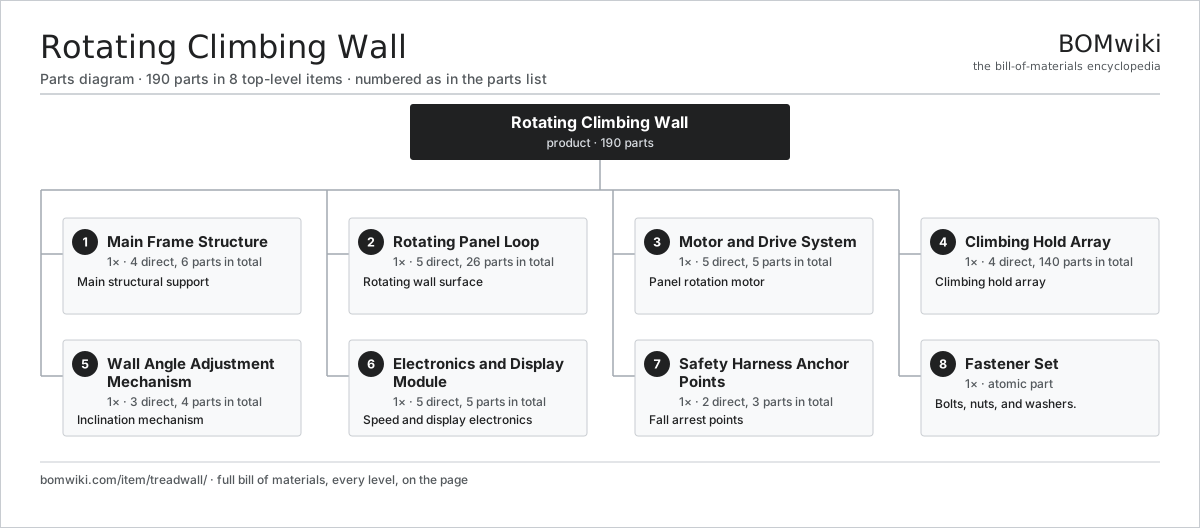
| # | Part | Qty | What it does |
|---|---|---|---|
| 1 | Main Frame Structure 4 parts | 1× | Main structural support |
| 2 | Rotating Panel Loop 5 parts | 1× | Rotating wall surface |
| 3 | Motor and Drive System 5 parts | 1× | Panel rotation motor |
| 4 | Climbing Hold Array 4 parts | 1× | Climbing hold array |
| 5 | Wall Angle Adjustment Mechanism 3 parts | 1× | Inclination mechanism |
| 6 | Electronics and Display Module 5 parts | 1× | Speed and display electronics |
| 7 | Safety Harness Anchor Points 2 parts | 1× | Fall arrest points |
| 8 | Fastener Set | 1× | Bolts, nuts, and washers. |
3D model
No 3D model yet. Have a CAD file of this? Add a 3D model. STL renders right on this page; STEP, FreeCAD, and OpenSCAD sources are welcome too (openly licensed, like all 3D models on BOMwiki).
Build & assembly graph
expand / collapse · shared sub-assemblies converge · links to related products · est. labourTap an assembly to expand/collapse · tap a part to open it · use “Open page” for any node · drag to pan, scroll to zoom.
Bill of materials for Rotating Climbing Wall
8 top-level lines · 36 rows shown · 190 parts total · indented to 3 levels| # | Item / sub-assembly | Part no. | Qty/assy | Ext. qty | Parts | Type |
|---|---|---|---|---|---|---|
| 1 | Main Frame Structure 4 parts | treadwall-frame | 1× | 1 | 6 | assembly |
| 1.1 | Base Platform | treadwall-base-frame | 1× | 1 | · | part |
| 1.2 | Vertical Support Post | treadwall-upright-posts | 2× | 2 | · | part |
| 1.3 | Motor Mount Bracket | treadwall-motor-mount | 1× | 1 | · | part |
| 1.4 | Panel Guide Rail | treadwall-panel-guide-rail | 2× | 2 | · | part |
| 2 | Rotating Panel Loop 5 parts | treadwall-panel-loop | 1× | 1 | 26 | assembly |
| 2.1 | Panel Segment | treadwall-panel-segment | 8× | 8 | · | part |
| 2.2 | Panel Joint Hinge | treadwall-panel-joint | 8× | 8 | · | part |
| 2.3 | Upper Redirect Pulley | treadwall-pulley-upper | 1× | 1 | · | part |
| 2.4 | Lower Drive Pulley | treadwall-pulley-lower | 1× | 1 | · | part |
| 2.5 | Ball Bearing | ball-bearing | 8× | 8 | · | part |
| 3 | Motor and Drive System 5 parts | treadwall-motor-drive | 1× | 1 | 5 | assembly |
| 3.1 | AC Motor | treadwall-motor-ac | 1× | 1 | · | part |
| 3.2 | Variable Speed Controller | treadwall-motor-controller | 1× | 1 | · | part |
| 3.3 | Motor Drive Pulley | treadwall-drive-pulley | 1× | 1 | · | part |
| 3.4 | Drive Belt | treadwall-belt-drive | 1× | 1 | · | part |
| 3.5 | Power Supply | power-supply | 1× | 1 | · | part |
| 4 | Climbing Hold Array 4 parts | treadwall-hold-set | 1× | 1 | 140 | assembly |
| 4.1 | Jug Hold | treadwall-hold-jug | 30× | 30 | · | part |
| 4.2 | Sloper Hold | treadwall-hold-sloper | 20× | 20 | · | part |
| 4.3 | Pocket Hold | treadwall-hold-pocket | 20× | 20 | · | part |
| 4.4 | Hold T-Nut Mount | treadwall-hold-mount-block | 70× | 70 | · | part |
| 5 | Wall Angle Adjustment Mechanism 3 parts | treadwall-angle-adjustment | 1× | 1 | 4 | assembly |
| 5.1 | Angle Adjustment Actuator | treadwall-angle-actuator | 1× | 1 | · | part |
| 5.2 | Angle Lock Pin | treadwall-angle-lock-pin | 2× | 2 | · | part |
| 5.3 | Angle Indicator Scale | treadwall-angle-scale | 1× | 1 | · | part |
| 6 | Electronics and Display Module 5 parts | treadwall-control-system | 1× | 1 | 5 | assembly |
| 6.1 | Control Board | treadwall-control-pcb | 1× | 1 | · | part |
| 6.2 | Display Panel | treadwall-display-lcd | 1× | 1 | · | part |
| 6.3 | Speed Encoder | treadwall-speed-encoder | 1× | 1 | · | part |
| 6.4 | Microcontroller | mcu | 1× | 1 | · | part |
| 6.5 | Power Supply | power-supply | 1× | 1 | · | part |
| 7 | Safety Harness Anchor Points 2 parts | treadwall-safety-harness-anchor | 1× | 1 | 3 | assembly |
| 7.1 | Anchor Bolt | treadwall-anchor-bolt | 2× | 2 | · | part |
| 7.2 | Anchor Plate | treadwall-anchor-plate | 1× | 1 | · | part |
| 8 | Fastener Set | fastener-set | 1× | 1 | · | part |
Something wrong in this list? Report a problem with this BOM.
Related products
same domain, ranked by shared parts Anti-Gravity Treadmill
96 parts · shares 2 with this page
Anti-Gravity Treadmill
96 parts · shares 2 with this page
 Baseball Pitching Machine
144 parts · shares 2 with this page
Climbing Ladder Ergometer
136 parts · shares 2 with this page
Percussion Massage Gun
71 parts · shares 2 with this page
Pneumatic Resistance Machine
52 parts · shares 2 with this page
Vertical Climber
59 parts · shares 2 with this page
Baseball Pitching Machine
144 parts · shares 2 with this page
Climbing Ladder Ergometer
136 parts · shares 2 with this page
Percussion Massage Gun
71 parts · shares 2 with this page
Pneumatic Resistance Machine
52 parts · shares 2 with this page
Vertical Climber
59 parts · shares 2 with this page
Sourcing: possible vendors
Browse the supplier directory → Prices, MOQ, and lead times are algorithmic estimates, not quotes, and not claims about these companies. Company mappings are curated by keyword; est. price band $100–$10k. How estimates work| Vendor | HQ | Specialty | MOQ | Lead time |
|---|---|---|---|---|
| lifefitness.com ↗ | Rosemont, US | Fitness equipment | 200 units | 8–14 wks |
| technogym.com ↗ | Cesena, IT | Fitness equipment | 200 units | 8–14 wks |
|
🇺🇸Peloton
onepeloton.com ↗
|
New York, US | Connected fitness | 200 units | 8–14 wks |
| johnsonhealthtech.com ↗ | Taichung, TW | Fitness (Matrix) | 200 units | 8–14 wks |
|
🇺🇸Precor
precor.com ↗
|
Woodinville, US | Fitness equipment | 200 units | 8–14 wks |
1,410-word article