Trekking Pole
ProductOverview
A trekking pole turns a hiker's arms into a second pair of legs. Studies of pole use show reductions of 10–25% in knee-joint loading on descents, which is where the product earns its place. Mechanically it is a telescoping column: three nested aluminium tubes in the Telescoping Shaft Set, clamped at any length between 62 and 135 cm by the two lever locks of the Locking Mechanisms, with a Grip Assembly at one end and a carbide-tipped Tip & Basket Assembly at the other. Each pole weighs 255 g and holds more than 120 kg axially without a section slipping.
Length is set so the elbow sits at 90° on flat ground, typically user height × 0.68, then shortened 5–10 cm for sustained climbs and lengthened the same for descents. The printed Length Scale makes both poles of a pair repeatable to the centimetre.
Shafts
The three tubes step down in diameter, 18 mm Upper Shaft (18 mm), 16 mm Middle Shaft (16 mm), 14 mm Lower Shaft (14 mm), so each slides inside the one above. The alloy is 7075-T6, the strongest common aluminium grade, drawn to roughly 0.7 mm walls. Aluminium is the deliberate choice over carbon fibre here: a bent aluminium pole can be straightened over a knee and finished out the trip, while carbon fails by sudden fracture, usually from an unseen impact crack. A Stop Bushing inside each joint stops a section being pulled past its maximum-extension mark, where insufficient overlap would let the tube lever the joint apart, and a Joint Bushing centres each inner tube so the collapsed pole does not rattle.
Locking mechanisms
Each joint is clamped by an external lever lock: an over-centre Lever Cam squeezes a glass-filled nylon Clamp Collar onto the inner tube, multiplying a fingertip flick into several hundred newtons of grip. External levers displaced the older internal twist-lock expander because they work with gloves, show their state at a glance, and do not seize when wet grit gets into the joint. The Tension Adjustment Screw opposite each lever trims clamping force, the correct setting closes with firm thumb pressure and holds full body weight without slip. This is checked before any descent, since a collapsing pole under commitment is the canonical trekking-pole accident.
Grip and strap
The Grip Body (EVA) is closed-cell EVA foam canted 15° forward, which keeps the wrist neutral on flat and uphill terrain; foam absorbs no sweat or rain, unlike cork, and weighs less than rubber. The rounded Grip Top Cap is for palming the pole from above on steep steps, and the Grip Extension Sleeve below lets the hand choke down on a sidehill traverse without touching the locks.
The Wrist Strap is the most misunderstood part of the pole. Worn correctly, hand entering from below, webbing crossing the back of the wrist, the Strap Webbing carries the pole load through the wrist bones so the fingers stay relaxed; gripping hard all day is what causes forearm fatigue. The Strap Length Lock cam inside the cap adjusts length by simply pulling the strap up and re-seating it. On talus or in avalanche terrain straps come off the wrists, so a trapped pole cannot trap the arm.
Tip and baskets
Ground contact is a sintered Carbide Tip, hard enough to bite polished granite for the life of the pole. It sits in a moulded Tip Body that presses onto the lower shaft and is replaced as a unit when worn. Above it threads whichever basket the terrain demands: the 38 mm Trekking Basket for three-season trails, the 95 mm Snow Basket for snowpack, or the Rubber Tip Protector pushed over the tip for pavement and for rock the carbide would scar.
Anti-shock
The Anti-Shock Module cartridge in the upper joint puts a Coil Spring and elastomer Damper Sleeve in series with the shaft, taking the edge off each plant on long downhills. The damper matters as much as the spring, an undamped pole pogos. Going uphill the suspension absorbs pushing effort instead of impact, so the Anti-Shock Lockout ring twists the module rigid. Suspension adds about 25 g per pole, which is why minimalist poles omit it entirely.
Trekking Pole parts and their functions
6 top-level parts · 29 parts in total · full bill of materials below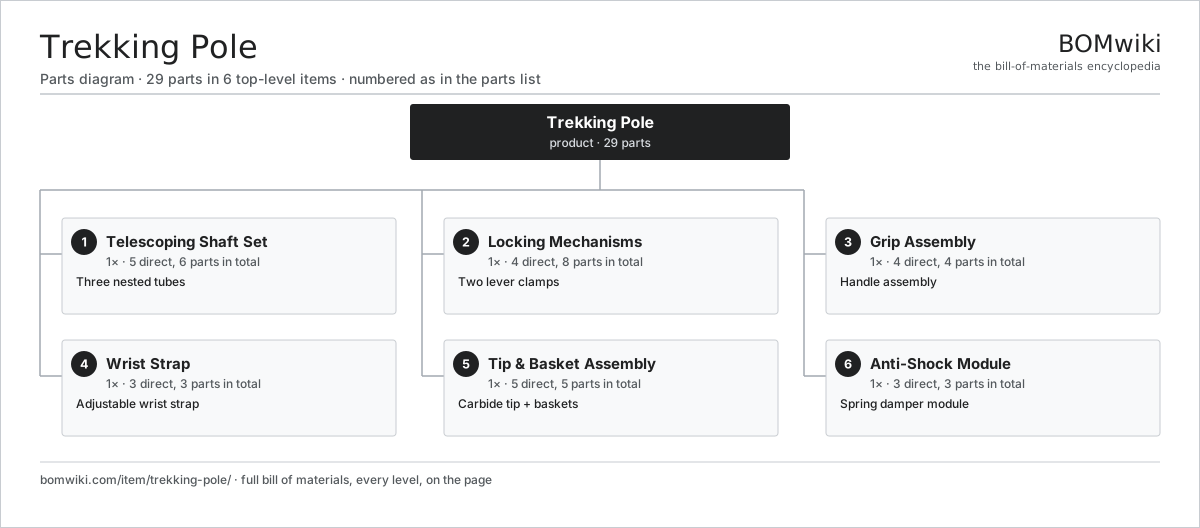
| # | Part | Qty | What it does |
|---|---|---|---|
| 1 | Telescoping Shaft Set 5 parts | 1× | Three nested tubes |
| 2 | Locking Mechanisms 4 parts | 1× | Two lever clamps |
| 3 | Grip Assembly 4 parts | 1× | Handle assembly |
| 4 | Wrist Strap 3 parts | 1× | Adjustable wrist strap |
| 5 | Tip & Basket Assembly 5 parts | 1× | Carbide tip + baskets |
| 6 | Anti-Shock Module 3 parts | 1× | Spring damper module |
3D model
No 3D model yet. Have a CAD file of this? Add a 3D model. STL renders right on this page; STEP, FreeCAD, and OpenSCAD sources are welcome too (openly licensed, like all 3D models on BOMwiki).
Build & assembly graph
expand / collapse · shared sub-assemblies converge · links to related products · est. labourTap an assembly to expand/collapse · tap a part to open it · use “Open page” for any node · drag to pan, scroll to zoom.
Bill of materials for Trekking Pole
6 top-level lines · 30 rows shown · 29 parts total · indented to 3 levels| # | Item / sub-assembly | Part no. | Qty/assy | Ext. qty | Parts | Type |
|---|---|---|---|---|---|---|
| 1 | Telescoping Shaft Set 5 parts | trekking-pole-shaft-set | 1× | 1 | 6 | assembly |
| 1.1 | Upper Shaft (18 mm) | trekking-pole-upper-shaft | 1× | 1 | · | part |
| 1.2 | Middle Shaft (16 mm) | trekking-pole-middle-shaft | 1× | 1 | · | part |
| 1.3 | Lower Shaft (14 mm) | trekking-pole-lower-shaft | 1× | 1 | · | part |
| 1.4 | Length Scale | trekking-pole-length-scale | 1× | 1 | · | part |
| 1.5 | Stop Bushing | trekking-pole-stop-bushing | 2× | 2 | · | part |
| 2 | Locking Mechanisms 4 parts | trekking-pole-lock-set | 1× | 1 | 8 | assembly |
| 2.1 | Lever Cam | trekking-pole-lever-cam | 2× | 2 | · | part |
| 2.2 | Clamp Collar | trekking-pole-clamp-collar | 2× | 2 | · | part |
| 2.3 | Tension Adjustment Screw | trekking-pole-tension-screw | 2× | 2 | · | part |
| 2.4 | Joint Bushing | trekking-pole-joint-bushing | 2× | 2 | · | part |
| 3 | Grip Assembly 4 parts | trekking-pole-grip | 1× | 1 | 4 | assembly |
| 3.1 | Grip Body (EVA) | trekking-pole-grip-body | 1× | 1 | · | part |
| 3.2 | Grip Top Cap | trekking-pole-top-cap | 1× | 1 | · | part |
| 3.3 | Grip Extension Sleeve | trekking-pole-grip-extension | 1× | 1 | · | part |
| 3.4 | Grip Bond | trekking-pole-grip-adhesive | 1× | 1 | · | part |
| 4 | Wrist Strap 3 parts | trekking-pole-strap | 1× | 1 | 3 | assembly |
| 4.1 | Strap Webbing | trekking-pole-strap-webbing | 1× | 1 | · | part |
| 4.2 | Strap Liner | trekking-pole-strap-padding | 1× | 1 | · | part |
| 4.3 | Strap Length Lock | trekking-pole-strap-lock | 1× | 1 | · | part |
| 5 | Tip & Basket Assembly 5 parts | trekking-pole-tip-assembly | 1× | 1 | 5 | assembly |
| 5.1 | Carbide Tip | trekking-pole-carbide-tip | 1× | 1 | · | part |
| 5.2 | Tip Body | trekking-pole-tip-body | 1× | 1 | · | part |
| 5.3 | Trekking Basket | trekking-pole-trekking-basket | 1× | 1 | · | part |
| 5.4 | Snow Basket | trekking-pole-snow-basket | 1× | 1 | · | part |
| 5.5 | Rubber Tip Protector | trekking-pole-rubber-foot | 1× | 1 | · | part |
| 6 | Anti-Shock Module 3 parts | trekking-pole-antishock | 1× | 1 | 3 | assembly |
| 6.1 | Coil Spring | coil-spring | 1× | 1 | · | part |
| 6.2 | Damper Sleeve | trekking-pole-damper-sleeve | 1× | 1 | · | part |
| 6.3 | Anti-Shock Lockout | trekking-pole-shock-lockout | 1× | 1 | · | part |
Something wrong in this list? Report a problem with this BOM.
Related products
same domain, ranked by shared parts Backpacking Stove
32 parts · shares 1 with this page
Bow Sight
72 parts · shares 1 with this page
Clay Pigeon Thrower
47 parts · shares 1 with this page
 Inflatable Kayak
71 parts · shares 1 with this page
 Portable Water Filter
23 parts · shares 1 with this page
Sourcing: possible vendors
Browse the supplier directory → Prices, MOQ, and lead times are algorithmic estimates, not quotes, and not claims about these companies. Company mappings are curated by keyword; est. price band $20–$2k. How estimates work| Vendor | HQ | Specialty | MOQ | Lead time |
|---|---|---|---|---|
|
🇺🇸Coleman
coleman.com ↗
|
Chicago, US | Camping gear | 1,000 units | 6–10 wks |
| thenorthface.com ↗ | Denver, US | Outdoor apparel & gear | 1,000 units | 6–10 wks |
|
🇺🇸YETI
yeti.com ↗
|
Austin, US | Coolers & drinkware | 1,000 units | 6–10 wks |
| decathlon.com ↗ | Villeneuve-d'Ascq, FR | Sporting goods | 1,000 units | 6–10 wks |
|
🇺🇸Garmin
garmin.com ↗
|
Olathe, US | GPS & wearables | 1,000 units | 6–10 wks |
748-word article