Trench Shield Box
ProductOverview
The trench shield box (or simply "trench box") is a welded steel shoring system designed for shallow excavations in utility work, foundation preparation, and open-cut trenching. The system is a simplified alternative to soldier-pile-and-lagging shoring or hydraulic shoring frames; it consists of a large rectangular steel box with reinforced side walls, spreader struts maintaining the interior width, and knife-edge cutting edges at the bottom allowing it to be jacked or excavated downward into the soil.
The advantage of trench boxes over conventional shoring is simplicity: they are manufactured complete, require no field assembly of lagging boards or pins, and can be deployed and removed quickly by heavy equipment (excavator or crane). A typical trench box is 2.0–3.0 m wide, 2.0–4.0 m deep, and weighs 8–20 tonnes. The unit cost is high (USD 15,000–50,000 depending on size), but amortized over many jobs (50–100 uses), the per-job cost is extremely competitive.
Structural Design & Load Path
The Side Wall Panels are the critical load-bearing members, resisting lateral earth pressure. The lateral pressure varies with depth and soil type:
- Sandy soil: 15–30 kPa (light shoring requirement)
- Firm clay or silt: 30–50 kPa (typical design case)
- Saturated clay or submerged sand: 50–80 kPa (worst case)
For a 3.0 m deep trench in firm soil (average 40 kPa), the side walls bear a total load of 40 kPa × 3.0 m = 120 kPa-meter, or roughly 360 kN for a 3.0 m wide box. This load creates large bending stresses in the steel plates.
Each Side Wall Panels assembly consists of:
Wall Plate Structure: Primary load-bearing plates, typically 12–20 mm thick steel (ASTM A36 or equivalent), forming the soil-contact surface. Wall plates are welded to internal stiffeners and the end frames, forming a bending-resistant plate girder.
Wall Stiffening Ribs: Vertical channels or ribs, 8–12 mm thick, welded to the back (interior) of the wall plates at 0.3–0.5 m spacing. Stiffeners transform the wall from a thin, easily deformable plate into a strong, deflection-resistant structure. Without stiffeners, a 1 mm deflection over a 3 m height would allow soil to slump and water to flow into the trench.
The bending moment on a side wall at mid-depth is approximately M = (w × L² ) / 8, where w is the lateral soil pressure and L is the height. For w = 40 kPa and L = 3 m, M ≈ 45 kN⋅m. A 15 mm plate with stiffeners spaced 0.4 m provides a section modulus of ~200 cm³, resulting in stress σ ≈ 225 MPa, acceptable for A36 steel (yield ~250 MPa) with a safety margin.
The End Wall & Closure Panels are lighter, typically 8–10 mm plate with fewer stiffeners, because they bear only a small fraction of the total load (the soil pressure acts on the length of the box, which is typically much longer than the end walls).
Spreader Strut System
The Internal Spreader Struts are internal jacks maintaining the fixed width of the box, counteracting the tendency of lateral soil pressure to compress the box inward. As the box is lowered and deeper soil is exposed, the cumulative lateral load increases, and the spreader struts must be extended or adjusted to maintain the design width.
The spreader system consists of:
Spreader Cylinders: Hydraulic or mechanical cylinders, typically 100–150 mm bore, rated for 50–200 kN each. Most modern boxes have two cylinders (one per pair of opposite walls), with synchronized extension controlled by a valve manifold or manual hand pump. The cylinders extend 0.5–2.0 m depending on the box width and design soil pressure.
Strut Connection Frame: The connection frame or channels on which the cylinders are mounted, designed to transmit the full spreader force into the side walls without deformation. Guides are typically bolted to the interior of the walls and provide bearing surfaces for the cylinder ends.
Spreader strut operation is simple: as soil is excavated and the weight of overburden increases, the operator monitors the hydraulic pressure (typically shown on a gauge) and adjusts cylinder extension to maintain a target pressure (usually set by the engineer at 70–80% of the cylinder capacity). Over-pressurizing can bend the walls; under-pressurizing allows inward deformation and settlement.
Knife-Edge Cutting System
The Bottom Knife Edges & Cutting are hardened steel edges at the bottom of the side walls, allowing the box to be progressively lowered into the soil with minimal resistance. This is a key feature enabling open-cut excavation: as a backhoe or dragline excavates soil from inside the box, the box itself is slowly lowered, cutting deeper into the ground.
Each side wall is fitted with a Knife Edge Bars, a hardened steel bar, 20–25 mm thick, with an angled leading edge (30–45° from vertical). The cutting edge is welded or bolted to the bottom of the wall plate. As soil is removed internally, the weight of the box pushes the knife edge downward and inward, shearing soil and allowing steady descent.
The knife edges experience severe wear and abrasion from stone, gravel, and ground friction. To extend the service life, Edge Wear Plates, bolted steel plates protecting the knife edge, are attached and replaced periodically (every 10–20 excavation jobs).
Lifting & Positioning
The Lifting & Handling Eyes enable the entire box to be lifted by crane or other heavy equipment, a critical requirement for deployment and removal from the trench. Each Lifting Lugs is a forged steel eye, typically rated for 50–100 kN per lug. A large box typically has 4–6 lifting lugs arranged at the top corners and mid-sides, allowing balanced, four-point or six-point lifts that prevent the box from tilting or twisting during handling.
Total lifting load for a 3 m × 3 m box filled with soil and water can be 30–50 tonnes, requiring a 50+ tonne capacity crane. Lifting eyes must be carefully inspected before each use, as fatigue cracks can develop if the box is cycled (lowered and raised) more than 100–200 times over its life.
Internal Bracing & Lateral Stability
The Internal Lateral Bracing resists racking (deformation of the rectangular shape into a parallelogram) and torsion from asymmetric soil loading or vibration. The bracing typically consists of Diagonal Bracing Members, steel tubes or angles welded in an X-pattern at two or more levels inside the box.
Racking can occur if one side of the trench is excavated deeper or if soil fails asymmetrically (e.g., a slope collapse on one side). Diagonal bracing stiffens the box laterally, keeping it rectangular and preventing the side walls from over-stressing.
Water Management & Drainage
The Water Management System system allows water to be managed during excavation. Groundwater or surface water infiltration is inevitable in most utility trenches:
Sump Pit: A welded depression at the bottom center of the box, typically 0.3–0.5 m deep and 0.5–1.0 m × 0.5–1.0 m in plan area. Water from inside the box collects in the sump, allowing a portable electric or diesel pump to remove it without interfering with excavation work.
Drain Port Holes: 50–100 mm diameter openings drilled through the side walls, spaced at 1.0–2.0 m intervals horizontally and 0.5–1.0 m vertically. Water in the surrounding soil can flow through these holes into the sump, reducing hydrostatic pressure on the walls and preventing seepage. In low-permeability soil (clay), drain holes are less effective and active pumping becomes essential.
Water management is critical: if hydrostatic pressure builds up on the exterior, the wall pressure can exceed the spreader strut capacity, and the box can suddenly fail. Engineers design the spreader system assuming some external water infiltration and account for it in the load calculations.
Deployment & Typical Use Sequence
A trench box is deployed as follows:
Positioning (30 min): The box is lifted by crane and lowered onto the ground at the planned trench location. Positioning is approximate; fine adjustments are made once excavation begins.
Initial excavation (1–2 hours): A backhoe or dragline begins excavating soil from inside the box, while the box is allowed to settle under its own weight, progressively lowering and cutting into the ground. The knife edges do most of the work; the excavator removes the loosened soil.
Spreader strut adjustment (ongoing): As depth increases, the operator monitors hydraulic pressure and adjusts spreader extension to maintain a target pressure (typically 70–80 bar). Adjustment is done manually with a hand pump valve or, in larger boxes, with a powered pump.
Utility work (varies): Once the trench reaches design depth, workers access the interior to install/repair utilities. Shoring remains in place to prevent soil collapse.
Final excavation & removal (1–2 hours): Once utilities are complete, soil is backfilled around and over the box. The box is left in place or extracted by crane (pulling upward with 50–150 kN of force).
Extraction (30 min–1 hour): Removal is straightforward, crane lifts the box out by the lifting eyes while backfill settles around and above.
Total trench box deployment time on a job is typically 2–5 days, depending on trench depth and site conditions. For repeated utility work (water mains, sewer lines, electrical conduits), the same box may be used 50+ times over 10–15 years, making the per-job cost economical despite the high initial cost.
Variants & Specialized Applications
- Stacked boxes: Two or more boxes stacked vertically for deep trenches (>4 m), with pins connecting the boxes. Common for deeper utility vaults.
- Wide boxes: 4.0–6.0 m wide for larger diameter sewer or water mains, with internal spreader columns instead of side-to-side cylinders.
- Aluminum boxes: Lighter alternative (50% weight reduction), used for confined-space hand-excavation work or in areas requiring minimal equipment.
- Coated boxes: Epoxy-coated interior to reduce corrosion in marine or highly corrosive soil environments.
Trench boxes remain the dominant open-cut shoring method globally, with an estimated 10,000+ units in active service, accumulating hundreds of thousands of excavation hours annually.
Trench Shield Box parts and their functions
7 top-level parts · 16 parts in total · full bill of materials below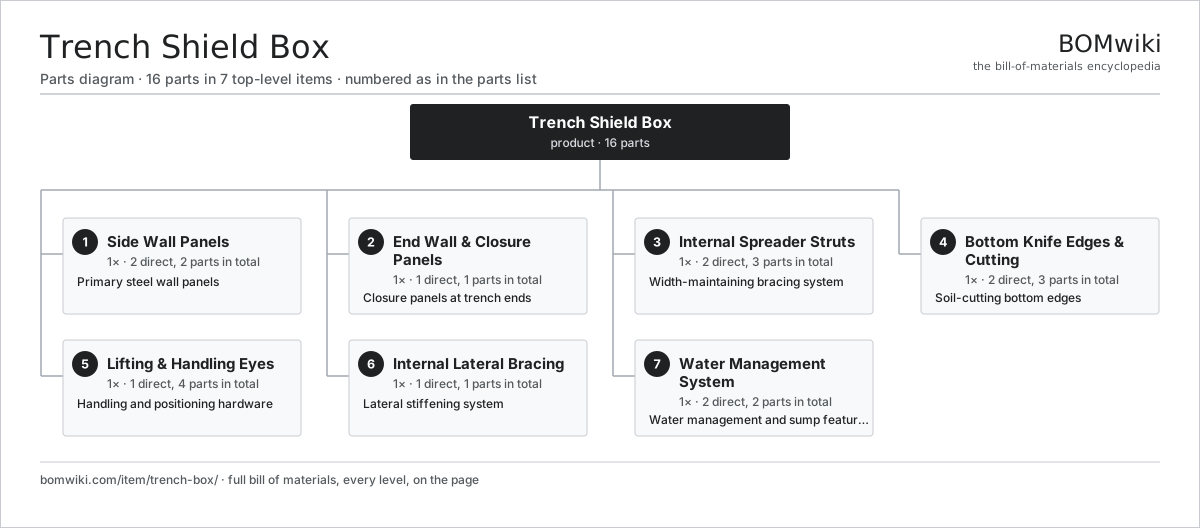
| # | Part | Qty | What it does |
|---|---|---|---|
| 1 | Side Wall Panels 2 parts | 1× | Primary steel wall panels |
| 2 | End Wall & Closure Panels 1 parts | 1× | Closure panels at trench ends |
| 3 | Internal Spreader Struts 2 parts | 1× | Width-maintaining bracing system |
| 4 | Bottom Knife Edges & Cutting 2 parts | 1× | Soil-cutting bottom edges |
| 5 | Lifting & Handling Eyes 1 parts | 1× | Handling and positioning hardware |
| 6 | Internal Lateral Bracing 1 parts | 1× | Lateral stiffening system |
| 7 | Water Management System 2 parts | 1× | Water management and sump features |
3D model
No 3D model yet. Have a CAD file of this? Add a 3D model. STL renders right on this page; STEP, FreeCAD, and OpenSCAD sources are welcome too (openly licensed, like all 3D models on BOMwiki).
Build & assembly graph
expand / collapse · shared sub-assemblies converge · links to related products · est. labourTap an assembly to expand/collapse · tap a part to open it · use “Open page” for any node · drag to pan, scroll to zoom.
Bill of materials for Trench Shield Box
7 top-level lines · 18 rows shown · 16 parts total · indented to 3 levels| # | Item / sub-assembly | Part no. | Qty/assy | Ext. qty | Parts | Type |
|---|---|---|---|---|---|---|
| 1 | Side Wall Panels 2 parts | trench-box-side-walls | 1× | 1 | 2 | assembly |
| 1.1 | Wall Plate Structure | trench-box-wall-plates | 1× | 1 | · | part |
| 1.2 | Wall Stiffening Ribs | trench-box-wall-stiffeners | 1× | 1 | · | part |
| 2 | End Wall & Closure Panels 1 parts | trench-box-end-walls | 1× | 1 | 1 | assembly |
| 2.1 | End Panel Assembly | trench-box-end-panel-structure | 1× | 1 | · | part |
| 3 | Internal Spreader Struts 2 parts | trench-box-spreader-struts | 1× | 1 | 3 | assembly |
| 3.1 | Spreader Cylinders | trench-box-strut-cylinders | 2× | 2 | · | part |
| 3.2 | Strut Connection Frame | trench-box-strut-guides | 1× | 1 | · | part |
| 4 | Bottom Knife Edges & Cutting 2 parts | trench-box-knife-edges | 1× | 1 | 3 | assembly |
| 4.1 | Knife Edge Bars | trench-box-cutting-edge-bars | 2× | 2 | · | part |
| 4.2 | Edge Wear Plates | trench-box-edge-wear-plates | 1× | 1 | · | part |
| 5 | Lifting & Handling Eyes 1 parts | trench-box-lifting-points | 1× | 1 | 4 | assembly |
| 5.1 | Lifting Lugs | trench-box-lifting-lugs | 4× | 4 | · | part |
| 6 | Internal Lateral Bracing 1 parts | trench-box-internal-bracing | 1× | 1 | 1 | assembly |
| 6.1 | Diagonal Bracing Members | trench-box-diagonal-braces | 1× | 1 | · | part |
| 7 | Water Management System 2 parts | trench-box-drainage | 1× | 1 | 2 | assembly |
| 7.1 | Sump Pit | trench-box-sump-pit | 1× | 1 | · | part |
| 7.2 | Drain Port Holes | trench-box-drain-holes | 1× | 1 | · | part |
Something wrong in this list? Report a problem with this BOM.
Sourcing: possible vendors
Browse the supplier directory → Prices, MOQ, and lead times are algorithmic estimates, not quotes, and not claims about these companies. Company mappings are curated by keyword; est. price band $15k–$2M. How estimates work| Vendor | HQ | Specialty | MOQ | Lead time |
|---|---|---|---|---|
| caterpillar.com ↗ | Irving, US | Construction & mining equipment | made to order | 16–28 wks |
|
🇯🇵Komatsu
komatsu.com ↗
|
Tokyo, JP | Construction & mining equipment | made to order | 16–28 wks |
|
🇸🇪Volvo CE
volvoce.com ↗
|
Gothenburg, SE | Construction equipment | made to order | 16–28 wks |
|
🇨🇭Liebherr
liebherr.com ↗
|
Bulle, CH | Cranes & heavy equipment | made to order | 16–28 wks |
|
🇨🇳XCMG
xcmg.com ↗
|
Xuzhou, CN | Construction machinery | made to order | 16–28 wks |
1,730-word article