Candy Twist Wrapper
ProductOverview
A candy twist wrapper is a fully automatic machine that wraps individual hard candies, taffy, or lollipops in film and seals them by twisting the ends. The process is entirely synchronized: bulk candies are fed from a vibrating bowl, singulated one at a time, positioned on wrapping film, the film is cut and folded around the candy, and rotating twist arms seal both ends. Output ranges from 200 to 600 pieces per minute depending on candy size and recipe. The machine is the industry standard for wrapping hard candies, rock candy, and high-volume taffy production.
Twist wrappers are valued for their simplicity, reliability, and flexibility. A single machine can wrap candies from 8 to 25 grams by adjusting the feed bowl sizing gate and film width. Recipe changeover is minimal: the operator loads a new film roll and adjusts software parameters for cut length and twist angle. No hardware swap is typically needed.
Feed and singulation
The process begins in the candy feed system. A stainless steel vibrating bowl (300 mm diameter) contains bulk candies that are continuously agitated via an eccentric motor at 10–30 Hz frequency. A spiral guide track guides candies upward and outward; as each candy reaches the top of the spiral, it drops onto a sizing gate that rejects any oversized or double-stacked pieces. Single candies fall onto a moving blanket or conveyor that indexes them one at a time to the wrapping station.
The feed rate (candies per minute) is tuned by adjusting the vibration frequency and gate opening. A 10-gram candy at 300 per minute requires gentle vibration (~15 Hz) with a tight gate; a 25-gram candy at 200 per minute may need wider openings and faster vibration.
Film supply and unwinding
Above the wrapping station sits the film supply system. A motorized spindle holds a supply roll of wrapping film (typically 100–300 mm width, up to 500 mm diameter roll) that is pulled downward by the machine. A spring-loaded tension dancer arm maintains constant slack in the film path, compensating for supply roll diameter change as film is consumed. The spindle motor is synchronized via encoder to the feed rate; as candies arrive, film is advanced by the servo to present a fresh wrap length at the cutting station.
Common film types include cellophane (brittle, crinkly, traditional look), polyester (strong, less noise), polypropylene (economical), and laminates with barrier properties. Film cost is typically €0.02–0.05 per candy wrap, making film selection critical to product margin.
Cutting and folding
As film advances into position above the waiting candy, a cutting head severs the film. Two methods are common:
Hot-wire cutter: A nichrome wire element (300 W, 1 mm diameter) heats to ~300 °C and melts through film in <100 ms, creating a sealed edge. This method works on thermoplastic films (cellophane, polyester, polypropylene) but is slow and can soften candy if set too close.
Rotary blade cutter: A small rotating blade (stainless steel, 1 mm thickness) driven by a servo motor shears the film. This is faster and cooler, preferred for films that soften or candies that melt easily.
The severed film is still loosely draped over the candy. Immediately, a pair of pneumatic folding jaws (40 mm bore, 6 bar) close around the candy and film bundle, pulling the film taut and tucking excess underneath. The jaws hold for ~0.5 seconds while the twist mechanism is engaged.
Twisting and sealing
Once the film is folded and compressed around the candy, two rotating twist arms engage both ends of the wrapped candy, gripping via spring-loaded fingers or magnetic pads. A servo motor (0.75 kW, 2 Nm) then rotates the arms synchronously, twisting the film ends together at the same rate. Typical twist angle is 720–1,080° (2–3 full revolutions), which creates a tight seal and aesthetic appeal. As the arms twist, friction between film layers creates a mechanical lock that holds even after the arms release. The twist speed is ramped (slow start, fast middle, slow end) to avoid tearing film in older equipment.
After twisting is complete, the arms open via spring release, and the wrapped candy falls onto the discharge chute or conveyor.
Machine control and synchronization
The PLC control system orchestrates all motion. Encoders on the film spindle, feed bowl, and twist motor provide real-time position feedback. The operator uses a 7-inch touchscreen HMI to enter recipe parameters:
- Feed rate (candies/min)
- Film width (mm)
- Cut length (distance between wrap start and cut)
- Fold duration (jaw close time)
- Twist angle (degrees)
- Twist speed (rpm)
The PLC then calculates spindle speed (to advance film at the correct rate), jaw timing (synchronized to candy arrival), and twist arm position. Interlocks prevent unsafe states: if a candy jam is detected (jaw pressure exceeding threshold), the machine halts.
Changeover and flexibility
Twist wrappers are designed for quick changeover. To switch from 10-gram to 15-gram candies:
- Remove the old film roll and load a new one (3 minutes).
- Adjust the feed bowl sizing gate (1 minute).
- On the HMI, input new candy weight and desired film cut length (2 minutes).
- Run a startup sequence to verify cutting and twist timing (1–2 minutes).
Total changeover time is ~10 minutes, making the machine versatile for multi-SKU production runs. Shape variation (spheres, ovals, hard candies vs. taffy) requires no hardware change; only film width and twist angle adjustments are needed.
Production metrics and throughput
A typical 300-candy-per-minute machine producing 10-gram candies wraps 3 kg per minute, or 180 kg per hour. Over a 16-hour daily shift, that is 2,880 kg per day. A large confectionery running multiple wrappers can produce 50,000+ units daily.
Hygiene and food safety
Twist wrappers are classified as food-contact equipment. Stainless steel contact surfaces (jaws, film guides, candy contact points) minimize contamination risk. The machine is designed for washdown (IP54 minimum), with removable guards and no crevices where candy dust or film scraps accumulate. Operators clean the machine daily at end-of-shift, and a quarterly deep-clean of the feed bowl and guides is standard practice.
Film waste and sustainability
Not all film becomes wrapped candy; some is lost to cutting margins, trimming, and startup/shutdown waste. Typical waste is 5–10% of film consumption. Scrap film is collected in a dedicated bin and recycled or incinerated. Some modern plants recover heat from scrap burning to offset production energy.
Maintenance and wear
The twist arm grip pads (silicone) wear after 100–200 operating hours and are replaced (cost ~€150 per pair). The cutting blade for rotary-cutter models dulls after 500 hours and is replaced (cost ~€300). The folder jaws accumulate candy residue and are cleaned daily; pads are replaced annually if hardened (cost ~€400 per pair). The spindle and servo motors are rated for 10+ years with sealed bearings and minimal maintenance.
Integration in production lines
Twist wrappers are rarely standalone; they feed downstream to case packers, multi-packs, or quality check conveyors. A typical candy production line is: deposition/cooking → extrusion (if applicable) → cooling → twist wrapper → case packer → shrink tunnel → palletizer. Total line footprint is 20–40 meters, and a single operator can monitor the entire line.
Candy Twist Wrapper parts and their functions
8 top-level parts · 86 parts in total · full bill of materials below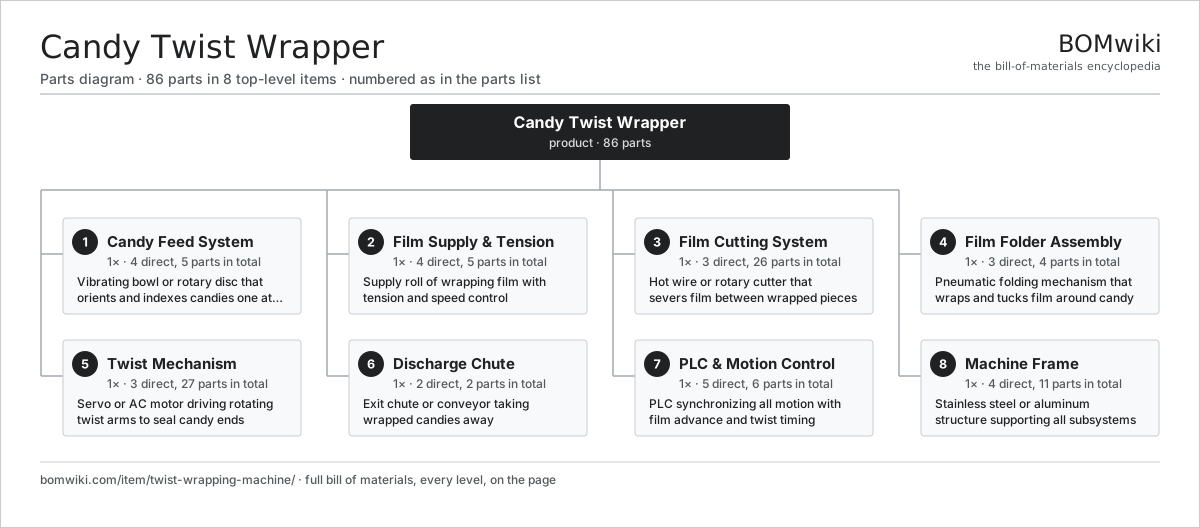
| # | Part | Qty | What it does |
|---|---|---|---|
| 1 | Candy Feed System 4 parts | 1× | Vibrating bowl or rotary disc that orients and indexes candies one at a time |
| 2 | Film Supply & Tension 4 parts | 1× | Supply roll of wrapping film with tension and speed control |
| 3 | Film Cutting System 3 parts | 1× | Hot wire or rotary cutter that severs film between wrapped pieces |
| 4 | Film Folder Assembly 3 parts | 1× | Pneumatic folding mechanism that wraps and tucks film around candy |
| 5 | Twist Mechanism 3 parts | 1× | Servo or AC motor driving rotating twist arms to seal candy ends |
| 6 | Discharge Chute 2 parts | 1× | Exit chute or conveyor taking wrapped candies away |
| 7 | PLC & Motion Control 5 parts | 1× | PLC synchronizing all motion with film advance and twist timing |
| 8 | Machine Frame 4 parts | 1× | Stainless steel or aluminum structure supporting all subsystems |
3D model
No 3D model yet. Have a CAD file of this? Add a 3D model. STL renders right on this page; STEP, FreeCAD, and OpenSCAD sources are welcome too (openly licensed, like all 3D models on BOMwiki).
Build & assembly graph
expand / collapse · shared sub-assemblies converge · links to related products · est. labourTap an assembly to expand/collapse · tap a part to open it · use “Open page” for any node · drag to pan, scroll to zoom.
Bill of materials for Candy Twist Wrapper
8 top-level lines · 44 rows shown · 86 parts total · indented to 3 levels| # | Item / sub-assembly | Part no. | Qty/assy | Ext. qty | Parts | Type |
|---|---|---|---|---|---|---|
| 1 | Candy Feed System 4 parts | twist-wrapping-machine-candy-feed | 1× | 1 | 5 | assembly |
| 1.1 | Feed Bowl | twist-wrapping-machine-feed-bowl | 1× | 1 | · | part |
| 1.2 | Vibration Motor | twist-wrapping-machine-vibrator-motor | 1× | 1 | · | part |
| 1.3 | Singulation Track | twist-wrapping-machine-track-guide | 1× | 1 | · | part |
| 1.4 | Ball Bearing | ball-bearing | 2× | 2 | · | part |
| 2 | Film Supply & Tension 4 parts | twist-wrapping-machine-film-unwind | 1× | 1 | 5 | assembly |
| 2.1 | Film Spindle | twist-wrapping-machine-unwind-spindle | 1× | 1 | · | part |
| 2.2 | Tension Dancer | twist-wrapping-machine-dancer-arm | 1× | 1 | · | part |
| 2.3 | Film Guide Rail | twist-wrapping-machine-film-guide | 2× | 2 | · | part |
| 2.4 | Motor Housing | motor-housing | 1× | 1 | · | part |
| 3 | Film Cutting System 3 parts | twist-wrapping-machine-cutter | 1× | 1 | 26 | assembly |
| 3.1 | Cutting Head | twist-wrapping-machine-cutting-head | 1× | 1 | · | part |
| 3.2 | Cutting Shoe | twist-wrapping-machine-cutting-guide | 1× | 1 | · | part |
| 3.3 | Servo Motor 4 parts | servo-motor | 1× | 1 | 24 | assembly |
| 3.3.1 | Stator Assembly 3 parts + deeper › | stator-assembly | 1× | 1 | 3 | assembly |
| 3.3.2 | Rotor Assembly 4 parts + deeper › | rotor-assembly | 1× | 1 | 19 | assembly |
| 3.3.3 | Encoder | encoder | 1× | 1 | · | part |
| 3.3.4 | Motor Housing | motor-housing | 1× | 1 | · | part |
| 4 | Film Folder Assembly 3 parts | twist-wrapping-machine-folder-jaws | 1× | 1 | 4 | assembly |
| 4.1 | Folder Jaw | twist-wrapping-machine-folder-jaw-pair | 2× | 2 | · | part |
| 4.2 | Folder Cylinder | twist-wrapping-machine-pneumatic-actuator | 1× | 1 | · | part |
| 4.3 | Connector | connector | 1× | 1 | · | part |
| 5 | Twist Mechanism 3 parts | twist-wrapping-machine-twist-motor | 1× | 1 | 27 | assembly |
| 5.1 | Twist Arm | twist-wrapping-machine-twist-arm-pair | 2× | 2 | · | part |
| 5.2 | Servo Motor 4 parts | servo-motor | 1× | 1 | 24 | assembly |
| 5.2.1 | Stator Assembly 3 parts + deeper › | stator-assembly | 1× | 1 | 3 | assembly |
| 5.2.2 | Rotor Assembly 4 parts + deeper › | rotor-assembly | 1× | 1 | 19 | assembly |
| 5.2.3 | Encoder | encoder | 1× | 1 | · | part |
| 5.2.4 | Motor Housing | motor-housing | 1× | 1 | · | part |
| 5.3 | Twist Coupler | twist-wrapping-machine-arm-coupler | 1× | 1 | · | part |
| 6 | Discharge Chute 2 parts | twist-wrapping-machine-discharge | 1× | 1 | 2 | assembly |
| 6.1 | Discharge Chute | twist-wrapping-machine-chute-panel | 1× | 1 | · | part |
| 6.2 | Discharge Conveyor | twist-wrapping-machine-discharge-conveyor | 1× | 1 | · | part |
| 7 | PLC & Motion Control 5 parts | twist-wrapping-machine-control-unit | 1× | 1 | 6 | assembly |
| 7.1 | Microcontroller | mcu | 1× | 1 | · | part |
| 7.2 | Servo Amplifier | lollipop-forming-machine-servo-drive | 2× | 2 | · | part |
| 7.3 | Power Supply | power-supply | 1× | 1 | · | part |
| 7.4 | LCD Panel | lcd-panel | 1× | 1 | · | part |
| 7.5 | Connector | connector | 1× | 1 | · | part |
| 8 | Machine Frame 4 parts | twist-wrapping-machine-frame | 1× | 1 | 11 | assembly |
| 8.1 | Sheet Metal Panel | sheet-panel | 2× | 2 | · | part |
| 8.2 | Fastener Set | fastener-set | 3× | 3 | · | part |
| 8.3 | Isolator Feet | twist-wrapping-machine-base-feet | 4× | 4 | · | part |
| 8.4 | Wire Bundle | wire-bundle | 2× | 2 | · | part |
Something wrong in this list? Report a problem with this BOM.
Related products
same domain, ranked by shared parts Candy Cane Machine
258 parts · shares 17 with this page
Dough Sheeting Line
456 parts · shares 17 with this page
Candy Cane Machine
258 parts · shares 17 with this page
Dough Sheeting Line
456 parts · shares 17 with this page
Sourcing: possible vendors
Browse the supplier directory → Prices, MOQ, and lead times are algorithmic estimates, not quotes, and not claims about these companies. Company mappings are curated by keyword; est. price band $1k–$500k. How estimates work| Vendor | HQ | Specialty | MOQ | Lead time |
|---|---|---|---|---|
| gea.com ↗ | Düsseldorf, DE | Process technology | 20 units | 12–20 wks |
| buhlergroup.com ↗ | Uzwil, CH | Food & materials processing | 20 units | 12–20 wks |
| tetrapak.com ↗ | Pully, CH | Food packaging & processing | 20 units | 12–20 wks |
| jbtc.com ↗ | Chicago, US | Food processing equipment | 20 units | 12–20 wks |
| alfalaval.com ↗ | Lund, SE | Heat transfer & separation | 20 units | 12–20 wks |
1,301-word article