Ultrasonic Rail Test Trolley
ProductOverview
An ultrasonic rail tester is a non-destructive inspection trolley that detects internal flaws in railroad rail without cutting or disrupting service. Rail defects, transverse cracks, longitudinal seams, internal voids from corrosion, originate at stress concentration points and propagate slowly over months or years. If undetected, a critical crack can lead to rail fracture, derailment, and loss of life. Modern railways rely on periodic ultrasonic inspection to map the rail condition continuously, target maintenance to defective sections, and prevent failures before they occur.
The trolley is towed behind a locomotive or driven by its own small motor. Two Ultrasonic Probe Sled Assembly ride on the rail head, each housing Piezoelectric Transducer Assembly transducers. A Ultrasonic Couplant Delivery continuously jets a thin film of water or gel onto the Probe Shoe, providing acoustic coupling so ultrasonic energy from the transducer is efficiently transmitted into the rail. A high-voltage Pulser-Receiver and High-Voltage Electronics inside the trolley generates 100–500 V pulses excitingthe transducer; the Receiver Amplifier receives the returning echoes, and the Data Logger and Display Console digitizes and displays the waveforms in real-time on a screen. A defect (a crack or void) creates an echo at an unexpected time or amplitude; the software automatically flags this as an anomaly, records the GPS Receiver position, and logs the waveform. After an inspection run, engineers review the data, plot defect maps, and schedule repairs or rail replacement.
How it works
A freight mainline is scheduled for inspection. An ultrasonic trolley is coupled to a locomotive and positioned ahead of a revenue train. The locomotive departs slowly at 10–20 km/h (inspection speed; faster is possible but wastes resolution), towing the trolley. As the trolley moves, the Ultrasonic Probe Sled Assembly ride freely on the rail head, held in contact by Spring Mount springs providing roughly 5–10 kg force per probe. The Ultrasonic Couplant Delivery pump runs continuously, spraying couplant at each probe shoe.
Inside the trolley, the Pulser-Receiver and High-Voltage Electronics triggers the Pulser Circuit ~2,000 times per second. Each pulse sends a 200 V, 1 microsecond impulse to the transducer, which rings at its resonant frequency (typically 2.25 or 4 MHz). The ultrasonic wave enters the rail and travels downward. If the rail is sound (no defects), the wave bounces off the rail bottom and returns to the transducer after a predictable delay (~20 microseconds for a 50 mm deep defect). The Receiver Amplifier captures this echo and amplifies it; the Gate and Discriminator determines if this is a valid echo (within the expected time window) or noise.
If a defect (e.g., a 2 mm transverse crack at 30 mm depth) interrupts the sound path, it creates a premature echo, energy bounces off the crack surface before reaching the bottom. This signal appears at an unexpected time and is flagged by the Alert Threshold Logic logic as a potential defect. The Data Logger and Display Console immediately records the full waveform, notes the GPS Receiver coordinates, and the Display Screen flashes an alert: "Defect detected at mile 47.325 km + 50 m, depth ~25–30 mm." The screen shows the raw A-scan (amplitude vs. time) with the anomalous echo highlighted in red.
The trolley continues at constant speed; the locomotive driver is notified via radio. By the time the inspection ends (say, 100 km covered in 8 hours), the Storage Media contains thousands of waveforms at every meter interval, and a list of ~20–50 flagged defects with location and estimated depth. If wireless telemetry is enabled, the Wireless Telemetry Module (Optional) uplinks defect summaries to the railway's central database in real-time, allowing dispatch to pre-plan rail replacement before trains arrive at defect sites.
Design considerations
The PZT Transducer is a piezoelectric (lead-zirconate-titanate) crystal tuned to a specific frequency (2.25 or 4 MHz typical). Lower frequencies (1–2 MHz) penetrate deeper but provide coarser resolution; higher frequencies (5–10 MHz) give finer defect images but attenuate quickly in steel, limiting depth. Rail inspection conventionally uses 2.25 MHz, a compromise achieving ~100 mm penetration with ~2 mm defect resolution.
The Ultrasonic Couplant Delivery is critical: air-rail interfaces have an acoustic impedance mismatch (steel ~45 MRayl, air ~0.0004 MRayl); 99.9% of energy reflects off the interface without couplant. Water or gel (Z ~1.5 MRayl) bridges this mismatch, allowing ~90% transmission. Water is cheap and simple but evaporates; gel is persistent but messy. Most modern systems spray water continuously at low flow (0.5–1 l/min) and accept evaporation losses.
The Data Logger and Display Console must synchronize data to position: a Speed Encoder wheel-encoder on the trolley measures linear distance, and the GPS Receiver stamps absolute location every 10 seconds. If a defect is detected at trolley meter 47.325 and GPS shows 45.0 km at that instant, the absolute location is 45.0 km + (47.325 km trolley distance / total trolley distance × total inspection distance). This fusion ensures defects are mapped to the correct track.
Post-processing is intensive: engineers replay waveform data, visually confirm anomalies (not all red flags are real defects, noise, rough rail spots, and mill marks create false positives), estimate defect size and depth, and prioritize repairs. A detected 5 mm × 10 mm transverse crack at 40 mm depth is an urgent repair (high fracture risk); a small 1 mm seam at 80 mm depth may be monitored for growth rather than immediately replaced. Modern AI/ML classification tools train on historical defect images to auto-classify severity, reducing engineer review time.
Rail replacement cost is high (~$500–1,000 per 33 m rail section); so precision in defect mapping justifies the inspection cost. A single prevented derailment (avoiding injury, cargo loss, line closure) exceeds the annual inspection budget for most railways.
Ultrasonic Rail Test Trolley parts and their functions
8 top-level parts · 50 parts in total · full bill of materials below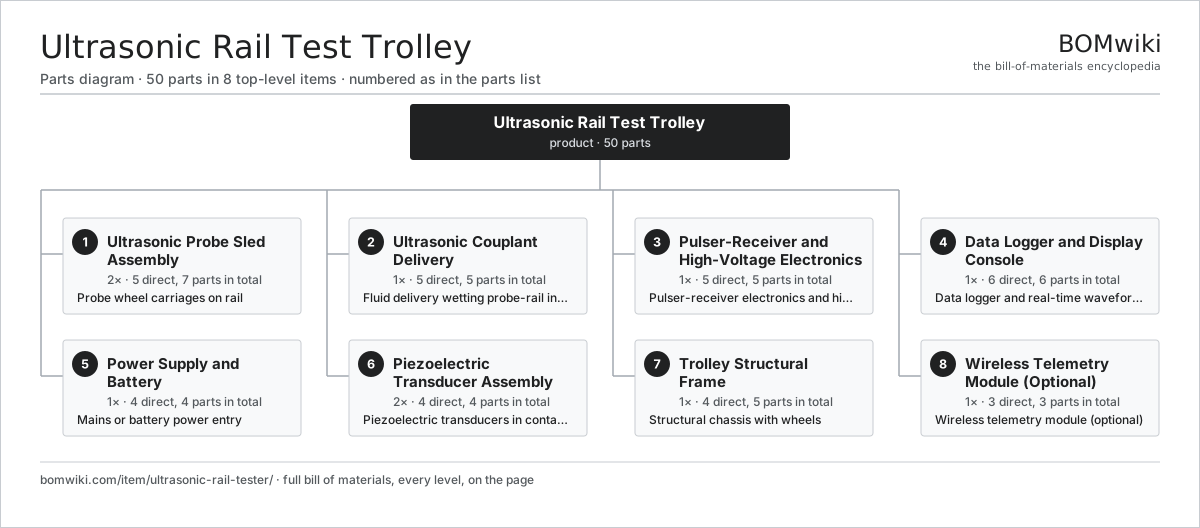
| # | Part | Qty | What it does |
|---|---|---|---|
| 1 | Ultrasonic Probe Sled Assembly 5 parts | 2× | Probe wheel carriages on rail |
| 2 | Ultrasonic Couplant Delivery 5 parts | 1× | Fluid delivery wetting probe-rail interface |
| 3 | Pulser-Receiver and High-Voltage Electronics 5 parts | 1× | Pulser-receiver electronics and high-voltage generation |
| 4 | Data Logger and Display Console 6 parts | 1× | Data logger and real-time waveform display |
| 5 | Power Supply and Battery 4 parts | 1× | Mains or battery power entry |
| 6 | Piezoelectric Transducer Assembly 4 parts | 2× | Piezoelectric transducers in contact shoes |
| 7 | Trolley Structural Frame 4 parts | 1× | Structural chassis with wheels |
| 8 | Wireless Telemetry Module (Optional) 3 parts | 1× | Wireless telemetry module (optional) |
3D model
No 3D model yet. Have a CAD file of this? Add a 3D model. STL renders right on this page; STEP, FreeCAD, and OpenSCAD sources are welcome too (openly licensed, like all 3D models on BOMwiki).
Build & assembly graph
expand / collapse · shared sub-assemblies converge · links to related products · est. labourTap an assembly to expand/collapse · tap a part to open it · use “Open page” for any node · drag to pan, scroll to zoom.
Bill of materials for Ultrasonic Rail Test Trolley
8 top-level lines · 44 rows shown · 50 parts total · indented to 3 levels| # | Item / sub-assembly | Part no. | Qty/assy | Ext. qty | Parts | Type |
|---|---|---|---|---|---|---|
| 1 | Ultrasonic Probe Sled Assembly 5 parts | ultrasonic-rail-tester-probe-sleds | 2× | 2 | 7 | assembly |
| 1.1 | Sled Frame | ultrasonic-rail-tester-sled-frame | 1× | 2 | · | part |
| 1.2 | Guide Wheel | ultrasonic-rail-tester-guide-wheels | 2× | 4 | · | part |
| 1.3 | Probe Shoe | ultrasonic-rail-tester-probe-shoe | 1× | 2 | · | part |
| 1.4 | Spring Mount | ultrasonic-rail-tester-spring-mount | 2× | 4 | · | part |
| 1.5 | Cable Reel | ultrasonic-rail-tester-cable-reel | 1× | 2 | · | part |
| 2 | Ultrasonic Couplant Delivery 5 parts | ultrasonic-rail-tester-couplant-system | 1× | 1 | 5 | assembly |
| 2.1 | Couplant Reservoir | ultrasonic-rail-tester-couplant-tank | 1× | 1 | · | part |
| 2.2 | Couplant Pump | ultrasonic-rail-tester-couplant-pump | 1× | 1 | · | part |
| 2.3 | Flow Control Valve | ultrasonic-rail-tester-couplant-valve | 1× | 1 | · | part |
| 2.4 | Delivery Nozzle | ultrasonic-rail-tester-couplant-nozzle | 1× | 1 | · | part |
| 2.5 | Delivery Hose | ultrasonic-rail-tester-couplant-hose | 1× | 1 | · | part |
| 3 | Pulser-Receiver and High-Voltage Electronics 5 parts | ultrasonic-rail-tester-instrumentation-cabinet | 1× | 1 | 5 | assembly |
| 3.1 | Pulser Circuit | ultrasonic-rail-tester-pulser-circuit | 1× | 1 | · | part |
| 3.2 | Receiver Amplifier | ultrasonic-rail-tester-receiver-amplifier | 1× | 1 | · | part |
| 3.3 | Filter Module | ultrasonic-rail-tester-filter-module | 1× | 1 | · | part |
| 3.4 | Gate and Discriminator | ultrasonic-rail-tester-gate-discriminator | 1× | 1 | · | part |
| 3.5 | Shielded Enclosure | ultrasonic-rail-tester-enclosure | 1× | 1 | · | part |
| 4 | Data Logger and Display Console 6 parts | ultrasonic-rail-tester-recording-unit | 1× | 1 | 6 | assembly |
| 4.1 | Display Screen | ultrasonic-rail-tester-display-screen | 1× | 1 | · | part |
| 4.2 | Data Logger CPU | ultrasonic-rail-tester-data-logger-cpu | 1× | 1 | · | part |
| 4.3 | Storage Media | ultrasonic-rail-tester-storage-media | 1× | 1 | · | part |
| 4.4 | GPS Receiver | ultrasonic-rail-tester-gps-receiver | 1× | 1 | · | part |
| 4.5 | Speed Encoder | ultrasonic-rail-tester-speed-sensor | 1× | 1 | · | part |
| 4.6 | Alert Threshold Logic | ultrasonic-rail-tester-alarm-threshold | 1× | 1 | · | part |
| 5 | Power Supply and Battery 4 parts | ultrasonic-rail-tester-power-supply | 1× | 1 | 4 | assembly |
| 5.1 | AC-DC Converter | ultrasonic-rail-tester-ac-converter | 1× | 1 | · | part |
| 5.2 | Lithium Battery Pack | ultrasonic-rail-tester-lithium-battery | 1× | 1 | · | part |
| 5.3 | Battery Charger | ultrasonic-rail-tester-battery-charger | 1× | 1 | · | part |
| 5.4 | Power Distribution | ultrasonic-rail-tester-power-distribution | 1× | 1 | · | part |
| 6 | Piezoelectric Transducer Assembly 4 parts | ultrasonic-rail-tester-probe-assembly | 2× | 2 | 4 | assembly |
| 6.1 | PZT Transducer | ultrasonic-rail-tester-transducer-element | 1× | 2 | · | part |
| 6.2 | Backing Damper | ultrasonic-rail-tester-backing-material | 1× | 2 | · | part |
| 6.3 | Acoustic Lens | ultrasonic-rail-tester-acoustic-lens | 1× | 2 | · | part |
| 6.4 | EMI Shield Can | ultrasonic-rail-tester-shielding-can | 1× | 2 | · | part |
| 7 | Trolley Structural Frame 4 parts | ultrasonic-rail-tester-trolley-frame | 1× | 1 | 5 | assembly |
| 7.1 | Main Frame | ultrasonic-rail-tester-main-frame | 1× | 1 | · | part |
| 7.2 | Carriage Wheel | ultrasonic-rail-tester-carriage-wheel | 2× | 2 | · | part |
| 7.3 | Tow Coupling | ultrasonic-rail-tester-frame-coupling | 1× | 1 | · | part |
| 7.4 | Brake Assembly | ultrasonic-rail-tester-brake-assembly | 1× | 1 | · | part |
| 8 | Wireless Telemetry Module (Optional) 3 parts | ultrasonic-rail-tester-antenna-receiver | 1× | 1 | 3 | assembly |
| 8.1 | Cellular Transceiver | ultrasonic-rail-tester-gsm-transceiver | 1× | 1 | · | part |
| 8.2 | Antenna Bracket | ultrasonic-rail-tester-antenna-mount | 1× | 1 | · | part |
| 8.3 | Wireless Gateway | ultrasonic-rail-tester-data-gateway | 1× | 1 | · | part |
Something wrong in this list? Report a problem with this BOM.
Sourcing: possible vendors
Browse the supplier directory → Prices, MOQ, and lead times are algorithmic estimates, not quotes, and not claims about these companies. Company mappings are curated by keyword; est. price band $500k–$60M. How estimates work| Vendor | HQ | Specialty | MOQ | Lead time |
|---|---|---|---|---|
|
🇨🇳CRRC
crrcgc.cc ↗
|
Beijing, CN | Rolling stock & rail systems | made to order | 40–72 wks |
|
🇫🇷Alstom
alstom.com ↗
|
Saint-Ouen, FR | Rail rolling stock | made to order | 40–72 wks |
| mobility.siemens.com ↗ | Munich, DE | Rail systems | made to order | 40–72 wks |
| stadlerrail.com ↗ | Bussnang, CH | Rail rolling stock | made to order | 40–72 wks |
|
🇺🇸Wabtec
wabteccorp.com ↗
|
Pittsburgh, US | Rail equipment | made to order | 40–72 wks |
1,029-word article