Understage Elevator
ProductOverview
An understage elevator (also called a trap lift or stage lift) is a motorized elevator platform recessed beneath the stage floor that can raise actors or light scenery through an opening (trap door) into the stage view. The platform is typically 2–4 m × 2–4 m and can support 2–5 tons. When lowered, it sits at or below the stage floor level, and the trap door (a large hinged panel) rests flush with the surrounding stage deck, creating a seamless floor surface. When the operator initiates a raise, the platform ascends, breaking through the trap door and carrying its passengers or load up into view. This creates a dramatic theatrical effect, often used for supernatural entrances, magical appearances, or mechanical revelation.
The system combines structural, mechanical, and electrical engineering: a motor and gearbox drive the platform vertically via chain or screw drive, while precision guide rails prevent tilting or lateral drift. Safety interlocks ensure the trap door is fully closed before the platform rises (preventing the platform from striking an open door) and limit travel to prevent over-rise into the stage floor opening or over-descent into the understage pit.
Structural Design
The Lift Platform Assembly consists of:
- A Platform Frame (welded steel box section, 250–300 mm depth) providing rigid primary structure
- A Platform Deck (40–50 mm hardwood or composite flooring) providing safe footing for actors
- Side Safety Guard mesh barriers (1100 mm high) on platform sides to prevent accidental contact with the stage edge during travel
The platform must withstand significant acceleration: raising 3–4 tons from rest to 1 m/s in 2 seconds generates approximately 0.25 g of acceleration. Actors standing on the platform experience a noticeable upward jolt, similar to an elevator starting its ascent. The platform frame must be rigid enough to prevent perceptible flex or vibration that would distract the audience.
Drive Mechanism
Two variants exist: chain drive and screw drive.
Chain Drive (more common in modern installations): The Drive Motor (2–5.5 kW) drives a Planetary Gearbox (planetary or worm reducer, 10:1–50:1). The gearbox output shaft drives a Chain Sprocket (typically 20–30 teeth) which engages a Drive Belt (roller chain) that wraps around a larger sprocket anchored to the stage floor structure above. As the motor rotates, the chain pulls the platform upward. This variant is simpler mechanically and provides inherent load-holding: if motor power is lost, friction in the chain and sprockets prevents uncontrolled descent.
Screw Drive (used when smoother, quieter motion is desired): A ball-screw or acme-screw mechanism converts motor rotation into vertical platform motion. The platform frame is threaded to the screw rod; as the screw rotates, the threads push the platform upward. Screw drives are inherently quieter and provide self-locking at rest (the thread pitch prevents gravity from backdriving the screw), but require more frequent lubrication and are heavier due to the large-diameter screw.
Most modern theaters prefer chain drive for reliability and ease of maintenance.
Guide System
The Vertical Guide Rail Assembly system prevents the platform from tilting, twisting, or drifting laterally during travel. Four corner-mounted Guide Rail Profile (C-channel or box rails) extend from the trap door opening down through the understage pit. Each corner has a Guide Carriage (roller or ball-bearing block) that runs on the rail, supporting the platform corner and controlling lateral play to <5 mm.
The guide rails must be vertically plumb (within 1:200 or 5 mm over a 1 m depth). Any deviation causes one side of the platform to rise faster than the other, creating a visible tilt that the audience immediately perceives. Annual inspection includes laser-theodolite verification of plumbness, with shim adjustment to maintain tolerance.
Trap Door System
The Trap Door & Opening Frame is a critical safety component. The trap door is typically 2–4 m × 2–4 m, large enough to allow the platform to fully emerge. The door is hinged (usually with a piano hinge or heavy-duty ball-bearing hinge set) and weighted to close automatically when the platform lowers.
The Door Leaf Panel is counterweighted with lead shot or springs so that its weight is neutral (approximately zero force required to open or close it manually). When the platform lowers, the door naturally falls closed under gravity. A Door Seal Gasket (compressed neoprene gasket) seals the gap between the door and frame, reducing light leakage and sound transmission from the understage to the audience.
A critical safety interlock: the Door Interlock Switch switch prevents the platform from rising if the trap door is open or not fully seated. If a stage crew member accidentally leaves the door unlatched, the motor will not energize, preventing the platform from striking and breaking the door.
Counterweight System
The Counterweight & Load Reduction typically consists of a stack of heavy compression coil springs mounted below the platform. The springs are sized to support 40–60% of the platform's weight, reducing the net load the motor must lift. For example, a 3-ton platform with 1.5-ton spring assist requires the motor to only lift an effective 1.5 tons, reducing required motor power from 5.5 kW to approximately 3 kW.
The springs are pre-compressed during installation so that when the platform is at rest on the stage floor, the springs are already loaded to 60% compression. This provides:
- Reduced motor power: Lower kW motor = lower electrical service cost, quieter operation
- Improved safety: If the motor loses power, the springs hold the platform stationary; gravity alone cannot overcome spring tension
- Smoother motion: Spring force smooths out the acceleration jerk, reducing the perceptible acceleration experienced by actors
Alternative designs use a counterweight pulley system: a mechanical advantage pulley (3:1 or 4:1) running the drive chain through a movable pulley block. This achieves similar load reduction without springs, but requires more floor space in the understage pit.
Electrical Control & Safety Interlocks
The Electrical Control System system enforces multiple safety rules:
Door Closed Interlock: The Door Interlock Switch microswitch must sense the trap door fully seated before the Motor Contactor can energize the motor. If the door is open or partially open, the motor cannot start.
Top Limit: The Top Limit Switch proximity sensor or mechanical stop halts the platform when it reaches stage deck level. This prevents the platform from rising so high that it hits stage floor structure or jams in the trap door opening.
Bottom Limit: The Bottom Limit Switch mechanical stop prevents descent below the understage pit floor, protecting equipment and personnel below.
Overload Detection: A Overload Pressure Switch monitors drive tension (chain tension or hydraulic pressure). If the load exceeds the rated capacity, the system alarms and prevents further operation.
Emergency Stop: A hardwired Control Pendant emergency stop button cuts power to the motor contactor immediately, halting the platform wherever it is. The Counterweight & Load Reduction springs hold the platform in place until the operator resumes control.
All interlocks are hard-wired through dual-channel safety relays; software cannot override them.
Operational Scenarios
Standard Entrance Cue: Stage crew pre-positions an actor on the platform in the understage area, trap door closed and locked. At the lighting designer's cue (e.g., "thunder flash, reveal the phantom"), the stage manager activates the raise button on the pendant. The platform smoothly rises in 5–10 seconds, breaking through the trap door and lifting the actor into full view. Dramatic orchestral music and lighting effects heighten the moment.
Multi-Stage Reveal: The platform can stop at intermediate positions (partial rise) to reveal props or other actors gradually. The Position Sensor provides continuous height feedback, allowing the operator to stop at any position.
Safe Descent in Darkness: Some shows choreograph the actor stepping off the platform at stage level (after being raised), while the platform alone lowers back down in darkness. The operator manually controls descent speed via the pendant speed dial, ensuring a smooth, silent descent that the audience doesn't hear.
Maintenance & Inspection
The Drive Belt (roller chain) requires lubrication every 50 operating hours, typically using an NLGI #1 or #2 grease with lithium or synthetic base. The chain should be visually inspected biannually for rust or stiffness; any sign of corrosion requires replacement.
The understage-elevator-guide-rail vertical plumbness must be verified annually using a laser theodolite or optical level. Deviations >5 mm require shim adjustment at the top anchor points.
The Guide Carriage roller bearings should be inspected for play (movement in the radial direction) annually; any play >2 mm indicates bearing wear and requires bearing replacement.
The Door Hinge should be re-lubricated annually with light oil or grease. Over time, hinges can bind, causing the door to stick or close incompletely, which can trip the door interlock and prevent platform operation.
The Counterweight & Load Reduction springs should be inspected visually for rust or pitting every 2 years. Springs exposed to moisture or salt spray (outdoor stages) may corrode internally, losing tension gradually. Corroded springs must be replaced as a set to maintain balanced load distribution.
All limit switch and proximity sensor mounting bolts should be re-torqued annually. Vibration from frequent platform cycles can loosen fasteners, causing switches to miss their trigger points and fail to stop the platform at the correct position.
Understage Elevator parts and their functions
7 top-level parts · 49 parts in total · full bill of materials below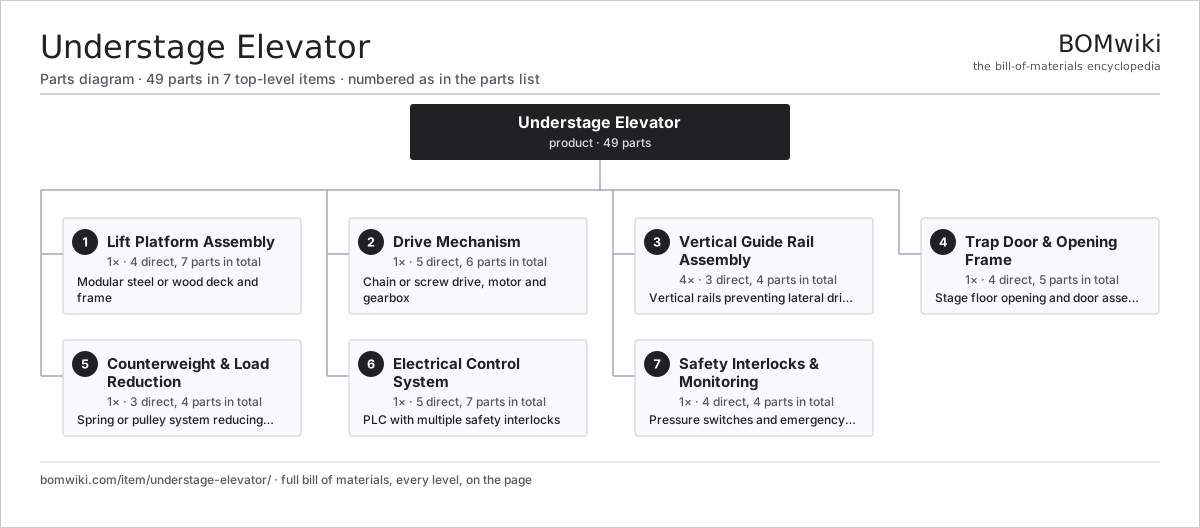
| # | Part | Qty | What it does |
|---|---|---|---|
| 1 | Lift Platform Assembly 4 parts | 1× | Modular steel or wood deck and frame |
| 2 | Drive Mechanism 5 parts | 1× | Chain or screw drive, motor and gearbox |
| 3 | Vertical Guide Rail Assembly 3 parts | 4× | Vertical rails preventing lateral drift during travel |
| 4 | Trap Door & Opening Frame 4 parts | 1× | Stage floor opening and door assembly |
| 5 | Counterweight & Load Reduction 3 parts | 1× | Spring or pulley system reducing motor load |
| 6 | Electrical Control System 5 parts | 1× | PLC with multiple safety interlocks |
| 7 | Safety Interlocks & Monitoring 4 parts | 1× | Pressure switches and emergency stop logic |
3D model
No 3D model yet. Have a CAD file of this? Add a 3D model. STL renders right on this page; STEP, FreeCAD, and OpenSCAD sources are welcome too (openly licensed, like all 3D models on BOMwiki).
Build & assembly graph
expand / collapse · shared sub-assemblies converge · links to related products · est. labourTap an assembly to expand/collapse · tap a part to open it · use “Open page” for any node · drag to pan, scroll to zoom.
Bill of materials for Understage Elevator
7 top-level lines · 35 rows shown · 49 parts total · indented to 3 levels| # | Item / sub-assembly | Part no. | Qty/assy | Ext. qty | Parts | Type |
|---|---|---|---|---|---|---|
| 1 | Lift Platform Assembly 4 parts | understage-elevator-lift-platform | 1× | 1 | 7 | assembly |
| 1.1 | Platform Frame | understage-elevator-platform-frame | 1× | 1 | · | part |
| 1.2 | Platform Deck | understage-elevator-platform-deck | 1× | 1 | · | part |
| 1.3 | Side Safety Guard | understage-elevator-side-guard | 1× | 1 | · | part |
| 1.4 | Rail Attachment Bracket | understage-elevator-platform-rail-mount | 4× | 4 | · | part |
| 2 | Drive Mechanism 5 parts | understage-elevator-drive-mechanism | 1× | 1 | 6 | assembly |
| 2.1 | Drive Motor | understage-elevator-motor | 1× | 1 | · | part |
| 2.2 | Planetary Gearbox | understage-elevator-gearbox | 1× | 1 | · | part |
| 2.3 | Chain Sprocket | understage-elevator-chain-sprocket | 2× | 2 | · | part |
| 2.4 | Drive Belt | drive-belt | 1× | 1 | · | part |
| 2.5 | Motor Mount Plate | understage-elevator-motor-mount | 1× | 1 | · | part |
| 3 | Vertical Guide Rail Assembly 3 parts | understage-elevator-guide-rails | 4× | 4 | 4 | assembly |
| 3.1 | Guide Rail Profile | understage-elevator-rail-profile | 1× | 4 | · | part |
| 3.2 | Guide Carriage | understage-elevator-guide-carriage | 2× | 8 | · | part |
| 3.3 | Fastener Set | fastener-set | 1× | 4 | · | part |
| 4 | Trap Door & Opening Frame 4 parts | understage-elevator-trap-door-frame | 1× | 1 | 5 | assembly |
| 4.1 | Door Leaf Panel | understage-elevator-door-leaf | 1× | 1 | · | part |
| 4.2 | Door Hinge | understage-elevator-door-hinge | 2× | 2 | · | part |
| 4.3 | Door Frame | understage-elevator-door-frame-member | 1× | 1 | · | part |
| 4.4 | Door Seal Gasket | understage-elevator-rubber-seal | 1× | 1 | · | part |
| 5 | Counterweight & Load Reduction 3 parts | understage-elevator-counterweight-system | 1× | 1 | 4 | assembly |
| 5.1 | Counterweight Spring Stack | understage-elevator-spring-stack | 1× | 1 | · | part |
| 5.2 | Spring Guide Rod | understage-elevator-spring-guide-rod | 1× | 1 | · | part |
| 5.3 | Counterweight Pulley | understage-elevator-counterweight-pulley | 2× | 2 | · | part |
| 6 | Electrical Control System 5 parts | understage-elevator-electrical-control | 1× | 1 | 7 | assembly |
| 6.1 | Microcontroller | mcu | 1× | 1 | · | part |
| 6.2 | Motor Contactor | understage-elevator-motor-contactor | 1× | 1 | · | part |
| 6.3 | Position Sensor | understage-elevator-proximity-sensor | 2× | 2 | · | part |
| 6.4 | Control Pendant | understage-elevator-pendant | 1× | 1 | · | part |
| 6.5 | Relay | relay | 2× | 2 | · | part |
| 7 | Safety Interlocks & Monitoring 4 parts | understage-elevator-safety-system | 1× | 1 | 4 | assembly |
| 7.1 | Top Limit Switch | understage-elevator-top-limit | 1× | 1 | · | part |
| 7.2 | Bottom Limit Switch | understage-elevator-bottom-limit | 1× | 1 | · | part |
| 7.3 | Door Interlock Switch | understage-elevator-door-interlock | 1× | 1 | · | part |
| 7.4 | Overload Pressure Switch | understage-elevator-pressure-switch | 1× | 1 | · | part |
Something wrong in this list? Report a problem with this BOM.
Related products
same domain, ranked by shared parts AAC Block Plant
155 parts · shares 1 with this page
AAC Block Plant
155 parts · shares 1 with this page
 Automatic Sliding Door
390 parts · shares 1 with this page
Automatic Sliding Door
390 parts · shares 1 with this page
 Clay Brick Extruder
154 parts · shares 1 with this page
Concrete Pipe Making Machine
154 parts · shares 1 with this page
Clay Brick Extruder
154 parts · shares 1 with this page
Concrete Pipe Making Machine
154 parts · shares 1 with this page
 Fiber Cement Sheet Machine
819 parts · shares 1 with this page
Fiber Cement Sheet Machine
819 parts · shares 1 with this page
 Garage Door Opener
280 parts · shares 1 with this page
Garage Door Opener
280 parts · shares 1 with this page
Sourcing: possible vendors
Browse the supplier directory → Prices, MOQ, and lead times are algorithmic estimates, not quotes, and not claims about these companies. Company mappings are curated by keyword; est. price band $50–$10k. How estimates work| Vendor | HQ | Specialty | MOQ | Lead time |
|---|---|---|---|---|
| assaabloy.com ↗ | Stockholm, SE | Locks & access | 1,000 units | 8–12 wks |
|
🇺🇸Allegion
allegion.com ↗
|
Dublin, US | Security products (Schlage) | 1,000 units | 8–12 wks |
| dormakaba.com ↗ | Rümlang, CH | Access & door systems | 1,000 units | 8–12 wks |
| honeywell.com ↗ | Charlotte, US | Building & safety tech | 1,000 units | 8–12 wks |
| hikvision.com ↗ | Hangzhou, CN | Surveillance & security | 1,000 units | 8–12 wks |
1,594-word article