Universal Testing Machine
ProductOverview
A universal testing machine (UTM) applies controlled tensile, compression, and flexural loads to material specimens while continuously measuring force, elongation, and deformation to generate stress-strain curves and determine mechanical properties. The machine consists of a rigid load frame with precision linear bearings, a servo-controlled crosshead driven by a ballscrew or hydraulic actuator, a calibrated load cell, and an extensometer that measures specimen elongation over a gauge length. The controller orchestrates closed-loop feedback at 1 kHz, adjusting the actuator to maintain constant strain rate or constant load as required by test standards (ISO 6892, ASTM E8).
Servo-hydraulic systems dominate high-load and high-speed fatigue testing, while electromechanical screwdrives are preferred for routine tensile testing in smaller labs due to lower maintenance and energy consumption. Both topologies deliver repeatable results across metals, polymers, composites, and elastomers.
How it works
The Load Frame is a rigid C-channel or box-section steel structure bolted to the lab floor. A Hydraulic Pump (hydraulic) or motor-driven ballnut (electromechanical) drives the Crosshead upward at a programmable rate (0.5–1000 mm/min). The specimen is clamped in the lower fixed Grips and Fixtures and the upper movable Grips and Fixtures, which are pneumatically actuated to prevent slipping.
As load builds, the Load Cell (a bonded strain-gauge bridge) generates a ±10 V output proportional to applied force. An Extensometer mounted across the specimen's gauge length outputs displacement via a LVDT Transducer. Both signals feed the Controller, which runs a 24-bit ADC Module at 1000 Hz per channel.
The controller computes stress (force ÷ original area) and strain (elongation ÷ gauge length) every millisecond, updating a proportional servo valve (or PWM motor controller) via a 16-bit DAC Module to maintain the desired test profile: constant strain rate (e.g., 5 mm/min) until yield, then constant load (e.g., 500 MPa) until rupture. A Hydraulic System system (pump, Servo Proportional Valve, Accumulator for shock damping, and return Return Filter) supplies 30–60 L/min at 210 bar.
Real-time data and the complete stress-strain curve are logged to internal storage or a connected PC, enabling post-test analysis of yield strength, tensile strength, elongation at break, elastic modulus, and Poisson's ratio.
Specimen preparation and test procedure
Specimens are prepared per ASTM E8 (metals) or ISO 527 (plastics): typically 10–12.5 mm diameter round bars or rectangular tabs with 50 mm gauge length. The operator mounts the specimen, applies initial preload (5–10% of expected peak), zeros the load and displacement data, then initiates the test. The crosshead accelerates to the target strain rate, and the controller adjusts servo commands every millisecond to maintain constant speed. At yield or rupture, the machine either stops automatically (limit trigger) or continues on a second phase (e.g., cyclic load for fatigue pre-conditioning).
Post-test, the operator retrieves the broken specimen, measures final gauge length and diameter (for reduction-of-area calculations), and exports the test data in CSV or proprietary format for statistical analysis and material database entry.
Standards and automation
Universal testing machines operating under ISO 6892 (metallic materials tensile test method) or ASTM E8 must meet class 0.5 or better for load measurement and demonstrate periodic calibration with calibration weights and secondary load cells. Many modern systems integrate with a lab's test-data management system (LIMS) or material database, auto-filling specimen ID, material grade, and test parameters to eliminate manual transcription.
Advanced controllers can execute complex multi-step sequences: constant strain rate to 0.2% offset yield, hold at yield for 1 minute, unload to zero, then reload at a different strain rate to simulate service cyclic loading.
Universal Testing Machine parts and their functions
7 top-level parts · 34 parts in total · full bill of materials below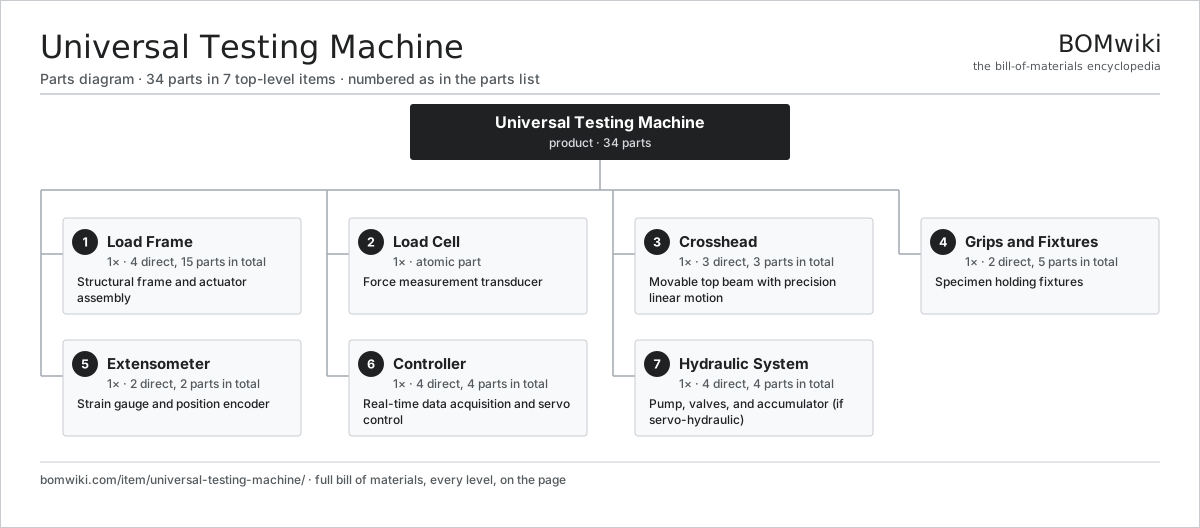
| # | Part | Qty | What it does |
|---|---|---|---|
| 1 | Load Frame 4 parts | 1× | Structural frame and actuator assembly |
| 2 | Load Cell | 1× | Force measurement transducer |
| 3 | Crosshead 3 parts | 1× | Movable top beam with precision linear motion |
| 4 | Grips and Fixtures 2 parts | 1× | Specimen holding fixtures |
| 5 | Extensometer 2 parts | 1× | Strain gauge and position encoder |
| 6 | Controller 4 parts | 1× | Real-time data acquisition and servo control |
| 7 | Hydraulic System 4 parts | 1× | Pump, valves, and accumulator (if servo-hydraulic) |
3D model
No 3D model yet. Have a CAD file of this? Add a 3D model. STL renders right on this page; STEP, FreeCAD, and OpenSCAD sources are welcome too (openly licensed, like all 3D models on BOMwiki).
Build & assembly graph
expand / collapse · shared sub-assemblies converge · links to related products · est. labourTap an assembly to expand/collapse · tap a part to open it · use “Open page” for any node · drag to pan, scroll to zoom.
Bill of materials for Universal Testing Machine
7 top-level lines · 26 rows shown · 34 parts total · indented to 3 levels| # | Item / sub-assembly | Part no. | Qty/assy | Ext. qty | Parts | Type |
|---|---|---|---|---|---|---|
| 1 | Load Frame 4 parts | universal-testing-machine-load-frame | 1× | 1 | 15 | assembly |
| 1.1 | Frame Columns | universal-testing-machine-frame-column | 1× | 1 | · | part |
| 1.2 | Base Plate | universal-testing-machine-base-plate | 1× | 1 | · | part |
| 1.3 | Ball Bearing | ball-bearing | 12× | 12 | · | part |
| 1.4 | Fastener Set | fastener-set | 1× | 1 | · | part |
| 2 | Load Cell | universal-testing-machine-load-cell | 1× | 1 | · | part |
| 3 | Crosshead 3 parts | universal-testing-machine-crosshead | 1× | 1 | 3 | assembly |
| 3.1 | Lead Screw | universal-testing-machine-lead-screw | 1× | 1 | · | part |
| 3.2 | Ball Screw | ball-screw | 1× | 1 | · | part |
| 3.3 | Encoder | encoder | 1× | 1 | · | part |
| 4 | Grips and Fixtures 2 parts | universal-testing-machine-grips | 1× | 1 | 5 | assembly |
| 4.1 | Grip Jaw | universal-testing-machine-grip-jaw | 4× | 4 | · | part |
| 4.2 | Pneumatic Valve | universal-testing-machine-pneumatic-valve | 1× | 1 | · | part |
| 5 | Extensometer 2 parts | universal-testing-machine-extensometer | 1× | 1 | 2 | assembly |
| 5.1 | LVDT Transducer | universal-testing-machine-lvdt | 1× | 1 | · | part |
| 5.2 | Encoder | encoder | 1× | 1 | · | part |
| 6 | Controller 4 parts | universal-testing-machine-controller | 1× | 1 | 4 | assembly |
| 6.1 | Microcontroller | mcu | 1× | 1 | · | part |
| 6.2 | DAC Module | universal-testing-machine-dac | 1× | 1 | · | part |
| 6.3 | ADC Module | universal-testing-machine-adc | 1× | 1 | · | part |
| 6.4 | LCD Panel | lcd-panel | 1× | 1 | · | part |
| 7 | Hydraulic System 4 parts | universal-testing-machine-hydraulic | 1× | 1 | 4 | assembly |
| 7.1 | Hydraulic Pump | universal-testing-machine-pump | 1× | 1 | · | part |
| 7.2 | Servo Proportional Valve | universal-testing-machine-servo-valve | 1× | 1 | · | part |
| 7.3 | Accumulator | universal-testing-machine-accumulator | 1× | 1 | · | part |
| 7.4 | Return Filter | universal-testing-machine-filter | 1× | 1 | · | part |
Something wrong in this list? Report a problem with this BOM.
Related products
same domain, ranked by shared parts Rockwell Hardness Tester
97 parts · shares 4 with this page
Rockwell Hardness Tester
97 parts · shares 4 with this page
 Scanning Electron Microscope
1,000 parts · shares 4 with this page
Scanning Electron Microscope
1,000 parts · shares 4 with this page
 Atomic Absorption Spectrometer
648 parts · shares 3 with this page
Atomic Absorption Spectrometer
648 parts · shares 3 with this page
 Automated Liquid Handler
817 parts · shares 3 with this page
Automated Liquid Handler
817 parts · shares 3 with this page
 Confocal Microscope
745 parts · shares 3 with this page
Confocal Microscope
745 parts · shares 3 with this page
Sourcing: possible vendors
Browse the supplier directory → Prices, MOQ, and lead times are algorithmic estimates, not quotes, and not claims about these companies. Company mappings are curated by keyword; est. price band $1k–$500k. How estimates work| Vendor | HQ | Specialty | MOQ | Lead time |
|---|---|---|---|---|
| thermofisher.com ↗ | Waltham, US | Lab instruments | 100 units | 10–18 wks |
|
🇺🇸Agilent
agilent.com ↗
|
Santa Clara, US | Analytical instruments | 100 units | 10–18 wks |
|
🇺🇸Bruker
bruker.com ↗
|
Billerica, US | Scientific instruments | 100 units | 10–18 wks |
|
🇯🇵Shimadzu
shimadzu.com ↗
|
Kyoto, JP | Analytical instruments | 100 units | 10–18 wks |
|
🇺🇸Waters
waters.com ↗
|
Milford, US | Chromatography & MS | 100 units | 10–18 wks |
649-word article