Vehicle-to-Grid Charger
ProductOverview
Vehicle-to-Grid (V2G) charging is a bidirectional power conversion system enabling electric vehicles to not only draw charge from the grid but also inject stored energy back during peak demand or grid emergencies. A V2G charger bridges the vehicle battery and the electrical grid, operating as a rectifier (charging) and inverter (discharging) in a single integrated unit.
A typical 11 kW charger adds 50 kWh to a vehicle in 4–5 hours; a 350 kW DC fast charger does the same in 10–15 minutes. More importantly, V2G enables the vehicle battery to serve as distributed energy storage, helping balance grid demand, smooth renewable variability, and reduce peak demand charges for buildings and fleets.
The global V2G market is nascent but rapidly growing. Pilot projects in Denmark, Germany, and Japan demonstrate stable, predictable discharge patterns. As EV penetration reaches 30–50% of the light-duty fleet (projected 2030–2035), aggregated V2G capacity will rival large central generation facilities, creating a "virtual power plant" distributed across millions of vehicles.
How it works
The AC Panel connects the charger to three-phase grid supply (230/400 V, 50–60 Hz). The Isolation Transformer provides galvanic isolation and limits inrush current during soft-start.
In charging mode (motor operation): The Control Module continuously samples AC grid voltage via Voltage Sensor and drives the Power Stage IGBT switching pattern to draw current sinusoidally aligned with grid voltage (power factor >0.99). The transformer steps down to 400 V AC, which the Power Stage rectifies to 400 V DC. A Reactor on the AC side limits switching harmonics. Current Sensor devices feedback instantaneous phase currents to maintain ±2% current accuracy across the 11–350 kW range.
The rectified DC is smoothed by the Capacitor Bank, a 2000–3000 µF bank at 700–800 V. The Connector Assembly interfaces with the vehicle battery management system (BMS) via power contacts and low-voltage handshake signals (CCS Type 2 or CHAdeMO). Vehicle BMS requests charging current in 1 A increments; the charger ramps current from 0 to the requested value in <100 ms, with Control Module proportional-integral control maintaining steady-state current ±1 A.
The Thermal Management system monitors heatsink temperature via thermostat and progressively increases cooling fan speed above 60°C, and reduces charging current above 80°C to protect IGBT junctions.
In discharging mode (generator operation, V2G): The vehicle BMS outputs 300–450 V DC through the Connector Assembly. The Control Module detects grid voltage and phase via the PLL Circuit (phase-locked loop), then modulates the Power Stage IGBT switching to synthesize AC voltage in phase with the grid. Current injection into the grid is proportional to the switching modulation index, ramping in <100 ms.
The Metering Unit tracks bidirectional energy flow and provides pulse outputs to the utility meter, ensuring accurate billing. A kWh Meter records export energy separately from import.
Safety interlocks: The Safety Systems continuously monitor isolation voltage, DC bus voltage, and ground continuity. On vehicle disconnect, a Grounding Contactor closes to discharge the DC link to <50 V within 10 s, preventing accidental shock. An Arc Detector monitors the DC-side connector for arcing (rapid dV/dt) and triggers isolation within <10 ms, preventing cable fire.
The Isolation Relay main contactor breaks the AC mains on demand or overvoltage (>264 V or <184 V), protecting grid-connected equipment.
Grid Synchronization
The PLL Circuit tracks grid voltage zero-crossing with <5° phase lag, enabling smooth current injection without transient inrush. During normal operation, the charger phase current leads or lags grid voltage by <5°, maintaining apparent power (VA) close to active power (W), minimizing reactive demand penalties.
Thermal Design
The Power Stage dissipates 6–12 kW in conduction and switching losses at full 350 kW load. The Cooling Plate directly bonds IGBTs to a liquid-cooled Heatsink. A Cooling Pump circulates 5–15 L/min of water or 40% glycol mix through the heatsink, maintaining junction temperature <125°C. The Cooling Fan (EC brushless, variable PWM) ramps speed proportionally above 60°C to reject residual heat to ambient air.
Peak power dissipation occurs at half-load (175 kW), due to lower current efficiency. At 11 kW (slow charge), efficiency is >92%; at 350 kW (fast charge), efficiency is >94% due to lower relative switching losses.
Standards & Compliance
- IEC 61851 (EV charging): Part 1 (general), Part 22 (DC charging)
- IEC 62196 (connector types): Type 2 (EU), CHAdeMO (Japan), GB/T (China)
- IEEE 1547 (interconnection): Grid voltage, frequency, and stability requirements
- ISO 15118 (communication): Handshake protocol between vehicle and charger
Modern chargers implement Plug & Charge (ISO 15118-20), allowing vehicles to authenticate and negotiate charging parameters without user intervention.
Economics
- Capital cost: 0.3–1.2 USD/W (11 kW $3,300–$13,200; 350 kW $105,000–$420,000)
- Installation: $1,000–$10,000 depending on site grid capacity and civils
- Efficiency gain over separate rectifier + inverter: 2–3% improvement
- Payback via V2G arbitrage (buy low, sell high): 5–10 years in volatile pricing regions, longer in stable grids
Vehicle electrification plus V2G is projected to cut peak grid demand by 10–15% by 2035, deferring $100+ billion in generation and transmission infrastructure investment in developed markets.
Vehicle-to-Grid Charger parts and their functions
8 top-level parts · 62 parts in total · full bill of materials below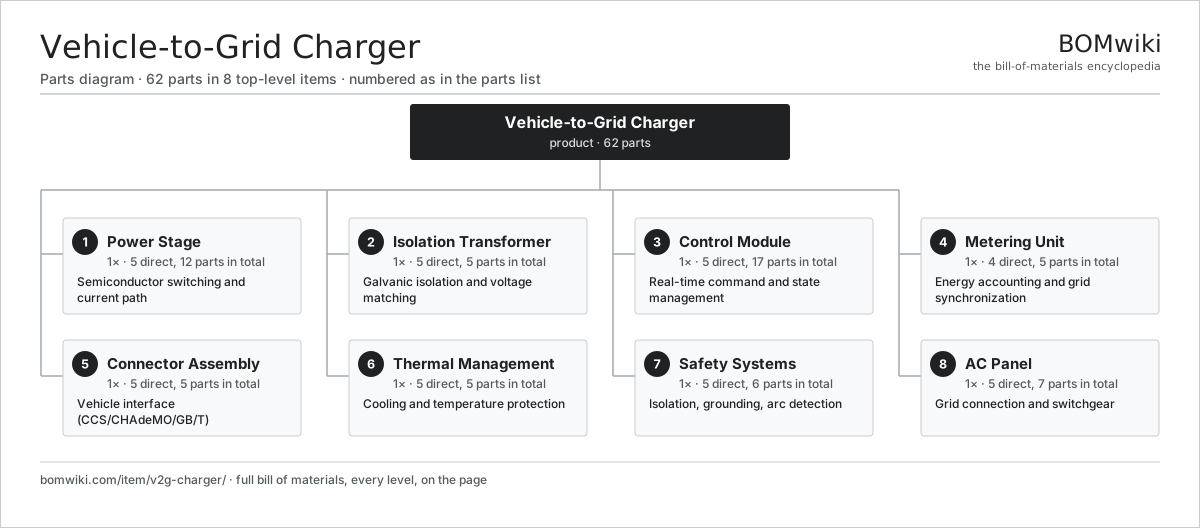
| # | Part | Qty | What it does |
|---|---|---|---|
| 1 | Power Stage 5 parts | 1× | Semiconductor switching and current path |
| 2 | Isolation Transformer 5 parts | 1× | Galvanic isolation and voltage matching |
| 3 | Control Module 5 parts | 1× | Real-time command and state management |
| 4 | Metering Unit 4 parts | 1× | Energy accounting and grid synchronization |
| 5 | Connector Assembly 5 parts | 1× | Vehicle interface (CCS/CHAdeMO/GB/T) |
| 6 | Thermal Management 5 parts | 1× | Cooling and temperature protection |
| 7 | Safety Systems 5 parts | 1× | Isolation, grounding, arc detection |
| 8 | AC Panel 5 parts | 1× | Grid connection and switchgear |
3D model
No 3D model yet. Have a CAD file of this? Add a 3D model. STL renders right on this page; STEP, FreeCAD, and OpenSCAD sources are welcome too (openly licensed, like all 3D models on BOMwiki).
Build & assembly graph
expand / collapse · shared sub-assemblies converge · links to related products · est. labourTap an assembly to expand/collapse · tap a part to open it · use “Open page” for any node · drag to pan, scroll to zoom.
Bill of materials for Vehicle-to-Grid Charger
8 top-level lines · 47 rows shown · 62 parts total · indented to 3 levels| # | Item / sub-assembly | Part no. | Qty/assy | Ext. qty | Parts | Type |
|---|---|---|---|---|---|---|
| 1 | Power Stage 5 parts | v2g-charger-power-stage | 1× | 1 | 12 | assembly |
| 1.1 | IGBT Module | v2g-charger-igbt-module | 6× | 6 | · | part |
| 1.2 | Capacitor Bank | v2g-charger-capacitor-bank | 2× | 2 | · | part |
| 1.3 | Reactor | v2g-charger-reactor | 2× | 2 | · | part |
| 1.4 | Cooling Plate | v2g-charger-cooling-plate | 1× | 1 | · | part |
| 1.5 | Fastener Set | fastener-set | 1× | 1 | · | part |
| 2 | Isolation Transformer 5 parts | v2g-charger-isolation-transformer | 1× | 1 | 5 | assembly |
| 2.1 | Transformer Core | v2g-charger-transformer-core | 1× | 1 | · | part |
| 2.2 | Primary Winding | v2g-charger-primary-winding | 1× | 1 | · | part |
| 2.3 | Secondary Winding | v2g-charger-secondary-winding | 1× | 1 | · | part |
| 2.4 | Thermal Protector | v2g-charger-thermal-protector | 1× | 1 | · | part |
| 2.5 | Fastener Set | fastener-set | 1× | 1 | · | part |
| 3 | Control Module 5 parts | v2g-charger-control-module | 1× | 1 | 17 | assembly |
| 3.1 | MCU | v2g-charger-mcu | 1× | 1 | · | part |
| 3.2 | Voltage Sensor | v2g-charger-voltage-sensor | 3× | 3 | · | part |
| 3.3 | Current Sensor | v2g-charger-current-sensor | 3× | 3 | · | part |
| 3.4 | PWM Gate Driver | v2g-charger-pwm-gate-driver | 6× | 6 | · | part |
| 3.5 | Isolation Coupler | v2g-charger-isolation-coupler | 4× | 4 | · | part |
| 4 | Metering Unit 4 parts | v2g-charger-metering-unit | 1× | 1 | 5 | assembly |
| 4.1 | kWh Meter | v2g-charger-kwh-meter | 1× | 1 | · | part |
| 4.2 | PLL Circuit | v2g-charger-pll-circuit | 1× | 1 | · | part |
| 4.3 | Relay Output | v2g-charger-relay-output | 2× | 2 | · | part |
| 4.4 | Fastener Set | fastener-set | 1× | 1 | · | part |
| 5 | Connector Assembly 5 parts | v2g-charger-connector-assembly | 1× | 1 | 5 | assembly |
| 5.1 | Connector Insert | v2g-charger-connector-insert | 1× | 1 | · | part |
| 5.2 | Connector Cable | v2g-charger-connector-cable | 1× | 1 | · | part |
| 5.3 | Connector Coupler | v2g-charger-connector-coupler | 1× | 1 | · | part |
| 5.4 | Arc Suppressor | v2g-charger-arc-suppressor | 1× | 1 | · | part |
| 5.5 | Fastener Set | fastener-set | 1× | 1 | · | part |
| 6 | Thermal Management 5 parts | v2g-charger-thermal-management | 1× | 1 | 5 | assembly |
| 6.1 | Heatsink | v2g-charger-heatsink | 1× | 1 | · | part |
| 6.2 | Cooling Pump | v2g-charger-cooling-pump | 1× | 1 | · | part |
| 6.3 | Cooling Fan | v2g-charger-cooling-fan | 1× | 1 | · | part |
| 6.4 | Thermostat | v2g-charger-thermostat | 1× | 1 | · | part |
| 6.5 | Fastener Set | fastener-set | 1× | 1 | · | part |
| 7 | Safety Systems 5 parts | v2g-charger-safety-systems | 1× | 1 | 6 | assembly |
| 7.1 | Isolation Relay | v2g-charger-isolation-relay | 1× | 1 | · | part |
| 7.2 | Grounding Contactor | v2g-charger-grounding-contactor | 1× | 1 | · | part |
| 7.3 | Arc Detector | v2g-charger-arc-detector | 1× | 1 | · | part |
| 7.4 | Capacitor Bleed Resistor | v2g-charger-capacitor-bleed-resistor | 1× | 1 | · | part |
| 7.5 | Relay | relay | 2× | 2 | · | part |
| 8 | AC Panel 5 parts | v2g-charger-ac-panel | 1× | 1 | 7 | assembly |
| 8.1 | Main Breaker | v2g-charger-main-breaker | 1× | 1 | · | part |
| 8.2 | RCD Device | v2g-charger-rcd-device | 1× | 1 | · | part |
| 8.3 | Contactors | v2g-charger-contactors | 2× | 2 | · | part |
| 8.4 | Terminal Block | v2g-charger-terminal-block | 2× | 2 | · | part |
| 8.5 | Fastener Set | fastener-set | 1× | 1 | · | part |
Something wrong in this list? Report a problem with this BOM.
Sourcing: possible vendors
Browse the supplier directory → Prices, MOQ, and lead times are algorithmic estimates, not quotes, and not claims about these companies. Company mappings are curated by keyword; est. price band $100–$20M. How estimates work| Vendor | HQ | Specialty | MOQ | Lead time |
|---|---|---|---|---|
|
🇩🇰Vestas
vestas.com ↗
|
Aarhus, DK | Wind turbines | 500 units | 12–24 wks |
| firstsolar.com ↗ | Tempe, US | PV modules | 500 units | 12–24 wks |
|
🇨🇳LONGi
longi.com ↗
|
Xi'an, CN | Solar wafers & modules | 500 units | 12–24 wks |
| enphase.com ↗ | Fremont, US | Microinverters & storage | 500 units | 12–24 wks |
|
🇨🇳Sungrow
sungrowpower.com ↗
|
Hefei, CN | Solar inverters & storage | 500 units | 12–24 wks |
923-word article