Vacuum Ejector
ProductOverview
A vacuum ejector (or pneumatic vacuum generator) creates suction by converting high-pressure compressed air into low pressure using the Coanda effect. Unlike mechanical vacuum pumps, ejectors have no moving parts, are maintenance-free, and generate vacuum instantly. The Vacuum Switch and Blow-Off Valve enable rapid pick-and-place cycles on automatic assembly machines: the ejector builds vacuum to grab a part, the switch signals completion, and the blow-off exhausts vacuum to drop the load.
How it works
Regulated compressed air (typically 6–8 bar) enters the Inlet Silencer and accelerates through the first Primary Nozzle Stage. Here, a Coanda profile, a precision-shaped throat, accelerates the air to near sonic speed. At this high velocity, the air's static pressure drops dramatically (Bernoulli principle), creating a region of suction. The Suction Port 1 taps into this low-pressure region; atmospheric pressure on the load forces air into this port, carrying the load into contact with the picker.
The suction from stage 1 is relatively modest (might achieve −0.3 bar). To improve vacuum, the ejector incorporates a second Secondary Nozzle Stage that takes the suction from stage 1 as an input and amplifies it through another Coanda nozzle. This secondary air jet reduces pressure further. A third Tertiary Nozzle Stage continues the cascade, achieving a final vacuum of −0.4 to −0.7 bar gauge (0.3–0.6 bar absolute).
All three stages exhaust into the Outlet Silencer, which muffles the noise. The pressure ratio efficiency is typically 60–75%: for every 10 L/min of useful vacuum output, the ejector consumes 8–15 L/min of supply air.
Control system
The Vacuum Switch is a diaphragm-operated pressure relay. When the vacuum port reaches the setpoint pressure (adjustable 0.3–0.8 bar), the Diaphragm deflects, closing an electrical contact that signals "vacuum ready" to the robot controller. This prevents part motion until vacuum is secure.
The Blow-Off Valve is a solenoid-piloted poppet valve connected in parallel to the vacuum outlet. When de-energized (normal state), it blocks the outlet, allowing vacuum to build. When the controller sends a 24 VDC signal (part release command), the Solenoid Coil opens the poppet, venting the vacuum line to atmosphere. The load drops in < 50 ms. Re-energizing the solenoid re-seats the poppet and allows a fresh vacuum build cycle.
Sizing and deployment
Ejectors are sized by vacuum capacity (L/min) and supply pressure. A small 10 L/min ejector might hold a 200 g plastic part; a 100 L/min unit handles heavy stamped steel components. Supply air must be clean (0.5 μm or finer) and regulated to prevent pressure spikes that damage nozzles. Many OEMs integrate ejectors directly into the gripper head, eliminating long suction lines that would reduce vacuum due to air leakage.
Because ejectors are passive (no electrical control except the solenoid blow-off), they are inherently reliable and used in food, automotive, electronics assembly, and printing industries where thousands of pick cycles per shift are routine.
Vacuum Ejector parts and their functions
8 top-level parts · 27 parts in total · full bill of materials below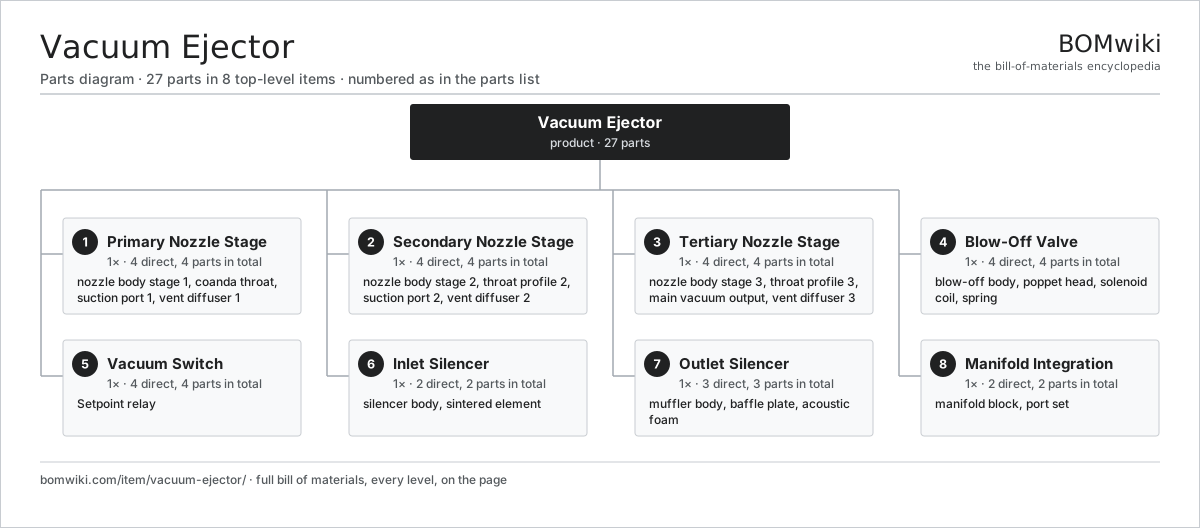
| # | Part | Qty | What it does |
|---|---|---|---|
| 1 | Primary Nozzle Stage 4 parts | 1× | First Coanda nozzle accelerates high-pressure supply air, creating suction at the primary vacuum port. |
| 2 | Secondary Nozzle Stage 4 parts | 1× | Second Coanda nozzle amplifies vacuum by entraining suction from stage 1 into another low-pressure jet. |
| 3 | Tertiary Nozzle Stage 4 parts | 1× | Third Coanda stage further reduces pressure, achieving deep vacuum (0.3–0.6 bar absolute). |
| 4 | Blow-Off Valve 4 parts | 1× | Solenoid vent valve that rapidly exhausts vacuum, dropping the load instantly when de-energized. |
| 5 | Vacuum Switch 4 parts | 1× | Setpoint relay |
| 6 | Inlet Silencer 2 parts | 1× | Sintered bronze filter on supply port, attenuating supply-air whistle. |
| 7 | Outlet Silencer 3 parts | 1× | Muffler on exhaust port absorbing expansion noise from vent air. |
| 8 | Manifold Integration 2 parts | 1× | Aluminum body housing all nozzles and integrating supply, vacuum, and exhaust galleries. |
3D model
No 3D model yet. Have a CAD file of this? Add a 3D model. STL renders right on this page; STEP, FreeCAD, and OpenSCAD sources are welcome too (openly licensed, like all 3D models on BOMwiki).
Build & assembly graph
expand / collapse · shared sub-assemblies converge · links to related products · est. labourTap an assembly to expand/collapse · tap a part to open it · use “Open page” for any node · drag to pan, scroll to zoom.
Bill of materials for Vacuum Ejector
8 top-level lines · 35 rows shown · 27 parts total · indented to 3 levels| # | Item / sub-assembly | Part no. | Qty/assy | Ext. qty | Parts | Type |
|---|---|---|---|---|---|---|
| 1 | Primary Nozzle Stage 4 parts | vacuum-ejector-nozzle-stage-1 | 1× | 1 | 4 | assembly |
| 1.1 | Nozzle Body Stage 1 | vacuum-ejector-nozzle-body-1 | 1× | 1 | · | part |
| 1.2 | Coanda Throat | vacuum-ejector-nozzle-seat | 1× | 1 | · | part |
| 1.3 | Suction Port 1 | vacuum-ejector-suction-port-1 | 1× | 1 | · | part |
| 1.4 | Vent Diffuser 1 | vacuum-ejector-vent-diffuser-1 | 1× | 1 | · | part |
| 2 | Secondary Nozzle Stage 4 parts | vacuum-ejector-nozzle-stage-2 | 1× | 1 | 4 | assembly |
| 2.1 | Nozzle Body Stage 2 | vacuum-ejector-nozzle-body-2 | 1× | 1 | · | part |
| 2.2 | Throat Profile 2 | vacuum-ejector-nozzle-throat-2 | 1× | 1 | · | part |
| 2.3 | Suction Port 2 | vacuum-ejector-suction-port-2 | 1× | 1 | · | part |
| 2.4 | Vent Diffuser 2 | vacuum-ejector-vent-diffuser-2 | 1× | 1 | · | part |
| 3 | Tertiary Nozzle Stage 4 parts | vacuum-ejector-nozzle-stage-3 | 1× | 1 | 4 | assembly |
| 3.1 | Nozzle Body Stage 3 | vacuum-ejector-nozzle-body-3 | 1× | 1 | · | part |
| 3.2 | Throat Profile 3 | vacuum-ejector-nozzle-throat-3 | 1× | 1 | · | part |
| 3.3 | Main Vacuum Output | vacuum-ejector-suction-port-3 | 1× | 1 | · | part |
| 3.4 | Vent Diffuser 3 | vacuum-ejector-vent-diffuser-3 | 1× | 1 | · | part |
| 4 | Blow-Off Valve 4 parts | vacuum-ejector-blow-off-valve | 1× | 1 | 4 | assembly |
| 4.1 | Blow-Off Body | vacuum-ejector-blowoff-body | 1× | 1 | · | part |
| 4.2 | Poppet Head | vacuum-ejector-blowoff-poppet | 1× | 1 | · | part |
| 4.3 | Solenoid Coil | vacuum-ejector-blowoff-solenoid | 1× | 1 | · | part |
| 4.4 | Spring | vacuum-ejector-blowoff-spring | 1× | 1 | · | part |
| 5 | Vacuum Switch 4 parts | vacuum-ejector-vacuum-switch | 1× | 1 | 4 | assembly |
| 5.1 | Switch Body | vacuum-ejector-switch-body | 1× | 1 | · | part |
| 5.2 | Diaphragm | vacuum-ejector-switch-diaphragm | 1× | 1 | · | part |
| 5.3 | Setpoint Spring | vacuum-ejector-switch-setpoint-spring | 1× | 1 | · | part |
| 5.4 | Relay | relay | 1× | 1 | · | part |
| 6 | Inlet Silencer 2 parts | vacuum-ejector-silencer-inlet | 1× | 1 | 2 | assembly |
| 6.1 | Silencer Body | vacuum-ejector-silencer-body | 1× | 1 | · | part |
| 6.2 | Sintered Element | vacuum-ejector-sintered-element | 1× | 1 | · | part |
| 7 | Outlet Silencer 3 parts | vacuum-ejector-silencer-outlet | 1× | 1 | 3 | assembly |
| 7.1 | Muffler Body | vacuum-ejector-muffler-body | 1× | 1 | · | part |
| 7.2 | Baffle Plate | vacuum-ejector-muffler-baffle | 1× | 1 | · | part |
| 7.3 | Acoustic Foam | vacuum-ejector-muffler-foam | 1× | 1 | · | part |
| 8 | Manifold Integration 2 parts | vacuum-ejector-manifold-body | 1× | 1 | 2 | assembly |
| 8.1 | Manifold Block | vacuum-ejector-manifold-block | 1× | 1 | · | part |
| 8.2 | Port Set | vacuum-ejector-manifold-port-set | 1× | 1 | · | part |
Something wrong in this list? Report a problem with this BOM.
Related products
same domain, ranked by shared parts Air Compressor
97 parts · shares 1 with this page
Air Compressor
97 parts · shares 1 with this page
 Ball Valve
61 parts · shares 1 with this page
Ball Valve
61 parts · shares 1 with this page
 Desiccant Air Dryer
43 parts · shares 1 with this page
Desiccant Air Dryer
43 parts · shares 1 with this page
 Hydraulic Power Unit
91 parts · shares 1 with this page
Hydraulic Power Unit
91 parts · shares 1 with this page
 Irrigation Pump Station
1,881 parts · shares 1 with this page
Irrigation Pump Station
1,881 parts · shares 1 with this page
 Mainline Pipeline Pump
166 parts · shares 1 with this page
Mainline Pipeline Pump
166 parts · shares 1 with this page
Sourcing: possible vendors
Browse the supplier directory → Prices, MOQ, and lead times are algorithmic estimates, not quotes, and not claims about these companies. Company mappings are curated by keyword; est. price band $50–$50k. How estimates work| Vendor | HQ | Specialty | MOQ | Lead time |
|---|---|---|---|---|
|
🇩🇰Grundfos
grundfos.com ↗
|
Bjerringbro, DK | Pumps | 200 units | 6–12 wks |
|
🇺🇸Xylem
xylem.com ↗
|
Washington, US | Water technology | 200 units | 6–12 wks |
| flowserve.com ↗ | Irving, US | Pumps & valves | 200 units | 6–12 wks |
|
🇩🇪KSB
ksb.com ↗
|
Frankenthal, DE | Pumps & valves | 200 units | 6–12 wks |
| parker.com ↗ | Cleveland, US | Motion & fluid control | 200 units | 6–12 wks |
533-word article