Vacuum Tumbler
ProductAlso known as: Vacuum Meat Tumbler
Overview
Vacuum tumblers are used in meat curing and marinating to rapidly infuse brines, phosphate solutions, and marinades deep into muscle tissue. Unlike passive marinating (soaking), which relies on osmosis and diffusion over many hours, a vacuum tumbler works on the principle of mechanical action combined with low pressure. The rotating drum tumbles meat at 20–40 rpm while the vacuum system reduces the chamber pressure to 85–95% vacuum (approximately 50 mbar absolute). This lower pressure causes moisture and fat cells to shrink, opening capillaries and pores. When air is re-admitted and atmospheric pressure returns, marinades are forced deep into the meat structure. The entire process, including tumbbling and marinade absorption, takes 5–20 minutes depending on meat thickness and cure formulation.
Vacuum tumblers are fundamental in industrial ham, bacon, and sausage production. They also accelerate marinades in chicken breast, pork chops, and fish fillets bound for grilling, roasting, or frying. A single 600 L tumbler can process 50–200 kg of meat per batch, and an operator can run 5–10 batches per shift, translating to 250–2000 kg of finished product daily.
The hinged lid with mechanical seal and vacuum regulator allows repeatable cycling. Modern machines include programmable controllers storing recipes for different meat types and cure formulations, minimizing operator error and ensuring consistency.
How It Works
At the start of a cycle, the operator loads pre-cut meat (typically 25–200 kg per batch) into the drum and adds measured marinade or brine (typically 15–30% of meat weight). The hinged lid is closed and clamped down via pneumatic or manual cam-lock clamps, creating an airtight seal.
The drum motor engages, rotating the drum at 20–40 rpm. Simultaneously, the vacuum pump begins extracting air from the chamber. As absolute pressure drops from atmospheric (1013 mbar) to 50–100 mbar over 1–3 minutes, the air and moisture within the meat expand and escape. Brine and fat are drawn outward by this expansion, and meat pores expand as internal pressure drops. The vacuum regulator maintains pressure at the operator-set level (typically 85–95% vacuum).
After 5–20 minutes of combined tumbling and vacuum exposure, the operator signals the machine to break vacuum and restore atmospheric pressure. As air is re-admitted, the pressure differential (now favoring atmospheric) compresses the meat and forces marinades inward. The meat absorbs marinade so effectively that yield (final weight divided by initial weight) increases by 10–20%. The drum continues rotating for another 1–3 minutes at atmospheric pressure to distribute absorbed marinades evenly.
The cycle ends, the lid clamps release, and the operator unloads the cured meat. Liquid (excess brine or juice) drains via the drain valve into the drip basin. The meat is then ready for smoking, cooking, freezing, or further processing.
Design Considerations
The lid gasket is a critical wear item. Silicone O-rings (typically Ø 850 mm, 10 mm cross-section) gradually lose elasticity from repeated cycles, thermal cycling, and chemical exposure from brines. A degraded gasket allows slow air leaks, preventing deep vacuum. Most operations replace gaskets every 6–12 months. Hard salt and mineral deposits on the gasket surface can also compromise the seal; regular cleaning with mild acid (citric acid solution) helps extend gasket life.
The vacuum pump is the heart of the system. Rotary-vane and screw-type pumps both see use; vane pumps are simpler and cheaper, while screw pumps are more efficient and quieter. Pump displacement (m³/h) determines how quickly vacuum is achieved. A 30 m³/h pump can pull full vacuum (from 1013 mbar to 50 mbar) in 1–3 minutes on a 600 L drum; smaller pumps take longer, extending cycle time and reducing throughput.
Marinade formulation affects results. Light marinades (< 5% salt, high water content) flow easily and penetrate quickly; thick marinades (high phosphate or starch content) move sluggishly. Some operations pre-thin thick formulations before tumbling, then concentrate the cured meat afterward. Temperature also matters: warm marinades (35–40°C) diffuse faster, shortening cycle time; cold brines (< 10°C) slow diffusion but reduce microbial growth risk during processing.
The internal blade system (typically 6 spiral flights) is critical. Blades lift meat during the down-stroke of rotation, causing it to cascade and tumble. Worn or damaged blades allow meat to remain static at the bottom, resulting in uneven marinade distribution. Blade maintenance is routine; many operators inspect and lightly polish blades monthly.
Meat type and thickness determine vacuum cycle time. Thick cuts (> 5 cm) or whole muscle (ham, pork shoulder) require longer vacuum exposure (15–20 minutes) to penetrate fully; thin cuts (chicken breast, fish fillet, thin chops) need only 5–10 minutes. Product recipes stored in the PLC help optimize times.
Overflow and drainage are often overlooked. As the meat absorbs marinades, the liquid level rises. The drip basin collects overflow, but oversized batches can overwhelm it. Most machines include a low-level sight glass allowing the operator to verify the charge will not overflow before committing to a cycle.
Cleanup is essential. Leftover brine and meat juice inside the drum create a breeding ground for bacteria by the next day. After each cycle, the drum interior should be rinsed with hot water, and the optional spray rinse system (available on modern machines) sprays sanitizer inside the rotating drum. Weekly alkaline-wash and citric-acid rinse cycles remove mineral deposits and salt buildup on internal surfaces and the gasket.
The cam-lock clamps require periodic service. Over time, the mechanical latches wear and no longer pull the lid down with full force, allowing vacuum leaks. Adjustment or replacement of worn clamp cams is routine maintenance.
Vacuum Tumbler parts and their functions
7 top-level parts · 35 parts in total · full bill of materials below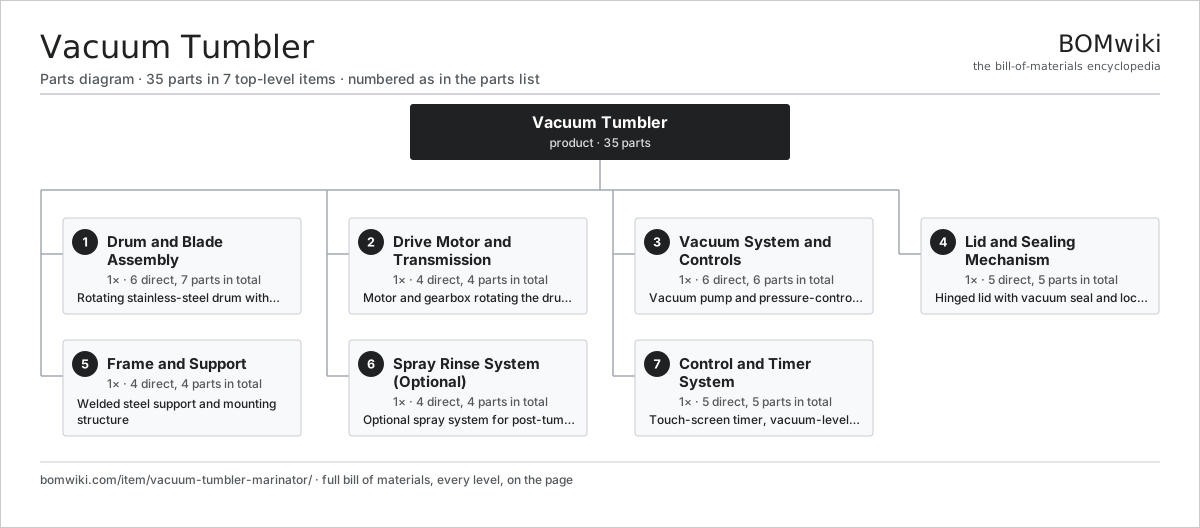
| # | Part | Qty | What it does |
|---|---|---|---|
| 1 | Drum and Blade Assembly 6 parts | 1× | Rotating stainless-steel drum with internal blade system |
| 2 | Drive Motor and Transmission 4 parts | 1× | Motor and gearbox rotating the drum at 20-40 rpm |
| 3 | Vacuum System and Controls 6 parts | 1× | Vacuum pump and pressure-control module |
| 4 | Lid and Sealing Mechanism 5 parts | 1× | Hinged lid with vacuum seal and locking mechanism |
| 5 | Frame and Support 4 parts | 1× | Welded steel support and mounting structure |
| 6 | Spray Rinse System (Optional) 4 parts | 1× | Optional spray system for post-tumble rinsing |
| 7 | Control and Timer System 5 parts | 1× | Touch-screen timer, vacuum-level monitor, and motor control |
3D model
No 3D model yet. Have a CAD file of this? Add a 3D model. STL renders right on this page; STEP, FreeCAD, and OpenSCAD sources are welcome too (openly licensed, like all 3D models on BOMwiki).
Build & assembly graph
expand / collapse · shared sub-assemblies converge · links to related products · est. labourTap an assembly to expand/collapse · tap a part to open it · use “Open page” for any node · drag to pan, scroll to zoom.
Bill of materials for Vacuum Tumbler
7 top-level lines · 41 rows shown · 35 parts total · indented to 3 levels| # | Item / sub-assembly | Part no. | Qty/assy | Ext. qty | Parts | Type |
|---|---|---|---|---|---|---|
| 1 | Drum and Blade Assembly 6 parts | vacuum-tumbler-marinator-drum-assembly | 1× | 1 | 7 | assembly |
| 1.1 | Drum Shell | vacuum-tumbler-marinator-drum-shell | 1× | 1 | · | part |
| 1.2 | Internal Blade System | vacuum-tumbler-marinator-drum-blades | 1× | 1 | · | part |
| 1.3 | Drum Shaft | vacuum-tumbler-marinator-drum-shaft | 1× | 1 | · | part |
| 1.4 | Drum Mechanical Seal | vacuum-tumbler-marinator-drum-seal | 1× | 1 | · | part |
| 1.5 | Ball Bearing | ball-bearing | 2× | 2 | · | part |
| 1.6 | Fastener Set | fastener-set | 1× | 1 | · | part |
| 2 | Drive Motor and Transmission 4 parts | vacuum-tumbler-marinator-drive-motor | 1× | 1 | 4 | assembly |
| 2.1 | Blower Motor | blower-motor | 1× | 1 | · | part |
| 2.2 | Helical Gearbox | vacuum-tumbler-marinator-gearbox | 1× | 1 | · | part |
| 2.3 | Motor Coupling | vacuum-tumbler-marinator-motor-coupling | 1× | 1 | · | part |
| 2.4 | Fastener Set | fastener-set | 1× | 1 | · | part |
| 3 | Vacuum System and Controls 6 parts | vacuum-tumbler-marinator-vacuum-system | 1× | 1 | 6 | assembly |
| 3.1 | Vacuum Pump | vacuum-tumbler-marinator-vacuum-pump | 1× | 1 | · | part |
| 3.2 | Vacuum Pump Motor | vacuum-tumbler-marinator-pump-motor | 1× | 1 | · | part |
| 3.3 | Vacuum Regulator | vacuum-tumbler-marinator-vacuum-regulator | 1× | 1 | · | part |
| 3.4 | Vacuum Check Valve | vacuum-tumbler-marinator-check-valve | 1× | 1 | · | part |
| 3.5 | Pressure Sensor | pressure-sensor | 1× | 1 | · | part |
| 3.6 | Fastener Set | fastener-set | 1× | 1 | · | part |
| 4 | Lid and Sealing Mechanism 5 parts | vacuum-tumbler-marinator-sealing-system | 1× | 1 | 5 | assembly |
| 4.1 | Lid Body | vacuum-tumbler-marinator-lid-body | 1× | 1 | · | part |
| 4.2 | Gasket Seal | vacuum-tumbler-marinator-gasket-seal | 1× | 1 | · | part |
| 4.3 | Hinged Hinge Assembly | vacuum-tumbler-marinator-hinge | 1× | 1 | · | part |
| 4.4 | Clamp Mechanism | vacuum-tumbler-marinator-clamp-mechanism | 1× | 1 | · | part |
| 4.5 | Fastener Set | fastener-set | 1× | 1 | · | part |
| 5 | Frame and Support 4 parts | vacuum-tumbler-marinator-frame | 1× | 1 | 4 | assembly |
| 5.1 | Main Frame | vacuum-tumbler-marinator-main-frame | 1× | 1 | · | part |
| 5.2 | Drip Basin | vacuum-tumbler-marinator-drip-basin | 1× | 1 | · | part |
| 5.3 | Drain Valve | vacuum-tumbler-marinator-drain-valve | 1× | 1 | · | part |
| 5.4 | Fastener Set | fastener-set | 1× | 1 | · | part |
| 6 | Spray Rinse System (Optional) 4 parts | vacuum-tumbler-marinator-spray-rinse | 1× | 1 | 4 | assembly |
| 6.1 | Rinse Pump | vacuum-tumbler-marinator-rinse-pump | 1× | 1 | · | part |
| 6.2 | Rinse Nozzles | vacuum-tumbler-marinator-rinse-nozzles | 1× | 1 | · | part |
| 6.3 | Connector | connector | 1× | 1 | · | part |
| 6.4 | Fastener Set | fastener-set | 1× | 1 | · | part |
| 7 | Control and Timer System 5 parts | vacuum-tumbler-marinator-controls | 1× | 1 | 5 | assembly |
| 7.1 | PLC Module | vacuum-tumbler-marinator-plc-module | 1× | 1 | · | part |
| 7.2 | Touchscreen Display | vacuum-tumbler-marinator-touchscreen | 1× | 1 | · | part |
| 7.3 | Control Box | vacuum-tumbler-marinator-control-box | 1× | 1 | · | part |
| 7.4 | Relay | relay | 1× | 1 | · | part |
| 7.5 | Fastener Set | fastener-set | 1× | 1 | · | part |
Something wrong in this list? Report a problem with this BOM.
Related products
same domain, ranked by shared parts Chocolate Enrober
470 parts · shares 3 with this page
Gummy Depositor
87 parts · shares 3 with this page
Spiral Freezer
179 parts · shares 3 with this page
Fish Deheading Machine
55 parts · shares 2 with this page
Chocolate Enrober
470 parts · shares 3 with this page
Gummy Depositor
87 parts · shares 3 with this page
Spiral Freezer
179 parts · shares 3 with this page
Fish Deheading Machine
55 parts · shares 2 with this page
Sourcing: possible vendors
Browse the supplier directory → Prices, MOQ, and lead times are algorithmic estimates, not quotes, and not claims about these companies. Company mappings are curated by keyword; est. price band $1k–$500k. How estimates work| Vendor | HQ | Specialty | MOQ | Lead time |
|---|---|---|---|---|
| gea.com ↗ | Düsseldorf, DE | Process technology | 20 units | 12–20 wks |
| buhlergroup.com ↗ | Uzwil, CH | Food & materials processing | 20 units | 12–20 wks |
| tetrapak.com ↗ | Pully, CH | Food packaging & processing | 20 units | 12–20 wks |
| jbtc.com ↗ | Chicago, US | Food processing equipment | 20 units | 12–20 wks |
| alfalaval.com ↗ | Lund, SE | Heat transfer & separation | 20 units | 12–20 wks |
1,055-word article