Van de Graaff Generator
ProductOverview
The Van de Graaff generator is a classic electrostatic machine that accumulates electric charge on an insulated conducting dome through mechanical motion. First developed in the 1930s by Robert J. Van de Graaff, it remains a cornerstone of physics education and demonstration laboratories because it reliably produces voltages exceeding 100 kV with minimal complexity. The device operates by moving an endless rubber belt upward inside an insulating column, with metallic combs collecting charge from the belt and depositing it onto the dome at the top. The high voltage buildup creates spectacular visible discharges including hair-raising effects on conductors and visible spark arcs across centimeters of air gap.
The fundamental principle relies on charge separation via friction and field concentration. As the belt moves through the machine, a comb electrode at the base initiates a charge imbalance on the belt surface. A second comb near the dome collects this charge and transfers it to the dome, where geometric concentration of the electric field creates the high potential difference. The dome can be conceptualized as a cylindrical capacitor: the charge spreads evenly over the conducting surface, raising the voltage continuously until leakage through the air (corona discharge and eventual spark formation) or deliberate grounding provides a discharge path.
The mechanical design is deliberately simple to allow operation over many hours without failures. The motor drives a single roller at the base, with an idler roller at the top; the belt forms a closed loop around both. Natural rubber is preferred over synthetics because it provides optimal charging characteristics, it retains a slight dielectric property without being fully insulating. The column isolates the dome electrically, preventing ground-path losses. The base houses the motor, power supply, and protective enclosure around the rotating belt.
How it works
The Van de Graaff operates through three interconnected processes: belt propulsion, charge accumulation, and potential buildup.
Belt motion: The Motor Drive System spins the Drive Roller at roughly 1000 RPM (varies by design). This pulls the Rubber Drive Belt upward along the interior of the Insulating Column Tube. The Idler Roller at the top provides an idler function and re-routes the belt downward on the inside of the column.
Charge initiation: At the base, the Bottom Charge Comb is positioned to nearly touch the ascending belt. When the machine is switched on, the comb (or a weak external voltage source in some designs) establishes an initial charge imbalance on the belt by corona discharge or contact charging. Electrons are either stripped from or added to the belt surface, creating a moving charge carrier.
Charge transport: The charged belt carries this imbalance upward continuously. As the belt approaches the dome region, the Top Charge Comb is positioned just below the dome opening. This comb extracts charge from the belt via corona discharge or induction and dumps it onto the dome. Crucially, the insulating Dome Support Coupling prevents any return path; charge accumulates monotonically on the dome.
Potential buildup: As charge Q accumulates on the dome (a conductor of radius R), the voltage V = kQ/R rises proportionally. In atmospheric conditions, a potential gradient around 30 kV/cm triggers corona discharge in the air, and beyond ~100–150 kV, breakdown occurs in a meter-scale gap. The machine self-limits when corona losses from the dome surface equal the charge delivery rate of the belt. This equilibrium typically occurs in the 150–400 kV range depending on dome size and environmental humidity.
Discharge demonstration: When a Discharge Target Sphere or conducting object is brought near the dome, the electric field concentrates at that point. Once the field strength exceeds air breakdown (~3 MV/m), a conductive plasma channel forms, a visible spark jumps from the dome to the object, often accompanied by audible crackling. The spark is a temporary surge of charge (billions of electrons) in a thin ionized channel. After discharge, the machine immediately begins recharging if the motor is still running.
Design variations
Laboratory models come in two configurations: terminal and belt-accessible. The terminal design encloses the belt fully inside the column, providing safety and eliminating touch hazards during demonstration. The belt-accessible design (older style) exposes the belt on the column exterior, allowing direct observation of charge transfer but requiring careful supervision.
Dome materials vary: polished aluminum offers corrosion resistance and good conductivity, while brass provides durability and a classic appearance. Some high-performance machines use multiple belts or wider belts to increase current capacity, enabling sustained arcs or light bulb powering via the high voltage.
Humidity significantly affects performance. In very dry conditions (< 20% relative humidity), the machine charges faster and reaches higher voltages because air resistivity is higher, reducing corona loss. In humid conditions, the high conductivity of moist air increases leakage, limiting the maximum voltage to ~150 kV.
Safety and operation
Van de Graaff generators are inherently safer than other high-voltage sources because the output current is typically 0.1–1 μA, far below the 5 mA threshold that causes ventricular fibrillation. However, the high voltage can be startling and can damage sensitive electronics. Best practice is to ground the Grounding Terminal firmly before bringing any apparatus into the vicinity and to discharge the dome explicitly via the Discharge Lead before shutting down the machine. Some machines include an automatic discharge path that activates at a preset voltage to prevent unexpected arcs.
The rotating Rubber Drive Belt is a pinch hazard; the Motor Enclosure Shell or protective guard should always be in place during operation.
Historical and educational significance
The Van de Graaff remains the go-to apparatus for demonstrating fundamental electrostatics in high school and university laboratories because it is visually dramatic, mechanically transparent, and electrically safe. It introduces students to charge accumulation, electric potential, corona discharge, and the nonlinear behavior of insulators under field stress. The audible crackling and visible sparks reinforce the reality of invisible electrical phenomena.
Van de Graaff Generator parts and their functions
7 top-level parts · 32 parts in total · full bill of materials below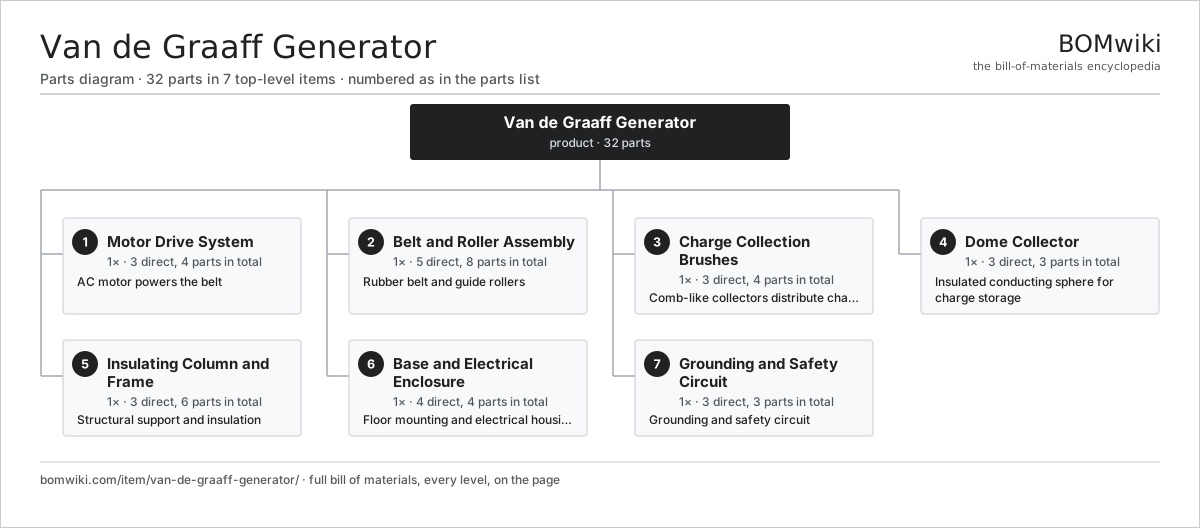
| # | Part | Qty | What it does |
|---|---|---|---|
| 1 | Motor Drive System 3 parts | 1× | AC motor powers the belt |
| 2 | Belt and Roller Assembly 5 parts | 1× | Rubber belt and guide rollers |
| 3 | Charge Collection Brushes 3 parts | 1× | Comb-like collectors distribute charge |
| 4 | Dome Collector 3 parts | 1× | Insulated conducting sphere for charge storage |
| 5 | Insulating Column and Frame 3 parts | 1× | Structural support and insulation |
| 6 | Base and Electrical Enclosure 4 parts | 1× | Floor mounting and electrical housing |
| 7 | Grounding and Safety Circuit 3 parts | 1× | Grounding and safety circuit |
3D model
No 3D model yet. Have a CAD file of this? Add a 3D model. STL renders right on this page; STEP, FreeCAD, and OpenSCAD sources are welcome too (openly licensed, like all 3D models on BOMwiki).
Build & assembly graph
expand / collapse · shared sub-assemblies converge · links to related products · est. labourTap an assembly to expand/collapse · tap a part to open it · use “Open page” for any node · drag to pan, scroll to zoom.
Bill of materials for Van de Graaff Generator
7 top-level lines · 31 rows shown · 32 parts total · indented to 3 levels| # | Item / sub-assembly | Part no. | Qty/assy | Ext. qty | Parts | Type |
|---|---|---|---|---|---|---|
| 1 | Motor Drive System 3 parts | van-de-graaff-generator-motor-drive | 1× | 1 | 4 | assembly |
| 1.1 | Blower Motor | blower-motor | 1× | 1 | · | part |
| 1.2 | Motor Mounting Bracket | van-de-graaff-generator-motor-mount | 1× | 1 | · | part |
| 1.3 | Connector | connector | 2× | 2 | · | part |
| 2 | Belt and Roller Assembly 5 parts | van-de-graaff-generator-belt-roller | 1× | 1 | 8 | assembly |
| 2.1 | Rubber Drive Belt | van-de-graaff-generator-belt | 1× | 1 | · | part |
| 2.2 | Drive Roller | van-de-graaff-generator-drive-roller | 1× | 1 | · | part |
| 2.3 | Idler Roller | van-de-graaff-generator-driven-roller | 1× | 1 | · | part |
| 2.4 | Roller Bearing | van-de-graaff-generator-roller-bearing | 4× | 4 | · | part |
| 2.5 | Belt Tension Adjuster | van-de-graaff-generator-belt-tension | 1× | 1 | · | part |
| 3 | Charge Collection Brushes 3 parts | van-de-graaff-generator-charge-brushes | 1× | 1 | 4 | assembly |
| 3.1 | Bottom Charge Comb | van-de-graaff-generator-bottom-comb | 1× | 1 | · | part |
| 3.2 | Top Charge Comb | van-de-graaff-generator-top-comb | 1× | 1 | · | part |
| 3.3 | Comb Support Bracket | van-de-graaff-generator-comb-support | 2× | 2 | · | part |
| 4 | Dome Collector 3 parts | van-de-graaff-generator-dome-assembly | 1× | 1 | 3 | assembly |
| 4.1 | Dome Shell | van-de-graaff-generator-dome-shell | 1× | 1 | · | part |
| 4.2 | Dome Support Coupling | van-de-graaff-generator-dome-support | 1× | 1 | · | part |
| 4.3 | Dome Terminal Post | van-de-graaff-generator-dome-terminal | 1× | 1 | · | part |
| 5 | Insulating Column and Frame 3 parts | van-de-graaff-generator-column-frame | 1× | 1 | 6 | assembly |
| 5.1 | Insulating Column Tube | van-de-graaff-generator-column-tube | 1× | 1 | · | part |
| 5.2 | Frame Support Strut | van-de-graaff-generator-frame-struts | 3× | 3 | · | part |
| 5.3 | Fastener Set | fastener-set | 2× | 2 | · | part |
| 6 | Base and Electrical Enclosure 4 parts | van-de-graaff-generator-base-enclosure | 1× | 1 | 4 | assembly |
| 6.1 | Base Platform | van-de-graaff-generator-base-plate | 1× | 1 | · | part |
| 6.2 | Motor Enclosure Shell | van-de-graaff-generator-enclosure-shell | 1× | 1 | · | part |
| 6.3 | Power Supply | power-supply | 1× | 1 | · | part |
| 6.4 | Connector | connector | 1× | 1 | · | part |
| 7 | Grounding and Safety Circuit 3 parts | van-de-graaff-generator-discharge-path | 1× | 1 | 3 | assembly |
| 7.1 | Grounding Terminal | van-de-graaff-generator-ground-rod | 1× | 1 | · | part |
| 7.2 | Discharge Target Sphere | van-de-graaff-generator-discharge-sphere | 1× | 1 | · | part |
| 7.3 | Discharge Lead | van-de-graaff-generator-safety-cord | 1× | 1 | · | part |
Something wrong in this list? Report a problem with this BOM.
Related products
same domain, ranked by shared parts Atomic Absorption Spectrometer
648 parts · shares 2 with this page
Atomic Absorption Spectrometer
648 parts · shares 2 with this page
 Biosafety Cabinet
33 parts · shares 2 with this page
Biosafety Cabinet
33 parts · shares 2 with this page
 Climate Test Chamber
64 parts · shares 2 with this page
Climate Test Chamber
64 parts · shares 2 with this page
 Cryostat Microtome
38 parts · shares 2 with this page
Cryostat Microtome
38 parts · shares 2 with this page
 Digital Refractometer
42 parts · shares 2 with this page
Freeze Dryer
317 parts · shares 2 with this page
Digital Refractometer
42 parts · shares 2 with this page
Freeze Dryer
317 parts · shares 2 with this page
Sourcing: possible vendors
Browse the supplier directory → Prices, MOQ, and lead times are algorithmic estimates, not quotes, and not claims about these companies. Company mappings are curated by keyword; est. price band $1k–$500k. How estimates work| Vendor | HQ | Specialty | MOQ | Lead time |
|---|---|---|---|---|
| thermofisher.com ↗ | Waltham, US | Lab instruments | 100 units | 10–18 wks |
|
🇺🇸Agilent
agilent.com ↗
|
Santa Clara, US | Analytical instruments | 100 units | 10–18 wks |
|
🇺🇸Bruker
bruker.com ↗
|
Billerica, US | Scientific instruments | 100 units | 10–18 wks |
|
🇯🇵Shimadzu
shimadzu.com ↗
|
Kyoto, JP | Analytical instruments | 100 units | 10–18 wks |
|
🇺🇸Waters
waters.com ↗
|
Milford, US | Chromatography & MS | 100 units | 10–18 wks |
1,023-word article