Vector Network Analyzer
ProductOverview
A vector network analyzer (VNA) measures the amplitude and phase response of a device under test (DUT) by applying a known stimulus and measuring the reflection and transmission coefficients. Unlike a spectrum analyzer (which measures only power), a VNA tracks both magnitude and phase, enabling calculation of impedance, reflection coefficient (S11), transmission coefficient (S21), and group delay. VNAs are essential for RF and microwave filter design, amplifier characterization, antenna tuning, and transmission line measurement.
The "vector" in VNA refers to complex-number representation; S-parameters are complex quantities with magnitude and phase. A coherent receiver architecture using quadrature demodulation extracts both I (in-phase) and Q (quadrature) components, preserving phase information across the measurement band.
How it works
The Signal Source generates a CW (continuous-wave) or swept RF signal at frequency f via the LO Synthesizer. The Output Amplifier regulates output power using automatic level control (ALC) to maintain constant amplitude across frequency. The signal passes through a Port 1 Coupler before reaching the Test Port 1.
When the signal exits the DUT and returns via reflection (or is transmitted to port 2), it passes through Port 1 Coupler (or Port 2 Coupler) again. The coupler is a passive device that extracts a sample proportional to incident and reflected waves:
- Incident wave (a1): directly from source
- Reflected wave (b1): bouncing back from DUT
- Transmitted wave (b2): emerging from port 2 of DUT
Each extracted sample feeds a Receiver Channel, which down-converts RF to IF via a Input Mixer phase-coherent with the source. The Phase Detector performs I/Q demodulation, yielding in-phase and quadrature voltage samples. Dual Quadrature ADC digitize I and Q.
The Processor and S-Parameters computes S-parameters:
- S11 = b1 / a1 (reflection coefficient)
- S21 = b2 / a1 (forward transmission)
- S12 = b1 / a2 (reverse transmission)
- S22 = b2 / a2 (reverse reflection)
A two-port VNA measures S11 and S21 directly; a switch in the Test Head reverses source and load to measure S12 and S22 via reciprocity.
Directional Couplers and Directivity
A directional coupler samples waves traveling in opposite directions on a transmission line. The Port 1 Coupler has four ports: input, through, isolated (couples forward wave), and coupled (couples reflected wave). Directivity measures how well the coupler rejects the unwanted direction; poor directivity (e.g., −20 dB) allows forward power to leak into the reflected path.
Receiver Architecture and Coherence
Two independent receiver channels allow simultaneous measurement of incident and reflected signals. Dual Receiver Channel units convert RF to IF via mixers driven by the same LO Synthesizer, maintaining phase coherence. The Phase Detector locks to the RF frequency, yielding absolute phase (not just relative).
Error Model and Calibration
Ideal VNA S-parameter measurement is corrupted by:
- Directivity: Unwanted coupling in couplers (fixed).
- Source match: Reflection from analyzer output port back into amplifier.
- Load match: Impedance discontinuities in receiver paths.
- Transmission tracking: Gain and phase difference between port 1 and port 2 receivers.
- Isolation: Leakage between ports via common grounds or coupling.
A one-port calibration (S11 only) uses three standards: Open Standard, Short Standard, and Load Standard. The analyzer measures each, solves for error terms, and applies correction to all subsequent measurements.
A full two-port calibration adds Through Standard (port-to-port transmission path) and Isolation Standard (high-loss path), reducing error to ±0.05 dB magnitude and ±2° phase across the band.
Smith Chart Display
The Display and UI typically renders the Smith chart, a graphical plot where impedance (Z = 50 Ω × (1 + Γ) / (1 − Γ), where Γ = S11) maps to a circular diagram. Constant-resistance and constant-reactance circles guide filter and matching network design. A cursor and markers read impedance, phase, and magnitude at any frequency.
S-Parameter Interpretation
- S11 magnitude |S11| > 0: Partial reflection; |S11| = 0 = perfect match (50 Ω), |S11| = 1 = total reflection (open or short).
- Phase ∠S11: 0° = inductive reactance, 180° = capacitive, ±90° = purely reactive.
- VSWR = (1 + |S11|) / (1 − |S11|): Voltage standing-wave ratio; VSWR = 1 is perfect, VSWR > 5 indicates poor match.
- S21 magnitude |S21| < 0 dB: Insertion loss; e.g., |S21| = −3 dB = half power transmitted.
- S21 phase ∠S21: Propagation delay and dispersion.
Swept Measurements and Averaging
A VNA sweeps frequency f from f_start to f_stop in discrete steps (1 MHz minimum, often 100 kHz granular). At each frequency, it settles for 1–10 ms, allowing transient response to decay, then samples I/Q. The Processor and S-Parameters computes S-parameters. Multiple sweeps can be averaged to reduce noise at the cost of measurement time.
Dynamic Range
Dynamic range is the ratio of the largest measurable reflection (−0 dB, perfect short/open) to the smallest (receiver noise floor, typically −80 to −100 dB). A 80 dB dynamic range allows measurement of |S11| = 10^(−4) = 0.0001, corresponding to a return loss (−|S11| dB) of 80 dB or a VSWR of 1.0002. Measurement uncertainty grows with dynamic range exploitation; best practice limits dynamic range usage to 60–70 dB.
Impedance and Reflection Coefficient
From Processor and S-Parameters, the reflection coefficient Γ = S11 relates to normalized impedance z = (1 + Γ) / (1 − Γ). Real and imaginary parts yield resistance and reactance. A 50 Ω resistor has Γ = 0, z = 1. A short (Γ = −1) has z = ∞ (infinite resistance). An open (Γ = 1) has z = ∞ (looks like a short on the chart).
Applications
- Transmission line and cable impedance profiling (using time-domain gating)
- Filter insertion loss and ripple measurement
- Amplifier gain and stability assessment (S21, input match S11, output match S22)
- Antenna return loss and bandwidth characterization
- Connector and transition loss quantification
- Tunable oscillator phase noise via phase vs. frequency slope
- Nonlinear device characterization using power sweeps with calibrated source
Portability and Field Use
Handheld and portable VNAs (compact test heads with external control units) are used for in-service antenna and transmission line maintenance. The Calibration Kit is essential; standards must be traceable to NIST. Mechanical repeatability and connector care are critical, worn SMA connectors introduce variability.
Tradeoff: Frequency Range vs. Directivity
Lower-frequency VNAs (10 kHz–500 MHz) achieve higher directivity and lower cost; higher-frequency VNAs (100 MHz–40 GHz) sacrifice directivity and require more careful calibration. Multiport analyzers (4, 8, or 12 ports) simultaneously measure all S-parameters of a multi-port DUT without switching, ideal for phased-array antenna and filter analysis.
Vector Network Analyzer parts and their functions
7 top-level parts · 84 parts in total · full bill of materials below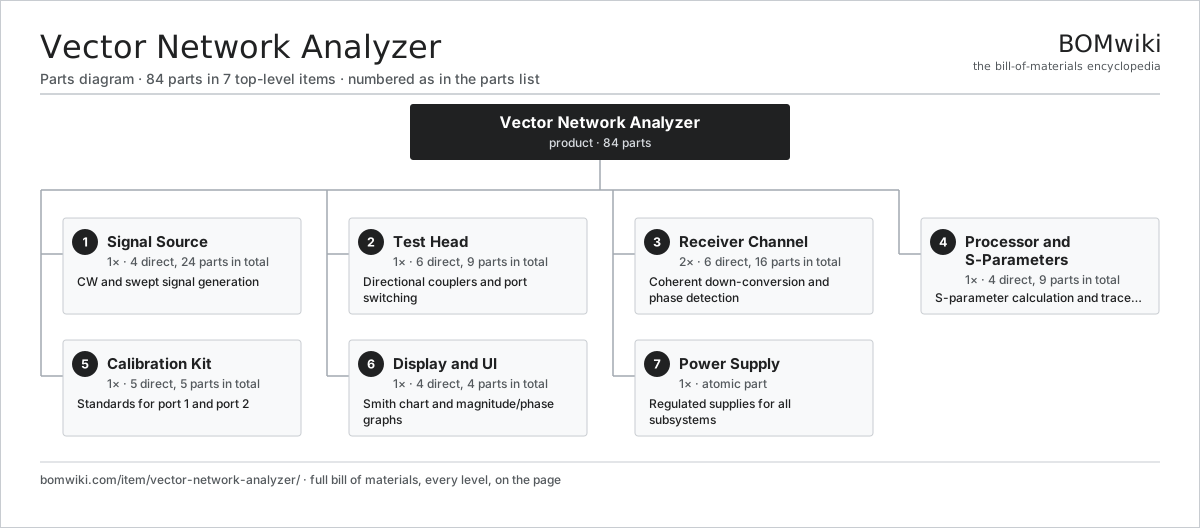
| # | Part | Qty | What it does |
|---|---|---|---|
| 1 | Signal Source 4 parts | 1× | CW and swept signal generation |
| 2 | Test Head 6 parts | 1× | Directional couplers and port switching |
| 3 | Receiver Channel 6 parts | 2× | Coherent down-conversion and phase detection |
| 4 | Processor and S-Parameters 4 parts | 1× | S-parameter calculation and trace display |
| 5 | Calibration Kit 5 parts | 1× | Standards for port 1 and port 2 |
| 6 | Display and UI 4 parts | 1× | Smith chart and magnitude/phase graphs |
| 7 | Power Supply | 1× | Regulated supplies for all subsystems |
3D model
No 3D model yet. Have a CAD file of this? Add a 3D model. STL renders right on this page; STEP, FreeCAD, and OpenSCAD sources are welcome too (openly licensed, like all 3D models on BOMwiki).
Build & assembly graph
expand / collapse · shared sub-assemblies converge · links to related products · est. labourTap an assembly to expand/collapse · tap a part to open it · use “Open page” for any node · drag to pan, scroll to zoom.
Bill of materials for Vector Network Analyzer
7 top-level lines · 41 rows shown · 84 parts total · indented to 3 levels| # | Item / sub-assembly | Part no. | Qty/assy | Ext. qty | Parts | Type |
|---|---|---|---|---|---|---|
| 1 | Signal Source 4 parts | vector-network-analyzer-signal-source | 1× | 1 | 24 | assembly |
| 1.1 | LO Synthesizer 5 parts | spectrum-analyzer-lo-synthesizer | 1× | 1 | 16 | assembly |
| 1.1.1 | VCO | spectrum-analyzer-lo-vco | 1× | 1 | · | part |
| 1.1.2 | PLL IC | spectrum-analyzer-pll-ic | 1× | 1 | · | part |
| 1.1.3 | Reference Oscillator | spectrum-analyzer-reference-oscillator | 1× | 1 | · | part |
| 1.1.4 | PLL Loop Filter | spectrum-analyzer-loop-filter | 1× | 1 | · | part |
| 1.1.5 | SMD Passive (R/C/L) | smd-passives | 12× | 12 | · | part |
| 1.2 | Output Amplifier | vector-network-analyzer-output-amplifier | 1× | 1 | · | part |
| 1.3 | Source Connector | vector-network-analyzer-output-connector | 1× | 1 | · | part |
| 1.4 | SMD Passive (R/C/L) | smd-passives | 6× | 6 | · | part |
| 2 | Test Head 6 parts | vector-network-analyzer-test-head | 1× | 1 | 9 | assembly |
| 2.1 | Port 1 Coupler | vector-network-analyzer-coupler-port1 | 1× | 1 | · | part |
| 2.2 | Port 2 Coupler | vector-network-analyzer-coupler-port2 | 1× | 1 | · | part |
| 2.3 | Port Switching Matrix | vector-network-analyzer-switching-matrix | 1× | 1 | · | part |
| 2.4 | Test Port 1 | vector-network-analyzer-port1-connector | 1× | 1 | · | part |
| 2.5 | Test Port 2 | vector-network-analyzer-port2-connector | 1× | 1 | · | part |
| 2.6 | SMD Passive (R/C/L) | smd-passives | 4× | 4 | · | part |
| 3 | Receiver Channel 6 parts | vector-network-analyzer-receiver-pair | 2× | 2 | 16 | assembly |
| 3.1 | Low-Noise Preamp | spectrum-analyzer-preamp | 1× | 2 | · | part |
| 3.2 | Input Mixer | vector-network-analyzer-input-mixer | 1× | 2 | · | part |
| 3.3 | IF Amplifier | vector-network-analyzer-if-amp | 1× | 2 | · | part |
| 3.4 | Phase Detector | vector-network-analyzer-phase-detector | 1× | 2 | · | part |
| 3.5 | Quadrature ADC | vector-network-analyzer-adc-pair | 2× | 4 | · | part |
| 3.6 | SMD Passive (R/C/L) | smd-passives | 10× | 20 | · | part |
| 4 | Processor and S-Parameters 4 parts | vector-network-analyzer-processor | 1× | 1 | 9 | assembly |
| 4.1 | DSP Unit | vector-network-analyzer-dsp-unit | 1× | 1 | · | part |
| 4.2 | Trace Memory | vector-network-analyzer-memory-trace | 1× | 1 | · | part |
| 4.3 | Microcontroller | mcu | 1× | 1 | · | part |
| 4.4 | SMD Passive (R/C/L) | smd-passives | 6× | 6 | · | part |
| 5 | Calibration Kit 5 parts | vector-network-analyzer-calibration-kit | 1× | 1 | 5 | assembly |
| 5.1 | Open Standard | vector-network-analyzer-open-standard | 1× | 1 | · | part |
| 5.2 | Short Standard | vector-network-analyzer-short-standard | 1× | 1 | · | part |
| 5.3 | Load Standard | vector-network-analyzer-load-standard | 1× | 1 | · | part |
| 5.4 | Through Standard | vector-network-analyzer-through-standard | 1× | 1 | · | part |
| 5.5 | Isolation Standard | vector-network-analyzer-isolation-standard | 1× | 1 | · | part |
| 6 | Display and UI 4 parts | vector-network-analyzer-display | 1× | 1 | 4 | assembly |
| 6.1 | LCD Panel | lcd-panel | 1× | 1 | · | part |
| 6.2 | Graphics Engine | vector-network-analyzer-graphics-engine | 1× | 1 | · | part |
| 6.3 | Touch Digitizer | touch-digitizer | 1× | 1 | · | part |
| 6.4 | Power Supply | power-supply | 1× | 1 | · | part |
| 7 | Power Supply | power-supply | 1× | 1 | · | part |
Something wrong in this list? Report a problem with this BOM.
Related products
same domain, ranked by shared parts Spectrum Analyzer
85 parts · shares 8 with this page
Spectrum Analyzer
85 parts · shares 8 with this page
 Analytical Balance
54 parts · shares 3 with this page
Analytical Balance
54 parts · shares 3 with this page
 Atomic Absorption Spectrometer
648 parts · shares 3 with this page
Autoclave Sterilizer
282 parts · shares 3 with this page
Automated Colony Counter
322 parts · shares 3 with this page
Atomic Absorption Spectrometer
648 parts · shares 3 with this page
Autoclave Sterilizer
282 parts · shares 3 with this page
Automated Colony Counter
322 parts · shares 3 with this page
 Automated Liquid Handler
817 parts · shares 3 with this page
Automated Liquid Handler
817 parts · shares 3 with this page
Sourcing: possible vendors
Browse the supplier directory → Prices, MOQ, and lead times are algorithmic estimates, not quotes, and not claims about these companies. Company mappings are curated by keyword; est. price band $1k–$500k. How estimates work| Vendor | HQ | Specialty | MOQ | Lead time |
|---|---|---|---|---|
| thermofisher.com ↗ | Waltham, US | Lab instruments | 100 units | 10–18 wks |
|
🇺🇸Agilent
agilent.com ↗
|
Santa Clara, US | Analytical instruments | 100 units | 10–18 wks |
|
🇺🇸Bruker
bruker.com ↗
|
Billerica, US | Scientific instruments | 100 units | 10–18 wks |
|
🇯🇵Shimadzu
shimadzu.com ↗
|
Kyoto, JP | Analytical instruments | 100 units | 10–18 wks |
|
🇺🇸Waters
waters.com ↗
|
Milford, US | Chromatography & MS | 100 units | 10–18 wks |
1,104-word article