Vertical Climber
ProductOverview
A vertical climber is a stair-climbing machine that mimics the repetitive motion of climbing stairs or a ladder while the user's arms slide freely on stabilizing rails. Unlike a stair-stepper, which moves two pedals in a flattened cycle, a climber drives one foot up at a time in nearly vertical motion, reaching step heights of 200–300 mm per crank revolution. The result is a sustained aerobic effort that engages the quadriceps, glutes, hip flexors, and core more intensely than flat-surface stepping, while the Arm Rail Assembly lets users modulate load with arm pressure or maintain balance at lower efforts.
The core mechanical difference from other cardio equipment is the Step Drive Linkage: a cable-and-pulley or rigid linkage that converts slow rotational motion (often 30–50 rpm) into the large vertical displacement and low speed that feels natural to climbing. The trade-off is complexity, a stepper with two pedals in phase is simpler, but a climber with alternating feet requires a more sophisticated drive.
Step drive mechanism
The Crank Shaft rotates as the user presses downward on the Foot Platform. The crank is geared down significantly, so one full revolution of the motor or user input might translate to only 200–300 mm of platform rise. A Link Arm is mounted off the crank at an offset angle. As the crank turns, the link arm's pivot traces a path that converts rotation into vertical motion. On a well-designed linkage, the relationship is not linear: early in the stroke the platform rises slowly, then faster, then slowly as the user approaches the top position. This vertical-climber-step-connector-rod smooths the feel and reduces impact at toe-off.
The Drive Cable and Pulley version uses a continuous cable looped around the crank pulley and routed through multiple fixed pulleys, so one crank rotation might produce two or three platform cycles, or the mechanical advantage is altered by changing pulley diameters. This is less common in commercial units, which favour rigid linkages for durability.
Arm rails and balance
The pair of Vertical Rail Track extrusions, one on each side, is spanned by the user's arms. Two Rail Bearing Block carriages per rail slide up and down as the user's arms move, creating the illusion of climbing. The Arm Grip Handle at the top of each rail is where the user holds for initial balance; as fatigue sets in, arm pressure increases and the user might support 20–30% of body weight through the arms, effectively reducing the load on the legs.
The sliding blocks use ball bearings or low-friction polymer wheels in grooves on the Rail Mounting Post, designed for smooth glide with minimal stick-slip. Wearing of these bearings is the dominant wear item after 2–3 years of gym use, particularly at higher intensities where users bounce or jolt the guides.
Resistance and load
A Resistance System system applies a magnetic or friction brake to the Crank Shaft, making it harder to rotate. Most commercial machines use Neodymium Magnet eddy-current braking: a steel Magnetic Rotor disc on the crank rotates in a magnetic field, inducing currents that resist motion. The closer the magnet assembly sits to the rotor, the stronger the braking force. Users adjust the Resistance Dial to select one of 16–20 levels, and the dial mechanically pushes the magnet housing in or out.
The advantage is that magnetic resistance is load-independent: effort does not rise if a user climbs slowly vs. fast at the same resistance setting, unlike some friction or fan-based systems. A 136 kg (300 lb) user at maximum resistance should require roughly the same torque to turn the crank as a 73 kg (160 lb) user at the same setting.
Electronics and metrics
The Electronics and Display module samples a Position Sensor encoder that counts crank rotations or detects foot-platform position. From this, the Main Control Board calculates distance climbed (by multiplying rotations by the step height), climbing rate (steps per minute), and estimated energy expenditure (calories, using body weight and step rate as heuristics). The LCD Panel displays time, distance, steps, and often a heart-rate graph if a wireless chest strap is paired.
Most models include a safety relay: if no activity is detected for 30 seconds the display resets, and some machines have an emergency stop clip that disables the motor. The Power Supply is typically a switched-mode converter from 120V AC mains to 12V or 24V DC for the control circuit.
User experience and fatigue
A climber induces faster onset of leg fatigue than walking or running because of the continuous upward push against gravity. Climbs lasting 5–10 minutes at high resistance are common anaerobic efforts; longer sessions are done at lower resistance for aerobic training. The arm rails serve a critical role: a user who cannot complete a set can relax leg effort and shift load to the arms, so the machine does not become a trap for someone who over-estimates their capacity.
Height range for comfort is ~165–190 cm (5'5"–6'3"); shorter users find the rails either too high or the crank geometry forces ankle plantarflexion, and much taller users risk impingement of the knees on the platform at the top of the stride.
Reliability and field issues
The sealed ball-bearing blocks in the arm rails are the most common point of degradation in high-use settings (commercial gyms). After 1–2 years the rails develop a notchy feel or slight binding. The Crank Shaft bearings and linkage pivots are also wear surfaces, and a clunking noise when changing load often signals bearing play.
The Electronics and Display are robust in most machines; the Thermal Fuse on the Power Supply is a safety feature to shut down the control board if the ambient temperature exceeds design limits. Replacement of a failed LCD Panel or Main Control Board typically requires factory service.
Linkage-driven climbers are mechanically sound for 10+ years; cable-driven designs can suffer cable stretch or fraying if used heavily without maintenance. Either way, lubrication of the linkage pivots and crank bearings is not typically user-serviceable but is part of annual gym maintenance.
Vertical Climber parts and their functions
7 top-level parts · 59 parts in total · full bill of materials below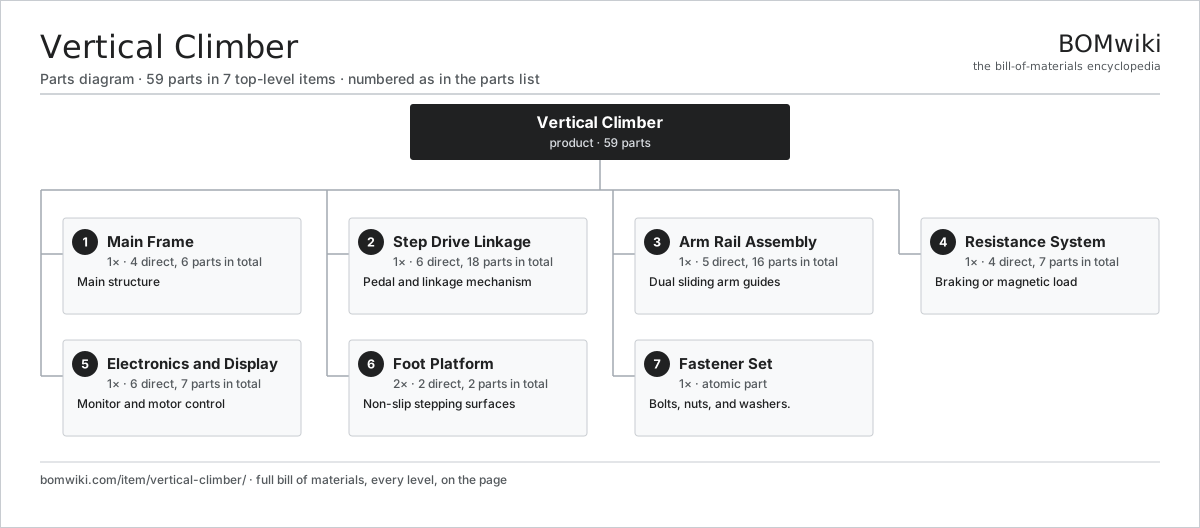
| # | Part | Qty | What it does |
|---|---|---|---|
| 1 | Main Frame 4 parts | 1× | Main structure |
| 2 | Step Drive Linkage 6 parts | 1× | Pedal and linkage mechanism |
| 3 | Arm Rail Assembly 5 parts | 1× | Dual sliding arm guides |
| 4 | Resistance System 4 parts | 1× | Braking or magnetic load |
| 5 | Electronics and Display 6 parts | 1× | Monitor and motor control |
| 6 | Foot Platform 2 parts | 2× | Non-slip stepping surfaces |
| 7 | Fastener Set | 1× | Bolts, nuts, and washers. |
3D model
No 3D model yet. Have a CAD file of this? Add a 3D model. STL renders right on this page; STEP, FreeCAD, and OpenSCAD sources are welcome too (openly licensed, like all 3D models on BOMwiki).
Build & assembly graph
expand / collapse · shared sub-assemblies converge · links to related products · est. labourTap an assembly to expand/collapse · tap a part to open it · use “Open page” for any node · drag to pan, scroll to zoom.
Bill of materials for Vertical Climber
7 top-level lines · 34 rows shown · 59 parts total · indented to 3 levels| # | Item / sub-assembly | Part no. | Qty/assy | Ext. qty | Parts | Type |
|---|---|---|---|---|---|---|
| 1 | Main Frame 4 parts | vertical-climber-frame | 1× | 1 | 6 | assembly |
| 1.1 | Base Rail Assembly | vertical-climber-frame-base | 1× | 1 | · | part |
| 1.2 | Vertical Post | vertical-climber-vertical-post | 2× | 2 | · | part |
| 1.3 | Cross Brace | vertical-climber-crossbrace | 2× | 2 | · | part |
| 1.4 | Drive Mount Plate | vertical-climber-drive-mount | 1× | 1 | · | part |
| 2 | Step Drive Linkage 6 parts | vertical-climber-step-drive-assy | 1× | 1 | 18 | assembly |
| 2.1 | Crank Shaft | vertical-climber-crank-shaft | 1× | 1 | · | part |
| 2.2 | Drive Cable | vertical-climber-drive-cable | 2× | 2 | · | part |
| 2.3 | Pulley | vertical-climber-pulley-set | 3× | 3 | · | part |
| 2.4 | Link Arm | vertical-climber-link-arm | 2× | 2 | · | part |
| 2.5 | Ball Bearing | ball-bearing | 8× | 8 | · | part |
| 2.6 | Step Connector Rod | vertical-climber-step-connector | 2× | 2 | · | part |
| 3 | Arm Rail Assembly 5 parts | vertical-climber-arm-rail-assy | 1× | 1 | 16 | assembly |
| 3.1 | Rail Mounting Post | vertical-climber-rail-post | 2× | 2 | · | part |
| 3.2 | Vertical Rail Track | vertical-climber-rail-track | 2× | 2 | · | part |
| 3.3 | Arm Grip Handle | vertical-climber-rail-grip | 2× | 2 | · | part |
| 3.4 | Rail Bearing Block | vertical-climber-rail-bearing-block | 8× | 8 | · | part |
| 3.5 | Coil Spring | coil-spring | 2× | 2 | · | part |
| 4 | Resistance System 4 parts | vertical-climber-resistance | 1× | 1 | 7 | assembly |
| 4.1 | Magnetic Rotor | vertical-climber-magnet-rotor | 1× | 1 | · | part |
| 4.2 | Neodymium Magnet | neodymium-magnet | 4× | 4 | · | part |
| 4.3 | Brake Housing | vertical-climber-brake-housing | 1× | 1 | · | part |
| 4.4 | Resistance Dial | vertical-climber-resistance-dial | 1× | 1 | · | part |
| 5 | Electronics and Display 6 parts | vertical-climber-electronics | 1× | 1 | 7 | assembly |
| 5.1 | Main Control Board | vertical-climber-main-pcb | 1× | 1 | · | part |
| 5.2 | LCD Panel | lcd-panel | 1× | 1 | · | part |
| 5.3 | Position Sensor | vertical-climber-sensor-pod | 2× | 2 | · | part |
| 5.4 | Microcontroller | mcu | 1× | 1 | · | part |
| 5.5 | Power Supply | power-supply | 1× | 1 | · | part |
| 5.6 | Thermal Fuse | thermal-fuse | 1× | 1 | · | part |
| 6 | Foot Platform 2 parts | vertical-climber-foot-platform | 2× | 2 | 2 | assembly |
| 6.1 | Platform Base | vertical-climber-platform-base | 1× | 2 | · | part |
| 6.2 | Non-slip Grip Strip | vertical-climber-platform-grip-strip | 1× | 2 | · | part |
| 7 | Fastener Set | fastener-set | 1× | 1 | · | part |
Something wrong in this list? Report a problem with this BOM.
Related products
same domain, ranked by shared parts Anti-Gravity Treadmill
96 parts · shares 4 with this page
Anti-Gravity Treadmill
96 parts · shares 4 with this page
 Baseball Pitching Machine
144 parts · shares 4 with this page
Baseball Pitching Machine
144 parts · shares 4 with this page
 Rowing Machine
60 parts · shares 4 with this page
Rowing Machine
60 parts · shares 4 with this page
 Treadmill
122 parts · shares 4 with this page
Treadmill
122 parts · shares 4 with this page
 Vibration Plate
77 parts · shares 4 with this page
Climbing Ladder Ergometer
136 parts · shares 3 with this page
Vibration Plate
77 parts · shares 4 with this page
Climbing Ladder Ergometer
136 parts · shares 3 with this page
Sourcing: possible vendors
Browse the supplier directory → Prices, MOQ, and lead times are algorithmic estimates, not quotes, and not claims about these companies. Company mappings are curated by keyword; est. price band $100–$10k. How estimates work| Vendor | HQ | Specialty | MOQ | Lead time |
|---|---|---|---|---|
| lifefitness.com ↗ | Rosemont, US | Fitness equipment | 200 units | 8–14 wks |
| technogym.com ↗ | Cesena, IT | Fitness equipment | 200 units | 8–14 wks |
|
🇺🇸Peloton
onepeloton.com ↗
|
New York, US | Connected fitness | 200 units | 8–14 wks |
| johnsonhealthtech.com ↗ | Taichung, TW | Fitness (Matrix) | 200 units | 8–14 wks |
|
🇺🇸Precor
precor.com ↗
|
Woodinville, US | Fitness equipment | 200 units | 8–14 wks |
1,076-word article