Vertical Roller Mill
ProductOverview
A vertical roller mill grinds material in a thin bed between a rotating table and three or four stationary rollers pressed down by hydraulic cylinders. Unlike tumbling mills (ball mills, SAG mills), a vertical mill uses compression and shear in a confined bed, making it highly energy-efficient for fine grinding to 10–20 μm. The technology originated in the cement industry for grinding clinker and is now widely adopted in mining for comminution of fine-grained ores, particularly gold, copper, and nickel.
A vertical mill comprises a horizontal rotating table (2–6 m diameter) with a replaceable liner, radially mounted grinding rollers (typically three or four per unit) that press down under hydraulic load (200–350 bar), and an integrated air classifier that separates fine product from coarse. The combination enables continuous, energy-efficient grinding with integrated size control.
How it works
Ore enters from the top of the grinding chamber and drops onto the rotating table. As the table rotates at 15–50 rpm, the ore is carried outward toward the grinding rollers. The hydraulic cylinders press each roller down onto the ore bed with a force equivalent to 200–350 bar pressure, creating a thin, concentrated grinding zone. Rollers can be conical or spherical; the shape influences bed geometry and particle residence time.
As ore flows radially outward from the table center, the rollers compress and shear it repeatedly, fracturing particles and reducing size. The action is akin to a mortar and pestle, but continuous and high-throughput. Temperature in the grinding bed can reach 80–120°C due to friction; this is managed by an integrated mill fan that circulates ambient air through the grinding zone.
Once the ore reaches the table edge, it enters the integrated air classifier. The classifier rotor rotates at 300–800 rpm, creating an upward air current. Fine particles (<20 μm, tunable) rise with the air and exit as product; coarse particles fall back onto the table, circulate, and undergo further grinding. An adjustable deflector plate balances the split between product and recirculation.
Grinding Mechanics
The grinding roller body is made of hardened steel or composite, sized 0.5–1.5 m in diameter depending on mill capacity. Each roller is mounted on a spindle that allows it to roll freely on the table surface. As the table rotates beneath, the roller spins passively at a speed determined by friction with the table (typical differential 2–5% slip).
The bed depth under the roller is thin, typically 20–50 mm, compared to tumbling mills. This confined bed gives the mill its high specific power: power per unit of volume is 5–10 times higher than a ball mill, enabling rapid comminution. However, it also means the mill must be fed with pre-crushed material; feeding raw run-of-mine ore would jam the bed.
Roller wear is the dominant maintenance cost. Depending on ore hardness, rollers are replaced every 6–24 months; the table liners are similarly wear-limited. Both are designed for quick replacement, critical for mill availability.
Integrated Classifier
Unlike external classifiers, the air classifier is built into the mill discharge. This integration means that coarse particles rejected by the classifier never leave the mill; they immediately re-feed the grinding table. The classifier rotor speed is independent (controlled by a separate VFD), allowing mill operators to adjust product fineness on-the-fly without changing table speed.
Increasing classifier rotor speed increases the air velocity, causing larger particles to be rejected (coarser product). Decreasing rotor speed releases finer particles to product. This dynamic control is a major advantage over external circuits: operators can trim product size by a few microns in minutes.
Drive and Power
The table motor is typically an AC induction motor rated 200–2000 kW, soft-started via a contactor or VFD. A gearbox reduces motor speed (1500–1800 rpm) to table speed (15–50 rpm). The coupling between gearbox and table shaft is flexible, absorbing torsional shock.
The mill fan is a separate system, driven by its own motor (50–200 kW), and is independently controlled by a VFD. Increasing fan airflow improves cooling and removes fines from the grinding zone more rapidly; it also increases the air drag on the bed, raising the grinding pressure needed to maintain the same throughput. Operators tune fan speed based on feed moisture and desired product fineness.
Hydraulic System
The hydraulic system delivers consistent downward force to each loader cylinder, holding grinding pressure constant. A pump circulates oil at 250–350 bar. A pressure transducer on the loader line feeds real-time pressure data to the controller.
If ore feed stalls (e.g., due to moisture bridging), grinding resistance increases and pressure rises. The controller can respond by reducing feed rate or increasing fan airflow to re-establish flow. A pressure relief valve protects the system, venting excess pressure if a bearing jam occurs.
The reservoir is sized 2–10 m³ and includes baffles and coolers to manage the steady heat load from grinding (a 2000 kW mill dissipates 1500+ kW as heat).
Control Architecture
Modern vertical mills employ closed-loop feedback:
- Pressure sensors on the loader cylinders feed back real-time grinding force.
- A controller monitors power draw at the table motor and mill fan motor.
- Product fineness can be adjusted via the classifier rotor VFD.
- Feed rate is metered by an upstream vibrating feeder or belt, controlled by the PLC based on mill load and product fineness targets.
This automation enables unattended operation and consistent product quality, critical for downstream flotation or leaching circuits.
Maintenance
Grinding rollers and table liners are subject to continuous wear. Replacement campaigns are typically scheduled every 12–18 months. Seal maintenance on rollers is important: if seals fail, moisture and fine particles can enter the main bearing, leading to accelerated bearing wear.
Hydraulic system cleanliness is critical; dirty oil clogs proportional valve spools, making pressure control erratic. Filters are typically ISO 18/16/13 grade, and oil analysis is performed quarterly.
Vertical Mill vs. Ball Mill
A vertical mill is 30–50% more energy-efficient than a ball mill for grinding to fine sizes (10–20 μm). However, it requires more complex automation and tighter feed size control. Ball mills are more forgiving of feed variability and moisture. For circuit design, vertical mills excel in closed-loop circuits where tight product size control is paramount; ball mills are preferred for simpler, more robust installations where feed is coarse and unpredictable.
Typical Applications
Vertical mills are dominant in cement clinker grinding and are increasingly used in hard-rock mining. In gold milling, a vertical mill grinds float concentrates to −20 μm for cyanide leaching. In copper flotation, vertical mills produce fine mill feed without the cost and complexity of a SAG + ball mill circuit. Industrial minerals such as talc, feldspar, and mica are routinely ground to micron sizes using vertical technology.
Vertical Roller Mill parts and their functions
8 top-level parts · 32 parts in total · full bill of materials below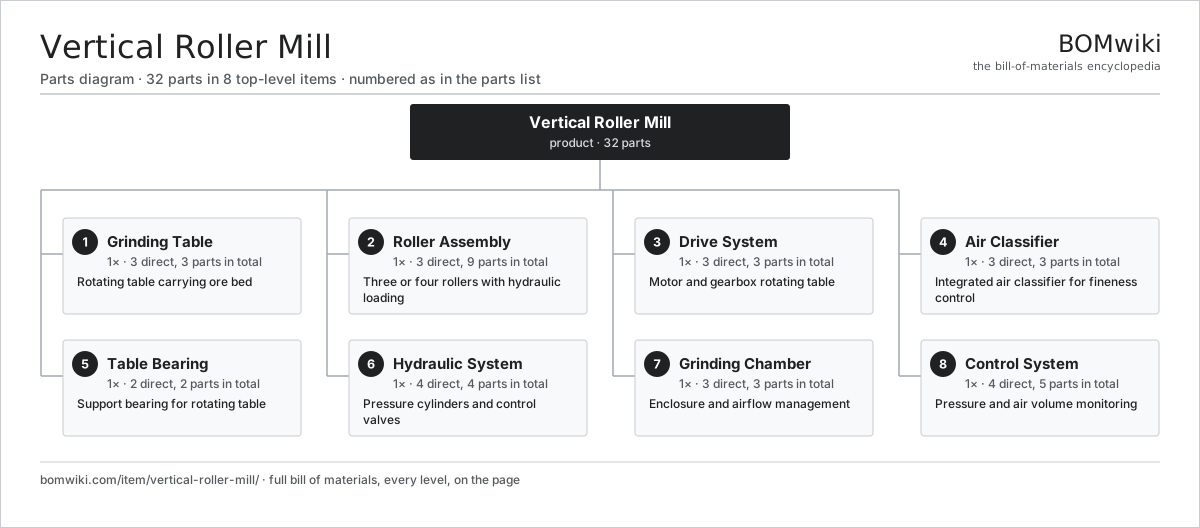
| # | Part | Qty | What it does |
|---|---|---|---|
| 1 | Grinding Table 3 parts | 1× | Rotating table carrying ore bed |
| 2 | Roller Assembly 3 parts | 1× | Three or four rollers with hydraulic loading |
| 3 | Drive System 3 parts | 1× | Motor and gearbox rotating table |
| 4 | Air Classifier 3 parts | 1× | Integrated air classifier for fineness control |
| 5 | Table Bearing 2 parts | 1× | Support bearing for rotating table |
| 6 | Hydraulic System 4 parts | 1× | Pressure cylinders and control valves |
| 7 | Grinding Chamber 3 parts | 1× | Enclosure and airflow management |
| 8 | Control System 4 parts | 1× | Pressure and air volume monitoring |
3D model
No 3D model yet. Have a CAD file of this? Add a 3D model. STL renders right on this page; STEP, FreeCAD, and OpenSCAD sources are welcome too (openly licensed, like all 3D models on BOMwiki).
Build & assembly graph
expand / collapse · shared sub-assemblies converge · links to related products · est. labourTap an assembly to expand/collapse · tap a part to open it · use “Open page” for any node · drag to pan, scroll to zoom.
Bill of materials for Vertical Roller Mill
8 top-level lines · 33 rows shown · 32 parts total · indented to 3 levels| # | Item / sub-assembly | Part no. | Qty/assy | Ext. qty | Parts | Type |
|---|---|---|---|---|---|---|
| 1 | Grinding Table 3 parts | vertical-roller-mill-grinding-table | 1× | 1 | 3 | assembly |
| 1.1 | Table Base | vertical-roller-mill-table-base | 1× | 1 | · | part |
| 1.2 | Table Liners | vertical-roller-mill-table-liners | 1× | 1 | · | part |
| 1.3 | Table Drive Coupling | vertical-roller-mill-table-drive-coupling | 1× | 1 | · | part |
| 2 | Roller Assembly 3 parts | vertical-roller-mill-roller-assembly | 1× | 1 | 9 | assembly |
| 2.1 | Grinding Roller | vertical-roller-mill-roller-body | 3× | 3 | · | part |
| 2.2 | Roller Seal | vertical-roller-mill-roller-seal | 3× | 3 | · | part |
| 2.3 | Loader Cylinder | vertical-roller-mill-loader-cylinder | 3× | 3 | · | part |
| 3 | Drive System 3 parts | vertical-roller-mill-drive-system | 1× | 1 | 3 | assembly |
| 3.1 | Table Drive Motor | vertical-roller-mill-motor | 1× | 1 | · | part |
| 3.2 | Table Gearbox | vertical-roller-mill-gearbox | 1× | 1 | · | part |
| 3.3 | Table Coupling | vertical-roller-mill-coupling | 1× | 1 | · | part |
| 4 | Air Classifier 3 parts | vertical-roller-mill-classifier | 1× | 1 | 3 | assembly |
| 4.1 | Classifier Rotor | vertical-roller-mill-classifier-rotor | 1× | 1 | · | part |
| 4.2 | Classifier Motor | vertical-roller-mill-classifier-motor | 1× | 1 | · | part |
| 4.3 | Classifier Deflector | vertical-roller-mill-classifier-deflector | 1× | 1 | · | part |
| 5 | Table Bearing 2 parts | vertical-roller-mill-table-bearings | 1× | 1 | 2 | assembly |
| 5.1 | Main Bearing | vertical-roller-mill-main-bearing | 1× | 1 | · | part |
| 5.2 | Bearing Housing | vertical-roller-mill-bearing-housing | 1× | 1 | · | part |
| 6 | Hydraulic System 4 parts | vertical-roller-mill-hydraulic-system | 1× | 1 | 4 | assembly |
| 6.1 | Hydraulic Pump | vertical-roller-mill-hydraulic-pump | 1× | 1 | · | part |
| 6.2 | Loader Cylinder Set | vertical-roller-mill-loader-cylinders | 1× | 1 | · | part |
| 6.3 | Pressure Relief Valve | vertical-roller-mill-pressure-valve | 1× | 1 | · | part |
| 6.4 | Hydraulic Tank | vertical-roller-mill-hydraulic-tank | 1× | 1 | · | part |
| 7 | Grinding Chamber 3 parts | vertical-roller-mill-grinding-chamber | 1× | 1 | 3 | assembly |
| 7.1 | Chamber Shell | vertical-roller-mill-chamber-shell | 1× | 1 | · | part |
| 7.2 | Mill Fan | vertical-roller-mill-mill-fan | 1× | 1 | · | part |
| 7.3 | Fan Motor | vertical-roller-mill-fan-motor | 1× | 1 | · | part |
| 8 | Control System 4 parts | vertical-roller-mill-control-system | 1× | 1 | 5 | assembly |
| 8.1 | Pressure Sensor | pressure-sensor | 2× | 2 | · | part |
| 8.2 | Mill Fan VFD | vertical-roller-mill-mill-fan-vfd | 1× | 1 | · | part |
| 8.3 | Classifier VFD | vertical-roller-mill-classifier-vfd | 1× | 1 | · | part |
| 8.4 | Mill Controller | vertical-roller-mill-plc | 1× | 1 | · | part |
Something wrong in this list? Report a problem with this BOM.
Sourcing: possible vendors
Browse the supplier directory → Prices, MOQ, and lead times are algorithmic estimates, not quotes, and not claims about these companies. Company mappings are curated by keyword; est. price band $200k–$5M. How estimates work| Vendor | HQ | Specialty | MOQ | Lead time |
|---|---|---|---|---|
| caterpillar.com ↗ | Irving, US | Construction & mining equipment | made to order | 20–36 wks |
|
🇯🇵Komatsu
komatsu.com ↗
|
Tokyo, JP | Construction & mining equipment | made to order | 20–36 wks |
|
🇸🇪Sandvik
rocktechnology.sandvik ↗
|
Stockholm, SE | Mining & rock technology | made to order | 20–36 wks |
|
🇸🇪Epiroc
epiroc.com ↗
|
Stockholm, SE | Mining & drilling equipment | made to order | 20–36 wks |
|
🇫🇮Metso
metso.com ↗
|
Helsinki, FI | Crushing & minerals processing | made to order | 20–36 wks |
1,288-word article