Volumetric Cup Filler
ProductOverview
Volumetric cup fillers are the standard high-speed machine for thick, viscous products that cannot be handled by piston fillers or rotary pumps: peanut butter, jam, honey, thick sauce, salsa, and similar products with 50–50,000 cP viscosity. The principle is elegant: a carousel of fixed-volume cups rotates through a product-fill station and a container-discharge station. At the fill station, each cup dips into a pressurized supply and fills to a fixed level (via overflow or piston stop). At the discharge station, the filled cup is lifted above a container and its contents dumped or squeezed into the jar.
The beauty of volumetric cup filling is accuracy and simplicity. Since each cup holds an exact volume, each fill is precise (±3–5% accuracy without calibration, ±2 mL with adjustment). There are no reciprocating pistons to jam or wear, no delicate valves to leak. The entire mechanism is forgiving of product variations in temperature, viscosity, and particle size, a massive practical advantage for food processors where product properties drift seasonally or batch-to-batch.
Modern volumetric fillers run at 30–100 fills per minute, serving soups, sauces, spreads, oils, and condiments worldwide. A single machine handles multiple products via carousel changeover (swap cups of different volumes, change seals, adjust pump speed).
How it works
Carousel rotation: A large horizontal carousel (24–40 inch diameter) with 6–12 precision-machined cup pockets rotates on a vertical shaft at 30–100 RPM (adjustable via VFD). Each pocket holds a stainless or lined steel cup of fixed volume (50–1,000 mL). As the carousel rotates, cups move sequentially through four main stations: (1) product-fill zone, (2) overflow/drain (excess product returns to hopper), (3) lift-and-dispense zone, (4) return-to-rest zone.
Product supply: A gear pump (10–50 L/min, powered by the same motor driving the carousel via a gearbox) draws product from a large hopper and supplies it via a tube to the fill station. An agitator in the hopper (5–20 RPM paddle) maintains product flow and prevents settling or separation (critical for chunky sauces, jam, or peanut butter with separate oil layer).
Cup fill: As a cup reaches the fill station, product flows down into the cup. A fixed weir (overflow ledge) in the cup stops flow at the precise volume, the cup fills to the weir and excess overflows back to the hopper. This is the volumetric principle: no scales, no stoppers, just gravity and geometry. Fill time is 2–5 seconds per cup, depending on product viscosity and pump pressure (typically 2–5 bar).
Lift and dispense: After rotating through the fill station, the cup continues until it reaches the dispense position, positioned directly above a container (bottle, jar, bucket) on an indexer conveyor below. A hydraulic or pneumatic cylinder lifts the cup 2–6 inches above the container. As the cup lifts, product (aided by gravity and the lift force) squeezes out, falling into the container. Some machines tilt or rotate the cup slightly to ensure complete discharge. After the cup empties, the cylinder retracts, and the carousel continues rotating.
Container indexing: Containers are positioned below the carousel via a conveyor or rotary table, synchronized to the carousel rotation. When a cup reaches the dispense station, a container is directly underneath (ensured by a mechanical stop gate). After the cup empties and lifts away, the container is pushed aside and a new one is positioned for the next fill. This synchronization is critical: if timing is off by more than a few milliseconds, product misses the target container or one container receives two fills.
Return and recovery: Any drips from the cups, leakage from the lift, or overflow from the hopper are collected in a funnel below the carousel and returned (via a strainer and pump) to the main hopper, a closed-loop system preventing product waste.
Product types and adjustments
Thin liquids (10–100 cP): Juice, honey, oil. Fill quickly; weir or piston stop must be accurate. Pump speed can be high (40–50 L/min).
Medium viscosity (100–10,000 cP): Sauce, ketchup, peanut butter. Fill time 2–5 seconds. Pump speed 20–40 L/min. Hopper may need heating to reduce viscosity if product is too thick to flow.
Thick pastes (10,000–50,000 cP): Jam, butter, chocolate spread. Fill time 5–10 seconds. Pump pressure 3–5 bar. Agitator must be robust to stir stiff product. Heating or cooling jackets are often used.
Chunky products (jam with seeds, salsa with peppers): Particle size must be <10% of cup volume to avoid jamming the pump or weir. A coarse strainer on hopper suction is essential.
Accuracy and calibration
Volumetric accuracy is ±3–5% straight from the box. For many products, this is acceptable: a 500 mL jar will contain 475–525 mL. For stricter tolerances:
- Weir calibration: Drain a known volume of product into a scale or graduated cylinder, adjusting the overflow ledge height until the fill volume matches target.
- Pump pressure: Increasing pressure slightly reduces fill time (faster flow), increasing throughput slightly; decreasing pressure increases dwell and accuracy.
- Cup surface finish: A rough cup interior may trap product, reducing fill volume. Polished or coated cups (Teflon) improve release.
With these adjustments, repeatability of ±2 mL per 500 mL (±0.4%) is achievable.
Common issues and troubleshooting
Inconsistent fills (variance >5%): Causes: hopper level too low (partial vacuum in cup), agitator not running (product settling), or worn cup weir. Remedies: maintain hopper level, verify agitator 5–20 RPM, inspect and polish or replace weir, check pump pressure (should be 2–4 bar).
Pump starvation and cavitation: If hopper suction line is kinked or if intake strainer is clogged, the pump cannot draw product, causing fills to be short or sporadic. Remedies: inspect suction line for kinks, clean intake strainer (100–200 micron), check that hopper drain valve is closed.
Misaligned container and fill: If the container indexer is not synchronized to the carousel, the cup may lift over an empty space or product lands on the container rim. Remedies: verify encoder on carousel is feeding timing pulses to PLC; check mechanical stops on indexer; adjust synchronization offset if needed (typically a few milliseconds).
Cup leakage during lift: If the cup seal or weir is damaged, product dribbles during lift. Remedies: inspect cup for cracks or wear, replace gaskets or the entire cup assembly, check weir flatness.
Hopper heating ineffective: If product is too thick to pump, heating to reduce viscosity is essential. If heating is insufficient (<50 °C) or heating element has failed, product won't flow. Remedies: increase thermostat setpoint to 60–70 °C (if product permits), verify heating element is powered, check insulation around hopper (should be 2–4 inches fiberglass).
Changeover and product switching
Changing products (e.g., peanut butter to jam) requires:
- Cup changeover: Drain hopper, pump out residual product, remove cups of old volume, install cups of new volume (clips or bolts, 10–30 minutes).
- Pump speed: Adjust motor speed (via VFD) for new product viscosity.
- Hopper heating/cooling: Adjust temperature if new product has different optimal viscosity range.
- Product fill: Add new product to hopper, run machine empty through 2–3 carousel cycles to purge old product from pump and piping.
- Test fills: Run 5–10 test fills, weigh or measure to verify accuracy before production.
Total changeover time: 30–60 minutes for an experienced operator.
Energy and hygiene
A typical 50 fills/minute line consumes:
- 5–8 kW continuous (motor, pump, lift, controls).
- Per 8-hour shift: 40–64 kWh energy ($2–$3 at $0.05/kWh).
- Per fill: ~1 mL product waste (drips and overflow returned to hopper).
For hygienic applications, stainless steel is standard: stainless cups, piping, and hopper. Easy-to-clean design (no crevices, open assembly) and quick-change cartridges (seals, cups) make sanitation fast. Some machines have a CIP (clean-in-place) rinse port allowing hot water/sanitizer flushing through the product path without disassembly.
Volumetric Cup Filler parts and their functions
8 top-level parts · 47 parts in total · full bill of materials below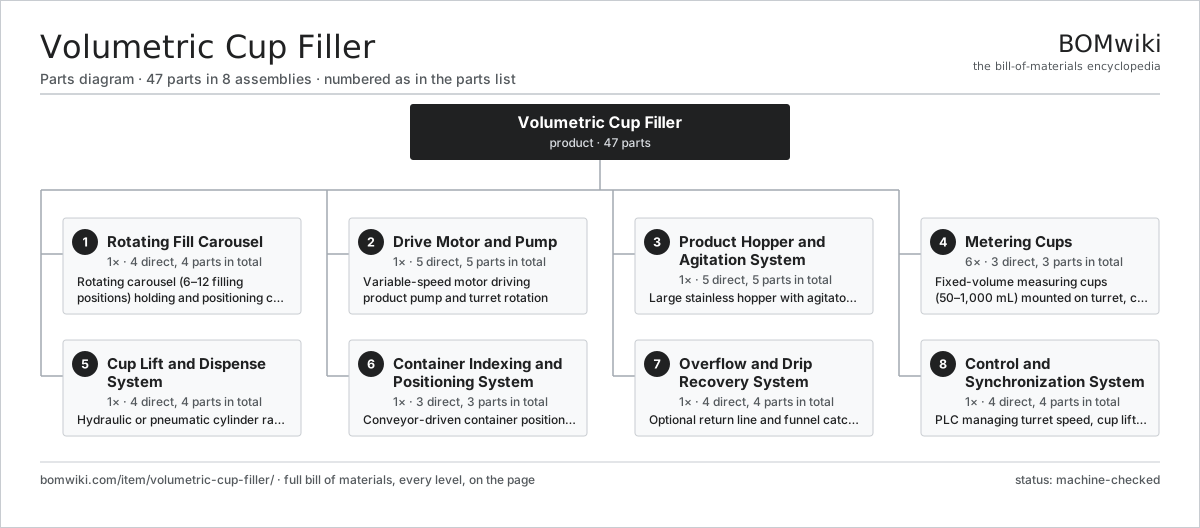
| # | Part | Qty | What it does |
|---|---|---|---|
| 1 | Rotating Fill Carousel 4 parts | 1× | Rotating carousel (6–12 filling positions) holding and positioning cups at fill, lift, and discharge stations |
| 2 | Drive Motor and Pump 5 parts | 1× | Variable-speed motor driving product pump and turret rotation |
| 3 | Product Hopper and Agitation System 5 parts | 1× | Large stainless hopper with agitator maintaining product consistency and flow |
| 4 | Metering Cups 3 parts | 6× | Fixed-volume measuring cups (50–1,000 mL) mounted on turret, collecting product via suction or gravity |
| 5 | Cup Lift and Dispense System 4 parts | 1× | Hydraulic or pneumatic cylinder raising filled cups above container to dispense by gravity or piston push |
| 6 | Container Indexing and Positioning System 3 parts | 1× | Conveyor-driven container positioning system placing jars or cups beneath each fill station |
| 7 | Overflow and Drip Recovery System 4 parts | 1× | Optional return line and funnel catching drips and excess product from cups |
| 8 | Control and Synchronization System 4 parts | 1× | PLC managing turret speed, cup lift timing, and hopper agitation synchronized to container indexing |
3D model
No 3D model yet. Have a CAD file of this? Add a 3D model — STL renders right on this page; STEP, FreeCAD, and OpenSCAD sources are welcome too (openly licensed, like all 3D models on BOMwiki).
Build & assembly graph
expand / collapse · shared sub-assemblies converge · links to related products · est. labourTap an assembly to expand/collapse · tap a part to open it · use “Open page” for any node · drag to pan, scroll to zoom.
Bill of materials for Volumetric Cup Filler
8 top-level lines · 40 rows shown · 47 parts total · indented to 3 levels| # | Item / sub-assembly | Part no. | Qty/assy | Ext. qty | Parts | Type |
|---|---|---|---|---|---|---|
| 1 | Rotating Fill Carousel 4 parts | volumetric-cup-filler-fill-turret | 1× | 1 | 4 | assembly |
| 1.1 | Carousel Casting | volumetric-cup-filler-carousel-body | 1× | 1 | · | part |
| 1.2 | Carousel Main Bearing | volumetric-cup-filler-carousel-bearing | 1× | 1 | · | part |
| 1.3 | Carousel Drive Sprocket | volumetric-cup-filler-drive-sprocket | 1× | 1 | · | part |
| 1.4 | Shaft Mechanical Seal | volumetric-cup-filler-carousel-seal | 1× | 1 | · | part |
| 2 | Drive Motor and Pump 5 parts | volumetric-cup-filler-pump-motor | 1× | 1 | 5 | assembly |
| 2.1 | AC Drive Motor | volumetric-cup-filler-ac-motor | 1× | 1 | · | part |
| 2.2 | Reduction Gearbox | volumetric-cup-filler-gearbox | 1× | 1 | · | part |
| 2.3 | Variable-Frequency Drive | volumetric-cup-filler-vfd | 1× | 1 | · | part |
| 2.4 | Product Gear Pump | volumetric-cup-filler-gear-pump | 1× | 1 | · | part |
| 2.5 | Motor-Pump Coupling | volumetric-cup-filler-pump-coupling | 1× | 1 | · | part |
| 3 | Product Hopper and Agitation System 5 parts | volumetric-cup-filler-product-hopper | 1× | 1 | 5 | assembly |
| 3.1 | Hopper Vessel | volumetric-cup-filler-hopper-vessel | 1× | 1 | · | part |
| 3.2 | Agitator Drive Motor | volumetric-cup-filler-agitator-motor | 1× | 1 | · | part |
| 3.3 | Agitator Paddle Blade | volumetric-cup-filler-agitator-blade | 1× | 1 | · | part |
| 3.4 | Hopper Heating Jacket | volumetric-cup-filler-hopper-heater | 1× | 1 | · | part |
| 3.5 | Hopper Level Sensor | volumetric-cup-filler-level-sensor | 1× | 1 | · | part |
| 4 | Metering Cups 3 parts | volumetric-cup-filler-metering-cup | 6× | 6 | 3 | assembly |
| 4.1 | Cup Cavity | volumetric-cup-filler-cup-cavity | 1× | 6 | · | part |
| 4.2 | Cup Fill Tube | volumetric-cup-filler-cup-fill-tube | 1× | 6 | · | part |
| 4.3 | Cup Drainage Valve | volumetric-cup-filler-cup-drain-valve | 1× | 6 | · | part |
| 5 | Cup Lift and Dispense System 4 parts | volumetric-cup-filler-lift-mechanism | 1× | 1 | 4 | assembly |
| 5.1 | Lift Cylinder | volumetric-cup-filler-lift-cylinder | 1× | 1 | · | part |
| 5.2 | Lift Linkage | volumetric-cup-filler-lift-linkage | 1× | 1 | · | part |
| 5.3 | Lift Solenoid Valve | volumetric-cup-filler-solenoid-valve-lift | 1× | 1 | · | part |
| 5.4 | Return Funnel and Chute | volumetric-cup-filler-return-chute | 1× | 1 | · | part |
| 6 | Container Indexing and Positioning System 3 parts | volumetric-cup-filler-container-indexer | 1× | 1 | 3 | assembly |
| 6.1 | Container Positioning System | volumetric-cup-filler-container-turret-or-belt | 1× | 1 | · | part |
| 6.2 | Container Stop Gate | volumetric-cup-filler-container-stop-gate | 1× | 1 | · | part |
| 6.3 | Container Index Motor | volumetric-cup-filler-container-drive-motor | 1× | 1 | · | part |
| 7 | Overflow and Drip Recovery System 4 parts | volumetric-cup-filler-overflow-recovery | 1× | 1 | 4 | assembly |
| 7.1 | Recovery Funnel | volumetric-cup-filler-recovery-funnel | 1× | 1 | · | part |
| 7.2 | Recovery Tank | volumetric-cup-filler-recovery-tank | 1× | 1 | · | part |
| 7.3 | Recovery Pump | volumetric-cup-filler-recovery-pump | 1× | 1 | · | part |
| 7.4 | Recovery Strainer | volumetric-cup-filler-recovery-strainer | 1× | 1 | · | part |
| 8 | Control and Synchronization System 4 parts | volumetric-cup-filler-control-system | 1× | 1 | 4 | assembly |
| 8.1 | Control PLC | volumetric-cup-filler-plc | 1× | 1 | · | part |
| 8.2 | HMI Touchscreen | volumetric-cup-filler-hmi-panel | 1× | 1 | · | part |
| 8.3 | Carousel Encoder | volumetric-cup-filler-encoder-carousel | 1× | 1 | · | part |
| 8.4 | Production Counter | volumetric-cup-filler-fill-counter | 1× | 1 | · | part |
Sourcing: possible vendors
Prices, MOQ, and lead times are algorithmic estimates, not quotes, and not claims about these companies. Company mappings are curated by keyword; est. price band $1k–$500k. How estimates work| Vendor | HQ | Specialty | MOQ | Lead time |
|---|---|---|---|---|
| gea.com ↗ | Düsseldorf, DE | Process technology | 20 units | 12–20 wks |
| buhlergroup.com ↗ | Uzwil, CH | Food & materials processing | 20 units | 12–20 wks |
| tetrapak.com ↗ | Pully, CH | Food packaging & processing | 20 units | 12–20 wks |
| jbtc.com ↗ | Chicago, US | Food processing equipment | 20 units | 12–20 wks |
| alfalaval.com ↗ | Lund, SE | Heat transfer & separation | 20 units | 12–20 wks |
1,340-word article