Warp Knitting Machine
ProductOverview
A warp knitting machine is an industrial textile machine that interlocks yarn loops across the width of fabric using multiple parallel yarn threads. Unlike weft knitting, where horizontal yarn rows are formed sequentially, warp knitting creates fabric by cycling through a fixed set of yarn threads arranged vertically. Each yarn thread contributes to an entire column of loops, enabling higher production rates and creating inherently stable fabrics with minimal curl or distortion.
Warp knitting dominates production of technical textiles, swimwear, nets, and patterned fabrics. The process is mechanically driven and fully mechanical machines remain common in legacy production lines, while newer machines incorporate electronic controls for pattern switching and process monitoring.
How It Works
The machine's core cycle repeats every few milliseconds, advancing the needle bar forward and backward while guide bars position yarn threads in front of the needles. Each cycle, all needles simultaneously form new loops, interlocking the yarn thread positions into a continuous fabric.
Yarn threads begin as multiple pattern beams held in the creel. The let-off mechanism unwinds these beams at a constant rate, maintaining tension. The yarn threads pass through guide bar hooks, which move in synchronized patterns controlled by a pattern drum or electronic controller.
During the forward stroke, the needle bar advances while guide bars position newly drafted yarn threads in front of the needles. The needle latches open and close, forming loops. During the return stroke, the needle bar retreats, drawing yarn through the newly formed loops to create the interlocking structure. This reciprocating motion repeats 300–600 times per minute.
Finished fabric emerges from the needle bed and is drawn over tension rollers, then wound onto rolls by the take-up mechanism. The fabric may be heated or cooled to stabilize loop dimensions before winding.
The main motor drives the needle bar and control system through a gearbox and synchronized shafts. Smaller electromagnetic brakes or pneumatic actuators control guide bar timing and let-off tension.
Machine Construction
The frame is a rigid casting or welded steel structure weighing 8–15 tonnes, ensuring precision alignment. The needle bar holds 400–1,400 hardened steel latch needles spaced 0.4–1.2 mm apart (gauge). The cams on the main shaft drive the needle bar's reciprocation, while yarn guide hooks mounted on up to 20 guide bars steer yarn threads into position.
The machine width determines production width and the number of needles. Common widths are 80, 120, and 168 inches. Gauge determines how closely spaced the needles are, which affects yarn fineness and loop density.
Pattern and Design
Patterns are created by the timing of guide bar movements. If all guide bars step forward together by one spacing each cycle, a simple net fabric forms. If certain bars hold position while others advance, loops interlock diagonally, creating patterned or lace-like structures. A pattern drum rotating once per pattern repeat selects which guide bars move on each cycle. Electronic machines replace the drum with a microcontroller, allowing instant pattern switching.
Each yarn thread typically contributes to 1–4 loops per cycle, depending on the number of guide bars and repeat structure. A 168-inch machine with 200-gauge needles has 840 needles and may use 10–20 yarn beams to feed them all.
Let-Off and Take-Up
The let-off mechanism controls yarn release rate. Mechanical versions use a friction brake that slips when yarn tension exceeds a setpoint. Electronic versions monitor yarn tension and adjust an electromagnetic brake to maintain constant tension despite varying yarn elasticity or knitting speed changes.
The take-up mechanism winds finished fabric onto rolls at a rate matching yarn consumption. A floating dancer arm senses fabric tension and adjusts the nip roller pressure to prevent wrinkles or crushing during winding.
Production Variants
Warp knitting produces numerous fabrics: tricot (close, dense loops), marquisette (open, netted), raschel (coarser, patterned), and locknit (interlocked guide bars preventing unraveling). Each variant uses a different guide bar arrangement and yarn count.
High-speed machines knit at 600+ needle cycles per minute, producing 50–150 kg/hour of fine fabric. Coarser machines knit slowly but produce heavier textiles. Modern digital machines allow quick pattern changes via electronic control, while mechanical machines require physical pattern drum changes.
Warp Knitting Machine parts and their functions
8 top-level parts · 623 parts in total · full bill of materials below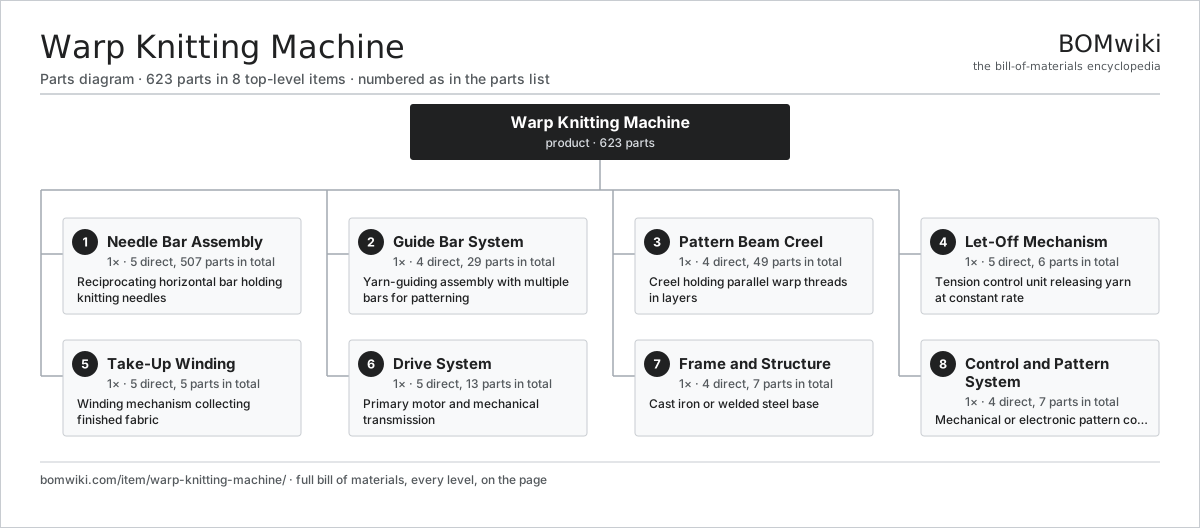
| # | Part | Qty | What it does |
|---|---|---|---|
| 1 | Needle Bar Assembly 5 parts | 1× | Reciprocating horizontal bar holding knitting needles |
| 2 | Guide Bar System 4 parts | 1× | Yarn-guiding assembly with multiple bars for patterning |
| 3 | Pattern Beam Creel 4 parts | 1× | Creel holding parallel warp threads in layers |
| 4 | Let-Off Mechanism 5 parts | 1× | Tension control unit releasing yarn at constant rate |
| 5 | Take-Up Winding 5 parts | 1× | Winding mechanism collecting finished fabric |
| 6 | Drive System 5 parts | 1× | Primary motor and mechanical transmission |
| 7 | Frame and Structure 4 parts | 1× | Cast iron or welded steel base |
| 8 | Control and Pattern System 4 parts | 1× | Mechanical or electronic pattern control |
3D model
No 3D model yet. Have a CAD file of this? Add a 3D model. STL renders right on this page; STEP, FreeCAD, and OpenSCAD sources are welcome too (openly licensed, like all 3D models on BOMwiki).
Build & assembly graph
expand / collapse · shared sub-assemblies converge · links to related products · est. labourTap an assembly to expand/collapse · tap a part to open it · use “Open page” for any node · drag to pan, scroll to zoom.
Bill of materials for Warp Knitting Machine
8 top-level lines · 44 rows shown · 623 parts total · indented to 3 levels| # | Item / sub-assembly | Part no. | Qty/assy | Ext. qty | Parts | Type |
|---|---|---|---|---|---|---|
| 1 | Needle Bar Assembly 5 parts | warp-knitting-machine-needle-bar | 1× | 1 | 507 | assembly |
| 1.1 | Latch Needles | warp-knitting-machine-needles | 500× | 500 | · | part |
| 1.2 | Needle Stem Rod | warp-knitting-machine-needle-stems | 1× | 1 | · | part |
| 1.3 | Needle Bed | warp-knitting-machine-needle-bed | 1× | 1 | · | part |
| 1.4 | Cam Assembly | warp-knitting-machine-cams-guidance | 1× | 1 | · | part |
| 1.5 | Ball Bearing | ball-bearing | 4× | 4 | · | part |
| 2 | Guide Bar System 4 parts | warp-knitting-machine-guide-bars | 1× | 1 | 29 | assembly |
| 2.1 | Individual Guide Bar | warp-knitting-machine-guide-bar-unit | 3× | 3 | · | part |
| 2.2 | Yarn Guide Hooks | warp-knitting-machine-guide-hooks | 24× | 24 | · | part |
| 2.3 | Guide Bar Linkage | warp-knitting-machine-bar-linkage | 1× | 1 | · | part |
| 2.4 | Pattern Cam | warp-knitting-machine-pattern-cam | 1× | 1 | · | part |
| 3 | Pattern Beam Creel 4 parts | warp-knitting-machine-pattern-beams | 1× | 1 | 49 | assembly |
| 3.1 | Warp Beam | warp-knitting-machine-warp-beams | 12× | 12 | · | part |
| 3.2 | Beam Shaft | warp-knitting-machine-beam-shafts | 12× | 12 | · | part |
| 3.3 | Creel Frame | warp-knitting-machine-creel-frame | 1× | 1 | · | part |
| 3.4 | Ball Bearing | ball-bearing | 24× | 24 | · | part |
| 4 | Let-Off Mechanism 5 parts | warp-knitting-machine-let-off | 1× | 1 | 6 | assembly |
| 4.1 | Tension Sensing Roller | warp-knitting-machine-tension-roller | 1× | 1 | · | part |
| 4.2 | Brake Band | warp-knitting-machine-brake-band | 1× | 1 | · | part |
| 4.3 | Electromagnetic Brake | warp-knitting-machine-solenoid-brake | 1× | 1 | · | part |
| 4.4 | Pressure Sensor | pressure-sensor | 1× | 1 | · | part |
| 4.5 | Ball Bearing | ball-bearing | 2× | 2 | · | part |
| 5 | Take-Up Winding 5 parts | warp-knitting-machine-take-up | 1× | 1 | 5 | assembly |
| 5.1 | Winding Mandrel | warp-knitting-machine-wind-roll | 1× | 1 | · | part |
| 5.2 | Dancer Arm | warp-knitting-machine-dancer-arm | 1× | 1 | · | part |
| 5.3 | Nip Roller | warp-knitting-machine-nip-roller | 1× | 1 | · | part |
| 5.4 | Drive Belt | drive-belt | 1× | 1 | · | part |
| 5.5 | Blower Motor | blower-motor | 1× | 1 | · | part |
| 6 | Drive System 5 parts | warp-knitting-machine-drive-system | 1× | 1 | 13 | assembly |
| 6.1 | Main Drive Motor | warp-knitting-machine-main-motor | 1× | 1 | · | part |
| 6.2 | Reduction Gearbox | warp-knitting-machine-gearbox | 1× | 1 | · | part |
| 6.3 | Main Shaft | warp-knitting-machine-main-shaft | 1× | 1 | · | part |
| 6.4 | Helical Gear Pair | gear-pair | 2× | 2 | · | part |
| 6.5 | Ball Bearing | ball-bearing | 8× | 8 | · | part |
| 7 | Frame and Structure 4 parts | warp-knitting-machine-frame-structure | 1× | 1 | 7 | assembly |
| 7.1 | Main Frame Casting | warp-knitting-machine-main-frame-casting | 1× | 1 | · | part |
| 7.2 | Upper Platen | warp-knitting-machine-upper-platen | 1× | 1 | · | part |
| 7.3 | Sheet Metal Panel | sheet-panel | 4× | 4 | · | part |
| 7.4 | Fastener Set | fastener-set | 1× | 1 | · | part |
| 8 | Control and Pattern System 4 parts | warp-knitting-machine-control-system | 1× | 1 | 7 | assembly |
| 8.1 | Pattern Drum | warp-knitting-machine-pattern-drum | 1× | 1 | · | part |
| 8.2 | Selector Fingers | warp-knitting-machine-selector-fingers | 1× | 1 | · | part |
| 8.3 | Microcontroller | mcu | 1× | 1 | · | part |
| 8.4 | Relay | relay | 4× | 4 | · | part |
Something wrong in this list? Report a problem with this BOM.
Related products
same domain, ranked by shared parts Textile Stenter Frame
1,683 parts · shares 3 with this page
Textile Stenter Frame
1,683 parts · shares 3 with this page
 Pillow Filling Machine
35 parts · shares 2 with this page
Pillow Filling Machine
35 parts · shares 2 with this page
 Automated Fabric Cutter
1,237 parts · shares 1 with this page
Automated Fabric Cutter
1,237 parts · shares 1 with this page
 Carding Machine
464 parts · shares 1 with this page
Carding Machine
464 parts · shares 1 with this page
 Circular Knitting Machine
958 parts · shares 1 with this page
Circular Knitting Machine
958 parts · shares 1 with this page
 Industrial Steam Press
133 parts · shares 1 with this page
Industrial Steam Press
133 parts · shares 1 with this page
Sourcing: possible vendors
Browse the supplier directory → Prices, MOQ, and lead times are algorithmic estimates, not quotes, and not claims about these companies. Company mappings are curated by keyword; est. price band $10k–$1M. How estimates work| Vendor | HQ | Specialty | MOQ | Lead time |
|---|---|---|---|---|
|
🇨🇭Rieter
rieter.com ↗
|
Winterthur, CH | Spinning machinery | 10 units | 14–24 wks |
| truetzschler.com ↗ | Mönchengladbach, DE | Textile machinery | 10 units | 14–24 wks |
|
🇧🇪Picanol
picanol.be ↗
|
Ypres, BE | Weaving machines | 10 units | 14–24 wks |
| karlmayer.com ↗ | Obertshausen, DE | Warp knitting machines | 10 units | 14–24 wks |
|
🇨🇭Saurer
saurer.com ↗
|
Arbon, CH | Spinning & embroidery | 10 units | 14–24 wks |
850-word article