Pump Water Blaster
ProductOverview
A pump water blaster is a manual hydraulic toy that shoots water using hand-compressed air pressure. The player fills the Water Reservoir with tap water, then operates the Pump Assembly, which compresses air and draws water into the Pressure Tank. Repeated pumping increases pressure inside the chamber (typically 200–600 kPa gauge). When the player pulls the Trigger Valve, pressurized water is expelled through the Nozzle Head, traveling 5–10 meters as a coherent stream or spray. Water blasters are popular outdoor toys for warm-weather play, water balloon battles, and cooling off during hot days.
The genius of the design is the combination of simplicity and effectiveness. Unlike battery-powered electric water guns, pump blasters require no electronics or electrical power, just mechanical action and fluid pressure. The lack of complexity makes them reliable, durable, affordable, and easy to maintain.
Pressurization cycle
The Pump Assembly is the propulsion engine. It consists of two cylinders, each with a Piston connected to a shared pump handle. When the player pushes the pump handle forward (compressing), the pistons move inward, reducing the cylinder volume. A Check Valve in each cylinder acts as a one-way valve: on the compression stroke, the valve closes, trapping the water inside, and the pressure forces it into the Pressure Tank. On the return stroke (pulling the handle back), the piston moves outward; the pressure drop allows the check valve to open, drawing fresh water from the Water Reservoir into the cylinders via an Inlet Tube.
Each pump stroke typically displaces 50–150 mL of water. Full pressurization (reaching operating pressure of 200–600 kPa) takes 5–15 strokes, depending on the pump cylinder size and chamber volume. Modern designs use dual-cylinder pumps to speed up pressurization, while one piston is compressing, the other is refilling, so the user pumps faster and achieves pressure more quickly than with single-cylinder pumps.
The Seal Pack, typically nitrile or rubber O-rings, maintain sealing between the piston and cylinder barrel. Over thousands of pump cycles, these seals wear; if leakage develops, the pump becomes inefficient. Replacement seal kits are common maintenance items.
Pressure accumulation and relief
The Pressure Tank is an intermediate storage tank that accumulates the compressed air and water from the pump. As pumping continues, pressure inside the chamber rises. A Relief Valve, a spring-loaded check valve, protects against over-pressurization. If internal pressure exceeds the spring preload (typically set at 600–800 kPa), the relief valve opens and vents excess pressure through an exhaust port, preventing the tank from rupturing.
Some water gun designs include a Pressure Gauge, a visual dial showing internal pressure. This helps the player know when maximum pressure is reached and firing time has come. Without a gauge, the player must rely on feel (increased resistance to pumping) or experience to judge when full pressure is attained.
Trigger and discharge
The Trigger Valve is a manually operated control valve. Pulling the Trigger Lever shifts the Valve Spool, a sliding piston or rotating shaft inside the Valve Body, opening a passage from the Pressure Tank to the Discharge Hose. Pressurized water flows through the Fluid Pathway to the Nozzle Head, where it is expelled.
The discharge rate depends on pressure and nozzle orifice size. At 400 kPa and a 4 mm diameter nozzle, a typical water gun discharges approximately 150–200 mL per second, sufficient to drench a target 5–10 meters away within 10–15 seconds (depleting a 2-liter reservoir in roughly 2–3 minutes of continuous firing at that range).
Releasing the trigger closes the spool, stopping flow. The remaining pressurized water is trapped in the chamber until the next firing event. Over time, the Valve Seals (O-rings inside the spool cavity) can leak, allowing slow pressure bleed-off when the gun is idle. High-quality designs minimize this; cheap toy guns may lose 30–50 percent of pressure over 30 minutes of sitting.
Nozzle design and spray patterns
The Nozzle Head is the final stage. Most pump water guns include 2–4 interchangeable or selectable spray modes via a Nozzle Selector that redirects flow through different Nozzle Tip:
- Stream mode: A single small orifice (2–3 mm diameter) creates a compact, high-velocity jet traveling far and hitting hard. Ideal for range and accuracy.
- Cone mode: Multiple small holes or a convergent nozzle creating a fan or cone spray. Covers a wider target area but delivers less force per unit area.
- Mist mode: Very fine atomization creating a cloud. Useful for cooling off but with minimal range.
Advanced models allow field-swappable nozzle inserts, so players can customize spray pattern mid-battle.
Water pathway integrity
The Fluid Pathway system must be sealed to maintain pressure. An Inlet Tube, typically a rigid or semi-rigid plastic tube with a foot valve (one-way check) at its submerged end, draws water from the Water Reservoir. The Discharge Hose, flexible tubing, carries pressurized water from the chamber to the nozzle. All connections use Connector barbed fittings or snap couplings; over time, vibration and pressure cycling can loosen these, causing weeping leaks.
Filling and air venting
The Vent and Fill System is critical for proper filling. When the player fills the Water Reservoir with water, air must escape, otherwise the tank becomes air-locked and won't fill. Most designs include a simple Air Valve, a duckbill or spring-loaded vent positioned near the top of the tank. As water enters, it displaces air, which exits through the vent. After filling, the vent closes, trapping water inside.
On the Pressure Tank side, an Vent and Fill System passage connects to atmosphere. As water is pumped in, air is vented out, keeping the chamber open for pressurization. Without this vent, as water fills the chamber, trapped air would compress and resist further water ingress, slowing down the charging process.
Handle and ergonomics
The Handle Assembly is shaped for a child's hand. A soft Grip Cover, typically a foam or rubber wrap, provides comfort and prevents blisters during extended play. The Pump Rod is the primary control interface; pumping requires flexing the arm and gripping tightly. Pump action rates vary: a vigorous player can pump 2–3 times per second, fully pressurizing a modest-sized gun in 5–10 seconds.
Durability and maintenance
Pump water guns are mechanically rugged. The main wear items are:
- Pump seals (O-rings): Leak after 2000–5000 pump cycles; typically replaced as a kit.
- Valve seals: Can weep or fail after years of UV exposure and pressure cycling.
- Check valves: Occasionally stick or fail to seal, losing pressure or preventing refill.
- Plastic components: Can crack from UV exposure or impact; tanks and tubes become brittle over 5–10 years in direct sunlight.
To extend life, rinse the gun with fresh water after use (chlorine and minerals in tap water can corrode internal parts), store in a cool, shaded location, and periodically lubricate the pump handle pivot with a light oil or silicone spray.
Variants and improvements
Modern pump water guns come in various sizes and configurations. Small single-tank designs (0.5–1 liter) are compact and fast-pressurizing but limited in playtime. Large reservoir models (2–3 liters) hold more water but require more pumping. Backpack-mounted high-capacity guns (5–10 liters) are designed for extended battles, often fed by a pressure-regulating system.
Some premium designs use elastic accumulators, rubber bladders filled with pressurized gas, instead of air-spring relief. These store energy more efficiently and allow pressure to be maintained longer without continued pumping. A few electronic designs add battery-powered solenoid valves for rapid-fire bursts, but these sacrifice the simplicity that makes pump guns iconic.
Pump Water Blaster parts and their functions
8 top-level parts · 32 parts in total · full bill of materials below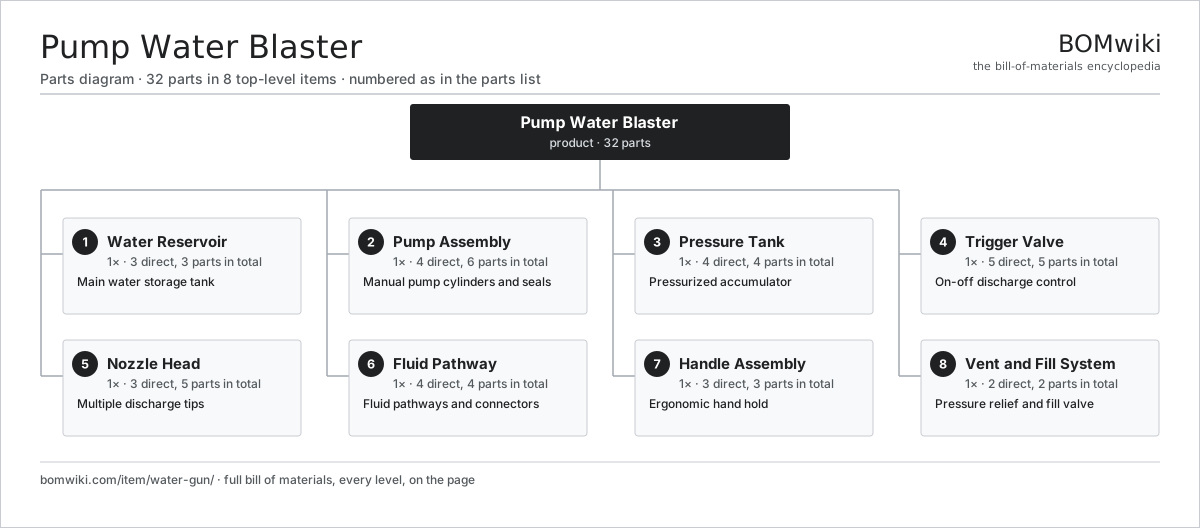
| # | Part | Qty | What it does |
|---|---|---|---|
| 1 | Water Reservoir 3 parts | 1× | Main water storage tank |
| 2 | Pump Assembly 4 parts | 1× | Manual pump cylinders and seals |
| 3 | Pressure Tank 4 parts | 1× | Pressurized accumulator |
| 4 | Trigger Valve 5 parts | 1× | On-off discharge control |
| 5 | Nozzle Head 3 parts | 1× | Multiple discharge tips |
| 6 | Fluid Pathway 4 parts | 1× | Fluid pathways and connectors |
| 7 | Handle Assembly 3 parts | 1× | Ergonomic hand hold |
| 8 | Vent and Fill System 2 parts | 1× | Pressure relief and fill valve |
3D model
No 3D model yet. Have a CAD file of this? Add a 3D model. STL renders right on this page; STEP, FreeCAD, and OpenSCAD sources are welcome too (openly licensed, like all 3D models on BOMwiki).
Build & assembly graph
expand / collapse · shared sub-assemblies converge · links to related products · est. labourTap an assembly to expand/collapse · tap a part to open it · use “Open page” for any node · drag to pan, scroll to zoom.
Bill of materials for Pump Water Blaster
8 top-level lines · 36 rows shown · 32 parts total · indented to 3 levels| # | Item / sub-assembly | Part no. | Qty/assy | Ext. qty | Parts | Type |
|---|---|---|---|---|---|---|
| 1 | Water Reservoir 3 parts | water-gun-reservoir | 1× | 1 | 3 | assembly |
| 1.1 | Tank Shell | water-gun-reservoir-shell | 1× | 1 | · | part |
| 1.2 | Fill Cap | water-gun-reservoir-cap | 1× | 1 | · | part |
| 1.3 | Filler Neck | water-gun-filler-neck | 1× | 1 | · | part |
| 2 | Pump Assembly 4 parts | water-gun-pump-mechanism | 1× | 1 | 6 | assembly |
| 2.1 | Piston | water-gun-pump-piston | 2× | 2 | · | part |
| 2.2 | Cylinder Barrel | water-gun-pump-barrels | 2× | 2 | · | part |
| 2.3 | Check Valve | water-gun-pump-check-valve | 1× | 1 | · | part |
| 2.4 | Seal Pack | water-gun-pump-seals | 1× | 1 | · | part |
| 3 | Pressure Tank 4 parts | water-gun-pressure-chamber | 1× | 1 | 4 | assembly |
| 3.1 | Chamber Tank | water-gun-chamber-shell | 1× | 1 | · | part |
| 3.2 | Pressure Gauge | water-gun-pressure-gauge | 1× | 1 | · | part |
| 3.3 | Relief Valve | water-gun-relief-valve | 1× | 1 | · | part |
| 3.4 | Fastener Set | fastener-set | 1× | 1 | · | part |
| 4 | Trigger Valve 5 parts | water-gun-trigger-valve | 1× | 1 | 5 | assembly |
| 4.1 | Valve Spool | water-gun-valve-spool | 1× | 1 | · | part |
| 4.2 | Trigger Lever | water-gun-trigger-lever | 1× | 1 | · | part |
| 4.3 | Valve Body | water-gun-valve-body | 1× | 1 | · | part |
| 4.4 | Valve Seals | water-gun-valve-seals | 1× | 1 | · | part |
| 4.5 | Fastener Set | fastener-set | 1× | 1 | · | part |
| 5 | Nozzle Head 3 parts | water-gun-nozzle-assembly | 1× | 1 | 5 | assembly |
| 5.1 | Nozzle Housing | water-gun-nozzle-body | 1× | 1 | · | part |
| 5.2 | Nozzle Tip | water-gun-nozzle-tips | 3× | 3 | · | part |
| 5.3 | Nozzle Selector | water-gun-nozzle-selector | 1× | 1 | · | part |
| 6 | Fluid Pathway 4 parts | water-gun-internal-tubing | 1× | 1 | 4 | assembly |
| 6.1 | Inlet Tube | water-gun-inlet-tube | 1× | 1 | · | part |
| 6.2 | Discharge Hose | water-gun-discharge-hose | 1× | 1 | · | part |
| 6.3 | Connector | water-gun-tube-connector | 1× | 1 | · | part |
| 6.4 | Fastener Set | fastener-set | 1× | 1 | · | part |
| 7 | Handle Assembly 3 parts | water-gun-handle-grip | 1× | 1 | 3 | assembly |
| 7.1 | Grip Cover | water-gun-grip-material | 1× | 1 | · | part |
| 7.2 | Pump Rod | water-gun-pump-handle-rod | 1× | 1 | · | part |
| 7.3 | Fastener Set | fastener-set | 1× | 1 | · | part |
| 8 | Vent and Fill System 2 parts | water-gun-air-vent | 1× | 1 | 2 | assembly |
| 8.1 | Air Valve | water-gun-air-valve | 1× | 1 | · | part |
| 8.2 | Vent Port | water-gun-vent-passage | 1× | 1 | · | part |
Something wrong in this list? Report a problem with this BOM.
Sourcing: possible vendors
Browse the supplier directory → Prices, MOQ, and lead times are algorithmic estimates, not quotes, and not claims about these companies. Company mappings are curated by keyword; est. price band $20–$3k. How estimates work| Vendor | HQ | Specialty | MOQ | Lead time |
|---|---|---|---|---|
|
🇩🇰LEGO
lego.com ↗
|
Billund, DK | Construction toys | 2,000 units | 6–10 wks |
|
🇺🇸Mattel
mattel.com ↗
|
El Segundo, US | Toys | 2,000 units | 6–10 wks |
|
🇺🇸Hasbro
hasbro.com ↗
|
Pawtucket, US | Toys & games | 2,000 units | 6–10 wks |
| bandainamco.co.jp ↗ | Tokyo, JP | Toys & amusement | 2,000 units | 6–10 wks |
| spinmaster.com ↗ | Toronto, CA | Toys | 2,000 units | 6–10 wks |
1,366-word article