Pressure Tank
ProductOverview
A pressure tank stores water under pressure so a well or booster pump does not have to start every time someone opens a tap. Without it, a pump would short-cycle on and off with each small draw, wearing out quickly. The tank holds a reserve of water against a cushion of compressed air; that air pushes the water back out into the house between pump runs, smoothing pressure and letting the pump rest. The bladder design keeps the air and water apart so the air charge cannot dissolve away over time, which was the weakness of older air-over-water tanks.
The Tank Shell is the steel vessel that contains everything. A Bladder divides it into a wet side and a dry side. The Air Valve sets the Air Cushion, the System Connection ties the wet side into the plumbing, and the Wet-Side Liner and Base Ring protect and support the tank.
How it works
The dry side of the tank is pre-charged with air through the Schrader Valve valve, typically two psi below the pump's cut-in setting. As the pump runs, water enters through the System Connection and stretches the Butyl Diaphragm, compressing the Air Cushion behind it. When the pressure reaches the cut-out setting the pump stops, leaving the tank charged. When a fixture is opened, the compressed air pushes the diaphragm back, forcing stored water out into the system until the pressure falls to cut-in and the pump restarts. The usable volume between those two points is the drawdown, and it is what keeps the pump from cycling on every cup of water.
The Check Valve in the inlet keeps stored water from bleeding back toward the pump, and the Bladder keeps the air charge captive so it does not become waterlogged. Over years the diaphragm can fatigue or the air charge can leak through the Schrader Valve valve; a tank that has lost its pre-charge lets the pump short-cycle again, which is the usual sign it needs recharging or replacement.
Pressure Tank parts and their functions
9 top-level parts · 16 parts in total · full bill of materials below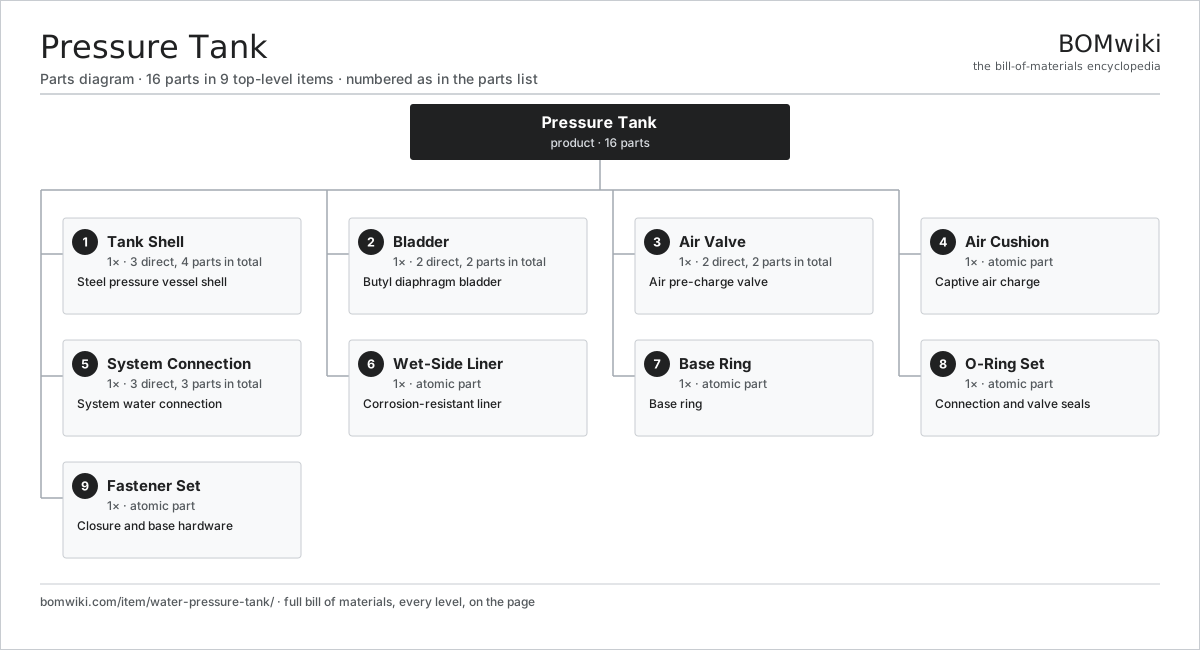
| # | Part | Qty | What it does |
|---|---|---|---|
| 1 | Tank Shell 3 parts | 1× | Steel pressure vessel shell |
| 2 | Bladder 2 parts | 1× | Butyl diaphragm bladder |
| 3 | Air Valve 2 parts | 1× | Air pre-charge valve |
| 4 | Air Cushion | 1× | Captive air charge |
| 5 | System Connection 3 parts | 1× | System water connection |
| 6 | Wet-Side Liner | 1× | Corrosion-resistant liner |
| 7 | Base Ring | 1× | Base ring |
| 8 | O-Ring Set | 1× | Connection and valve seals |
| 9 | Fastener Set | 1× | Closure and base hardware |
3D model
No 3D model yet. Have a CAD file of this? Add a 3D model. STL renders right on this page; STEP, FreeCAD, and OpenSCAD sources are welcome too (openly licensed, like all 3D models on BOMwiki).
Build & assembly graph
expand / collapse · shared sub-assemblies converge · links to related products · est. labourTap an assembly to expand/collapse · tap a part to open it · use “Open page” for any node · drag to pan, scroll to zoom.
Bill of materials for Pressure Tank
9 top-level lines · 19 rows shown · 16 parts total · indented to 3 levels| # | Item / sub-assembly | Part no. | Qty/assy | Ext. qty | Parts | Type |
|---|---|---|---|---|---|---|
| 1 | Tank Shell 3 parts | water-pressure-tank-shell | 1× | 1 | 4 | assembly |
| 1.1 | Cylinder | water-pressure-tank-cylinder | 1× | 1 | · | part |
| 1.2 | End Dome | water-pressure-tank-dome | 2× | 2 | · | part |
| 1.3 | Exterior Coating | water-pressure-tank-coating | 1× | 1 | · | part |
| 2 | Bladder 2 parts | water-pressure-tank-bladder | 1× | 1 | 2 | assembly |
| 2.1 | Butyl Diaphragm | water-pressure-tank-diaphragm | 1× | 1 | · | part |
| 2.2 | Bladder Clamp | water-pressure-tank-bladder-clamp | 1× | 1 | · | part |
| 3 | Air Valve 2 parts | water-pressure-tank-air-valve | 1× | 1 | 2 | assembly |
| 3.1 | Schrader Valve | water-pressure-tank-schrader | 1× | 1 | · | part |
| 3.2 | Valve Cap | water-pressure-tank-valve-cap | 1× | 1 | · | part |
| 4 | Air Cushion | water-pressure-tank-air-cushion | 1× | 1 | · | part |
| 5 | System Connection 3 parts | water-pressure-tank-connection | 1× | 1 | 3 | assembly |
| 5.1 | Inlet Fitting | water-pressure-tank-inlet-fitting | 1× | 1 | · | part |
| 5.2 | Check Valve | water-pressure-tank-check-valve | 1× | 1 | · | part |
| 5.3 | O-Ring Set | oring-set | 1× | 1 | · | part |
| 6 | Wet-Side Liner | water-pressure-tank-liner | 1× | 1 | · | part |
| 7 | Base Ring | water-pressure-tank-base | 1× | 1 | · | part |
| 8 | O-Ring Set | oring-set | 1× | 1 | · | part |
| 9 | Fastener Set | fastener-set | 1× | 1 | · | part |
Something wrong in this list? Report a problem with this BOM.
Related products
same domain, ranked by shared parts Electric Shower
33 parts · shares 1 with this page
Electric Shower
33 parts · shares 1 with this page
 Electronic Bidet Seat
197 parts · shares 1 with this page
Frost-Free Yard Hydrant
16 parts · shares 1 with this page
Electronic Bidet Seat
197 parts · shares 1 with this page
Frost-Free Yard Hydrant
16 parts · shares 1 with this page
 Grease Interceptor
45 parts · shares 1 with this page
Grease Interceptor
45 parts · shares 1 with this page
 Greywater Recycling Unit
77 parts · shares 1 with this page
Greywater Recycling Unit
77 parts · shares 1 with this page
Sourcing: possible vendors
Browse the supplier directory → Prices, MOQ, and lead times are algorithmic estimates, not quotes, and not claims about these companies. Company mappings are curated by keyword; est. price band $20–$3k. How estimates work| Vendor | HQ | Specialty | MOQ | Lead time |
|---|---|---|---|---|
|
🇺🇸Kohler
kohler.com ↗
|
Kohler, US | Plumbing fixtures | 1,000 units | 6–12 wks |
|
🇯🇵TOTO
toto.com ↗
|
Kitakyushu, JP | Sanitaryware | 1,000 units | 6–12 wks |
|
🇯🇵LIXIL
lixil.com ↗
|
Tokyo, JP | Plumbing (Grohe, American Std) | 1,000 units | 6–12 wks |
|
🇺🇸Moen
moen.com ↗
|
North Olmsted, US | Faucets & fixtures | 1,000 units | 6–12 wks |
|
🇨🇭Geberit
geberit.com ↗
|
Rapperswil, CH | Sanitary systems | 1,000 units | 6–12 wks |
377-word article