Wave Tank
ProductOverview
A wave tank is a specialized laboratory apparatus that generates and studies water waves in a controlled environment. Used in coastal engineering research, hydraulics education, and maritime design, the wave tank permits detailed observation and measurement of wave phenomena: generation, propagation, breaking, interaction with structures, and energy dissipation. The fundamental setup is deceptively simple, a long rectangular channel filled with water, driven at one end by a motorized paddle, and lined at the far end with a porous absorbing beach. The paddle oscillates at a controlled frequency and amplitude, launching plane waves down the channel. Sophisticated versions add sensors to measure wave height, velocity, and pressure at multiple stations, allowing quantitative study of nonlinear wave dynamics, wave breaking thresholds, and sediment transport.
Wave tanks have been essential tools in coastal and civil engineering since the early 20th century. They enable engineers to test harbor designs, evaluate seawall effectiveness, understand tsunami propagation, and optimize offshore structure resilience, all at reduced scale and cost compared to full-scale field trials. Modern wave tanks integrate digital control and data acquisition, allowing researchers to conduct parametric studies (varying amplitude, frequency, water depth) and capture high-resolution time series of wave motion.
How it works
Wave generation via paddle: The Paddle Drive Motor drives a Crank Linkage that converts continuous rotation into sinusoidal (or programmed waveform) motion of the Wave Paddle Blade. The paddle oscillates perpendicular to the water surface with amplitude A (10–150 mm) and frequency f (0.1–2 Hz). At each oscillation cycle, the paddle pushes water forward (raising surface elevation), then retracts (lowering it). This repetitive disturbance launches a train of plane waves (straight-crested wavefronts perpendicular to the paddle) down the channel.
The relationship between paddle motion and generated wave parameters is complex and nonlinear, but in shallow-water and linear-wave regimes, the wave amplitude is approximately proportional to paddle amplitude, and the wave frequency matches the paddle frequency exactly. For small-amplitude, long-period waves (f < 0.5 Hz), linear wave theory applies, and wave behavior is predictable from theory.
Water depth and wave speed: In shallow water (depth h << wavelength λ), the wave speed c is governed by:
c = √(gh)
where g is gravitational acceleration. For a 0.5 m deep tank, c ≈ 2.2 m/s. If the paddle oscillates at 1 Hz, waves are generated every 1 second and propagate at 2.2 m/s, yielding a wavelength λ = c/f = 2.2 m. In a 3 m tank, the wave "sees" the beach after ~1.4 seconds.
For deeper water or higher frequencies, wave speed depends on wavelength via the dispersion relation:
c = √(gλ/(2π)) tanh(2πh/λ)
which leads to shorter waves traveling slower than longer waves (dispersive behavior). This complicates wave tank experiments because wave packets separate and disperse as they propagate.
Wave propagation and nonlinearity: As waves travel down the channel, their shape evolves. Small-amplitude waves remain sinusoidal and travel without changing amplitude (ignoring friction). Large-amplitude waves (when wave height H becomes comparable to water depth h) are nonlinear: the wave shape steepens, the crest becomes peaked, the trough flattens, and energy transfers from the fundamental frequency to higher harmonics (secondary waves). Eventually, if the wave steepens beyond a critical slope (~1:7 for gravity waves), it breaks, the crest becomes unstable and cascades forward in a turbulent bore. The Absorbing Beach at the far end absorbs remaining wave energy, preventing reflections that would interfere with the paddle-generated waves and corrupt the experiment.
Measurement and data acquisition: Wave Measurement Instrumentation sensors (capacitive or ultrasonic probes) positioned along the channel measure water surface elevation η(t) at each location. Sampling at 10–100 Hz over several wave periods yields time series that are analyzed to extract wave height H (difference between crest and trough), period T (time between successive zero-crossings), and wavelength λ (spatial extent of one cycle). The Data Logger and Digitizer digitizes sensor signals and stores them, enabling post-processing (Fourier analysis, wavelet decomposition, nonlinearity metrics).
Energy dissipation in the beach: The Absorbing Beach is critical. Without absorption, waves reflect from the far wall, returning upstream and interfering with the paddle-generated wavefront. This superposition creates a complex, standing-wave-like pattern unsuitable for controlled study. The absorbing beach (typically a 1:3 to 1:5 slope covered with foam, rubber chips, or fiber) dissipates 70–90% of incident wave energy through viscous friction and turbulent dissipation in the porous medium. The remaining 10–30% reflects, but weak reflections are often accepted in practice.
Experimental configurations and applications
Monochromatic waves: The paddle oscillates at a constant frequency and amplitude, generating a regular wave train. This is ideal for validating linear or nonlinear wave theories, studying wave shoaling (amplitude growth as water shallows), and investigating wave breaking thresholds.
Irregular (random) waves: The Waveform Generator produces a pseudo-random superposition of many frequencies (simulating ocean sea states), creating realistic, non-periodic wave conditions. Statistical analysis of the time series yields spectral properties (significant wave height Hs, peak period Tp), matching real-world wave climatology.
Bathymetry effects: By adjusting the Structural Support and Leveling leveling, the channel bottom can be tilted or modified (submerged bars, slopes) to study how topography alters wave propagation. Waves shoal on shallow slopes and refract around underwater features.
Structure interaction: Models of breakwaters, piers, or coastal structures are placed in the channel; the resulting forces and reflections are measured, informing engineering design.
Sediment transport: Beaches or movable-bed sections can be added to study sediment suspension, transport, and deposition under wave action, critical for predicting shoreline erosion or accretion.
Limitations and practical constraints
Scale effects: Laboratory waves (period 1–10 s, height 10–100 mm) are scaled-down versions of ocean waves (period 5–20 s, height 1–10 m). Not all physical phenomena scale linearly; viscous forces, which are negligible in oceans, can become significant in small tanks. This introduces systematic errors that must be corrected or accepted.
Surface tension: In very shallow or small-amplitude wave tanks, surface tension effects become important, causing higher wave speed than gravity-wave theory predicts. Most tanks are deep and forceful enough to ignore surface tension.
Reflections and boundaries: Despite the absorbing beach, reflections from the paddle, channel walls, and corners can contaminate measurements. Careful design and high-quality absorber materials minimize these errors, but they are never zero.
Paddle nonlinearity: The paddle-to-wave relationship is nonlinear at large amplitudes; higher harmonics appear in the generated wave spectrum even if the paddle motion is sinusoidal. This is actually realistic, ocean storms also contain a spectrum of harmonics, but it complicates controlled experiments.
Educational and research significance
Wave tanks are invaluable for:
- Validating wave theory: Experimental measurements confirm or refute theoretical predictions from linear, weakly nonlinear, and fully nonlinear wave models.
- Teaching hydrodynamics: Students visualize abstract concepts like dispersion, shoaling, refraction, and breaking.
- Coastal design: Engineers test harbor geometries, jetty layouts, and offshore structure resilience before costly construction.
- Sediment dynamics: Understanding sand migration, dune formation, and beach erosion under wave action.
- Tsunami hazard assessment: Scaled models can explore tsunami generation by earthquakes and landslides, informing coastal defense strategies.
Modern wave tanks are increasingly coupled to numerical simulation (computational fluid dynamics, CFD) for model validation and to digital controls for automated parameter sweeps, enabling high-throughput experimental research.
Wave Tank parts and their functions
7 top-level parts · 35 parts in total · full bill of materials below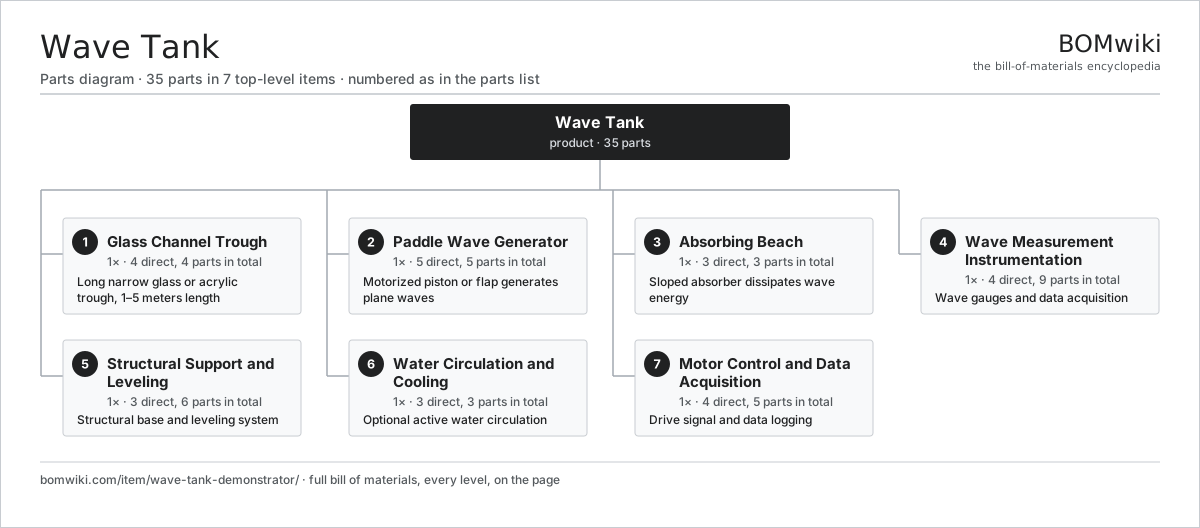
| # | Part | Qty | What it does |
|---|---|---|---|
| 1 | Glass Channel Trough 4 parts | 1× | Long narrow glass or acrylic trough, 1–5 meters length |
| 2 | Paddle Wave Generator 5 parts | 1× | Motorized piston or flap generates plane waves |
| 3 | Absorbing Beach 3 parts | 1× | Sloped absorber dissipates wave energy |
| 4 | Wave Measurement Instrumentation 4 parts | 1× | Wave gauges and data acquisition |
| 5 | Structural Support and Leveling 3 parts | 1× | Structural base and leveling system |
| 6 | Water Circulation and Cooling 3 parts | 1× | Optional active water circulation |
| 7 | Motor Control and Data Acquisition 4 parts | 1× | Drive signal and data logging |
3D model
No 3D model yet. Have a CAD file of this? Add a 3D model. STL renders right on this page; STEP, FreeCAD, and OpenSCAD sources are welcome too (openly licensed, like all 3D models on BOMwiki).
Build & assembly graph
expand / collapse · shared sub-assemblies converge · links to related products · est. labourTap an assembly to expand/collapse · tap a part to open it · use “Open page” for any node · drag to pan, scroll to zoom.
Bill of materials for Wave Tank
7 top-level lines · 33 rows shown · 35 parts total · indented to 3 levels| # | Item / sub-assembly | Part no. | Qty/assy | Ext. qty | Parts | Type |
|---|---|---|---|---|---|---|
| 1 | Glass Channel Trough 4 parts | wave-tank-demonstrator-channel | 1× | 1 | 4 | assembly |
| 1.1 | Glass Side Panels | wave-tank-demonstrator-glass-walls | 1× | 1 | · | part |
| 1.2 | Channel Bottom Panel | wave-tank-demonstrator-bottom-panel | 1× | 1 | · | part |
| 1.3 | Channel Frame | wave-tank-demonstrator-channel-frame | 1× | 1 | · | part |
| 1.4 | Drain/Fill Valve | wave-tank-demonstrator-drain-valve | 1× | 1 | · | part |
| 2 | Paddle Wave Generator 5 parts | wave-tank-demonstrator-paddle-generator | 1× | 1 | 5 | assembly |
| 2.1 | Paddle Drive Motor | wave-tank-demonstrator-paddle-motor | 1× | 1 | · | part |
| 2.2 | Wave Paddle Blade | wave-tank-demonstrator-paddle-blade | 1× | 1 | · | part |
| 2.3 | Crank Linkage | wave-tank-demonstrator-crank-mechanism | 1× | 1 | · | part |
| 2.4 | Paddle Drive Rod | wave-tank-demonstrator-paddle-rod | 1× | 1 | · | part |
| 2.5 | Paddle Rod Seal | wave-tank-demonstrator-paddle-seal | 1× | 1 | · | part |
| 3 | Absorbing Beach 3 parts | wave-tank-demonstrator-beach-section | 1× | 1 | 3 | assembly |
| 3.1 | Beach Slope Frame | wave-tank-demonstrator-slope-frame | 1× | 1 | · | part |
| 3.2 | Wave Absorber Material | wave-tank-demonstrator-porous-material | 1× | 1 | · | part |
| 3.3 | Geotextile Retention Fabric | wave-tank-demonstrator-geotextile-backing | 1× | 1 | · | part |
| 4 | Wave Measurement Instrumentation 4 parts | wave-tank-demonstrator-measurement-system | 1× | 1 | 9 | assembly |
| 4.1 | Wave Height Sensor | wave-tank-demonstrator-wave-probe | 3× | 3 | · | part |
| 4.2 | Probe Mounting Bracket | wave-tank-demonstrator-probe-mount | 3× | 3 | · | part |
| 4.3 | Data Logger and Digitizer | wave-tank-demonstrator-data-logger | 1× | 1 | · | part |
| 4.4 | Connector | connector | 2× | 2 | · | part |
| 5 | Structural Support and Leveling 3 parts | wave-tank-demonstrator-support-frame | 1× | 1 | 6 | assembly |
| 5.1 | Support Frame Beams | wave-tank-demonstrator-frame-steel | 1× | 1 | · | part |
| 5.2 | Adjustable Leveling Jack | wave-tank-demonstrator-leveling-jack | 4× | 4 | · | part |
| 5.3 | Vibration Isolation Pad | wave-tank-demonstrator-vibration-isolator | 1× | 1 | · | part |
| 6 | Water Circulation and Cooling 3 parts | wave-tank-demonstrator-pump-circulation | 1× | 1 | 3 | assembly |
| 6.1 | Water Circulation Pump | wave-tank-demonstrator-circulation-pump | 1× | 1 | · | part |
| 6.2 | Filter Cartridge | wave-tank-demonstrator-filter-cartridge | 1× | 1 | · | part |
| 6.3 | Return Water Manifold | wave-tank-demonstrator-return-manifold | 1× | 1 | · | part |
| 7 | Motor Control and Data Acquisition 4 parts | wave-tank-demonstrator-control-electronics | 1× | 1 | 5 | assembly |
| 7.1 | Variable-Frequency Drive | wave-tank-demonstrator-vfd | 1× | 1 | · | part |
| 7.2 | Waveform Generator | wave-tank-demonstrator-waveform-generator | 1× | 1 | · | part |
| 7.3 | Drive Signal Amplifier | wave-tank-demonstrator-amplifier | 1× | 1 | · | part |
| 7.4 | Connector | connector | 2× | 2 | · | part |
Something wrong in this list? Report a problem with this BOM.
Sourcing: possible vendors
Browse the supplier directory → Prices, MOQ, and lead times are algorithmic estimates, not quotes, and not claims about these companies. Company mappings are curated by keyword; est. price band $1k–$500k. How estimates work| Vendor | HQ | Specialty | MOQ | Lead time |
|---|---|---|---|---|
| thermofisher.com ↗ | Waltham, US | Lab instruments | 100 units | 10–18 wks |
|
🇺🇸Agilent
agilent.com ↗
|
Santa Clara, US | Analytical instruments | 100 units | 10–18 wks |
|
🇺🇸Bruker
bruker.com ↗
|
Billerica, US | Scientific instruments | 100 units | 10–18 wks |
|
🇯🇵Shimadzu
shimadzu.com ↗
|
Kyoto, JP | Analytical instruments | 100 units | 10–18 wks |
|
🇺🇸Waters
waters.com ↗
|
Milford, US | Chromatography & MS | 100 units | 10–18 wks |
1,239-word article