Hydraulic Wedge Barrier
ProductOverview
Hydraulic wedge barriers are portable or fixed perimeter-defense systems designed to block unauthorized vehicle entry. Unlike traditional bollards that resist impact, wedge barriers actively prevent wheel passage by deploying angled steel plates from below grade or a recessed pit. The wedge geometry, typically 15–25 degrees from horizontal, forces tires upward and outward, creating a mechanical block. A single 2-ton wedge deployment exerts approximately 66 kN of upward force against a vehicle's undercarriage, sufficient to prevent passage of standard sedans, SUVs, and light trucks.
Hydraulic wedge barriers are commonly installed at:
- Government building entrances (embassies, courthouse steps, police stations)
- Military bases and secure perimeters
- Airport access control points
- High-security parking facilities
- Border checkpoints
The system operates via remote control (RF or hardwired), with vehicle detection loops and pressure-sensitive safety mats preventing accidental deployment. Emergency manual override and rapid retraction capability ensure safe egress during evacuation.
Mechanical Principles
Wedge Plate Design & Load Analysis
Each wedge plate is cast or forged from AISI 1045 steel, hardened to 45–55 HRC, with dimensions approximately 600 mm wide × 800 mm long × 40 mm thick. The leading edge is angled at 15–25 degrees, a critical parameter:
- Shallower angles (15°) require less hydraulic force to lift the vehicle (mechanical advantage is higher) but protrude further from the ground at full extension (600–700 mm).
- Steeper angles (25°) require more force but occupy less horizontal space (<500 mm protrusion).
Typical systems use 20-degree wedges as a compromise. When deployed, the leading edge contacts the vehicle's undercarriage (oil pan, transmission casing, or lower suspension arms). If the driver attempts to push through, the wedge's incline redirects the vertical load outward, lifting the wheel off the ground and preventing forward motion.
Force analysis: A 1500 kg sedan on a 20-degree wedge experiences:
- Vertical component (parallel to plate): W × sin(20°) = 1500 × 9.81 × 0.342 = 5.0 kN
- Horizontal component (perpendicular to plate): W × cos(20°) = 1500 × 9.81 × 0.940 = 13.8 kN
The vehicle attempting to drive forward generates additional horizontal reaction force. Total force pressing the vehicle against the wedge during push-through attempt: ~20–25 kN. Each hydraulic cylinder (80 mm bore at 250 bar) develops 125 kN of thrust, more than sufficient to resist or dislodge the vehicle.
Hydraulic Actuation System
The hydraulic power unit is a self-contained station comprising:
- Pump & Motor: A gear pump (16 cc/rev) powered by a 5.5 kW electric motor or 7 kW diesel engine. At 2850 rpm, the pump delivers 45 L/min.
- Reservoir: 200 L capacity with internal baffle and 10 µm return filtration, maintaining ISO VG 46 mineral hydraulic oil.
- Directional Control: A 4/3 solenoid spool valve with manual override, directing flow to the wedge cylinders for extend/retract/hold.
- Pressure Relief: Pilot-operated relief valve set to 250 bar, protecting hoses and cylinders from overpressure.
- Accumulator: A 5 L bladder accumulator precharged to 1.1 bar, serving dual functions:
- Shock absorption: Cushions sudden load reversals when a wedge contacts a vehicle.
- Emergency retraction: If electrical power fails, stored hydraulic energy can retract both wedges via a gravity-operated backup valve.
Deployment sequence: Operator presses RF transmitter "EXTEND" button → receiver activates solenoid valve coil → spool shifts, opening P (pump) → A port to actuator → pressure oil flows into cylinder cap end → rod extends → wedge plate pivots upward over its hinge pin → pressure reaches 250 bar or full extension → system holds. Retraction reverses the valve: spool shifts → return line drains cap-end oil → rod springs back under load → wedges collapse flush to ground.
Safety Interlocks & Detection
No operational system is legally compliant without layered safety interlocks:
- Vehicle Detection Loop: An inductive loop detector buried in the approach lane detects ferrous vehicle approach. If a vehicle is sensed, the system enters a "vehicle present" state and blocks manual EXTEND command.
- Pressure-Sensitive Safety Mats: Dual-channel pneumatic safety mats, typically 600 mm wide × 1000 mm long, are positioned at the wedge deployment zone. If any weight is detected on the mat, a solenoid-controlled shut-off valve prevents pressure from reaching the extend solenoid.
- Safety Relay Module: A Category 3 PLd safety relay per ISO 13849-1 monitors both the vehicle loop and pressure mat. Only if BOTH are clear does the relay permit solenoid energization.
- Emergency Stop Button: A hardwired mushroom E-stop button, typically mounted on the control cabinet, directly de-energizes solenoids and vents hydraulic pressure through a manual proportional valve.
- Audible Warning: An 100 dB(A) sounder activates 3–5 seconds before wedge deployment, alerting pedestrians.
Operational Scenarios
Scenario 1: Authorized Vehicle Passage
- Vehicle detection loop senses approaching car.
- Operator verifies authorization (video intercom, credential reader).
- Operator presses RF "RETRACT" → safety loop confirmation → solenoid vents pressure → wedges collapse into pit → inductive loop confirms wedges below threshold → gate opens.
Scenario 2: Unauthorized Breach Attempt
- Unauthorized vehicle approaches and attempts to push through deployed wedges.
- Vehicle undercarriage strikes wedge plates at ~15 km/h.
- Impact force absorbed by accumulator and cylinder cushioning.
- Wedge plates remain extended (system holds pressure).
- Vehicle unable to progress; driver retreats or is apprehended.
Scenario 3: Emergency Evacuation
- Interior occupants press panic button or exit via adjacent gate.
- All solenoids de-energize → spring-return directional valve centers → pump discharge vents to tank.
- If no electrical power, manual proportional override valve on control cabinet can be hand-operated to proportionally retract wedges within 30–60 seconds.
Installation & Site Preparation
Pit Excavation (Permanent Installation)
Most hydraulic wedge barriers are installed in a recessed pit, typically:
- Width: 2400–3000 mm (to accommodate dual or quad plates plus pivot pins and hinge points)
- Depth: 400–600 mm below finish grade
- Length (perpendicular to approach): 1200–1500 mm
The pit must have:
- Concrete base slab (minimum 150 mm thick, 20 MPa compressive strength) sloped toward drain sumps at both ends.
- Structural grade drain with 50 mm PVC or cast iron pipes carrying stormwater to main site drainage.
- Electrical conduit (PVC or rigid steel) buried in slab for solenoid wiring and sensor cables, with drip loops at low points.
- Pit walls either cast-in-place concrete (reinforced with #4 rebar @ 300 mm centers) or precast concrete segments.
Power & Control Infrastructure
Electrical supply:
- Electric motor-driven units require 3-phase 480 VAC or 208 VAC (or single-phase 240 VAC for smaller units).
- Control cabinet houses a Variable Frequency Drive (VFD) to modulate motor start ramp (soft-start prevents inrush current spikes).
- 24 VDC control power derived from 480/24 V control transformer and battery backup (UPS) for safety solenoid operation during power loss.
RF Antenna: Mounted 2–3 m above grade on a pole or building corner, receiving operator transmitter signal within 200 m line-of-sight.
Conduit & wiring: All low-voltage sensors and solenoid coils run through steel conduit with strain-relief entries into the control cabinet.
Hydraulic Hose Routing
High-pressure hoses are routed from the power unit to the double-acting hydraulic cylinders, with:
- Pressure line (pump to cylinders): EN 286 4SP wire-braid hose, SAE J518 Code 61 flanges, rated 250 bar minimum burst (4:1 safety factor).
- Return line (cylinder to tank): Lower-pressure hose, typically EN 856 2SN (10 bar rated), routed above the tank return filter intake to prevent siphoning.
- Quick-disconnect couplings at the pit edge allow the mobile power unit to be positioned above or beside the pit without buried hoses.
Maintenance & Service Life
Preventive Maintenance Schedule
Every 2 weeks (or 40 operational cycles):
- Visually inspect hydraulic hoses for external damage, abrasion, or weeping oil.
- Check accumulator nitrogen precharge pressure (should be 1.1 bar) using an accumulator charging kit.
- Test RF remote transmission by pressing all buttons and confirming solenoid audible click.
Monthly:
- Manually cycle wedge extend/retract 3 times, observing smooth motion with no noise or jerking.
- Measure deployment/retraction time; if >6 seconds, inspect for internal leakage.
- Check pressure gauge readings during extend (should reach 250 bar within 4 seconds); if slower, pump may be cavitating or filtration clogged.
- Drain accumulator and bleed air bubbles if detected.
Quarterly:
- Change hydraulic oil return filter cartridge.
- Sample oil from the drain valve (lowest point of tank) and test for water content (Karl Fischer titration); if >300 ppm, change entire system oil.
- Calibrate pressure relief valve (should be set to 250 bar ±5 bar).
Annually:
- Full system pressure test: isolate accumulator, pressurize to 260 bar, hold 30 minutes, measure pressure drop (acceptable: <10 bar); greater loss indicates internal leakage requiring actuator seal replacement.
- Inspect hardened wear plates on top of wedges for deep scoring or chipping; if >2 mm pitting depth, replace plate ($150–250).
- Power cycle the control cabinet, verify all indicator lights and relay chattering.
- Pressure-wash debris from pit slab and drain inlets.
Failure Modes & Remediation
Slow deployment (>5 seconds):
- Cause: Clogged return filter, cavitation, or worn pump.
- Remedy: Replace filter cartridge first. If no improvement, run pump displacement test (measure actual vs. theoretical flow at known rpm).
Wedges will not fully retract:
- Cause: Debris trapped under hinge pin, frozen seal, or loss of return line pressure.
- Remedy: Manually apply pressure to tank return line using accumulator backup; if wedges still stick, pit access required to free mechanical bind.
Hydraulic oil discoloration (dark brown or black):
- Cause: Thermal degradation (oil exceeded 60 °C) or oxidation.
- Remedy: Full system flush (pump, hoses, cylinders); change oil and filter; check motor cooling (may indicate overheated operation).
RF remote non-responsive:
- Cause: Battery depletion in transmitter, loss of receiver antenna signal, or interference.
- Remedy: Replace transmitter batteries; reposition antenna away from high-frequency sources (cell towers, radar); verify RF module continues to power solenoid test button on cabinet.
Component Lifespan
| Component | Service Life | Replacement Cost |
|---|---|---|
| Hydraulic pump (gear type) | 10,000–15,000 operating hours | $1200–1800 |
| Hydraulic cylinders | 8,000–12,000 cycles (if sealed properly) | $800–1200 each |
| Directional solenoid valve | 5,000–8,000 cycles | $400–600 |
| Accumulator bladder | 7–10 years | $300–500 |
| Hoses (EN 286 4SP) | 10–15 years (UV and ozone limit) | $200–400 per hose set |
| Wedge steel plates | 20+ years (abrasion/corrosion dependent) | $2000–3500 per pair |
Standards & Certifications
- ASTM F2291: Standard test method for vehicle-impact resistance of perimeter security barriers.
- ASCE 42-16: Seismic Design of Piers and Wharves.
- ISO 13849-1: Safety of machinery, Safety-related parts of control systems; wedge barriers typically achieve Category 3 PLd (medium-criticality safety function).
- ANSI/ISEA A10.1: Safety requirements for foot-operated hydraulic systems (for manual override).
- UL 60950-1: Safety of information technology equipment (for RF receiver module).
Performance Under Attack
Crash testing per ASTM F2291 Category P-10 (5000 kg vehicle at 80 km/h) on properly installed systems shows:
- Wedge plate deflection: <50 mm under peak load.
- Structural integrity: No permanent deformation; system remains operable post-impact.
- Vehicle penetration: 0 mm; vehicle stops on contact or bounces backward.
For extreme threats (vehicle >7500 kg or intentional ram at >100 km/h), quad-wedge systems (four actuators) provide redundancy and increased blocking force (260 kN vs. 125 kN per dual-wedge).
Economics & ROI
A dual-wedge barrier system (power unit, two hydraulic cylinders, pit excavation, electrical integration) costs $35,000–55,000 installed. Quad-wedge and motorized variants reach $65,000–95,000. Maintenance (filter changes, calibration, inspections) averages $2,000–3,000 annually.
High-value protection justifies the cost: a single vehicle breach costing $500,000+ in property damage or liability claims. Insurance premium reductions (typically 10–20% for perimeter security upgrades) recover capital costs within 4–7 years.
Hydraulic Wedge Barrier parts and their functions
8 top-level parts · 135 parts in total · full bill of materials below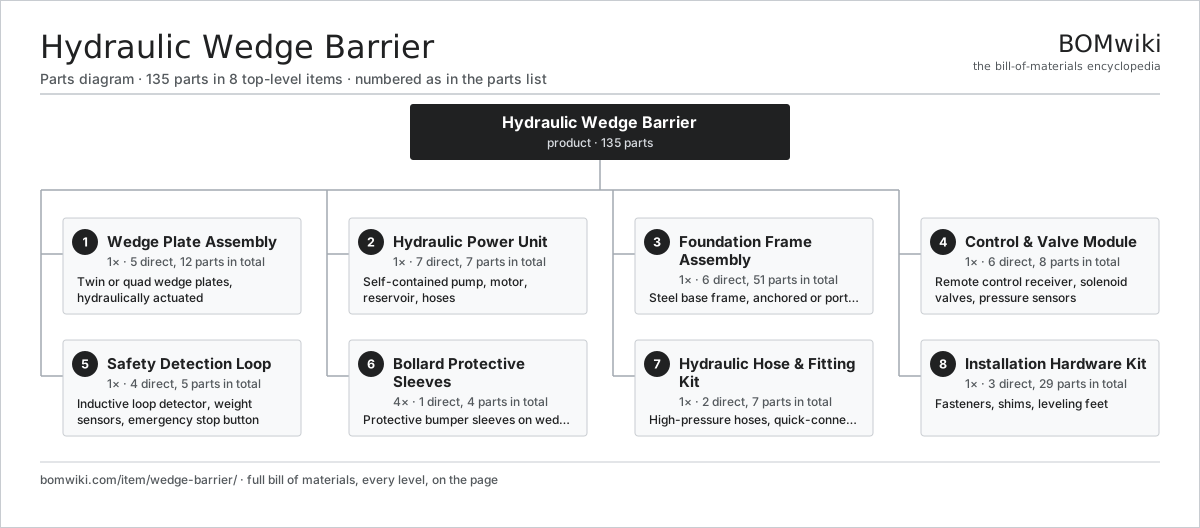
| # | Part | Qty | What it does |
|---|---|---|---|
| 1 | Wedge Plate Assembly 5 parts | 1× | Twin or quad wedge plates, hydraulically actuated |
| 2 | Hydraulic Power Unit 7 parts | 1× | Self-contained pump, motor, reservoir, hoses |
| 3 | Foundation Frame Assembly 6 parts | 1× | Steel base frame, anchored or portable wheels |
| 4 | Control & Valve Module 6 parts | 1× | Remote control receiver, solenoid valves, pressure sensors |
| 5 | Safety Detection Loop 4 parts | 1× | Inductive loop detector, weight sensors, emergency stop button |
| 6 | Bollard Protective Sleeves 1 parts | 4× | Protective bumper sleeves on wedge ends |
| 7 | Hydraulic Hose & Fitting Kit 2 parts | 1× | High-pressure hoses, quick-connect fittings |
| 8 | Installation Hardware Kit 3 parts | 1× | Fasteners, shims, leveling feet |
3D model
No 3D model yet. Have a CAD file of this? Add a 3D model. STL renders right on this page; STEP, FreeCAD, and OpenSCAD sources are welcome too (openly licensed, like all 3D models on BOMwiki).
Build & assembly graph
expand / collapse · shared sub-assemblies converge · links to related products · est. labourTap an assembly to expand/collapse · tap a part to open it · use “Open page” for any node · drag to pan, scroll to zoom.
Bill of materials for Hydraulic Wedge Barrier
8 top-level lines · 42 rows shown · 135 parts total · indented to 3 levels| # | Item / sub-assembly | Part no. | Qty/assy | Ext. qty | Parts | Type |
|---|---|---|---|---|---|---|
| 1 | Wedge Plate Assembly 5 parts | wedge-barrier-wedge-plate-assembly | 1× | 1 | 12 | assembly |
| 1.1 | Steel Wedge Plate | wedge-barrier-wedge-plate | 2× | 2 | · | part |
| 1.2 | Wedge Hinge Pin | wedge-barrier-plate-hinge-pin | 2× | 2 | · | part |
| 1.3 | Hydraulic Actuator Cylinder | wedge-barrier-plate-actuator-rod | 2× | 2 | · | part |
| 1.4 | Extension Limit Switch | wedge-barrier-limit-switch | 2× | 2 | · | part |
| 1.5 | Hardened Wear Plate | wedge-barrier-wear-plate | 4× | 4 | · | part |
| 2 | Hydraulic Power Unit 7 parts | wedge-barrier-hydraulic-power-unit | 1× | 1 | 7 | assembly |
| 2.1 | Gear Pump | wedge-barrier-hydraulic-pump | 1× | 1 | · | part |
| 2.2 | Prime Mover | wedge-barrier-prime-mover | 1× | 1 | · | part |
| 2.3 | Oil Reservoir Tank | wedge-barrier-reservoir-tank | 1× | 1 | · | part |
| 2.4 | Pressure Relief Valve | wedge-barrier-pressure-relief-valve | 1× | 1 | · | part |
| 2.5 | Directional Control Valve | wedge-barrier-directional-control-valve | 1× | 1 | · | part |
| 2.6 | Bladder Accumulator | wedge-barrier-accumulator | 1× | 1 | · | part |
| 2.7 | Return Filter Cartridge | wedge-barrier-filter-element | 1× | 1 | · | part |
| 3 | Foundation Frame Assembly 6 parts | wedge-barrier-foundation-frame | 1× | 1 | 51 | assembly |
| 3.1 | Frame Main Beam | wedge-barrier-frame-beam | 2× | 2 | · | part |
| 3.2 | Cross-Bracing Member | wedge-barrier-frame-cross-member | 4× | 4 | · | part |
| 3.3 | Welded Gusset Plate | wedge-barrier-frame-gusset-plate | 8× | 8 | · | part |
| 3.4 | Adjustable Leveling Foot | wedge-barrier-leveling-foot | 4× | 4 | · | part |
| 3.5 | Power Unit Mounting Pad | wedge-barrier-mounting-pad | 1× | 1 | · | part |
| 3.6 | Fastener Set | fastener-set | 32× | 32 | · | part |
| 4 | Control & Valve Module 6 parts | wedge-barrier-control-system | 1× | 1 | 8 | assembly |
| 4.1 | Valve Manifold Block | wedge-barrier-manifold-block | 1× | 1 | · | part |
| 4.2 | Solenoid Directional Valve | wedge-barrier-solenoid-valve | 2× | 2 | · | part |
| 4.3 | Pressure Gauge | wedge-barrier-pressure-gauge | 2× | 2 | · | part |
| 4.4 | RF Remote Receiver | wedge-barrier-rf-receiver-module | 1× | 1 | · | part |
| 4.5 | Electrical Control Cabinet | wedge-barrier-control-enclosure | 1× | 1 | · | part |
| 4.6 | Emergency Stop Button | wedge-barrier-emergency-stop-button | 1× | 1 | · | part |
| 5 | Safety Detection Loop 4 parts | wedge-barrier-safety-loop | 1× | 1 | 5 | assembly |
| 5.1 | Vehicle Detection Loop | wedge-barrier-inductive-loop | 1× | 1 | · | part |
| 5.2 | Pressure Safety Mat | wedge-barrier-pressure-pad | 2× | 2 | · | part |
| 5.3 | Safety Relay Module | wedge-barrier-safety-relay-module | 1× | 1 | · | part |
| 5.4 | Audible Warning Sounder | wedge-barrier-audible-warning | 1× | 1 | · | part |
| 6 | Bollard Protective Sleeves 1 parts | wedge-barrier-bollard-sleeves | 4× | 4 | 4 | assembly |
| 6.1 | Elastomer Bumper Sleeve | wedge-barrier-sleeve-elastomer | 4× | 16 | · | part |
| 7 | Hydraulic Hose & Fitting Kit 2 parts | wedge-barrier-hydraulic-hose-kit | 1× | 1 | 7 | assembly |
| 7.1 | Hose En856 4sp | wedge-barrier-hose-en856-4sp | 3× | 3 | · | part |
| 7.2 | Quick-Connect Coupling | wedge-barrier-quick-disconnect-coupling | 4× | 4 | · | part |
| 8 | Installation Hardware Kit 3 parts | wedge-barrier-mounting-hardware | 1× | 1 | 29 | assembly |
| 8.1 | Fastener Set | fastener-set | 24× | 24 | · | part |
| 8.2 | Concrete Anchor Sleeve | wedge-barrier-concrete-anchor-sleeve | 4× | 4 | · | part |
| 8.3 | Stainless Steel Shim Pack | wedge-barrier-shim-pack | 1× | 1 | · | part |
Something wrong in this list? Report a problem with this BOM.
Sourcing: possible vendors
Browse the supplier directory → Prices, MOQ, and lead times are algorithmic estimates, not quotes, and not claims about these companies. Company mappings are curated by keyword; est. price band $200–$100M. How estimates work| Vendor | HQ | Specialty | MOQ | Lead time |
|---|---|---|---|---|
| smithsdetection.com ↗ | London, GB | Security screening | made to order | 24–52 wks |
|
🇺🇸Leidos
leidos.com ↗
|
Reston, US | Security & screening | made to order | 24–52 wks |
|
🇺🇸Rapiscan
rapiscansystems.com ↗
|
Torrance, US | X-ray screening | made to order | 24–52 wks |
|
🇫🇷Thales
thalesgroup.com ↗
|
Paris, FR | Defense electronics | made to order | 24–52 wks |
| baesystems.com ↗ | London, GB | Defense | made to order | 24–52 wks |
1,988-word article