Weightlifting Platform
ProductOverview
A weightlifting platform is a purpose-built stage for barbell exercises, particularly Olympic lifts (snatch and clean-and-jerk) where a fully loaded barbell is dropped from overhead or chest height onto the platform. The impact forces generated (100 kN or more for a heavy lift) are absorbed by the platform, preventing damage to the underlying floor and reducing noise and vibration.
The basic structure is simple: a Base Frame Assembly of hardwood beams elevated 100–150 mm above the floor; a Deck Surface of plywood or composite material; and a Rubber Surface Layer shock layer of high-density elastomer tiles. Regulation competition platforms are 2.4×2.4 meters (8×8 feet), marked with a Center Lifting Stripe and designed to withstand barbell drops of 200 kg or more.
Frame and structural design
The Base Frame Assembly is constructed from hardwood, typically 2×8 or 2×10 inch pine, oak, or treated lumber, arranged in a rectangular perimeter. The beams are bolted or bolted/lag-screwed together at the corners. Internal Internal Cross Brace members are added diagonally or perpendicularly to prevent racking (lateral deformation under load).
The frame is elevated slightly above the floor (100–150 mm) on Platform Leveling Foot rubbers or steel feet at each corner. This elevation:
- Allows cable or hose runs beneath the platform if needed.
- Prevents water pooling if used in outdoor or wet environments.
- Allows air circulation for drying, extending plywood life.
The leveling feet are critical: a platform that is not level tilts the barbell during lifts, increasing injury risk and compromising lift technique. Most platforms include a spirit level check as part of installation, and fine-tuning is done by adjusting foot height.
Deck and reinforcement
The Deck Surface is the surface upon which the barbell rests. Most platforms use 3/4 inch (19 mm) plywood, exterior-grade birch or maple, as a cost-effective shock-absorbing base. The plywood is nailed or bolted to the frame, providing distributed load support.
Some competition platforms incorporate a Metal Reinforcement Plate, a 1/4 inch (6 mm) steel plate bolted to the plywood center (roughly 1.5 meters square), centered under the lift zone. The steel plate is stiffer than plywood alone and better resists localized indentation from repeated barbell drops. It also provides a more stable, consistent feel for lifters, as the plywood will gradually compress and soften with use, whereas steel is unchanging.
Plywood is the dominant material because:
- Cost: ~1/10 the price of steel.
- Maintenance: worn plywood can be replaced relatively easily.
- Shock absorption: plywood is more forgiving to joints than steel.
- Tradition: generations of weightlifting platforms have used plywood.
Rubber surface and shock absorption
The Rubber Surface Layer layer is high-density elastomer tiles, typically 50–100 mm thick, arranged in a grid pattern and glued to the plywood. Rubber tiles are preferred over a monolithic rubber sheet because:
- Individual tiles can be replaced if damaged.
- Varying tile thickness (thicker center, thinner edges) can be used to customize shock absorption.
- Tiles distribute load more evenly, preventing oil-can buckling.
Typical rubber is EPDM (ethylene-propylene-diene monomer) or a synthetic rubber blend, with density around 1200–1500 kg/m³. This density is a balance: too soft (low density) and the platform becomes mushy and unstable; too hard (high density) and impact forces are transmitted to the floor.
The shock absorption is characterized by how much a barbell dropped from 2 meters "bounces" or rebounds. Ideally, the rebound is minimal: the barbell hits the surface and stays there, rather than bouncing up. Over-bouncing indicates inadequate shock absorption and can destabilize a lifter attempting to rerack the barbell quickly after a heavy drop.
Color is typically black, though some platforms use blue, red, or alternating colored tiles for aesthetic or organizational purposes (e.g., multiple platforms in a row, each a different color). The rubber surface is non-slip, essential for maintaining foot position during the explosive push-off of a snatch or clean.
Markings and lift zones
The Center Lifting Stripe is a contrasting color line (yellow, red, or white) marking the center of the platform and the primary lifting zone. In competition, this line is exactly 2 feet (0.61 meters) wide and runs the full length of the platform. The stripe serves as:
- A visual guide for foot placement and body alignment.
- A boundary for judging side-to-side movement during a lift.
- A marking for spectators and commentators.
Side zones (the areas left and right of the center stripe) are often marked with a different color or left as bare rubber. Some platforms have a secondary stripe at 1 meter from the center to indicate the zone where backup lifters stand.
Assembly and installation
Platform assembly requires:
- Building or sourcing the frame and deck components.
- Leveling the frame on the floor using shims or adjustable feet.
- Affixing the rubber tiles to the plywood with contact cement or polyurethane adhesive.
- Applying edge trim to the perimeter.
- Applying or painting the center and zone markings.
Installation typically takes 4–8 hours for a two-person crew. The platform should be allowed to set for 24 hours after gluing before heavy use, to allow adhesive to fully cure.
Durability and maintenance
The plywood core lasts 5–10 years in a light-to-moderate use gym, longer if the platform is indoors and well-ventilated. In high-use competitive settings (training camps, university weight rooms), plywood replacement may be needed every 3–5 years. Replacement involves unbolting the rubber layer, removing the old plywood, and installing new sheets.
The rubber tiles are durable for 8–15 years depending on use. High-impact drops and heavy foot traffic lead to:
- Surface cracking and spalling (small surface defects).
- Compression set (the rubber becomes permanently dented where the barbell consistently lands).
- Oil staining (if exposed to mineral oil or lubricants).
Individual tiles can be replaced as they wear, though a platform in a competitive setting might gradually have a patchwork of different-aged tiles, which is cosmetically undesirable and sometimes not allowed in competition.
The Center Lifting Stripe marking fades with foot traffic and barbell impacts. Re-striping is a periodic maintenance task, either by repainting or replacing the stripe using adhesive tape.
Safety and user considerations
A properly maintained platform is safe for any barbell load. The limiting factor is not the platform but the floor beneath: if the floor cannot support concentrated load (e.g., a wooden floor in an apartment), the platform will sag or the floor will fail. Most platforms are installed in concrete floors (gyms, training facilities) where load is not a concern.
The slight elevation of the platform (100–150 mm) can catch a user's toe if they are not paying attention during rerack or dismount. This is minor in practice, as lifters are typically focused on the barbell and looking upward during active lifts.
A platform that is not level or is wobbly is dangerous: it will tilt the barbell and cause lifters to slip or lose balance. Installation and maintenance must ensure level and stability.
Regional variations
Smaller platforms (2.0×1.5 meters or 3.0×2.0 meters) are common in home gyms or small commercial facilities where space is limited. These are built the same way as regulation platforms but are lighter and cheaper.
Training platforms may use thinner rubber (25–50 mm) to reduce cost, accepting slightly more vibration transmission to the floor. Competition platforms use thicker rubber (75–100 mm) for better shock absorption and a more consistent feel.
Outdoor platforms are built with treated plywood and sealed to resist weathering. They are usually lighter in construction and not used for maximal barbell drops.
Weightlifting Platform parts and their functions
5 top-level parts · 21 parts in total · full bill of materials below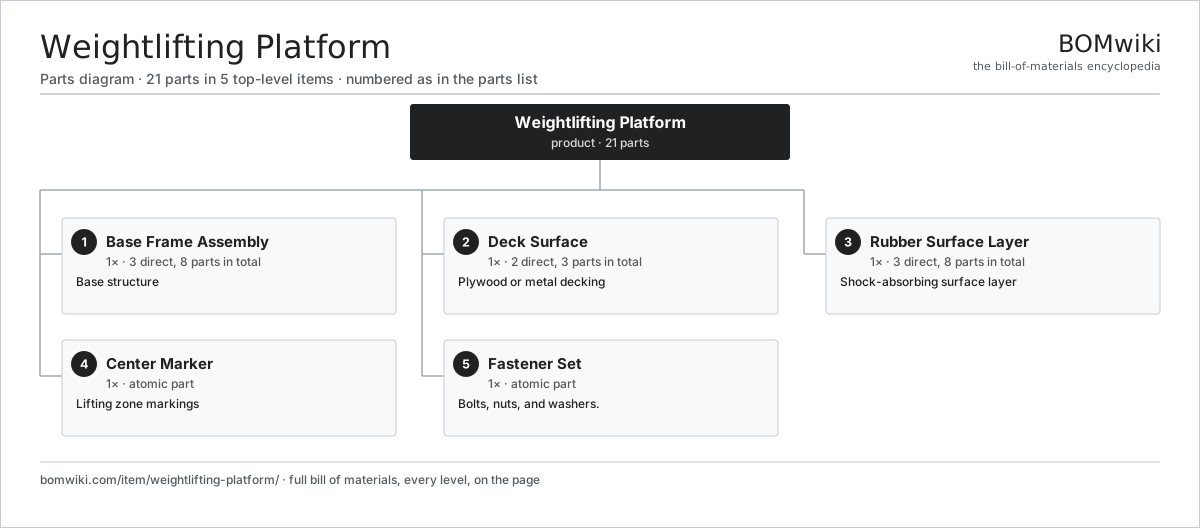
| # | Part | Qty | What it does |
|---|---|---|---|
| 1 | Base Frame Assembly 3 parts | 1× | Base structure |
| 2 | Deck Surface 2 parts | 1× | Plywood or metal decking |
| 3 | Rubber Surface Layer 3 parts | 1× | Shock-absorbing surface layer |
| 4 | Center Marker | 1× | Lifting zone markings |
| 5 | Fastener Set | 1× | Bolts, nuts, and washers. |
3D model
No 3D model yet. Have a CAD file of this? Add a 3D model. STL renders right on this page; STEP, FreeCAD, and OpenSCAD sources are welcome too (openly licensed, like all 3D models on BOMwiki).
Build & assembly graph
expand / collapse · shared sub-assemblies converge · links to related products · est. labourTap an assembly to expand/collapse · tap a part to open it · use “Open page” for any node · drag to pan, scroll to zoom.
Bill of materials for Weightlifting Platform
5 top-level lines · 13 rows shown · 21 parts total · indented to 3 levels| # | Item / sub-assembly | Part no. | Qty/assy | Ext. qty | Parts | Type |
|---|---|---|---|---|---|---|
| 1 | Base Frame Assembly 3 parts | weightlifting-platform-frame | 1× | 1 | 8 | assembly |
| 1.1 | Timber Beam | weightlifting-platform-timber-frame | 2× | 2 | · | part |
| 1.2 | Internal Cross Brace | weightlifting-platform-frame-cross-brace | 2× | 2 | · | part |
| 1.3 | Platform Leveling Foot | weightlifting-platform-leveling-foot | 4× | 4 | · | part |
| 2 | Deck Surface 2 parts | weightlifting-platform-deck | 1× | 1 | 3 | assembly |
| 2.1 | Plywood Sheet | weightlifting-platform-plywood-sheet | 2× | 2 | · | part |
| 2.2 | Metal Reinforcement Plate | weightlifting-platform-metal-plate | 1× | 1 | · | part |
| 3 | Rubber Surface Layer 3 parts | weightlifting-platform-rubber | 1× | 1 | 8 | assembly |
| 3.1 | Rubber Tile | weightlifting-platform-rubber-tiles | 6× | 6 | · | part |
| 3.2 | Rubber Edge Trim | weightlifting-platform-rubber-edge-trim | 1× | 1 | · | part |
| 3.3 | Center Lifting Stripe | weightlifting-platform-center-stripe | 1× | 1 | · | part |
| 4 | Center Marker | weightlifting-platform-center-marker | 1× | 1 | · | part |
| 5 | Fastener Set | fastener-set | 1× | 1 | · | part |
Something wrong in this list? Report a problem with this BOM.
Sourcing: possible vendors
Browse the supplier directory → Prices, MOQ, and lead times are algorithmic estimates, not quotes, and not claims about these companies. Company mappings are curated by keyword; est. price band $100–$10k. How estimates work| Vendor | HQ | Specialty | MOQ | Lead time |
|---|---|---|---|---|
| lifefitness.com ↗ | Rosemont, US | Fitness equipment | 200 units | 8–14 wks |
| technogym.com ↗ | Cesena, IT | Fitness equipment | 200 units | 8–14 wks |
|
🇺🇸Peloton
onepeloton.com ↗
|
New York, US | Connected fitness | 200 units | 8–14 wks |
| johnsonhealthtech.com ↗ | Taichung, TW | Fitness (Matrix) | 200 units | 8–14 wks |
|
🇺🇸Precor
precor.com ↗
|
Woodinville, US | Fitness equipment | 200 units | 8–14 wks |
1,311-word article