Well Development Pump
ProductOverview
Well development is a critical post-drilling step. When a water well is first completed, the aquifer formation around the screen is disturbed, compacted by the drilling process, clogged with fines (clay and silt), and encased in drilling mud residue. The well''s initial yield is low and muddy. Development removes the fines by creating pressure and flow transients that shock and agitate the formation, forcing fine particles back into the well where they are removed by a Sand Separator. A properly developed well can increase yield by 100–200% and provide crystal-clear water from day one.
The well development pump is a portable air-powered surge system. Compressed air alternately pushes and pulls water in the well column, creating waves that dislodge compacted sediment and fines. Simultaneously, an airlift or surge pump evacuates the sand-laden water. The system is simple, robust, and can be deployed in a few hours. A typical development cycle lasts 2–8 hours and produces thousands of gallons of cloudy water containing sand and silt.
How it works
The Air Compressor Unit is the power source. A diesel engine drives a reciprocating air compressor that delivers 150–300 CFM at 80–120 psi. The compressed air is stored in a Air Receiver Tank tank and dried by an air dryer to prevent moisture in the system. This air is then fed to a Surge Pump Unit, a pair of double-acting pneumatic cylinders controlled by a solenoid 4-way valve.
When the solenoid valve switches, air pressure alternately pushes and pulls the cylinders, forcing the surge pump discharge into the Pump Column Assembly. The column is a steel or PVC pipe suspended in the well, open at the bottom and connected to the manifold at the top. As the surge pump drives water downward at 200–300 psi, a shock wave travels down the column and hits the Well Screen. The water is compressed against the screen, and the pressure surge forces water sideways into the formation. Fines and sand are pushed into the spaces between screen and formation.
After a fraction of a second, the solenoid valve reverses, and the surge pump withdraws. The pressure in the column drops suddenly, creating a vacuum. Water and suspended sand are sucked back into the column. The sand is lifted by the hydraulic action and discharged to the surface where a Sand Separator removes the sand and returns clean water to the environment.
This cycle repeats 20–60 times per minute. Over 2–8 hours, hundreds of cubic meters of water pass through the well, and the formation is thoroughly flushed. The returned water starts turbid (opaque gray-brown from silt) and gradually clears as fines are exhausted. Clear discharge is the signal that development is complete.
Key systems
Air compressor: The mud-pump-drilling-compressor is typically a reciprocating (piston) compressor rated for 15–50 kW and producing 150–300 CFM. A diesel engine (15–30 kW) drives the compressor continuously. The compressor is air-cooled and oil-lubricated. Intake air passes through an air filter, is compressed to 80–120 psi, and is cooled in an aftercooler before entering the air receiver tank. The Air Dryer removes moisture, critical because water in the compressed air would corrode check valves and surge cylinders. Two types of dryers are used: refrigerated (cooler downstream of compressor, water condenses and is drained) or desiccant (silica gel cartridge absorbs moisture). Most field rigs use desiccant dryers because they are self-contained and don't require power.
Surge pump: The Surge Pump Unit is a pneumatic actuator system. Two double-acting cylinders (2–4 inch bore) are plumbed in parallel. Air pressure pushes the rods outward, and air pressure pulls them inward via a pilot-operated solenoid 4-way valve. A Surge Manifold with check valves ensures one-way flow: discharge goes into the column via a check valve (preventing backflow), and relief air vents to atmosphere. The cycle rate (20–60 oscillations per minute) is adjustable by changing the solenoid frequency or orifice sizes.
Pump column: The Pump Column Assembly is the transmission line. A typical steel Schedule 40 pipe (2–4 inches, 100+ meters long) is suspended in the well from a rope or guide clamps. The column is open at the bottom and sealed at the top to a Discharge Manifold. Small-diameter air hoses run alongside or inside the column to deliver airlift air. As the surge pump discharges, water fills the column from the bottom; when surge reverses, water is sucked back. The column must be rigid (steel preferred) to avoid kinking during rapid pressure changes.
Sand separator: The Sand Separator is a hydrocyclone, a tapered cylindrical tank with a tangential inlet. Water and sand enter tangentially, spinning at high velocity. Centrifugal force throws sand particles outward against the wall, where they fall into a conical sump at the bottom. Clean water spirals upward and exits via an internal vortex finder tube. Sand accumulates in the sump and is periodically discharged via a manual or solenoid gate valve to an above-ground pit. Separator capacity ranges from 500–2000 liters, sized to handle 50–200 GPM of sand-laden water without overflow.
Discharge manifold: The Discharge Manifold is a ported cast iron block that controls flow and backpressure. A discharge check valve allows surge pump output into the column. A Backpressure Relief valve (typically set at 20–50 psi) prevents excessive backpressure and vents any overpressure. Pressure gauges and sensor ports monitor system condition in real time.
Hose system: All connections are made with high-pressure hoses rated for 300–500 psi. The compressor discharge hose (1–2 inch diameter) carries air to the manifold. The surge pump discharge hose (2–3 inch) runs from the manifold to the top of the pump column. Return piping from the separator carries sand-cleaned water to disposal. All hoses are color-coded (blue for air, red for liquid) and clearly labeled.
Field deployment
A development crew, operator, helper, and pumper, sets up the rig in 2–3 hours. The compressor and surge pump unit is positioned near the wellhead. The pump column is lowered into the well and connected to the manifold. The separator is positioned downhill from the wellhead. Hoses are connected, the system is pressurized, and solenoid cycles are started.
During the first 30 minutes, the water coming back is typically black or dark gray from drilling mud residue. After 1–2 hours, it clears to brown (silt and fines). After 4–6 hours, it runs light brown or tan. When it finally runs clear or nearly clear for 15 minutes of continuous operation, development is considered complete. The well is then tested for yield, bacteria, and turbidity. A properly developed well recovers 50–100% higher yield than an undeveloped well.
Environmental and operational considerations
The volume of water produced during development can be substantial, a 6-hour development may produce 20,000–50,000 gallons. Local regulations often require that this water be settled before discharge to surface water bodies. A settling pond (a simple earthen berm and basin) is constructed on-site. Sand settles in 12–24 hours, and the clarified water is discharged to a creek or storm drain.
In arid regions, some water is recirculated (returned to the separator and re-pumped) to reduce fresh-water demand. In cold climates, the air dryer must be inspected frequently because compressed air can condense in hoses during cooler nights.
Development is skipped in rare cases, fractured rock aquifers with stable boreholes may yield clear water immediately, or shallow dug wells may not benefit from mechanical development. But for most drilled wells, especially in unconsolidated sediments, development is indispensable to achieving design yield and water clarity.
Well Development Pump parts and their functions
7 top-level parts · 30 parts in total · full bill of materials below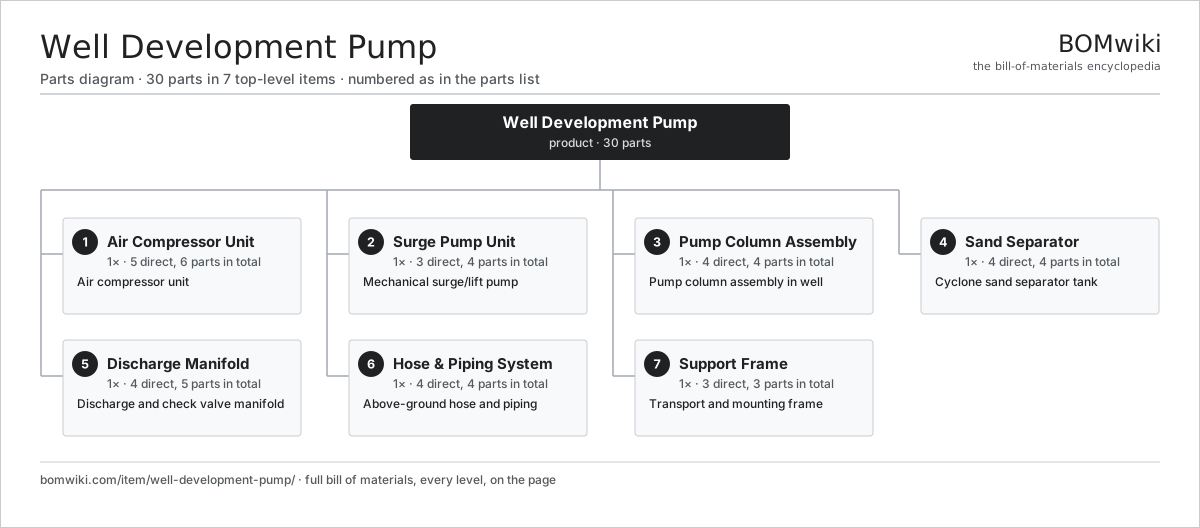
| # | Part | Qty | What it does |
|---|---|---|---|
| 1 | Air Compressor Unit 5 parts | 1× | Air compressor unit |
| 2 | Surge Pump Unit 3 parts | 1× | Mechanical surge/lift pump |
| 3 | Pump Column Assembly 4 parts | 1× | Pump column assembly in well |
| 4 | Sand Separator 4 parts | 1× | Cyclone sand separator tank |
| 5 | Discharge Manifold 4 parts | 1× | Discharge and check valve manifold |
| 6 | Hose & Piping System 4 parts | 1× | Above-ground hose and piping |
| 7 | Support Frame 3 parts | 1× | Transport and mounting frame |
3D model
No 3D model yet. Have a CAD file of this? Add a 3D model. STL renders right on this page; STEP, FreeCAD, and OpenSCAD sources are welcome too (openly licensed, like all 3D models on BOMwiki).
Build & assembly graph
expand / collapse · shared sub-assemblies converge · links to related products · est. labourTap an assembly to expand/collapse · tap a part to open it · use “Open page” for any node · drag to pan, scroll to zoom.
Bill of materials for Well Development Pump
7 top-level lines · 34 rows shown · 30 parts total · indented to 3 levels| # | Item / sub-assembly | Part no. | Qty/assy | Ext. qty | Parts | Type |
|---|---|---|---|---|---|---|
| 1 | Air Compressor Unit 5 parts | well-development-pump-compressor | 1× | 1 | 6 | assembly |
| 1.1 | Compressor Motor | well-development-pump-compressor-engine | 1× | 1 | · | part |
| 1.2 | Compressor Pump Head | well-development-pump-compressor-head | 1× | 1 | · | part |
| 1.3 | Air Receiver Tank | well-development-pump-air-receiver | 1× | 1 | · | part |
| 1.4 | Air Dryer | well-development-pump-air-dryer | 1× | 1 | · | part |
| 1.5 | Pressure Sensor | pressure-sensor | 2× | 2 | · | part |
| 2 | Surge Pump Unit 3 parts | well-development-pump-surge-pump | 1× | 1 | 4 | assembly |
| 2.1 | Surge Cylinder | well-development-pump-surge-cylinder | 2× | 2 | · | part |
| 2.2 | Air Valve Controller | well-development-pump-surge-valve | 1× | 1 | · | part |
| 2.3 | Surge Manifold | well-development-pump-surge-manifold | 1× | 1 | · | part |
| 3 | Pump Column Assembly 4 parts | well-development-pump-column | 1× | 1 | 4 | assembly |
| 3.1 | Column Pipe | well-development-pump-column-pipe | 1× | 1 | · | part |
| 3.2 | Column Couplings | well-development-pump-column-connections | 1× | 1 | · | part |
| 3.3 | Air Supply Line | well-development-pump-column-air-line | 1× | 1 | · | part |
| 3.4 | Column Check Valve | well-development-pump-column-bottom | 1× | 1 | · | part |
| 4 | Sand Separator 4 parts | well-development-pump-sand-separator | 1× | 1 | 4 | assembly |
| 4.1 | Separator Tank | well-development-pump-separator-tank | 1× | 1 | · | part |
| 4.2 | Cyclone Inlet | well-development-pump-separator-inlet | 1× | 1 | · | part |
| 4.3 | Vortex Finder | well-development-pump-separator-vortex | 1× | 1 | · | part |
| 4.4 | Separator Sump Valve | well-development-pump-separator-discharge | 1× | 1 | · | part |
| 5 | Discharge Manifold 4 parts | well-development-pump-manifold | 1× | 1 | 5 | assembly |
| 5.1 | Manifold Block | well-development-pump-manifold-block | 1× | 1 | · | part |
| 5.2 | Check Valves | well-development-pump-manifold-checks | 2× | 2 | · | part |
| 5.3 | Backpressure Relief | well-development-pump-manifold-relief | 1× | 1 | · | part |
| 5.4 | Pressure Sensor | pressure-sensor | 1× | 1 | · | part |
| 6 | Hose & Piping System 4 parts | well-development-pump-hose-system | 1× | 1 | 4 | assembly |
| 6.1 | Compressor Air Hose | well-development-pump-compressor-hose | 1× | 1 | · | part |
| 6.2 | Surge Discharge Hose | well-development-pump-discharge-hose | 1× | 1 | · | part |
| 6.3 | Return & Disposal Piping | well-development-pump-return-pipe | 1× | 1 | · | part |
| 6.4 | Hose Fittings | well-development-pump-fittings | 1× | 1 | · | part |
| 7 | Support Frame 3 parts | well-development-pump-frame | 1× | 1 | 3 | assembly |
| 7.1 | Frame Chassis | well-development-pump-frame-chassis | 1× | 1 | · | part |
| 7.2 | Equipment Mounts | well-development-pump-frame-mounts | 1× | 1 | · | part |
| 7.3 | Control Panel | well-development-pump-frame-controls | 1× | 1 | · | part |
Something wrong in this list? Report a problem with this BOM.
Related products
same domain, ranked by shared parts All-Terrain Mobile Crane
594 parts · shares 1 with this page
All-Terrain Mobile Crane
594 parts · shares 1 with this page
 Articulated Dump Truck
128 parts · shares 1 with this page
Articulated Dump Truck
128 parts · shares 1 with this page
 Articulated Haul Truck
128 parts · shares 1 with this page
Articulated Haul Truck
128 parts · shares 1 with this page
 Articulating Boom Lift
120 parts · shares 1 with this page
Articulating Boom Lift
120 parts · shares 1 with this page
 Asphalt Batch Plant
160 parts · shares 1 with this page
Asphalt Batch Plant
160 parts · shares 1 with this page
 Asphalt Distributor Truck
113 parts · shares 1 with this page
Asphalt Distributor Truck
113 parts · shares 1 with this page
Sourcing: possible vendors
Browse the supplier directory → Prices, MOQ, and lead times are algorithmic estimates, not quotes, and not claims about these companies. Company mappings are curated by keyword; est. price band $15k–$2M. How estimates work| Vendor | HQ | Specialty | MOQ | Lead time |
|---|---|---|---|---|
| caterpillar.com ↗ | Irving, US | Construction & mining equipment | made to order | 16–28 wks |
|
🇯🇵Komatsu
komatsu.com ↗
|
Tokyo, JP | Construction & mining equipment | made to order | 16–28 wks |
|
🇸🇪Volvo CE
volvoce.com ↗
|
Gothenburg, SE | Construction equipment | made to order | 16–28 wks |
|
🇨🇭Liebherr
liebherr.com ↗
|
Bulle, CH | Cranes & heavy equipment | made to order | 16–28 wks |
|
🇨🇳XCMG
xcmg.com ↗
|
Xuzhou, CN | Construction machinery | made to order | 16–28 wks |
1,336-word article