Well Screen
ProductOverview
The well screen is the interface between the aquifer and the well. It must accomplish a difficult balance: allow the maximum flow of water into the well while excluding sand and fine sediment that would clog the pump and degrade water quality. A well screen that is too restrictive (small slots, low open area) reduces yield and increases drawdown. A screen that is too permissive (large slots, high open area) allows sand entry, causing pump wear and water turbidity.
The design of a well screen depends on aquifer geology, particularly the grain size distribution of the formation sand. A geologist or engineer analyzes sediment cores or borehole logs to determine the 10%, 50%, and 90% percentile grain sizes. The screen slot size is chosen to exclude 90%+ of the formation material while remaining as open as possible. For example, a medium sand aquifer with a d90 of 0.5 mm might use a screen with 0.020-inch (0.5 mm) slots, sized to intercept formation material near the 75th percentile.
How it works
A completed water well has three vertical sections: casing (from surface to above the aquifer, stabilizes the borehole and seals off shallow formations), a transition zone, and the Well Screen (in the aquifer proper). During drilling, once the drill bit reaches the aquifer, drilling is stopped. The borehole is developed (see Well Development Pump) to remove drilling mud and fines. Then, the screen is lowered on a cable or riser and set at the design depth.
As the static water table is within the aquifer (below the bottom of the casing), groundwater flows radially inward through the slots of the screen, through the screen pipe wall, and up the interior of the riser pipe. The slots are sized so sand grains in the formation cannot pass through. Water enters, but sand is excluded. In practice, a small amount of fine sand (called "formation material") may initially enter the well; this is tolerated for 24–48 hours. As the well is pumped, a "filter cake" of self-bridging sand forms immediately outside the screen, acting as a natural filter. After a few days of pumping, the water becomes clear.
Key components
Screen body: The Pipe Body comes in three main types:
Slotted screen: Circular or rectangular slots are factory-drilled through the wall of a pipe. Steel is preferred because the drilling and edge-hardening process results in sharp-edged slots that resist sand bridges. Slot width is precise (0.020 inch ± 0.005 inch is achievable). Disadvantages: drilling induces micro-stress in the pipe wall, and the small openings are prone to chemical clogging in iron or manganese-rich waters.
Wire-wrapped screen: A support cage of vertical ribs is welded inside the pipe. Triangular stainless steel wire is wrapped helically around the ribs, forming a spiral slot (keyway) between adjacent wraps. The slot width is adjustable by changing wire diameter and spacing. Wire-wrapped screens have higher open area (30–40%) and are less susceptible to chemical clogging. Disadvantages: more complex to manufacture and more expensive. The wire can corrode if not stainless in aggressive groundwater.
Bridge slot screen: Slightly larger slots with small "bridges" of material left at intervals to prevent slot overlap and sand bridging. A compromise between slotted and wire-wrapped.
Slot width selection is critical. Too narrow (<0.010 inch), and fine sand still enters; water entry is restricted. Too wide (>0.050 inch), and medium sand passes through. Typical rule: slot width = d60 of the formation sand (the grain size at the 60th percentile). This excludes ~70–80% of formation material while allowing 30–40% open area.
Riser pipe: The Riser Pipe is a solid continuation of the screen diameter from the screen top to the wellhead. It carries the water column weight (hydrostatic pressure) and, later, the pump discharge pressure. Steel or PVC is used, matching the screen material to avoid galvanic corrosion at the joint. The riser is typically 2–4 inches in diameter to balance water entry area (larger = higher yield) and cost (larger = more material).
Couplings: The Top Coupling connects the screen to the riser with a threaded or slip joint. The joint must be water-tight. Field joints are sealed with PTFE (plumber's) tape or thread compound to prevent leakage. Couplings are sized to fit inside the casing by at least 0.5 inches on all sides (required for gravel pack placement around the screen).
Bottom cap: The Bottom Cap is a solid cap welded or threaded to the bottom of the screen, sealing the end. Small Drain Holes (1/8–1/4 inch diameter) are drilled in the cap. These holes allow water to enter the screen from the formation bottom (where water approaches from below in some aquifer geometries) while preventing large sand or formation material from clogging the screen. If the cap is completely sealed (no holes), the well is a "blind" well, used only in thin, confined aquifers.
Materials and corrosion: Stainless steel is preferred in aggressive groundwater (high chloride, sulfide, or low pH). Galvanized steel is suitable in neutral to slightly alkaline waters. PVC is used in corrosive aquifers and is cheaper, but less durable (expected life 20–30 years vs. 40–50 for stainless). The material choice is site-specific, based on water quality analysis.
Installation sequence
- After drilling reaches target depth, the Well Screen is lowered into the well, suspended from a rope or cable.
- The screen is set at the predetermined elevation (e.g., from 100 m to 108 m below surface in an 8 m thick aquifer).
- The riser pipe is connected at the top and extended to the surface.
- Gravel pack material (carefully sized sand, typically 20–40 mesh) is poured into the annulus (the gap between the outside of the screen and the borehole wall) above the screen.
- If the Gravel Pack Cloth (filter cloth) is used, it is wrapped around the screen before installation to retain the gravel pack.
- A bentonite or cement seal is placed above the gravel pack to prevent contamination from shallow formations.
- The well is then developed (surged and pumped) to clear fines and establish yield.
- A Submersible Well Pump is installed in the riser pipe.
Aquifer suitability
Well screens are most effective in unconsolidated aquifers (sand, gravel, silt): the material is loose and easily eroded into the well, but the natural grain-size distribution allows design of a screen to intercept the coarse fraction.
In consolidated aquifers (fractured limestone, granite, sandstone), well screens are less useful. The aquifer material is hard and does not erode; instead, water enters through fractures or dissolution openings. Screen design is irrelevant because there is no sand to exclude. In these settings, simple open-ended casing is used, or screen is omitted entirely. The well relies on the natural strength of the rock to prevent borehole collapse.
Clogging and maintenance
Well screens can be clogged by:
- Sand intrusion: If the slot size is wrong or formation sand shifts, sand accumulates at the screen opening, reducing flow. Remedy: pull the pump, develop the well again.
- Chemical deposits: Iron oxide, calcium carbonate, or manganese oxide precipitate from the water and coat the screen. Remedy: acidify (dilute HCl) or chelate (phosphate compounds) to dissolve deposits.
- Biofouling: Biofilm bacteria grow on the screen and reduce permeability. Remedy: disinfect with chlorine or shock-treat.
- Gravel pack migration: If gravel is not carefully sized or the Gravel Pack Cloth is omitted, gravel can settle and clog the screen. Remedy: re-develop or re-gravel pack.
Modern screens for deep or high-yield wells are increasingly made of stainless steel and are wrapped in synthetic geotextile to prevent clogging. These systems cost more but extend service life significantly and reduce maintenance burden.
Performance metrics
A well''s yield (GPM) is determined by the transmissivity of the aquifer (a measure of how fast water flows through the formation) and the screen length and design. Longer screen = higher yield. Larger slot area = higher yield (if sand exclusion is maintained). Typical water well yields range from 5–50 GPM in small residential wells to 100–500 GPM in municipal or irrigation wells.
The well drawdown (the distance the water level drops when pumping) is inversely related to the screen effective area. A well with 20 m of screen in high-transmissivity sand can pump 50 GPM with <5 m drawdown. A well with 5 m of screen in the same aquifer would need 10–20 m drawdown to achieve the same yield. The penalty for a short or restrictive screen is high drawdown, which wastes pump energy and requires a deeper pump setting.
Well screen design is ultimately a trade-off between competing goals: water entry area (high = better), sand exclusion (tight slot = better), cost (simple slotted = cheaper, wire-wrapped = expensive), and durability (stainless = long-lived, galvanized = maintenance-prone). The engineer balances these factors based on the aquifer, the desired yield, and the budget.
Well Screen parts and their functions
6 top-level parts · 11 parts in total · full bill of materials below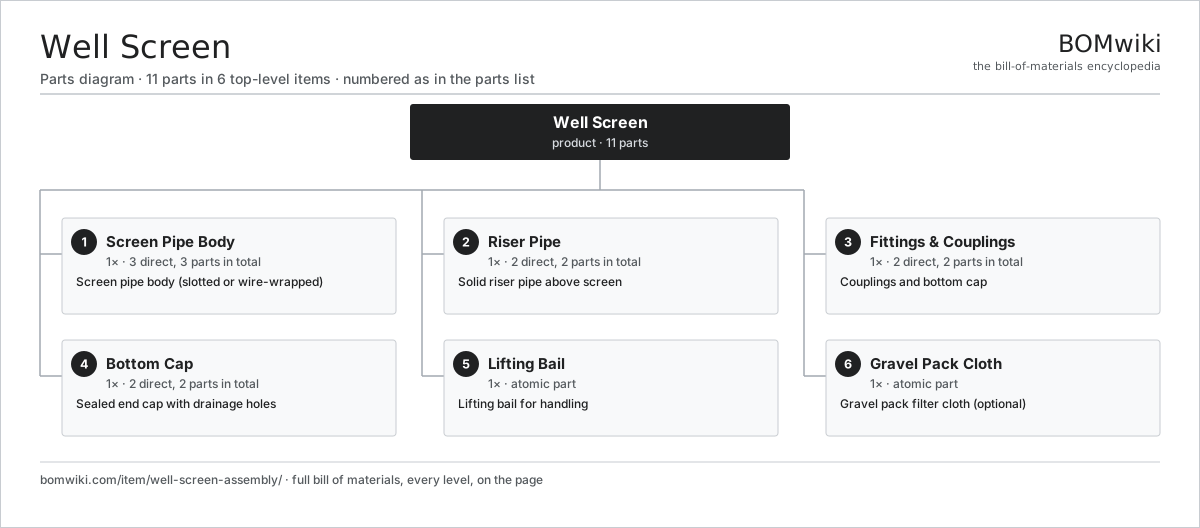
| # | Part | Qty | What it does |
|---|---|---|---|
| 1 | Screen Pipe Body 3 parts | 1× | Screen pipe body (slotted or wire-wrapped) |
| 2 | Riser Pipe 2 parts | 1× | Solid riser pipe above screen |
| 3 | Fittings & Couplings 2 parts | 1× | Couplings and bottom cap |
| 4 | Bottom Cap 2 parts | 1× | Sealed end cap with drainage holes |
| 5 | Lifting Bail | 1× | Lifting bail for handling |
| 6 | Gravel Pack Cloth | 1× | Gravel pack filter cloth (optional) |
3D model
No 3D model yet. Have a CAD file of this? Add a 3D model. STL renders right on this page; STEP, FreeCAD, and OpenSCAD sources are welcome too (openly licensed, like all 3D models on BOMwiki).
Build & assembly graph
expand / collapse · shared sub-assemblies converge · links to related products · est. labourTap an assembly to expand/collapse · tap a part to open it · use “Open page” for any node · drag to pan, scroll to zoom.
Bill of materials for Well Screen
6 top-level lines · 15 rows shown · 11 parts total · indented to 3 levels| # | Item / sub-assembly | Part no. | Qty/assy | Ext. qty | Parts | Type |
|---|---|---|---|---|---|---|
| 1 | Screen Pipe Body 3 parts | well-screen-assembly-pipe | 1× | 1 | 3 | assembly |
| 1.1 | Pipe Body | well-screen-assembly-pipe-body | 1× | 1 | · | part |
| 1.2 | Slot Size | well-screen-assembly-slot-size | 1× | 1 | · | part |
| 1.3 | Wire Material | well-screen-assembly-wire-material | 1× | 1 | · | part |
| 2 | Riser Pipe 2 parts | well-screen-assembly-riser-pipe | 1× | 1 | 2 | assembly |
| 2.1 | Riser Body | well-screen-assembly-riser-body | 1× | 1 | · | part |
| 2.2 | Riser Couplings | well-screen-assembly-riser-couplings | 1× | 1 | · | part |
| 3 | Fittings & Couplings 2 parts | well-screen-assembly-fittings | 1× | 1 | 2 | assembly |
| 3.1 | Top Coupling | well-screen-assembly-top-coupling | 1× | 1 | · | part |
| 3.2 | Thread Sealant | well-screen-assembly-thread-seal | 1× | 1 | · | part |
| 4 | Bottom Cap 2 parts | well-screen-assembly-bottom-cap | 1× | 1 | 2 | assembly |
| 4.1 | Cap Body | well-screen-assembly-cap-body | 1× | 1 | · | part |
| 4.2 | Drain Holes | well-screen-assembly-cap-drain-holes | 1× | 1 | · | part |
| 5 | Lifting Bail | well-screen-assembly-bail | 1× | 1 | · | part |
| 6 | Gravel Pack Cloth | well-screen-assembly-sock | 1× | 1 | · | part |
Something wrong in this list? Report a problem with this BOM.
Sourcing: possible vendors
Browse the supplier directory → Prices, MOQ, and lead times are algorithmic estimates, not quotes, and not claims about these companies. Company mappings are curated by keyword; est. price band $15k–$2M. How estimates work| Vendor | HQ | Specialty | MOQ | Lead time |
|---|---|---|---|---|
| caterpillar.com ↗ | Irving, US | Construction & mining equipment | made to order | 16–28 wks |
|
🇯🇵Komatsu
komatsu.com ↗
|
Tokyo, JP | Construction & mining equipment | made to order | 16–28 wks |
|
🇸🇪Volvo CE
volvoce.com ↗
|
Gothenburg, SE | Construction equipment | made to order | 16–28 wks |
|
🇨🇭Liebherr
liebherr.com ↗
|
Bulle, CH | Cranes & heavy equipment | made to order | 16–28 wks |
|
🇨🇳XCMG
xcmg.com ↗
|
Xuzhou, CN | Construction machinery | made to order | 16–28 wks |
1,545-word article