Wetsuit
ProductOverview
A wetsuit is a thermal protection garment enabling divers to remain comfortable in cold water for extended periods. Unlike a dry suit (which keeps the diver completely dry), a wetsuit allows a thin layer of water to enter and be trapped against the skin. The diver's body heat warms this water film, creating an insulating barrier.
The Neoprene Panel Assembly are closed-cell rubber foam, 3–7 mm thickness depending on water temperature and diver tolerance. Closed-cell neoprene contains tiny air bubbles, reducing thermal conductivity and providing buoyancy.
Modern wetsuits are constructed from multiple Neoprene Panel Assembly with Panel Seam Bonding joining them. The internal Thermal Fleece Lining (fleece or nylon) improves comfort and insulation. A Back or Chest Zipper Entry enables rapid entry and exit.
Thermal Mechanics
Heat loss in water occurs through conduction (direct heat transfer through the suit material) and convection (water circulation within the suit). A thin water layer (0.5–2 mm) trapped at the skin surface provides insulation if water circulation is minimized.
The closed-cell neoprene itself is a good insulator due to the air bubble structure. As depth increases and pressure rises, the neoprene compresses, air bubbles collapse, reducing thickness and buoyancy. A 7 mm suit might compress to 5 mm at 20 meters, reducing thermal and buoyancy protection.
The Panel Seam Bonding are critical, water movement through gaps reduces the thermal layer effectiveness. Modern manufacturing uses both stitching and waterproof adhesive, ensuring full sealing.
Design Features
The Neck Collar Seal is a tight neoprene collar at the head entry point, minimizing water exchange at the neck. The Wrist & Ankle Cuff Seals are tapered cuffs around wrists and ankles, reducing circulation at extremities.
Some wetsuits feature Reinforced Knee & Elbow Pads and elbow pads, double or triple neoprene layers resisting abrasion from rocks, reefs, and sandy bottoms. These high-wear zones would otherwise tear or thin with repeated use.
The Back or Chest Zipper Entry is typically a back-entry YKK aquatic zip or chest-entry design. Back zips are easier to don and doff alone; chest zips are more streamlined underwater. Waterproof zips are essential, non-sealed zips allow water to leak in along the slider.
Buoyancy Considerations
New wetsuits are slightly negatively buoyant due to neoprene density (denser than water). At depth, compression reduces buoyancy further. Divers compensate by adding lead weight in their Integrated Weight Pockets (typically 2–5 kg per suit).
As a suit ages and neoprene degrades (especially in thick suits), buoyancy can change. Periodic reassessment of weight requirements ensures proper buoyancy control.
Thickness Selection
Water temperature and personal cold tolerance dictate suit thickness:
- 3 mm: Warm water (24–27°C), beginner-friendly, minimal buoyancy changes.
- 5 mm: Temperate water (15–20°C), common recreational choice.
- 7 mm: Cold water (10–15°C), requires significant weight compensation.
- Hooded 7 mm + booties: Very cold water (5–10°C), extended exposure time.
Thin suits are flexible and reduce buoyancy swings; thick suits are warm but heavy and bulky.
Material Variants
Traditional neoprene is derived from petroleum. Environmental variants using recycled neoprene or plant-based alternatives are emerging. Some brands offer titanium-lined wetsuits (metallic lining bonded to neoprene) for enhanced warmth without thickness.
Stretchy blends (nylon-neoprene hybrids) improve range of motion but may sacrifice some insulation and durability.
Care & Longevity
Wetsuits should be rinsed in fresh water after every saltwater dive. Dried salt crystallizes inside, degrading the material. The Panel Seam Bonding must not be flexed excessively while wet, they can separate if the suit is wrung out violently.
Storage should be in a cool, dark place. UV exposure and chlorine degrade neoprene. A well-maintained suit lasts 5–10 years; heavy-use suits (weekly+ diving) may degrade faster.
When seams begin leaking or neoprene becomes thin and compressed, the suit is approaching end-of-life. Professional repair of small seam leaks is sometimes possible, extending lifespan by a year or two.
Wetsuit parts and their functions
7 top-level parts · 26 parts in total · full bill of materials below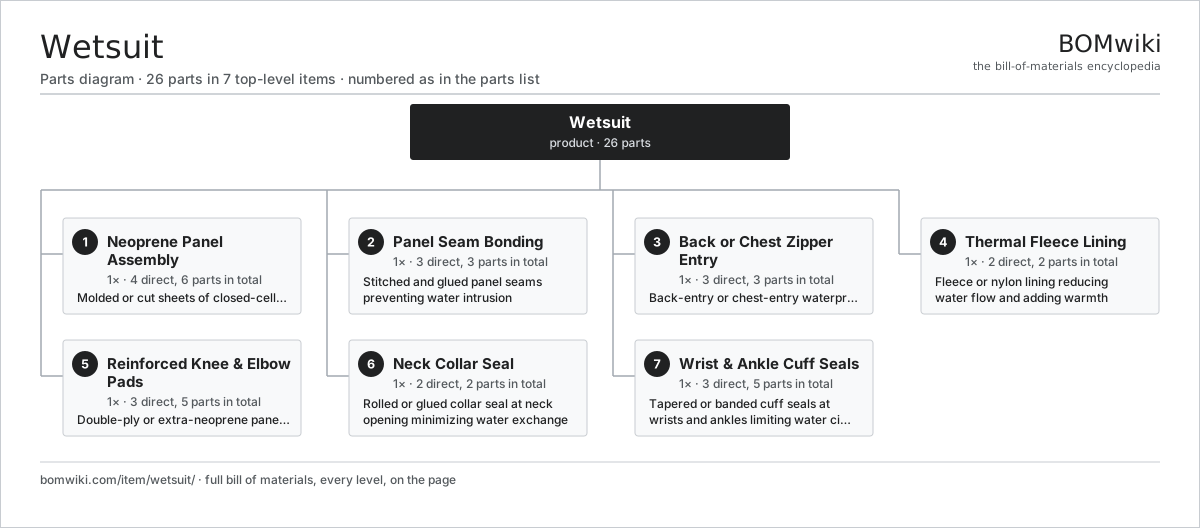
| # | Part | Qty | What it does |
|---|---|---|---|
| 1 | Neoprene Panel Assembly 4 parts | 1× | Molded or cut sheets of closed-cell neoprene, 3–7 mm thickness |
| 2 | Panel Seam Bonding 3 parts | 1× | Stitched and glued panel seams preventing water intrusion |
| 3 | Back or Chest Zipper Entry 3 parts | 1× | Back-entry or chest-entry waterproof YKK or custom dive zip |
| 4 | Thermal Fleece Lining 2 parts | 1× | Fleece or nylon lining reducing water flow and adding warmth |
| 5 | Reinforced Knee & Elbow Pads 3 parts | 1× | Double-ply or extra-neoprene panel at knees and elbows resisting abrasion |
| 6 | Neck Collar Seal 2 parts | 1× | Rolled or glued collar seal at neck opening minimizing water exchange |
| 7 | Wrist & Ankle Cuff Seals 3 parts | 1× | Tapered or banded cuff seals at wrists and ankles limiting water circulation |
3D model
No 3D model yet. Have a CAD file of this? Add a 3D model. STL renders right on this page; STEP, FreeCAD, and OpenSCAD sources are welcome too (openly licensed, like all 3D models on BOMwiki).
Build & assembly graph
expand / collapse · shared sub-assemblies converge · links to related products · est. labourTap an assembly to expand/collapse · tap a part to open it · use “Open page” for any node · drag to pan, scroll to zoom.
Bill of materials for Wetsuit
7 top-level lines · 27 rows shown · 26 parts total · indented to 3 levels| # | Item / sub-assembly | Part no. | Qty/assy | Ext. qty | Parts | Type |
|---|---|---|---|---|---|---|
| 1 | Neoprene Panel Assembly 4 parts | wetsuit-neoprene-panels | 1× | 1 | 6 | assembly |
| 1.1 | Front and Back Torso Neoprene | wetsuit-torso-panel | 1× | 1 | · | part |
| 1.2 | Arm Neoprene Sleeve | wetsuit-sleeve-panel | 2× | 2 | · | part |
| 1.3 | Leg Neoprene Panel | wetsuit-leg-panel | 2× | 2 | · | part |
| 1.4 | Crotch Flex Gusset | wetsuit-gusset-inlay | 1× | 1 | · | part |
| 2 | Panel Seam Bonding 3 parts | wetsuit-sealed-seams | 1× | 1 | 3 | assembly |
| 2.1 | Panel Seam Stitching | wetsuit-seam-stitching | 1× | 1 | · | part |
| 2.2 | Seam Bonding Adhesive | wetsuit-seam-adhesive | 1× | 1 | · | part |
| 2.3 | Nylon Seam Reinforcement Tape | wetsuit-seam-tape | 1× | 1 | · | part |
| 3 | Back or Chest Zipper Entry 3 parts | wetsuit-zipper-system | 1× | 1 | 3 | assembly |
| 3.1 | YKK Waterproof Zipper | wetsuit-zipper-track | 1× | 1 | · | part |
| 3.2 | Zipper Slider Guard | wetsuit-zipper-guard | 1× | 1 | · | part |
| 3.3 | Zipper Neoprene Backing | wetsuit-zipper-backing | 1× | 1 | · | part |
| 4 | Thermal Fleece Lining 2 parts | wetsuit-internal-padding | 1× | 1 | 2 | assembly |
| 4.1 | Brushed Fleece Lining | wetsuit-fleece-material | 1× | 1 | · | part |
| 4.2 | Fleece-to-Neoprene Adhesion | wetsuit-fleece-bonding | 1× | 1 | · | part |
| 5 | Reinforced Knee & Elbow Pads 3 parts | wetsuit-knee-reinforcement | 1× | 1 | 5 | assembly |
| 5.1 | Knee Double-Ply Neoprene | wetsuit-knee-pad | 2× | 2 | · | part |
| 5.2 | Elbow Double-Ply Neoprene | wetsuit-elbow-pad | 2× | 2 | · | part |
| 5.3 | Reinforcement Pad Stitching | wetsuit-pad-stitching | 1× | 1 | · | part |
| 6 | Neck Collar Seal 2 parts | wetsuit-neck-seal | 1× | 1 | 2 | assembly |
| 6.1 | Finished Neck Band | wetsuit-neck-edge | 1× | 1 | · | part |
| 6.2 | Neck Seal Adhesive | wetsuit-neck-adhesive | 1× | 1 | · | part |
| 7 | Wrist & Ankle Cuff Seals 3 parts | wetsuit-wrist-ankle-seals | 1× | 1 | 5 | assembly |
| 7.1 | Wrist Seal Cuff | wetsuit-wrist-cuff | 2× | 2 | · | part |
| 7.2 | Ankle Seal Cuff | wetsuit-ankle-cuff | 2× | 2 | · | part |
| 7.3 | Cuff Seal Adhesive | wetsuit-cuff-adhesive | 1× | 1 | · | part |
Something wrong in this list? Report a problem with this BOM.
Sourcing: possible vendors
Browse the supplier directory → Prices, MOQ, and lead times are algorithmic estimates, not quotes, and not claims about these companies. Company mappings are curated by keyword; est. price band $20–$2k. How estimates work| Vendor | HQ | Specialty | MOQ | Lead time |
|---|---|---|---|---|
|
🇺🇸Coleman
coleman.com ↗
|
Chicago, US | Camping gear | 1,000 units | 6–10 wks |
| thenorthface.com ↗ | Denver, US | Outdoor apparel & gear | 1,000 units | 6–10 wks |
|
🇺🇸YETI
yeti.com ↗
|
Austin, US | Coolers & drinkware | 1,000 units | 6–10 wks |
| decathlon.com ↗ | Villeneuve-d'Ascq, FR | Sporting goods | 1,000 units | 6–10 wks |
|
🇺🇸Garmin
garmin.com ↗
|
Olathe, US | GPS & wearables | 1,000 units | 6–10 wks |
652-word article