Quarry Wheel Loader
ProductOverview
A quarry wheel loader is a flexible excavation machine designed to move blasted rock, stockpile aggregates, and feed processing plants in open-pit mining. These machines combine high-capacity buckets (2.5–5.5 m³), articulated steering, and sufficient power to operate on rough terrain with zero-turn agility. Unlike fixed-geometry loaders used in construction, quarry loaders feature reinforced tooth-edge buckets, heavy-duty tires, and compact turning envelopes optimized for crowded pit layouts. Production rates reach 120–200 m³ per hour moving loose or semi-consolidated aggregate, making them essential for blasting cycle recovery and stockpile management.
How it works
The wheel loader operates through a coordinated diesel powerplant, torque converter transmission, and hydraulic bucket system. When the operator engages the joystick in the cab, a proportional valve responds instantly, directing pressurized oil to lift or tilt the bucket.
Bucket Operation
The bucket linkage is a four-bar mechanism: as the lift cylinders extend, they raise the bucket and bucket arms simultaneously. At the same time, the tilt cylinder can be independently modulated to rotate the bucket around its pin. This dual control allows the operator to:
- Dig: Lower the bucket at an aggressive tilt angle, driving the tooth bar and teeth into fragmented rock, generating 80–160 kN of digging force.
- Load: Lift the bucket while reducing tilt, curling rock and aggregate up and back into the bucket cavity.
- Carry: Level the bucket at mid-lift for transport across rough pit surfaces.
- Dump: Raise bucket fully and increase tilt to maximum, emptying the load into a haul truck or onto a processing stockpile.
The proportional valve continuously monitors joystick position and modulates cylinder flow so that both lift and tilt can be executed simultaneously. This reduces loading cycle time compared to sequential valve systems.
Drive and Steering
Power flows from the diesel engine (120–180 kW) through a torque converter that multiplies engine torque at low speeds, enabling smooth acceleration from a standstill even with a full bucket. The transmission provides four to six forward speeds and two reverse, allowing rapid recovery from loading to haul truck.
Steering is the defining feature of articulated loaders. The steering cylinders pivot the entire front section of the machine at the hinge pin, allowing turning radii as tight as 4–6 meters despite the overall length. In cramped pit environments where multiple loaders jostle for position, this maneuverability is critical to cycle time. The steering valve is load-sensing; it prevents jerky steering by continuously balancing cylinder pressure against load.
All four wheels mount heavy-duty industrial tires with deep lug patterns. Front wheels on the front axle steer with the loader; rear wheels on the rear axle are fixed but driven. This layout, combined with articulation, gives excellent traction on loose rock and mud.
Hydraulic System Integration
The hydraulic system is the machine's nervous system. The main pump is a variable-displacement unit that continuously adjusts its output to match demand. When the bucket is lifted, pressure rises. The pump senses this and increases displacement to flow more oil at the same pressure, reducing fuel consumption compared to fixed-displacement designs.
The proportional valve manifold integrates all control functions, lift, tilt, steering, and brake pressure, into a single spool block. Joystick inputs are electronically amplified and sent to proportional solenoids, which meter oil flow to each circuit. The accumulator absorbs pressure spikes when the bucket hits hard rock or when steering demand is sudden, protecting cylinders and hoses from shock damage.
Pressure sensors at three points, system pressure, bucket pressure, and steering pressure, feed back to the loader's electronics. If bucket pressure exceeds a limit (typically 280 bar), the system automatically reduces pump displacement to protect the machine. Similarly, if steering pressure climbs, steering response is softened to prevent the operator from overstressing the hinge bushing.
Return oil from all circuits flows through the return filter before entering the tank. The cooler is mounted alongside the engine radiator; a fan draws cooling air through both cores. This combined cooling keeps engine coolant and hydraulic oil within their operating windows (45–60°C for hydraulic oil, 85–95°C for engine coolant).
Operator Station and Control Philosophy
The cab provides full panoramic visibility. Large windows and mirrors allow the operator to see the bucket's cutting edge when digging and to judge truck positioning when loading. Air conditioning is essential in desert quarries and summer conditions.
Modern quarry loaders offer multiple joystick configurations:
- Single Joystick: One stick controls lift and tilt, push forward to tilt down, push right to raise. This is fastest for experienced operators but requires precise coordination.
- Dual Joystick: Left stick controls lift, right stick controls tilt. More intuitive for operators new to the machine.
- Load-Sensing Joystick: Electronic proportional input with force feedback, allowing subtle control of breakout force.
The display panel shows hydraulic pressures, engine RPM, fuel level, and operating hours. Safety features include an electric horn activated when the loader reverses, and automatic engine shutdowns if coolant temperature exceeds 105°C.
Durability in Quarry Service
Quarry loaders operate in extreme conditions: abrasive dust corrodes seals, fragmented rock punctures hydraulic hoses, and the continuous jolting of rough terrain fatigues welds. Manufacturers expect 10,000–15,000 operating hours before major overhauls.
Critical wear items include:
- Teeth and tooth bar: Replaced every 500–2000 operating hours depending on rock type. Tungsten carbide teeth extend tooth life threefold compared to hardened steel.
- Tires: Last 2,000–4,000 operating hours. In quarries with sharp rock, solid foam-filled tires are preferred over pneumatic tires to avoid flats, accepting a slight increase in fuel consumption.
- Hydraulic hoses: Replaced annually or when cracks appear. Hose abrasion against engine brackets is common.
- Hinge bushings: Wear rapidly due to continuous articulation. Replacement every 3000–5000 hours prevents excessive free play and steering lag.
Environmental and Regulatory Compliance
Modern quarry loaders meet Tier 3 or Tier 4 diesel emission standards, reducing particulate and NOx emissions by 50–80% compared to older machines. Many quarries now require water-spray dust suppression systems on the bucket or cab to meet air quality regulations.
Noise output at the operator ear is 85–90 dB, mitigated by cab insulation and rubber engine mounts. The horn and reversing alarm meet ISO 6954 and ANSI safety standards.
Hydraulic fluid is either mineral oil (ISO VG 46) or biodegradable ester, depending on environmental sensitivities near water supplies. Leaks are contained in drip pans and absorbent mats, and used hydraulic fluid is disposed of through licensed recyclers to prevent groundwater contamination.
Quarry Wheel Loader parts and their functions
9 top-level parts · 227 parts in total · full bill of materials below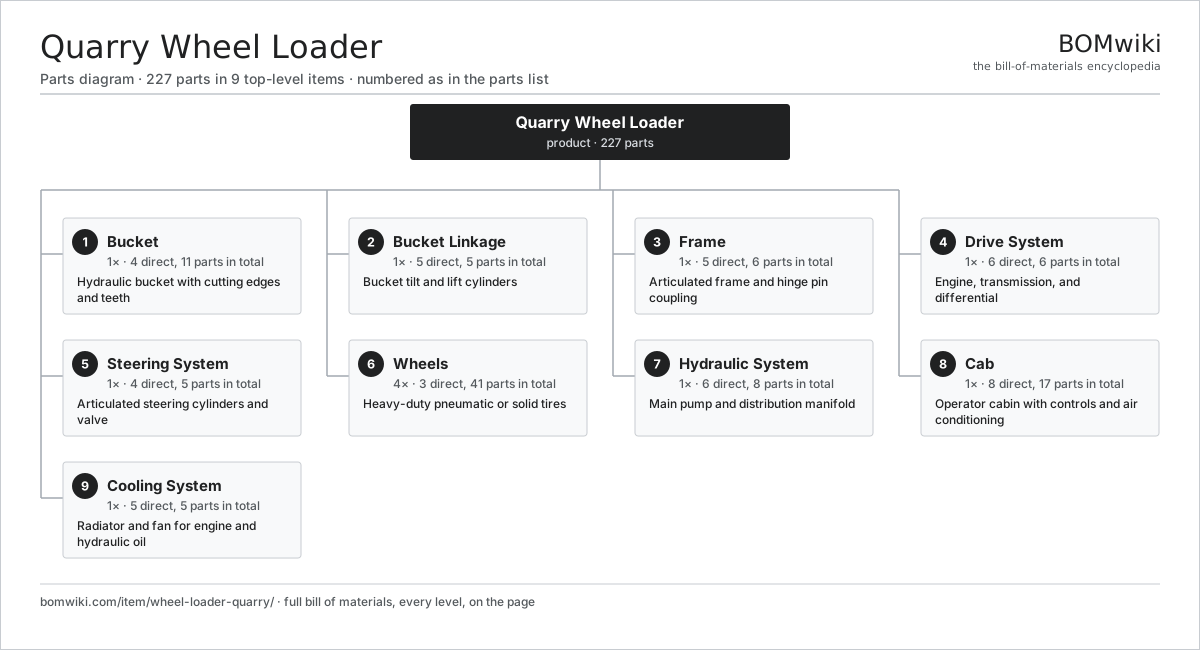
| # | Part | Qty | What it does |
|---|---|---|---|
| 1 | Bucket 4 parts | 1× | Hydraulic bucket with cutting edges and teeth |
| 2 | Bucket Linkage 5 parts | 1× | Bucket tilt and lift cylinders |
| 3 | Frame 5 parts | 1× | Articulated frame and hinge pin coupling |
| 4 | Drive System 6 parts | 1× | Engine, transmission, and differential |
| 5 | Steering System 4 parts | 1× | Articulated steering cylinders and valve |
| 6 | Wheels 3 parts | 4× | Heavy-duty pneumatic or solid tires |
| 7 | Hydraulic System 6 parts | 1× | Main pump and distribution manifold |
| 8 | Cab 8 parts | 1× | Operator cabin with controls and air conditioning |
| 9 | Cooling System 5 parts | 1× | Radiator and fan for engine and hydraulic oil |
3D model
No 3D model yet. Have a CAD file of this? Add a 3D model. STL renders right on this page; STEP, FreeCAD, and OpenSCAD sources are welcome too (openly licensed, like all 3D models on BOMwiki).
Build & assembly graph
expand / collapse · shared sub-assemblies converge · links to related products · est. labourTap an assembly to expand/collapse · tap a part to open it · use “Open page” for any node · drag to pan, scroll to zoom.
Bill of materials for Quarry Wheel Loader
9 top-level lines · 65 rows shown · 227 parts total · indented to 3 levels| # | Item / sub-assembly | Part no. | Qty/assy | Ext. qty | Parts | Type |
|---|---|---|---|---|---|---|
| 1 | Bucket 4 parts | wheel-loader-quarry-bucket | 1× | 1 | 11 | assembly |
| 1.1 | Bucket Shell | wheel-loader-quarry-bucket-shell | 1× | 1 | · | part |
| 1.2 | Tooth Bar | wheel-loader-quarry-tooth-bar | 1× | 1 | · | part |
| 1.3 | Bucket Tooth | wheel-loader-quarry-bucket-teeth | 8× | 8 | · | part |
| 1.4 | Fastener Set | fastener-set | 1× | 1 | · | part |
| 2 | Bucket Linkage 5 parts | wheel-loader-quarry-bucket-linkage | 1× | 1 | 5 | assembly |
| 2.1 | Lift Cylinder | wheel-loader-quarry-lift-cylinder | 1× | 1 | · | part |
| 2.2 | Tilt Cylinder | wheel-loader-quarry-tilt-cylinder | 1× | 1 | · | part |
| 2.3 | Linkage Pins | wheel-loader-quarry-linkage-pins | 1× | 1 | · | part |
| 2.4 | Bucket Proportional Valve | wheel-loader-quarry-proportional-valve-bucket | 1× | 1 | · | part |
| 2.5 | O-Ring Set | oring-set | 1× | 1 | · | part |
| 3 | Frame 5 parts | wheel-loader-quarry-frame | 1× | 1 | 6 | assembly |
| 3.1 | Front Frame | wheel-loader-quarry-front-frame | 1× | 1 | · | part |
| 3.2 | Rear Frame | wheel-loader-quarry-rear-frame | 1× | 1 | · | part |
| 3.3 | Hinge Pin | wheel-loader-quarry-hinge-pin | 1× | 1 | · | part |
| 3.4 | Hinge Bushing | wheel-loader-quarry-hinge-bushing | 2× | 2 | · | part |
| 3.5 | Bumper | wheel-loader-quarry-bumper | 1× | 1 | · | part |
| 4 | Drive System 6 parts | wheel-loader-quarry-drive | 1× | 1 | 6 | assembly |
| 4.1 | Diesel Engine | wheel-loader-quarry-engine | 1× | 1 | · | part |
| 4.2 | Torque Converter | wheel-loader-quarry-torque-converter | 1× | 1 | · | part |
| 4.3 | Transmission | wheel-loader-quarry-transmission | 1× | 1 | · | part |
| 4.4 | Front Axle | wheel-loader-quarry-front-axle | 1× | 1 | · | part |
| 4.5 | Rear Axle | wheel-loader-quarry-rear-axle | 1× | 1 | · | part |
| 4.6 | Fuel Tank | wheel-loader-quarry-fuel-tank | 1× | 1 | · | part |
| 5 | Steering System 4 parts | wheel-loader-quarry-steering | 1× | 1 | 5 | assembly |
| 5.1 | Steering Cylinder | wheel-loader-quarry-steering-cylinder | 2× | 2 | · | part |
| 5.2 | Steering Valve | wheel-loader-quarry-steering-valve | 1× | 1 | · | part |
| 5.3 | Steering Joystick | wheel-loader-quarry-steering-joystick | 1× | 1 | · | part |
| 5.4 | Pressure Sensor | pressure-sensor | 1× | 1 | · | part |
| 6 | Wheels 3 parts | wheel-loader-quarry-wheels | 4× | 4 | 41 | assembly |
| 6.1 | Wheel Assembly 5 parts | wheel-assembly | 4× | 16 | 9 | assembly |
| 6.1.1 | Alloy Wheel | alloy-wheel | 1× | 16 | · | part |
| 6.1.2 | Tire | tire | 1× | 16 | · | part |
| 6.1.3 | TPMS Sensor | tpms-sensor | 1× | 16 | · | part |
| 6.1.4 | Lug Nut | lug-nut | 5× | 80 | · | part |
| 6.1.5 | Valve Stem | valve-stem | 1× | 16 | · | part |
| 6.2 | Industrial Tire | wheel-loader-quarry-tire | 4× | 16 | · | part |
| 6.3 | Lug Pattern | wheel-loader-quarry-lug-pattern | 1× | 4 | · | part |
| 7 | Hydraulic System 6 parts | wheel-loader-quarry-hydraulics | 1× | 1 | 8 | assembly |
| 7.1 | Main Pump | wheel-loader-quarry-pump | 1× | 1 | · | part |
| 7.2 | Accumulator | wheel-loader-quarry-accumulator | 1× | 1 | · | part |
| 7.3 | Filter | wheel-loader-quarry-filter | 1× | 1 | · | part |
| 7.4 | Valve Manifold | wheel-loader-quarry-manifold | 1× | 1 | · | part |
| 7.5 | Hose Bundle | wheel-loader-quarry-hose-bundle | 1× | 1 | · | part |
| 7.6 | Pressure Sensor | pressure-sensor | 3× | 3 | · | part |
| 8 | Cab 8 parts | wheel-loader-quarry-cab | 1× | 1 | 17 | assembly |
| 8.1 | Cab Frame | wheel-loader-quarry-cab-frame | 1× | 1 | · | part |
| 8.2 | Cab Window | wheel-loader-quarry-cab-window | 4× | 4 | · | part |
| 8.3 | Cab Door | wheel-loader-quarry-cab-door | 1× | 1 | · | part |
| 8.4 | Seat Assembly | wheel-loader-quarry-seat-assembly | 1× | 1 | · | part |
| 8.5 | Seat Assembly 5 parts | seat-assembly | 1× | 1 | 7 | assembly |
| 8.5.1 | Seat Frame | seat-frame | 1× | 1 | · | part |
| 8.5.2 | Seat Foam | seat-foam | 2× | 2 | · | part |
| 8.5.3 | Seat Cover | seat-cover | 1× | 1 | · | part |
| 8.5.4 | Seat Motor | seat-motor | 2× | 2 | · | part |
| 8.5.5 | Seat Heater Mat | seat-heater | 1× | 1 | · | part |
| 8.6 | Air Conditioning Unit | wheel-loader-quarry-ac-unit | 1× | 1 | · | part |
| 8.7 | LCD Panel | lcd-panel | 1× | 1 | · | part |
| 8.8 | Electric Horn | wheel-loader-quarry-horn | 1× | 1 | · | part |
| 9 | Cooling System 5 parts | wheel-loader-quarry-cooling | 1× | 1 | 5 | assembly |
| 9.1 | Radiator | wheel-loader-quarry-radiator | 1× | 1 | · | part |
| 9.2 | Fan | wheel-loader-quarry-fan | 1× | 1 | · | part |
| 9.3 | Oil Cooler | wheel-loader-quarry-hydraulic-oil-cooler | 1× | 1 | · | part |
| 9.4 | Thermostat | wheel-loader-quarry-thermostat | 1× | 1 | · | part |
| 9.5 | Coolant Hose | wheel-loader-quarry-coolant-hose | 1× | 1 | · | part |
Something wrong in this list? Report a problem with this BOM.
Related products
same domain, ranked by shared parts Drilling Jumbo
175 parts · shares 13 with this page
Drilling Jumbo
175 parts · shares 13 with this page
 Load-Haul-Dump (LHD)
164 parts · shares 13 with this page
Load-Haul-Dump (LHD)
164 parts · shares 13 with this page
 Mining Haul Truck
1,000 parts · shares 13 with this page
Mining Haul Truck
1,000 parts · shares 13 with this page
 Shotcrete Spraying Machine
133 parts · shares 13 with this page
Shotcrete Spraying Machine
133 parts · shares 13 with this page
 Underground Utility Vehicle
148 parts · shares 13 with this page
Underground Utility Vehicle
148 parts · shares 13 with this page
 Rotary Blasthole Drill
92 parts · shares 7 with this page
Rotary Blasthole Drill
92 parts · shares 7 with this page
Sourcing: possible vendors
Browse the supplier directory → Prices, MOQ, and lead times are algorithmic estimates, not quotes, and not claims about these companies. Company mappings are curated by keyword; est. price band $200k–$5M. How estimates work| Vendor | HQ | Specialty | MOQ | Lead time |
|---|---|---|---|---|
| caterpillar.com ↗ | Irving, US | Construction & mining equipment | made to order | 20–36 wks |
|
🇯🇵Komatsu
komatsu.com ↗
|
Tokyo, JP | Construction & mining equipment | made to order | 20–36 wks |
|
🇸🇪Sandvik
rocktechnology.sandvik ↗
|
Stockholm, SE | Mining & rock technology | made to order | 20–36 wks |
|
🇸🇪Epiroc
epiroc.com ↗
|
Stockholm, SE | Mining & drilling equipment | made to order | 20–36 wks |
|
🇫🇮Metso
metso.com ↗
|
Helsinki, FI | Crushing & minerals processing | made to order | 20–36 wks |
1,261-word article