Subsonic Wind Tunnel
ProductOverview
A subsonic wind tunnel is a laboratory facility that generates controlled airflow over a scale aircraft model, measuring aerodynamic forces and visualizing flow patterns. The machine is fundamentally a giant fan that circulates air through a circuit: fan accelerates low-pressure settling-chamber air through a convergent nozzle into a test section, over the model, then through a diffuser and back to the fan inlet.
The test section is the measurement region, holding a precision balance that converts aerodynamic lift, drag, and moment loads into digital signals. By varying the model's angle of attack and observing how lift and drag change, engineers build the aerodynamic database underlying aircraft design, wing area, tail size, engine inlet compatibility, and control effectiveness.
The circuit
The Fan Drive System begins at the inlet: a large axial or centrifugal Electric Motor (50–300 kW) turns Fan Blade rotor blades that draw air into the circuit. The fan discharge is turbulent (high turbulence, eddies), so it feeds into the Settling Chamber, a large low-velocity plenum where Turbulence Screen mesh screens and Baffle Plate internal baffles calm the flow.
From there, low-speed settled air enters the Contraction Nozzle, a smoothly converging nozzle that accelerates the flow to test-section velocity (5–100 m/s). The contraction's Contraction Wall parabolic shape prevents flow separation, and the acceleration suppresses boundary-layer growth, exiting the contraction, the test-section boundary layer is thin (~1 cm at 100 m/s).
Measurement
The Test Section is the working region: a rectangular chamber typically 1–2 m wide, with the model mounted on an adjustable Model Mount sting. The sting pivots to vary the model's angle of attack from roughly −10° to +30°, allowing engineers to measure lift and drag across the full flight envelope.
The Force Balance System system is the heart of the facility: six Load Cell strain-gauge transducers mounted in a Balance Structure cantilever frame transfer all aerodynamic loads from the model to the laboratory. Three transducers measure orthogonal force components (drag, lift, side force); three measure moments (pitch, roll, yaw). Resolution is ~0.1% of full scale, so a 100 Newton full-scale drag measurement resolves to ±0.1 N.
As air flows over the model, local pressures vary. Flow Probe Pitot-static rakes at the test-section entrance measure dynamic and static pressure, allowing calculation of airspeed and velocity profile. View Port transparent windows let researchers photograph model surfaces with tufts or oil-flow visualizations, revealing flow separation and transition regions.
Exit and return
Air leaving the test section is still at high velocity (e.g., 80 m/s). The Diffuser Section gradually expands the flow back to low velocity (~1–2 m/s), recovering most of the dynamic pressure as static pressure. Diffuser design is critical: too steep an expansion angle causes boundary-layer separation and energy loss; too shallow requires excessive length. Typical expansion angles are 5–8° half-angle.
From the diffuser, air enters the Return Duct, a large-diameter low-loss duct routed back to the fan inlet. Return Return Damping screens suppress oscillations in the return path, and optional Return Insulation jackets maintain temperature stability, important because air density affects measured forces, and temperature changes of >1°C can introduce 0.3% measurement error.
Data and control
The Control and Instrumentation system includes a Speed Control variable-frequency inverter drive that ramps the fan speed from 0–100%, commanding test-section velocities from 5 m/s (low Reynolds number) to maximum (~100 m/s). As the pilot selects a test speed via software, the control loop adjusts motor frequency to maintain constant velocity despite model-induced pressure fluctuations.
Pressure Sensor transducers monitor static and dynamic pressure at the test section, and Temperature Sensor probes track ambient and settling-chamber air temperature. The Control Software acquisition system logs all signals at 10–1000 Hz, computes lift coefficient (CL = Lift / (0.5 × ρ × V² × Area)), drag coefficient (CD), and moment coefficient (CM) in real time, and displays the aerodynamic database as the test progresses.
Typical operations
A test campaign:
- Rig the 1:50 or 1:20 scale model on the Model Mount sting, connect the Force Balance System electronics.
- Set the test speed (e.g., 50 m/s, Re ~3 × 10^6) and angle of attack (0°).
- Run the fan to steady state and log 10–30 seconds of data.
- Increment angle of attack by 1–2° and repeat.
- Continue from −10° to +30° angle of attack, building CL vs. alpha and CD vs. alpha curves.
- Analyze data to extract wing area, CM (pitching moment), control-surface effectiveness, and stall angle.
A single test point takes ~2–3 minutes; a full stall sweep of 40 points takes 1–2 hours, plus setup and calibration. Modern tunnels can test multiple configurations (wing shapes, tail sizes, fuselage variants) in a day.
Design roles
Wind-tunnel data validates computational fluid dynamics (CFD) predictions, informs control-system design (tail sizing, control-authority margins), and uncovers surprises: unexpected pitch-up near stall, wing-drop asymmetry, fin buffeting at high speed. No CFD model is perfect; a few hours in a tunnel de-risks an aircraft program.
Early jet aircraft were designed almost entirely from wind-tunnel data (tunnels predate computers by decades). Modern practice combines CFD, wind-tunnel testing on critical components, and flight test. Tunnels remain essential for unconventional configurations (blended-wing-body aircraft, long-endurance UAV wings, advanced rotor designs) where CFD validation is weak.
Subsonic Wind Tunnel parts and their functions
8 top-level parts · 51 parts in total · full bill of materials below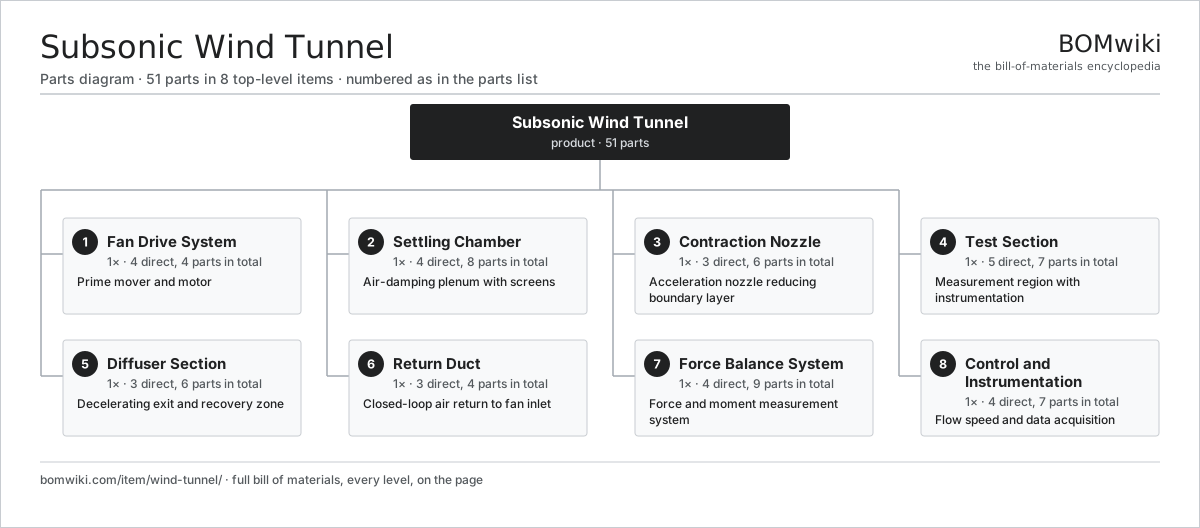
| # | Part | Qty | What it does |
|---|---|---|---|
| 1 | Fan Drive System 4 parts | 1× | Prime mover and motor |
| 2 | Settling Chamber 4 parts | 1× | Air-damping plenum with screens |
| 3 | Contraction Nozzle 3 parts | 1× | Acceleration nozzle reducing boundary layer |
| 4 | Test Section 5 parts | 1× | Measurement region with instrumentation |
| 5 | Diffuser Section 3 parts | 1× | Decelerating exit and recovery zone |
| 6 | Return Duct 3 parts | 1× | Closed-loop air return to fan inlet |
| 7 | Force Balance System 4 parts | 1× | Force and moment measurement system |
| 8 | Control and Instrumentation 4 parts | 1× | Flow speed and data acquisition |
3D model
No 3D model yet. Have a CAD file of this? Add a 3D model. STL renders right on this page; STEP, FreeCAD, and OpenSCAD sources are welcome too (openly licensed, like all 3D models on BOMwiki).
Build & assembly graph
expand / collapse · shared sub-assemblies converge · links to related products · est. labourTap an assembly to expand/collapse · tap a part to open it · use “Open page” for any node · drag to pan, scroll to zoom.
Bill of materials for Subsonic Wind Tunnel
8 top-level lines · 38 rows shown · 51 parts total · indented to 3 levels| # | Item / sub-assembly | Part no. | Qty/assy | Ext. qty | Parts | Type |
|---|---|---|---|---|---|---|
| 1 | Fan Drive System 4 parts | wind-tunnel-fan-drive | 1× | 1 | 4 | assembly |
| 1.1 | Electric Motor | wind-tunnel-electric-motor | 1× | 1 | · | part |
| 1.2 | Fan Blade | wind-tunnel-fan-blade | 1× | 1 | · | part |
| 1.3 | Fan Hub | wind-tunnel-fan-hub | 1× | 1 | · | part |
| 1.4 | Motor Mount | wind-tunnel-motor-mount | 1× | 1 | · | part |
| 2 | Settling Chamber 4 parts | wind-tunnel-settling-chamber | 1× | 1 | 8 | assembly |
| 2.1 | Chamber Shell | wind-tunnel-chamber-shell | 1× | 1 | · | part |
| 2.2 | Turbulence Screen | wind-tunnel-turbulence-screen | 3× | 3 | · | part |
| 2.3 | Baffle Plate | wind-tunnel-baffle-plate | 2× | 2 | · | part |
| 2.4 | Access Door | wind-tunnel-access-door | 2× | 2 | · | part |
| 3 | Contraction Nozzle 3 parts | wind-tunnel-contraction | 1× | 1 | 6 | assembly |
| 3.1 | Contraction Wall | wind-tunnel-contraction-wall | 1× | 1 | · | part |
| 3.2 | Contraction Support | wind-tunnel-contraction-support | 4× | 4 | · | part |
| 3.3 | Contraction Seal | wind-tunnel-contraction-seal | 1× | 1 | · | part |
| 4 | Test Section 5 parts | wind-tunnel-test-section | 1× | 1 | 7 | assembly |
| 4.1 | Test Chamber | wind-tunnel-test-chamber | 1× | 1 | · | part |
| 4.2 | Model Mount | wind-tunnel-model-mount | 1× | 1 | · | part |
| 4.3 | Model Support | wind-tunnel-model-support | 1× | 1 | · | part |
| 4.4 | Flow Probe | wind-tunnel-flow-probe | 2× | 2 | · | part |
| 4.5 | View Port | wind-tunnel-view-ports | 2× | 2 | · | part |
| 5 | Diffuser Section 3 parts | wind-tunnel-diffuser | 1× | 1 | 6 | assembly |
| 5.1 | Diffuser Wall | wind-tunnel-diffuser-wall | 1× | 1 | · | part |
| 5.2 | Diffuser Strut | wind-tunnel-diffuser-strut | 4× | 4 | · | part |
| 5.3 | Diffuser Gate | wind-tunnel-diffuser-gate | 1× | 1 | · | part |
| 6 | Return Duct 3 parts | wind-tunnel-return-duct | 1× | 1 | 4 | assembly |
| 6.1 | Return Duct | wind-tunnel-return-duct-tube | 1× | 1 | · | part |
| 6.2 | Return Damping | wind-tunnel-return-damping | 2× | 2 | · | part |
| 6.3 | Return Insulation | wind-tunnel-return-insulation | 1× | 1 | · | part |
| 7 | Force Balance System 4 parts | wind-tunnel-balance | 1× | 1 | 9 | assembly |
| 7.1 | Load Cell | wind-tunnel-load-cell | 6× | 6 | · | part |
| 7.2 | Balance Structure | wind-tunnel-balance-structure | 1× | 1 | · | part |
| 7.3 | Amplifier | wind-tunnel-amplifier | 1× | 1 | · | part |
| 7.4 | Data Recorder | wind-tunnel-data-recorder | 1× | 1 | · | part |
| 8 | Control and Instrumentation 4 parts | wind-tunnel-controls | 1× | 1 | 7 | assembly |
| 8.1 | Speed Control | wind-tunnel-speed-control | 1× | 1 | · | part |
| 8.2 | Pressure Sensor | wind-tunnel-pressure-sensor | 3× | 3 | · | part |
| 8.3 | Temperature Sensor | wind-tunnel-temperature-sensor | 2× | 2 | · | part |
| 8.4 | Control Software | wind-tunnel-software | 1× | 1 | · | part |
Something wrong in this list? Report a problem with this BOM.
Sourcing: possible vendors
Browse the supplier directory → Prices, MOQ, and lead times are algorithmic estimates, not quotes, and not claims about these companies. Company mappings are curated by keyword; est. price band $50k–$300M. How estimates work| Vendor | HQ | Specialty | MOQ | Lead time |
|---|---|---|---|---|
|
🇺🇸Boeing
boeing.com ↗
|
Arlington, US | Aerospace OEM | made to order | 40–80 wks |
|
🇫🇷Airbus
airbus.com ↗
|
Toulouse, FR | Aerospace OEM | made to order | 40–80 wks |
| lockheedmartin.com ↗ | Bethesda, US | Aerospace & defense | made to order | 40–80 wks |
|
🇧🇷Embraer
embraer.com ↗
|
São José dos Campos, BR | Aircraft OEM | made to order | 40–80 wks |
| txtav.com ↗ | Wichita, US | Aircraft OEM | made to order | 40–80 wks |
961-word article