Wind Turbine Service Lift
ProductOverview
A wind turbine service lift is an external vertical lift permanently installed on a turbine tower to transport technicians and small equipment from ground level to nacelle height (80–120 m on modern utility-scale turbines). Unlike conventional building elevators, service lifts operate in an open, exposed environment with extreme wind loading, temperature swings, and infrequent use. The design prioritizes mechanical simplicity, safety redundancy, and weather resistance over energy efficiency or frequent service.
The lift uses a traction-rope system: four Suspension Ropes support the Cabin, which is raised and lowered by a Drive System traction motor turning the Traction Sheave. A Counterweight balances the cabin load, reducing motor power demand. Guide Ropes stabilize the cabin against side sway in high winds.
Cabin and structural frame
The Cabin is a compact (1.2 × 1.2 × 2.0 m) enclosed steel Cabin Frame with hinged Safety Doors and Interlocks, sized for a technician in full safety harness plus one or two colleagues and light tools. The Cabin Floor is high-friction steel grating, and Handrails run the full perimeter. Critically, three Anchor Point fall-arrest attachment points are rated for 4 kN each, complying with EN 795, so every occupant can tether a personal lanyard.
The Top Frame is bolted to the turbine tower top or the nacelle support structure, housing the motor, Gearbox, and Pulleys and Sheaves. Two parallel vertical Guide Rails (U-channel 100–150 mm sections) bolt to the tower exterior, guiding the cabin and counterweight during ascent and descent.
Drive and power
The Drive System comprises a three-phase 5–10 kW AC squirrel-cage Traction Motor, coupled via Flexible Coupling to a Gearbox (20:1 helical inline reducer). A spring-set Spring Set Brake holding brake (24 VDC solenoid release) locks the drive shaft when the motor is de-energized, preventing uncontrolled cabin descent on power loss.
The Traction Sheave is a large grooved pulley (500 mm diameter, 2 or 4 grooves) gripping the suspension ropes through friction, traction-type elevators are mechanically simple and inherently safe, as rope slip limits acceleration. The motor/brake/gearbox assembly is mounted on the Top Frame, often with spring isolators to damp vibration.
Ropes and balance
Four Suspension Ropes (16 mm diameter, 1960 MPa steel wire rope, 8×19S strand) support the cabin and counterweight, each rated for ~40 kN tensile load. These are socketed or swaged at both the cabin Cabin Frame and the Counterweight (a 2000–3000 kg steel-plate box). Because the counterweight approaches the cabin mass, the motor need only overcome friction and acceleration, not full cabin weight.
Four Guide Ropes (12 mm diameter, lower strength) keep the cabin and counterweight running parallel to the Guide Rails, preventing side-to-side sway from wind gusts. In open-air tower operation, wind pressure can exceed 1 kPa on the cabin side, so guide ropes and rigid guide rails are critical to safety.
Safety systems: fall arrest and overspeed
The Fall Arrest and Safety Systems assembly is the mechanical safety backbone. A spring-loaded Safety Gear roller or guide-shoe rides on the guide rail; if cabin speed exceeds ~1.2× normal operation (overspeed condition), the gear wedges against the rail, gripping and halting descent within ~1 meter. This is passive, no power required, and activates automatically.
A Pressure Sensor continuously monitors rope tension via load cells. If tension drops suddenly (indicating rope breakage or gross overload), the sensor triggers the Emergency Brake, a direct-acting solenoid or contactor that cuts power to the drive motor. The Spring Set Brake holding brake then engages, holding the cabin in place.
An additional manual Push Button emergency stop button on the cabin and at the base allows operators to halt the lift immediately.
Control and electrical systems
The Control System panel houses a Variable Frequency Drive variable-frequency drive (10 kW, 400 VAC three-phase) that modulates motor speed for smooth up/down motion. A Contactor handles motor switching, and Limit Switch at top and bottom of travel cut the motor when the cabin reaches terminal positions.
Push buttons for up, down, stop, and emergency are mounted in a Control Panel (NEMA 4X stainless enclosure) at ground level or on the cabin itself. Modern lifts often incorporate a dual-channel safety relay module (SIL 2 or 3) monitoring limit switches and emergency circuits, ensuring redundant safety logic independent of the main VFD.
Doors and interlocks
The front Safety Doors and Interlocks is a hinged or sliding gate of expanded metal or perforated steel, providing visibility and safety rails. A Gate Sensor (magnetic proximity or limit switch) signals when the gate is fully closed. A Gate Lock solenoid lock prevents the motor from starting until the gate is locked, an interlock protecting operators from premature ascent.
Environmental and operational context
Wind turbine service lifts are rated for continuous environmental exposure: wind speeds up to 15 m/s (34 mph), extreme temperature swings (−30 to +50 °C), UV exposure, salt spray in coastal locations, and occasional lightning. All rope and fastener materials are stainless or heavily galvanized. Motor enclosures are TEFC (totally enclosed, fan-cooled) and drip-proof. Cable runs to the Control System are jacketed and routed through conduit.
Cycle duty is intermittent, typically 1–2 ascents per week during maintenance activities, with the lift sitting idle otherwise. A single ascent to 120 m at 0.4 m/s takes ~5 minutes, leaving ample time for technicians to survey the nacelle, inspect rotor blades, service gearbox, or attend to control electronics.
Maintenance intervals are 12 months or every 500 cycles, whichever is first, including rope inspection, brake and safety-gear testing, and bearing lubrication. Rope replacement is typically required every 10 years.
Wind Turbine Service Lift parts and their functions
8 top-level parts · 61 parts in total · full bill of materials below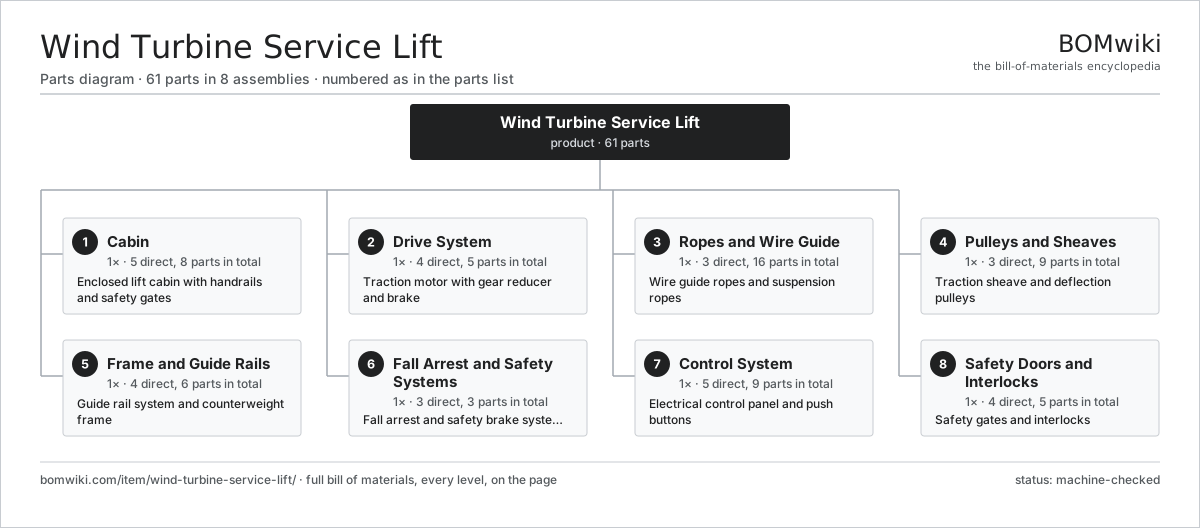
| # | Part | Qty | What it does |
|---|---|---|---|
| 1 | Cabin 5 parts | 1× | Enclosed lift cabin with handrails and safety gates |
| 2 | Drive System 4 parts | 1× | Traction motor with gear reducer and brake |
| 3 | Ropes and Wire Guide 3 parts | 1× | Wire guide ropes and suspension ropes |
| 4 | Pulleys and Sheaves 3 parts | 1× | Traction sheave and deflection pulleys |
| 5 | Frame and Guide Rails 4 parts | 1× | Guide rail system and counterweight frame |
| 6 | Fall Arrest and Safety Systems 3 parts | 1× | Fall arrest and safety brake systems |
| 7 | Control System 5 parts | 1× | Electrical control panel and push buttons |
| 8 | Safety Doors and Interlocks 4 parts | 1× | Safety gates and interlocks |
3D model
No 3D model yet. Have a CAD file of this? Add a 3D model — STL renders right on this page; STEP, FreeCAD, and OpenSCAD sources are welcome too (openly licensed, like all 3D models on BOMwiki).
Build & assembly graph
expand / collapse · shared sub-assemblies converge · links to related products · est. labourTap an assembly to expand/collapse · tap a part to open it · use “Open page” for any node · drag to pan, scroll to zoom.
Bill of materials for Wind Turbine Service Lift
8 top-level lines · 39 rows shown · 61 parts total · indented to 3 levels| # | Item / sub-assembly | Part no. | Qty/assy | Ext. qty | Parts | Type |
|---|---|---|---|---|---|---|
| 1 | Cabin 5 parts | wind-turbine-service-lift-cabin | 1× | 1 | 8 | assembly |
| 1.1 | Cabin Frame | wind-turbine-service-lift-cabin-frame | 1× | 1 | · | part |
| 1.2 | Cabin Panels | wind-turbine-service-lift-cabin-panels | 1× | 1 | · | part |
| 1.3 | Cabin Floor | wind-turbine-service-lift-cabin-floor | 1× | 1 | · | part |
| 1.4 | Handrails | wind-turbine-service-lift-cabin-handrails | 2× | 2 | · | part |
| 1.5 | Anchor Point | wind-turbine-service-lift-cabin-anchor | 3× | 3 | · | part |
| 2 | Drive System 4 parts | wind-turbine-service-lift-drive | 1× | 1 | 5 | assembly |
| 2.1 | Traction Motor | wind-turbine-service-lift-motor | 1× | 1 | · | part |
| 2.2 | Gearbox | wind-turbine-service-lift-gearbox | 1× | 1 | · | part |
| 2.3 | Spring Set Brake | wind-turbine-service-lift-brake | 1× | 1 | · | part |
| 2.4 | Flexible Coupling | wind-turbine-service-lift-coupling | 2× | 2 | · | part |
| 3 | Ropes and Wire Guide 3 parts | wind-turbine-service-lift-ropes | 1× | 1 | 16 | assembly |
| 3.1 | Suspension Ropes | wind-turbine-service-lift-suspension-ropes | 4× | 4 | · | part |
| 3.2 | Guide Ropes | wind-turbine-service-lift-guide-ropes | 4× | 4 | · | part |
| 3.3 | Rope Attachment | wind-turbine-service-lift-rope-attachments | 8× | 8 | · | part |
| 4 | Pulleys and Sheaves 3 parts | wind-turbine-service-lift-pulleys | 1× | 1 | 9 | assembly |
| 4.1 | Traction Sheave | wind-turbine-service-lift-traction-sheave | 1× | 1 | · | part |
| 4.2 | Deflection Pulley | wind-turbine-service-lift-deflection-pulley | 2× | 2 | · | part |
| 4.3 | Pulley Bearing | wind-turbine-service-lift-pulley-bearing | 6× | 6 | · | part |
| 5 | Frame and Guide Rails 4 parts | wind-turbine-service-lift-frame | 1× | 1 | 6 | assembly |
| 5.1 | Top Frame | wind-turbine-service-lift-top-frame | 1× | 1 | · | part |
| 5.2 | Guide Rails | wind-turbine-service-lift-guide-rails | 2× | 2 | · | part |
| 5.3 | Counterweight | wind-turbine-service-lift-counterweight | 1× | 1 | · | part |
| 5.4 | Buffer Spring | wind-turbine-service-lift-buffer-spring | 2× | 2 | · | part |
| 6 | Fall Arrest and Safety Systems 3 parts | wind-turbine-service-lift-arrest | 1× | 1 | 3 | assembly |
| 6.1 | Safety Gear | wind-turbine-service-lift-safety-gear | 1× | 1 | · | part |
| 6.2 | Pressure Sensor | wind-turbine-service-lift-pressure-sensor | 1× | 1 | · | part |
| 6.3 | Emergency Brake | wind-turbine-service-lift-emergency-brake | 1× | 1 | · | part |
| 7 | Control System 5 parts | wind-turbine-service-lift-controls | 1× | 1 | 9 | assembly |
| 7.1 | Variable Frequency Drive | wind-turbine-service-lift-vfd | 1× | 1 | · | part |
| 7.2 | Contactor | wind-turbine-service-lift-contactor | 1× | 1 | · | part |
| 7.3 | Control Panel | wind-turbine-service-lift-control-panel | 1× | 1 | · | part |
| 7.4 | Push Button | wind-turbine-service-lift-push-buttons | 4× | 4 | · | part |
| 7.5 | Limit Switch | wind-turbine-service-lift-limit-switches | 2× | 2 | · | part |
| 8 | Safety Doors and Interlocks 4 parts | wind-turbine-service-lift-doors | 1× | 1 | 5 | assembly |
| 8.1 | Entry Gate | wind-turbine-service-lift-entry-gate | 1× | 1 | · | part |
| 8.2 | Gate Hinge | wind-turbine-service-lift-gate-hinge | 2× | 2 | · | part |
| 8.3 | Gate Lock | wind-turbine-service-lift-gate-lock | 1× | 1 | · | part |
| 8.4 | Gate Sensor | wind-turbine-service-lift-gate-sensor | 1× | 1 | · | part |
Sourcing: possible vendors
Prices, MOQ, and lead times are algorithmic estimates, not quotes, and not claims about these companies. Company mappings are curated by keyword; est. price band $10k–$200k. How estimates work| Vendor | HQ | Specialty | MOQ | Lead time |
|---|---|---|---|---|
|
🇺🇸Otis
otis.com ↗
|
Farmington, US | Elevators & escalators | 20 units | 14–24 wks |
| schindler.com ↗ | Ebikon, CH | Elevators & escalators | 20 units | 14–24 wks |
|
🇫🇮KONE
kone.com ↗
|
Espoo, FI | Elevators & escalators | 20 units | 14–24 wks |
| tkelevator.com ↗ | Düsseldorf, DE | Elevators | 20 units | 14–24 wks |
| mitsubishielectric.com ↗ | Tokyo, JP | Elevators & electronics | 20 units | 14–24 wks |
1,102-word article