World Time Clock
ProductOverview
A world time clock displays every standard time zone simultaneously rather than switching between them. The mechanism descends from Louis Cottier's 1931 heure universelle design for Patek Philippe wristwatches, scaled to a desk instrument and driven by quartz: local time reads normally from hands on a 12-hour dial, while a wheel turning once per 24 hours is read against a surrounding ring of 24 city names. Wherever a city stands on the 24-hour scale, that is the current hour in that city, all zones, one glance, no arithmetic.
The clock divides into a stock Quartz Base Movement, the World-Time Gearing that creates the complication, the City Ring index, and conventional Dial, Hand Set, Desk Case, and Power groups.
Timekeeping
The base movement is the ubiquitous quartz architecture. The Quartz Crystal vibrates at 32,768 Hz, 2^15, chosen so a simple binary divider chain in the Driver IC reaches exactly 1 Hz. Each second the IC reverses current through the Copper Winding, and the Stepper Rotor snaps through 180°. The Gear Train reduces this to the second, minute, and hour rates, and everything mounts in the snap-fit Movement Frame. Average drain is a microamp or two, which is why a single AA in the Battery Holder runs the clock for over a year through the Contact Set.
Accuracy is the crystal's: around ±20 ppm over normal room temperatures, or a minute a month. Nothing in the world-time mechanism affects rate, it is purely display gearing downstream of the hour wheel.
The world-time mechanism
The complication is one extra gearing step. The Transfer Pinion and a Helical Gear Pair couple the 12-hour wheel to the 24-Hour Wheel at a 2:1 reduction, so the 24-hour wheel makes one revolution per day, locked in phase with the local hands: when the hour hand reads 12 noon, the wheel's 12 stands at the home city. The 24-hour scale is graduated around the dial's perimeter with the Day/Night Band shading roughly 1800 to 0600 dark, so a glance shows not just the hour in Sydney but whether Sydney is asleep.
The City Ring Disc carries the 24 reference cities, one per whole-hour UTC offset, in geographic order, London, Paris, Cairo, Moscow, Dubai, Karachi, Dhaka, Bangkok, Beijing, Tokyo, Sydney, and so on around through Honolulu, Anchorage, Los Angeles, Denver, Chicago, New York, Caracas, Rio, and the mid-Atlantic back to London. Reading any zone is mechanical: find the city, read the 24-hour graduation under it.
Setting up is a two-step operation. Local time is set normally through the hands; then the Setting Knob rotates the city ring against its Coil Spring detent until the home city aligns with the current local hour on the 24-hour wheel. The Friction Clutch lets the ring move without back-driving the train, and the detent clicks it in whole-hour steps so the alignment cannot drift between zones. A traveller re-zones the clock by rotating the ring one click per hour of travel, the hands never need touching, because every standard zone differs from every other by whole hours (the half-hour zones such as India's UTC+5:30 are the design's known blind spot, usually handled by a marginal mark on the ring).
Display and construction
The Dial Plate carries both scales, with Applied Markers for the local 12 hours. The Hour Hand, Minute Hand, and Second Hand mount on concentric pipes with Hand Bushes; only the hour indication differs between zones, so the single minute hand serves the whole planet. The Ring Guide keeps the city ring concentric and free-running under the Front Glass, and the Back Cover gives access to the battery and setting knobs.
Variants
The same display logic appears across a wide price spectrum. Mechanical desk versions exist, but quartz dominates because the complication adds no load worth mentioning to a Lavet stepper. Radio-controlled and GPS-disciplined versions sync the base time automatically and leave only the ring to the user. The persistent engineering compromises are daylight saving time, which shifts individual cities off their printed offset for half the year, better clocks print dual-zone markings or accept the error, and the handful of non-integer offsets. Within those limits, a mechanism of three extra wheels and a printed ring delivers what otherwise takes a row of 24 separate clocks on a newsroom wall.
World Time Clock parts and their functions
7 top-level parts · 30 parts in total · full bill of materials below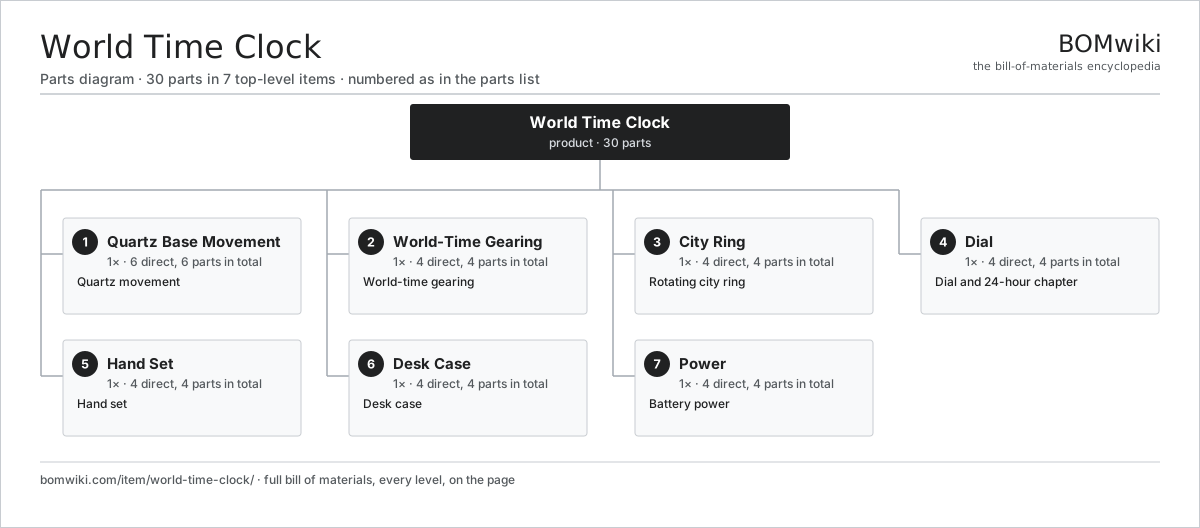
| # | Part | Qty | What it does |
|---|---|---|---|
| 1 | Quartz Base Movement 6 parts | 1× | Quartz movement |
| 2 | World-Time Gearing 4 parts | 1× | World-time gearing |
| 3 | City Ring 4 parts | 1× | Rotating city ring |
| 4 | Dial 4 parts | 1× | Dial and 24-hour chapter |
| 5 | Hand Set 4 parts | 1× | Hand set |
| 6 | Desk Case 4 parts | 1× | Desk case |
| 7 | Power 4 parts | 1× | Battery power |
3D model
No 3D model yet. Have a CAD file of this? Add a 3D model. STL renders right on this page; STEP, FreeCAD, and OpenSCAD sources are welcome too (openly licensed, like all 3D models on BOMwiki).
Build & assembly graph
expand / collapse · shared sub-assemblies converge · links to related products · est. labourTap an assembly to expand/collapse · tap a part to open it · use “Open page” for any node · drag to pan, scroll to zoom.
Bill of materials for World Time Clock
7 top-level lines · 37 rows shown · 30 parts total · indented to 3 levels| # | Item / sub-assembly | Part no. | Qty/assy | Ext. qty | Parts | Type |
|---|---|---|---|---|---|---|
| 1 | Quartz Base Movement 6 parts | world-time-clock-base-movement | 1× | 1 | 6 | assembly |
| 1.1 | Quartz Crystal | world-time-clock-quartz-crystal | 1× | 1 | · | part |
| 1.2 | Driver IC | world-time-clock-driver-ic | 1× | 1 | · | part |
| 1.3 | Stepper Rotor | world-time-clock-stepper-rotor | 1× | 1 | · | part |
| 1.4 | Copper Winding | copper-winding | 1× | 1 | · | part |
| 1.5 | Gear Train | world-time-clock-gear-train | 1× | 1 | · | part |
| 1.6 | Movement Frame | world-time-clock-movement-frame | 1× | 1 | · | part |
| 2 | World-Time Gearing 4 parts | world-time-clock-zone-gearing | 1× | 1 | 4 | assembly |
| 2.1 | 24-Hour Wheel | world-time-clock-24h-wheel | 1× | 1 | · | part |
| 2.2 | Transfer Pinion | world-time-clock-transfer-pinion | 1× | 1 | · | part |
| 2.3 | Friction Clutch | world-time-clock-friction-clutch | 1× | 1 | · | part |
| 2.4 | Helical Gear Pair | gear-pair | 1× | 1 | · | part |
| 3 | City Ring 4 parts | world-time-clock-city-ring | 1× | 1 | 4 | assembly |
| 3.1 | City Ring Disc | world-time-clock-ring-disc | 1× | 1 | · | part |
| 3.2 | Setting Knob | world-time-clock-setting-knob | 1× | 1 | · | part |
| 3.3 | Ring Guide | world-time-clock-ring-guide | 1× | 1 | · | part |
| 3.4 | Coil Spring | coil-spring | 1× | 1 | · | part |
| 4 | Dial 4 parts | world-time-clock-dial | 1× | 1 | 4 | assembly |
| 4.1 | Dial Plate | world-time-clock-dial-plate | 1× | 1 | · | part |
| 4.2 | Day/Night Band | world-time-clock-day-night-band | 1× | 1 | · | part |
| 4.3 | Applied Markers | world-time-clock-applied-markers | 1× | 1 | · | part |
| 4.4 | Fastener Set | fastener-set | 1× | 1 | · | part |
| 5 | Hand Set 4 parts | world-time-clock-hands | 1× | 1 | 4 | assembly |
| 5.1 | Hour Hand | world-time-clock-hour-hand | 1× | 1 | · | part |
| 5.2 | Minute Hand | world-time-clock-minute-hand | 1× | 1 | · | part |
| 5.3 | Second Hand | world-time-clock-second-hand | 1× | 1 | · | part |
| 5.4 | Hand Bushes | world-time-clock-hand-bushes | 1× | 1 | · | part |
| 6 | Desk Case 4 parts | world-time-clock-case | 1× | 1 | 4 | assembly |
| 6.1 | Case Shell | world-time-clock-case-shell | 1× | 1 | · | part |
| 6.2 | Front Glass | world-time-clock-front-glass | 1× | 1 | · | part |
| 6.3 | Back Cover | world-time-clock-back-cover | 1× | 1 | · | part |
| 6.4 | Fastener Set | fastener-set | 1× | 1 | · | part |
| 7 | Power 4 parts | world-time-clock-power | 1× | 1 | 4 | assembly |
| 7.1 | Battery Holder | world-time-clock-battery-holder | 1× | 1 | · | part |
| 7.2 | Contact Set | world-time-clock-contact-set | 1× | 1 | · | part |
| 7.3 | Wire Bundle | wire-bundle | 1× | 1 | · | part |
| 7.4 | Connector | connector | 1× | 1 | · | part |
Something wrong in this list? Report a problem with this BOM.
Related products
same domain, ranked by shared parts Flip Clock
119 parts · shares 4 with this page
Flip Clock
119 parts · shares 4 with this page
 Railway Station Clock
43 parts · shares 4 with this page
Railway Station Clock
43 parts · shares 4 with this page
 Analog Alarm Clock
38 parts · shares 2 with this page
Analog Alarm Clock
38 parts · shares 2 with this page
 Radio-Controlled Atomic Clock
130 parts · shares 3 with this page
Radio-Controlled Atomic Clock
130 parts · shares 3 with this page
 Watch Winder
39 parts · shares 3 with this page
Watch Winder
39 parts · shares 3 with this page
 Chess Clock
47 parts · shares 2 with this page
Chess Clock
47 parts · shares 2 with this page
Sourcing: possible vendors
Browse the supplier directory → Prices, MOQ, and lead times are algorithmic estimates, not quotes, and not claims about these companies. Company mappings are curated by keyword; est. price band $20–$50k. How estimates work| Vendor | HQ | Specialty | MOQ | Lead time |
|---|---|---|---|---|
|
🇯🇵Seiko
seikowatches.com ↗
|
Tokyo, JP | Watches | 500 units | 8–14 wks |
|
🇯🇵Citizen
citizenwatch-global.com ↗
|
Tokyo, JP | Watches | 500 units | 8–14 wks |
|
🇯🇵Casio
casio.com ↗
|
Tokyo, JP | Watches & electronics | 500 units | 8–14 wks |
| swatchgroup.com ↗ | Biel, CH | Watches (Omega, Tissot) | 500 units | 8–14 wks |
| titancompany.in ↗ | Bengaluru, IN | Watches & timepieces | 500 units | 8–14 wks |
826-word article